Cosmetic Packaging Machinery Market Size and Growth
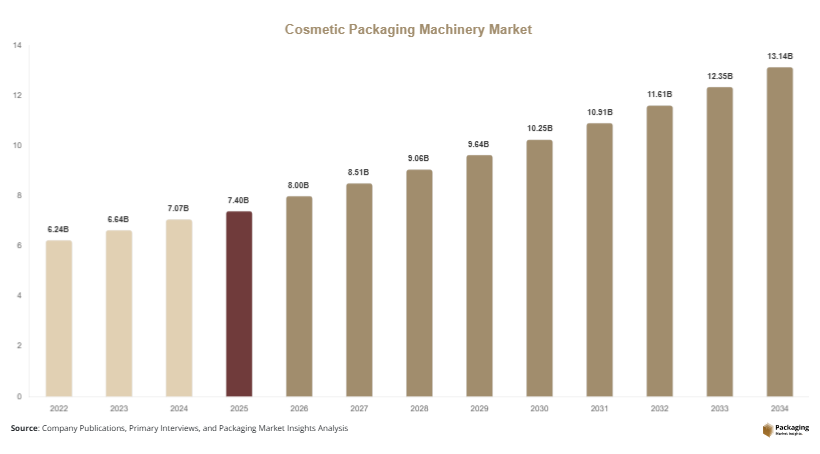
The global cosmetic packaging machinery market size is estimated at USD 7.4 billion in 2025 and is projected to reach USD 8.0 billion in 2026. Over the forecast period from 2025 to 2034, the market is expected to grow at a CAGR of 6.4%, reaching approximately USD 13.8 billion by 2034. The cosmetic packaging machinery market is witnessing consistent growth driven by the expanding global cosmetics industry and increasing demand for automation in packaging operations.
Cosmetic packaging machinery includes equipment used for filling, labeling, capping, sealing, and wrapping cosmetic products such as creams, lotions, perfumes, and makeup items. One of the major growth factors is the rising demand for personal care and beauty products, particularly in emerging economies where disposable incomes and consumer awareness are increasing. This surge in demand requires efficient and high-speed packaging solutions, driving the adoption of advanced machinery.
Key Market Highlights
- Asia Pacific dominated the market with a 39.1% share in 2025, while Latin America is projected to grow at the fastest CAGR of 7.0%.
- Filling machinery led the type segment with a 34.5% share, while labeling machinery is expected to grow at a CAGR of 6.8%.
- Plastic packaging compatibility dominated with a 51.7% share, while sustainable material-compatible machinery is forecasted to grow at a CAGR of 6.9%.
- Personal care applications led the segment with 46.2% share, while skincare packaging is expected to grow at a CAGR of 6.7%.
- China remained the dominant country with a market size of USD 1.6 billion in 2025 and USD 1.7 billion in 2026.
Explore more data points, trends and opportunities Download Free Sample Report
Market Trends
Increasing adoption of automated and robotic packaging systems
The cosmetic packaging machinery market is experiencing a shift toward automation and robotics, driven by the need for efficiency and precision. Automated packaging systems reduce manual intervention, minimize errors, and enhance production speed. Manufacturers are integrating robotic arms for tasks such as filling, capping, and labeling, which improves accuracy and consistency. For example, large cosmetic brands are adopting fully automated lines capable of handling multiple product types with minimal downtime. This trend is expected to drive further innovation in smart packaging machinery, including AI-based quality control systems and predictive maintenance capabilities, enhancing overall operational efficiency.
Rising demand for machinery compatible with sustainable packaging materials
Sustainability is becoming a central focus in the cosmetics industry, influencing the design and functionality of packaging machinery. Manufacturers are developing equipment that can handle eco-friendly materials such as biodegradable plastics, glass, and paper-based packaging. For instance, companies are introducing filling and sealing machines that can process lightweight and recyclable materials without compromising speed or precision. This trend is expected to accelerate as regulatory pressure and consumer demand for sustainable products increase. Future developments may include machinery specifically designed for zero-waste packaging and refillable systems, expanding the scope of sustainable packaging solutions.
Market Drivers
Growth of the global cosmetics and personal care industry
The rapid expansion of the cosmetics and personal care industry is a major driver for the cosmetic packaging machinery market. Increasing consumer demand for skincare, haircare, and beauty products is driving production volumes, which in turn increases the need for efficient packaging solutions. For example, the rise of premium skincare products has led to higher demand for precision filling and labeling machinery. This cause-and-effect relationship between product demand and packaging requirements is fueling market growth. Additionally, the introduction of new product lines and frequent product launches require flexible and adaptable machinery, further driving demand.
Increasing focus on operational efficiency and cost reduction
Manufacturers are under pressure to improve operational efficiency and reduce production costs, leading to increased adoption of advanced packaging machinery. Automated systems enable faster production rates, reduce labor dependency, and minimize material wastage. For instance, high-speed filling machines can significantly increase output while maintaining accuracy. This focus on efficiency is particularly important in competitive markets where cost optimization is critical. As a result, companies are investing in modern packaging equipment that offers higher productivity and lower operational costs, driving market growth.
Market Restraint
High initial investment and maintenance costs
The high cost of acquiring and maintaining advanced cosmetic packaging machinery is a significant restraint for the market. Automated and robotic systems require substantial capital investment, which can be challenging for small and medium-sized enterprises. Additionally, maintenance and operational costs, including training and technical support, can add to the financial burden. For example, companies adopting advanced filling and labeling systems may face high upfront costs and ongoing maintenance expenses. This can limit adoption, particularly in developing regions where budget constraints are more prominent. Despite the long-term benefits of automation, the initial cost barrier remains a key challenge for market growth.
Market Opportunities
Expansion of cosmetic manufacturing in emerging economies
Emerging economies are offering significant growth opportunities for the cosmetic packaging machinery market. Countries in Asia, Latin America, and Africa are witnessing rapid growth in cosmetic manufacturing due to increasing consumer demand and favorable economic conditions. For example, India and Brazil are experiencing a surge in local cosmetic brands, driving demand for packaging machinery. This expansion is supported by government initiatives and investments in manufacturing infrastructure. Over time, the development of local production facilities is expected to create new opportunities for machinery manufacturers.
Advancements in smart and connected packaging machinery
Technological advancements in smart and connected machinery are creating new opportunities in the market. IoT-enabled packaging systems allow real-time monitoring, predictive maintenance, and data-driven decision-making. For instance, manufacturers can track machine performance and identify potential issues before they lead to downtime. These innovations improve efficiency and reduce operational risks. The future outlook includes increased adoption of AI-driven systems and integration with Industry 4.0 technologies, enabling more efficient and flexible production processes.
Report Scope
| Report Metric | Details |
|---|---|
| Market Size in 2025 | USD 7.4 Billion |
| Market Size in 2026 | USD 8.0 Billion |
| Market Size in 2034 | USD 13.8 Billion |
| CAGR | 6.4% (2026-2034) |
| Base Year for Estimation | 2025 |
| Historical Data | 2022-2024 |
| Forecast Period | 2026-2034 |
| Report Coverage | Revenue Forecast, Competitive Landscape, Supply Chain Disruption, Growth Factors, Environment & Regulatory Landscape and Trends |
| Geographies Covered | North America, Europe, APAC, Middle East and Africa, LATAM |
| Countries Covered | U.S., Canada, U.K., Germany, France, Spain, Italy, Russia, Nordic, Benelux, Rest of Europe, China, South Korea, Japan, India, Australia, Singapore, Taiwan, South East Asia, Rest of Asia-Pacific, UAE, Turky, Saudi Arabia, South Africa, Egypt, Nigeria, Rest of MEA, Brazil, Mexico, Argentina, Chile, Colombia, Rest of LATAM |
Explore more data points, trends and opportunities Download Free Sample Report
Segmental Analysis
By Type
Filling machinery dominated the segment with a 34.5% market share in 2024. This segment includes equipment used for filling liquids, creams, and gels into containers. The dominance is attributed to the high demand for precision and efficiency in cosmetic production. Filling machines are widely used in skincare and personal care product manufacturing. For example, automated filling systems are used to ensure consistent product volume and reduce wastage. The segment is expected to maintain its dominance due to continuous demand from the cosmetics industry.
Labeling machinery is the fastest-growing segment, with a CAGR of 6.8%. This growth is driven by the increasing need for branding and product information. Labeling machines enable high-speed and accurate application of labels, which is essential for product identification and marketing. For instance, cosmetic companies are using advanced labeling systems to apply decorative and informative labels. Future developments are expected to focus on digital labeling and customization.
By Material
Plastic-compatible machinery dominated the segment with a 51.7% share in 2024. Plastic packaging is widely used in the cosmetics industry due to its durability and flexibility. Machinery designed for plastic packaging is capable of handling various shapes and sizes, making it suitable for a wide range of products. For example, plastic bottles and containers are commonly used for lotions and shampoos. The segment is expected to maintain its dominance due to the continued use of plastic packaging.
Sustainable material-compatible machinery is the fastest-growing segment, with a CAGR of 6.9%. This growth is driven by increasing demand for eco-friendly packaging solutions. Machinery capable of processing materials such as glass, paper, and biodegradable plastics is gaining popularity. For instance, cosmetic brands are adopting sustainable packaging to reduce environmental impact. Future developments are expected to focus on improving efficiency and compatibility with new materials.
By End-Use
Personal care applications dominated the segment with a 46.2% share in 2024. This includes packaging machinery used for products such as shampoos, lotions, and deodorants. The dominance is driven by high demand for personal care products and the need for efficient packaging solutions. For example, large-scale production of personal care items requires high-speed machinery to meet demand. The segment is expected to maintain its dominance due to continuous growth in the personal care industry.
Skincare packaging is the fastest-growing segment, with a CAGR of 6.7%. This growth is driven by increasing demand for skincare products and premium packaging. Skincare products often require specialized packaging to maintain product quality and enhance brand appeal. For instance, high-end creams and serums use precision filling and sealing machinery. Future growth is expected to be supported by innovation and increasing consumer demand for skincare products.
Cosmetic Packaging Machinery Market Segmentations
By Type
- Filling Machinery
- Labeling Machinery
- Capping Machinery
- Wrapping Machinery
- Others
By Material
- Plastic-Compatible
- Glass-Compatible
- Metal-Compatible
- Sustainable Material-Compatible
By End-Use
- Personal Care
- Skincare
- Haircare
- Fragrance
- Others
Regional Analysis
North America
North America accounted for approximately 24.8% of the cosmetic packaging machinery market share in 2025 and is expected to grow at a CAGR of 6.1% during the forecast period. The region benefits from a well-established cosmetics industry and high adoption of advanced manufacturing technologies. Companies are investing in automated packaging systems to improve efficiency and meet increasing demand. The growth of premium and organic cosmetic products is also driving demand for specialized packaging machinery. Additionally, the presence of major market players and strong distribution networks supports market growth.
The United States dominates the North American market due to its large consumer base and advanced manufacturing capabilities. A unique growth driver in this region is the increasing demand for customized packaging solutions. For example, cosmetic brands are adopting flexible machinery that can handle small batch production and personalized packaging. This trend is expected to drive innovation and support market growth.
Europe
Europe held a market share of 27.6% in 2025 and is projected to grow at a CAGR of 6.3%. The region is characterized by stringent regulations related to product safety and sustainability. Companies are focusing on adopting advanced packaging machinery that complies with regulatory requirements and supports eco-friendly packaging. The presence of established cosmetic brands and strong consumer demand further supports market growth.
Germany is the leading country in the European market, driven by its strong industrial base and technological expertise. A key growth driver in this region is the focus on sustainable manufacturing practices. For example, companies are investing in machinery that can process recyclable and biodegradable materials. This trend is expected to drive innovation and support market growth.
Asia Pacific
Asia Pacific dominated the market with a 39.1% share in 2025 and is expected to grow at a CAGR of 6.8%. Rapid urbanization, population growth, and increasing disposable incomes are driving demand for cosmetic products in this region. The expansion of local manufacturing and the presence of large-scale production facilities are supporting the adoption of packaging machinery. Additionally, the growth of e-commerce is increasing demand for efficient packaging solutions.
China is the dominant country in the Asia Pacific region due to its large manufacturing base and strong export capabilities. A unique growth driver is the increasing demand for high-speed packaging machinery to support large-scale production. For example, cosmetic manufacturers in China are investing in automated lines to meet both domestic and international demand. This trend is expected to drive market growth.
Middle East & Africa
The Middle East & Africa region accounted for 5.8% of the market share in 2025 and is expected to grow at a CAGR of 6.0%. The region is experiencing growth in the cosmetics industry, driven by increasing consumer awareness and rising disposable incomes. Companies are investing in packaging machinery to improve production efficiency and meet growing demand. Additionally, the expansion of retail and e-commerce sectors is supporting market growth.
The United Arab Emirates is the dominant country in this region, driven by its strong retail and tourism sectors. A key growth driver is the increasing demand for luxury cosmetic products, which require high-quality packaging. For example, premium brands are investing in advanced machinery to produce visually appealing packaging. This trend is expected to support market growth.
Latin America
Latin America held a market share of 4.7% in 2025 and is projected to grow at the fastest CAGR of 7.0%. The region is witnessing increasing demand for cosmetic products due to changing consumer lifestyles and rising urbanization. The expansion of local manufacturing is driving demand for packaging machinery. Additionally, the availability of raw materials supports production.
Brazil is the dominant country in the Latin American market, supported by its large consumer base and growing cosmetics industry. A unique growth driver is the rise of local cosmetic brands, which require efficient packaging solutions. For example, small and medium enterprises are investing in cost-effective machinery to support production. This trend is expected to drive market growth.
Competitive Landscape
The cosmetic packaging machinery market is moderately competitive, with several global players focusing on innovation and technological advancements. A leading company in this market has established a strong position through continuous investment in research and development. Companies are adopting strategies such as product innovation, partnerships, and expansion into emerging markets to strengthen their position.
Manufacturers are increasingly focusing on developing machinery that offers higher efficiency, flexibility, and sustainability. Recent developments include the introduction of smart packaging systems and expansion of production capacities. Collaborations between machinery manufacturers and cosmetic companies are also driving innovation. Additionally, the adoption of advanced technologies such as IoT and AI is enhancing competitiveness.
Key Players List
- Bosch Packaging Technology
- IMA Group
- Marchesini Group
- Coesia Group
- Krones AG
- ProMach Inc.
- Syntegon Technology
- Barry-Wehmiller Companies
- Accutek Packaging Equipment
- Cozzoli Machine Company
- Ronchi Mario S.p.A.
- Tetra Pak International
- OPTIMA Packaging Group
- GEA Group
- Serac Group