Cosmetic Dropper Market Size
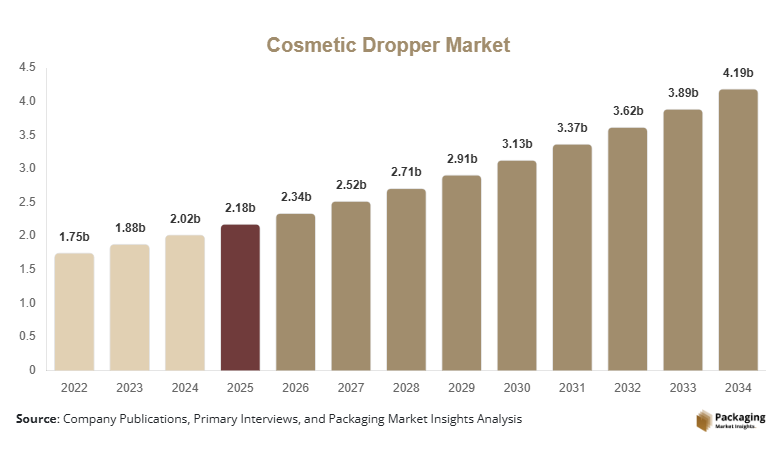
Cosmetic Dropper market size is projected at USD 2.34 billion in 2026 and is expected to hit USD 4.19 billion by 2034 with a CAGR of 7.54%. Rising investments in premium cosmetic packaging, increasing demand for precision dispensing solutions, and expansion of luxury skincare brands continue to support market expansion. The report provides comprehensive quantitative analysis covering production volumes, demand distribution, segmentation, competitive landscape, technological developments, and regional performance across the forecast period.
The cosmetic dropper market comprises precision dispensing closures used in serums, facial oils, essential oils, scalp treatments, and liquid cosmetic formulations. Global production exceeded 8.4 billion units in 2025, while premium skincare applications accounted for nearly 58% of total consumption. Glass droppers represented approximately 63% of overall production due to superior chemical resistance, whereas plastic variants contributed nearly 31%. Premium cosmetic brands achieved penetration exceeding 72% for dropper-packaged serums, reinforcing continued expansion of the cosmetic dropper market.
Explore more data points, trends and opportunities Download Free Sample Report
Cosmetic Dropper Market Trends
Increasing Premium Skincare Packaging Adoption
Luxury skincare manufacturers are increasingly replacing pumps with precision droppers to improve dosage accuracy and reduce product wastage. More than 5.2 billion dropper units were supplied for skincare formulations during 2025, while recyclable glass usage increased by 19% year-over-year. Automated filling technologies have improved production efficiency by approximately 24%, supporting higher manufacturing capacity and consistent product quality across the cosmetic dropper market.
Growing demand for refillable and recyclable packaging has encouraged manufacturers to introduce PCR plastics, lightweight glass, and aluminum collar designs. Sustainable packaging adoption surpassed 42% among premium cosmetic launches, while automated inspection systems achieved defect detection rates above 99%. Smart manufacturing technologies continue transforming production efficiency across the cosmetic dropper market.
Cosmetic Dropper Market Drivers
Growing Demand for Premium Serums and Precision Dispensing
Premium facial serums, vitamin formulations, botanical extracts, and anti-aging oils increasingly require controlled dispensing systems. Global serum sales expanded by nearly 11% during 2025, while cosmetic brands introduced over 4,800 new dropper-based SKUs worldwide. Precision dispensing reduces product wastage by approximately 18% and improves dosage consistency by nearly 25%, strengthening long-term demand across the cosmetic dropper market.
Cosmetic Dropper Market Restraints
High Manufacturing Cost of Premium Glass Packaging
Glass molding, chemical strengthening, decorative coating, and quality inspection significantly increase production costs. Premium borosilicate glass droppers cost approximately 22–30% more than conventional plastic alternatives, while energy-intensive manufacturing raises operational expenditure by nearly 16%. Small cosmetic brands often prefer economical dispensing systems, limiting broader penetration despite increasing consumer preference within the cosmetic dropper market.
Cosmetic Dropper Market Opportunities
Expansion of Sustainable Cosmetic Packaging
Demand for recyclable packaging continues accelerating as cosmetic companies pursue sustainability goals. Recycled glass utilization increased by approximately 27%, while PCR plastic content exceeded 35% in newly introduced packaging formats. Eco-certified packaging programs across Europe and North America encourage innovation, creating substantial investment opportunities throughout the cosmetic dropper market.
Challenges in Cosmetic Dropper Market
Maintaining Supply Chain Stability and Product Compatibility
Manufacturers must ensure compatibility between dispensing components and increasingly complex cosmetic formulations. More than 450 formulation variants require specialized elastomers and closures, while global logistics costs fluctuated by nearly 14% during recent years. Strict quality control, leak prevention, and material compatibility remain major operational challenges for the cosmetic dropper market.
Report Scope
| Report Metric | Details |
|---|---|
| Market Size in 2025 | USD 2.18 billion |
| Market Size in 2026 | USD 2.34 billion |
| Market Size in 2034 | USD 4.19 billion |
| CAGR | 7.54% (2026-2034) |
| Base Year for Estimation | 2025 |
| Historical Data | 2022-2024 |
| Forecast Period | 2026-2034 |
| Report Coverage | Revenue Forecast, Competitive Landscape, Supply Chain Disruption, Growth Factors, Environment & Regulatory Landscape and Trends |
| Geographies Covered | North America, Europe, APAC, Middle East and Africa, LATAM |
| Countries Covered | U.S., Canada, U.K., Germany, France, Spain, Italy, Russia, Nordic, Benelux, Rest of Europe, China, South Korea, Japan, India, Australia, Singapore, Taiwan, South East Asia, Rest of Asia-Pacific, UAE, Turky, Saudi Arabia, South Africa, Egypt, Nigeria, Rest of MEA, Brazil, Mexico, Argentina, Chile, Colombia, Rest of LATAM |
Explore more data points, trends and opportunities Download Free Sample Report
Cosmetic Dropper Market Segmentation
The market is segmented by type and application, with glass droppers accounting for nearly 63% of total market volume owing to premium positioning and chemical stability. Skincare applications contribute approximately 58% of overall consumption, followed by haircare and color cosmetics.
By Type
Glass Droppers
Glass droppers dominate the market with approximately 63% share and production exceeding 5.3 billion units annually. Borosilicate and soda-lime glass provide high chemical resistance, excellent transparency, and compatibility with vitamin C, retinol, and botanical oils. Precision pipettes improve dispensing accuracy for premium skincare applications.
Plastic Droppers
Plastic droppers account for nearly 31% of market volume with production exceeding 2.6 billion units annually. PP, PETG, and PCR plastics reduce packaging weight by nearly 45%, improve transportation efficiency, and lower manufacturing costs while maintaining suitable dispensing performance.
Metal Droppers
Metal droppers represent approximately 6% of total production. Aluminum collars combined with glass pipettes improve premium appearance, corrosion resistance, and structural durability for luxury cosmetic packaging and high-end skincare products.
By Application
Skincare
Skincare represents the largest application with nearly 58% market share and annual demand exceeding 4.8 billion units. Facial serums, anti-aging products, facial oils, and vitamin concentrates increasingly rely on droppers for controlled dispensing and contamination reduction.
Haircare
Haircare contributes approximately 24% of market demand. Scalp serums, hair oils, and strengthening treatments increasingly utilize droppers due to improved dosage precision and reduced product wastage. Production exceeded 2 billion units during 2025.
Color Cosmetics
Color cosmetics account for roughly 18% of consumption, supported by liquid highlighters, foundation boosters, and pigment concentrates. Premium cosmetic brands increasingly adopt decorative droppers featuring UV coatings and customized metallic finishes.
Cosmetic Dropper Market Segmentations
Type
- Glass Droppers
- Plastic Droppers
- Metal Droppers
Application
- Skincare
- Haircare
- Color Cosmetics
Cosmetic Dropper Regional Outlook
North America
North America accounted for approximately 31% of global demand during 2025. The United States contributed nearly 82% of regional production, supported by premium skincare manufacturers, advanced packaging suppliers, and strong consumer preference for luxury cosmetic products exceeding 2.1 billion units annually.
Europe
Europe represented nearly 29% of total consumption. France, Germany, Italy, and the United Kingdom collectively generated over 2 billion units annually, while sustainable packaging adoption exceeded 48% among premium cosmetic manufacturers.
Asia-Pacific
Asia-Pacific held approximately 32% market share and remained the fastest-growing regional market. China, South Korea, Japan, and India accounted for over 4 billion units of production, supported by expanding skincare exports and increasing domestic cosmetic manufacturing.
Latin America, Middle East & Africa
These regions collectively contributed nearly 8% of global demand. Brazil, Mexico, UAE, Saudi Arabia, and South Africa experienced rising investments in premium cosmetics, increasing production capacity beyond 650 million units annually.
Top players in Cosmetic Dropper Market
- AptarGroup, Inc.
- Silgan Dispensing Systems
- Gerresheimer AG
- Quadpack Industries
- Lumson S.p.A.
- Virospack S.L.
- Berlin Packaging
- Raepak Ltd.
- APG Packaging
- Fusion Packaging
- Stoelzle Glass Group
- HCP Packaging
- Baralan International S.p.A.
- Bormioli Luigi S.p.A.
- HEINZ-GLAS GmbH
AptarGroup, Inc.
-
Estimated global market share of approximately 12%.
-
Strong leadership in dispensing technologies and premium cosmetic closures.
-
Extensive manufacturing network across North America, Europe, and Asia.
-
Continuous investments in recyclable packaging, automation, and sustainable dispensing innovations support long-term competitive positioning in premium cosmetic packaging.
Silgan Dispensing Systems
-
Estimated global market share of approximately 10%.
-
Broad portfolio of cosmetic droppers, pumps, and dispensing systems.
-
Strong partnerships with international beauty brands and contract manufacturers.
-
Significant investments in lightweight packaging, PCR materials, and production automation strengthen its position across premium skincare and cosmetic applications.