Corrugated Packaging For Pharmaceutical Market Size and Growth
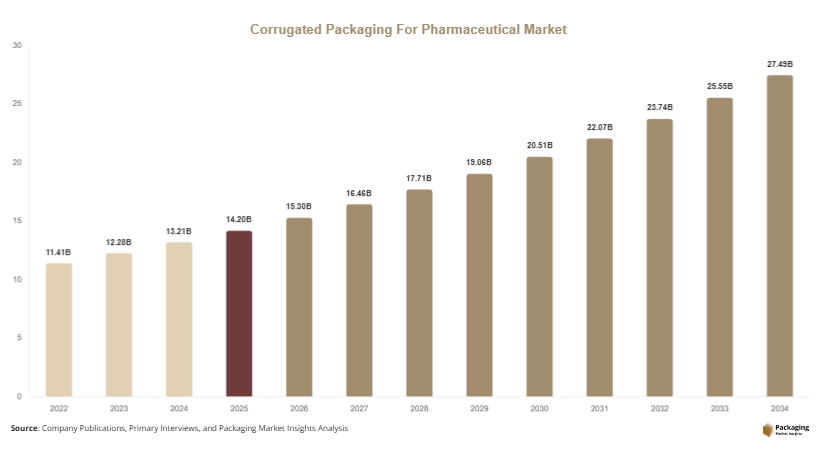
The Corrugated Packaging For Pharmaceutical Market size was valued at approximately USD 14.2 billion in 2025 and is projected to reach USD 15.3 billion in 2026. With the continuous growth of global pharmaceutical production and distribution, the market is expected to reach USD 29.7 billion by 2034, registering a CAGR of 7.6% during the forecast period (2025–2034). The corrugated packaging for pharmaceutical market is witnessing steady expansion due to the increasing demand for safe, durable, and cost-effective packaging solutions for pharmaceutical products.
One of the primary growth factors is the rising demand for secure and protective packaging in pharmaceutical logistics. Corrugated packaging provides cushioning and structural integrity, ensuring that medicines, vaccines, and medical devices are transported safely without damage. As pharmaceutical supply chains become more complex, the need for reliable packaging solutions continues to increase.
Key Highlights:
- The market size reached USD 14.2 billion in 2025 and is projected to grow steadily, reaching USD 29.7 billion by 2034. This growth reflects increasing demand for reliable pharmaceutical packaging solutions worldwide.
- The market is expected to expand at a CAGR of 7.6% during the forecast period from 2025 to 2034. This steady growth is supported by rising healthcare needs and expanding pharmaceutical distribution networks.
- There is increasing demand for secure pharmaceutical logistics and distribution. This is driven by the need to ensure product safety, compliance, and integrity during transportation.
- The rising adoption of sustainable and recyclable packaging solutions is further supporting market growth. Companies are focusing on eco-friendly materials to reduce environmental impact and meet regulatory standards.
Explore more data points, trends and opportunities Download Free Sample Report
Market Trends
Integration of Temperature-Controlled Corrugated Packaging
A significant trend in the corrugated packaging for pharmaceutical market is the integration of temperature-controlled features within corrugated packaging. Pharmaceutical products such as vaccines and biologics require strict temperature conditions during transportation. Manufacturers are developing corrugated boxes with insulation layers and phase change materials to maintain temperature stability. This innovation enhances the functionality of corrugated packaging and expands its application scope. As demand for cold chain logistics increases, the adoption of temperature-controlled corrugated packaging is expected to grow. This trend reflects the industry's focus on maintaining product integrity and meeting regulatory requirements.
Increasing Use of Smart and Trackable Packaging Solutions
Another important trend is the growing use of smart and trackable packaging solutions. Technologies such as QR codes, RFID tags, and IoT sensors are being integrated into corrugated packaging to improve traceability and supply chain visibility. These solutions enable real-time monitoring of shipments, ensuring compliance with regulatory standards. Smart packaging also helps reduce losses due to theft or damage. The adoption of digital technologies is transforming pharmaceutical logistics, making it more efficient and transparent. This trend is expected to drive innovation and enhance the value proposition of corrugated packaging solutions.
Market Drivers
Growth of Global Pharmaceutical Industry
The growth of the global pharmaceutical industry is a major driver of the corrugated packaging for pharmaceutical market. Increasing demand for medicines, vaccines, and healthcare products is driving the need for reliable packaging solutions. Pharmaceutical companies require packaging that ensures product safety and compliance with regulatory standards. Corrugated packaging offers durability, cost efficiency, and customization options, making it suitable for various pharmaceutical applications. The expansion of healthcare infrastructure and rising investments in drug development are further supporting market growth.
Rising Demand for Sustainable Packaging Solutions
The increasing focus on sustainability is another key driver of the market. Governments and regulatory bodies are encouraging the use of eco-friendly packaging materials to reduce environmental impact. Corrugated packaging is widely recognized for its recyclability and biodegradability, making it a preferred choice for pharmaceutical companies. Consumers are also becoming more environmentally conscious, influencing companies to adopt sustainable practices. This driver is expected to play a significant role in shaping the future of the market.
Market Restraint
Stringent Regulatory Requirements and Compliance Challenges
One of the major restraints in the corrugated packaging for pharmaceutical market is the stringent regulatory requirements associated with pharmaceutical packaging. Packaging solutions must comply with various standards related to safety, hygiene, and product integrity. These regulations can vary across regions, making it challenging for manufacturers to maintain compliance. The need for specialized materials and processes to meet these standards can increase production costs.
For example, pharmaceutical packaging must often meet guidelines for moisture resistance, contamination prevention, and labeling accuracy. Failure to comply with these regulations can result in product recalls and financial losses. This creates additional pressure on manufacturers to invest in quality control and testing processes. While these regulations are essential for ensuring product safety, they can act as a barrier to market growth.
Market Opportunities
Expansion of Pharmaceutical E-commerce
The expansion of pharmaceutical e-commerce presents significant opportunities for the corrugated packaging for pharmaceutical market. Online pharmacies and direct-to-consumer healthcare services are gaining popularity, increasing the demand for efficient packaging solutions. Corrugated packaging provides durability and protection during last-mile delivery, making it suitable for e-commerce applications. The growth of digital healthcare platforms is expected to drive demand for packaging solutions that ensure safe and timely delivery of products.
Innovation in Lightweight and High-Strength Materials
Another opportunity lies in the development of lightweight and high-strength corrugated materials. Manufacturers are focusing on improving material performance to reduce weight while maintaining strength and durability. This helps reduce transportation costs and environmental impact. Innovations in material science are enabling the production of advanced corrugated packaging solutions that meet the evolving needs of the pharmaceutical industry. This is expected to create new growth opportunities in the market.
Report Scope
| Report Metric | Details |
|---|---|
| Market Size in 2025 | USD 14.2 Billion |
| Market Size in 2026 | USD 15.3 Billion |
| Market Size in 2034 | USD 29.7 Billion |
| CAGR | 7.6% (2026-2034) |
| Base Year for Estimation | 2025 |
| Historical Data | 2022-2024 |
| Forecast Period | 2026-2034 |
| Report Coverage | Revenue Forecast, Competitive Landscape, Supply Chain Disruption, Growth Factors, Environment & Regulatory Landscape and Trends |
| Geographies Covered | North America, Europe, APAC, Middle East and Africa, LATAM |
| Countries Covered | U.S., Canada, U.K., Germany, France, Spain, Italy, Russia, Nordic, Benelux, Rest of Europe, China, South Korea, Japan, India, Australia, Singapore, Taiwan, South East Asia, Rest of Asia-Pacific, UAE, Turky, Saudi Arabia, South Africa, Egypt, Nigeria, Rest of MEA, Brazil, Mexico, Argentina, Chile, Colombia, Rest of LATAM |
Explore more data points, trends and opportunities Download Free Sample Report
Segmental Analysis
By Type
The single-wall corrugated boxes segment dominated the market in 2024, accounting for approximately 49% of the total share. These boxes are widely used due to their cost-effectiveness and versatility. They are suitable for packaging a wide range of pharmaceutical products, including tablets, syrups, and medical devices. The segment benefits from ease of manufacturing and availability of materials. Additionally, single-wall boxes provide adequate protection during transportation.
The double-wall corrugated boxes segment is the fastest-growing, expected to register a CAGR of 8.1% during the forecast period. These boxes offer enhanced strength and durability, making them suitable for heavy and sensitive pharmaceutical products. The increasing demand for secure packaging is driving the growth of this segment. The ability to provide better protection against impact is a key factor contributing to its expansion.
By Application
The drug packaging segment held the largest market share in 2024, accounting for approximately 50% of the total market. The increasing demand for pharmaceutical products is driving growth in this segment. Corrugated packaging is widely used for transporting medicines safely. The segment benefits from the expansion of global healthcare systems.
The medical devices segment is the fastest-growing, with a projected CAGR of 8.4% during the forecast period. The increasing demand for advanced medical equipment is driving growth in this segment. Packaging solutions need to provide high levels of protection for sensitive devices. Corrugated packaging with reinforced structures is gaining popularity.
By End-Use
The pharmaceutical manufacturers segment dominated the market in 2024, accounting for approximately 52% of the total share. These manufacturers require large volumes of packaging solutions for product distribution. The adoption of corrugated packaging helps reduce costs and improve logistics efficiency.
The e-commerce pharmacies segment is the fastest-growing, expected to register a CAGR of 8.6% during the forecast period. The increasing popularity of online pharmacies is driving demand for packaging solutions that can withstand multiple handling stages. Corrugated packaging is widely used due to its durability.
Corrugated Packaging For Pharmaceutical Market Segmentations
By Type
- Single-Wall Corrugated Boxes
- Double-Wall Corrugated Boxes
- Triple-Wall Corrugated Boxes
By Application
- Drug Packaging
- Medical Devices
- Laboratory Supplies
By End-Use
- Pharmaceutical Manufacturers
- E-commerce Pharmacies
- Logistics Providers
Regional Analysis
North America
North America accounted for approximately 30% of the global corrugated packaging for pharmaceutical market share in 2025 and is expected to register a CAGR of 7.2% during the forecast period. The region benefits from a well-established pharmaceutical industry and advanced logistics infrastructure. Increasing demand for biologics and specialty drugs is driving the need for reliable packaging solutions. The adoption of sustainable packaging practices is also contributing to market growth.
The United States dominates the regional market due to its strong healthcare system and high pharmaceutical consumption. A unique growth factor is the increasing demand for home healthcare services, which require efficient packaging solutions for medication delivery. This trend is encouraging the adoption of corrugated packaging.
Europe
Europe held around 24% of the market share in 2025 and is projected to grow at a CAGR of 7.0% through 2034. The region is characterized by strict environmental regulations and a strong focus on sustainability. Pharmaceutical companies are adopting eco-friendly packaging solutions to comply with regulatory requirements. The presence of established pharmaceutical manufacturers further supports market growth.
Germany leads the European market, driven by its strong manufacturing capabilities. A unique growth factor is the increasing adoption of circular economy practices, which promote the use of recyclable materials. This is creating opportunities for corrugated packaging solutions.
Asia Pacific
Asia Pacific dominated the global market with a share of approximately 32% in 2025 and is expected to register the highest CAGR of 8.3% during the forecast period. The region is a major hub for pharmaceutical manufacturing, with countries such as China and India playing a significant role. Increasing production and export of pharmaceutical products are driving demand for packaging solutions.
China is the dominant country in the region, supported by large-scale manufacturing operations. A key growth factor is the expansion of generic drug production, which requires cost-effective packaging solutions. This is encouraging the adoption of corrugated packaging.
Middle East & Africa
The Middle East & Africa region accounted for around 7% of the market share in 2025 and is expected to grow at a CAGR of 6.5% during the forecast period. The market is gradually expanding due to increasing investment in healthcare infrastructure. The development of pharmaceutical distribution networks is supporting market growth.
The United Arab Emirates is a leading country in the region, driven by its focus on healthcare development. A unique growth factor is the establishment of pharmaceutical distribution hubs, which require efficient packaging solutions.
Latin America
Latin America held approximately 7% of the global market share in 2025 and is projected to grow at a CAGR of 6.8% through 2034. The region is witnessing growth due to increasing demand for pharmaceutical products. Governments are investing in healthcare infrastructure, supporting market expansion.
Brazil dominates the regional market, supported by its growing pharmaceutical industry. A key growth factor is the expansion of vaccination programs, which require reliable packaging solutions. This is driving demand for corrugated packaging.
Competitive Landscape
The corrugated packaging for pharmaceutical market is moderately competitive, with several key players focusing on innovation and sustainability. Companies are investing in advanced materials and technologies to enhance packaging performance. Strategic partnerships and acquisitions are common strategies used to expand market presence.
A leading player in the market is International Paper Company, which has been actively developing sustainable packaging solutions. The company recently introduced new corrugated packaging designs for pharmaceutical applications. Other major players are focusing on expanding their product portfolios and improving distribution networks.
Key Players List
- International Paper Company
- WestRock Company
- Smurfit Kappa Group
- DS Smith Plc
- Mondi Group
- Packaging Corporation of America
- Georgia-Pacific LLC
- Stora Enso Oyj
- Oji Holdings Corporation
- Rengo Co., Ltd.
- Cascades Inc.
- Klabin S.A.
- Pratt Industries Inc.
- Nine Dragons Paper Holdings
- Lee & Man Paper Manufacturing Ltd.