Corrugated Automotive Packaging Market Size and Growth
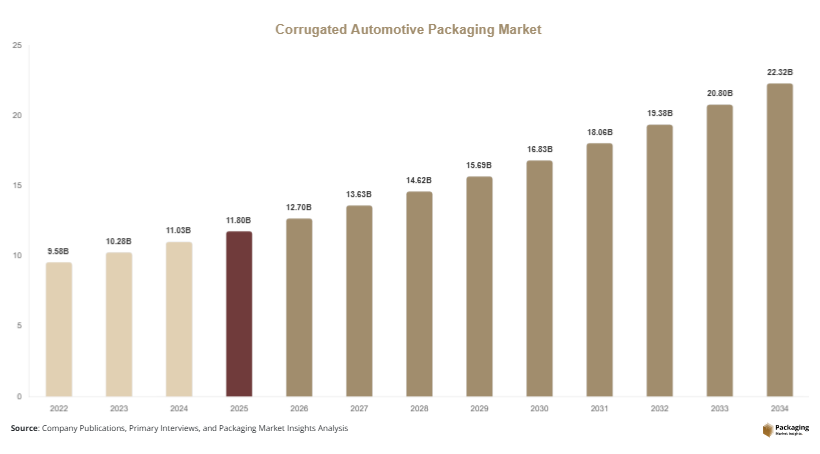
The global Corrugated Automotive Packaging Market size reached approximately USD 11.8 billion in 2025 and is projected to grow to USD 12.7 billion in 2026. By 2034, the market is expected to reach USD 23.9 billion, expanding at a CAGR of 7.3% during the forecast period from 2025 to 2034. This growth reflects the increasing reliance on corrugated packaging solutions for the safe transport and storage of automotive components across domestic and international markets.
One of the primary growth factors is the expansion of the global automotive industry, particularly in emerging economies. Rising vehicle production and increasing demand for spare parts and components are fueling the need for efficient packaging solutions that ensure product safety during transit. Corrugated packaging offers durability, cushioning, and flexibility, making it suitable for a wide range of automotive applications.
Key Highlights:
- The market size reached USD 11.8 billion in 2025 and is projected to grow significantly, reaching USD 23.9 billion by 2034. This steady expansion reflects increasing demand across multiple industrial applications and evolving packaging requirements.
- The market is expected to register a CAGR of 7.3% from 2025 to 2034. This growth rate is supported by continuous innovation and rising adoption of efficient and cost-effective packaging solutions.
- Increasing demand from automotive manufacturing and aftermarket sectors is a key growth driver. The need for safe, durable, and efficient transport of components is boosting packaging consumption.
- There is a strong focus on sustainable and recyclable packaging solutions across industries. Companies are shifting toward eco-friendly materials to meet regulatory standards and environmental goals.
- Advancements in high-strength and customized corrugated packaging are enhancing product protection. These innovations enable better durability, flexibility, and cost optimization in logistics and storage.
Explore more data points, trends and opportunities Download Free Sample Report
Market Trends
Increasing Adoption of Lightweight and Sustainable Packaging Solutions
A prominent trend in the corrugated automotive packaging market is the growing adoption of lightweight and sustainable packaging solutions. Automotive manufacturers are focusing on reducing transportation costs and carbon emissions by using lighter packaging materials. Corrugated packaging offers an ideal solution due to its low weight and high strength. Additionally, increasing environmental concerns and regulatory pressures are encouraging companies to adopt recyclable and biodegradable packaging materials. This trend is further supported by the shift toward circular economy practices, where packaging materials are reused and recycled. As sustainability becomes a key priority, the demand for corrugated packaging solutions is expected to rise significantly across the automotive sector.
Customization and Smart Packaging Integration
Another significant trend is the increasing demand for customized and smart packaging solutions. Automotive components vary widely in size, shape, and fragility, requiring tailored packaging solutions to ensure safe handling and transportation. Manufacturers are investing in advanced design technologies to create customized corrugated packaging that meets specific requirements. Additionally, the integration of smart packaging technologies, such as tracking systems and RFID tags, is gaining traction. These technologies enhance supply chain visibility and improve inventory management. The combination of customization and smart packaging is expected to drive innovation and growth in the market.
Market Drivers
Growth of the Automotive Industry and Aftermarket Services
The growth of the automotive industry is a key driver of the corrugated automotive packaging market. Increasing vehicle production and rising demand for automotive components are driving the need for efficient packaging solutions. The expansion of aftermarket services, including repair and maintenance, is also contributing to market growth. Corrugated packaging is widely used for transporting spare parts, as it provides protection against damage and ensures safe delivery. The growing complexity of automotive components further increases the demand for specialized packaging solutions, supporting the growth of the market.
Rising Focus on Cost Efficiency and Logistics Optimization
Another major driver is the increasing focus on cost efficiency and logistics optimization. Corrugated packaging is cost-effective compared to alternative materials, making it a preferred choice for automotive manufacturers and suppliers. Its lightweight nature reduces transportation costs, while its stackability and flexibility improve storage efficiency. Additionally, the ability to customize corrugated packaging solutions allows companies to optimize their logistics operations. These advantages are driving the adoption of corrugated packaging across the automotive supply chain.
Market Restraint
Limited Durability Compared to Alternative Materials
One of the key restraints in the corrugated automotive packaging market is the limited durability of corrugated materials compared to alternatives such as plastic and metal packaging. While corrugated packaging offers several advantages, including cost-effectiveness and sustainability, it may not provide the same level of protection for heavy or highly sensitive components. Exposure to moisture, extreme temperatures, and rough handling can compromise the integrity of corrugated packaging, leading to potential product damage.
For example, automotive components such as engines and heavy mechanical parts require robust packaging solutions that can withstand harsh conditions. In such cases, manufacturers may prefer plastic or metal packaging, which offers higher durability and protection. This limitation can restrict the adoption of corrugated packaging in certain applications.
Despite these challenges, ongoing innovations in material strength and coating technologies are helping to improve the durability of corrugated packaging. However, the need to balance cost, performance, and sustainability remains a challenge for market participants.
Market Opportunities
Expansion of Electric Vehicle Supply Chains
The rapid growth of the electric vehicle (EV) market presents significant opportunities for the corrugated automotive packaging market. EV production requires the transportation of specialized components, such as batteries and electronic systems, which need secure and efficient packaging solutions. Corrugated packaging can be customized to meet these requirements, offering protection and cost efficiency. As the adoption of electric vehicles continues to increase, the demand for corrugated packaging solutions is expected to grow, creating new opportunities for market players.
Increasing Demand in Emerging Markets
Emerging markets offer substantial growth opportunities for the corrugated automotive packaging industry. Rapid industrialization, urbanization, and increasing vehicle ownership in regions such as Asia Pacific and Latin America are driving the demand for automotive components and packaging solutions. Additionally, governments in these regions are promoting local manufacturing and infrastructure development, further supporting market growth. Companies that expand their presence in emerging markets can benefit from the growing demand and strengthen their competitive position.
Report Scope
| Report Metric | Details |
|---|---|
| Market Size in 2025 | USD 11.8 Billion |
| Market Size in 2026 | USD 12.7 Billion |
| Market Size in 2034 | USD 23.9 Billion |
| CAGR | 7.3% (2026-2034) |
| Base Year for Estimation | 2025 |
| Historical Data | 2022-2024 |
| Forecast Period | 2026-2034 |
| Report Coverage | Revenue Forecast, Competitive Landscape, Supply Chain Disruption, Growth Factors, Environment & Regulatory Landscape and Trends |
| Geographies Covered | North America, Europe, APAC, Middle East and Africa, LATAM |
| Countries Covered | U.S., Canada, U.K., Germany, France, Spain, Italy, Russia, Nordic, Benelux, Rest of Europe, China, South Korea, Japan, India, Australia, Singapore, Taiwan, South East Asia, Rest of Asia-Pacific, UAE, Turky, Saudi Arabia, South Africa, Egypt, Nigeria, Rest of MEA, Brazil, Mexico, Argentina, Chile, Colombia, Rest of LATAM |
Explore more data points, trends and opportunities Download Free Sample Report
Segmental Analysis
By Type
Single-wall corrugated packaging dominated the market in 2024, accounting for approximately 42% of the total market share. This dominance is attributed to its cost-effectiveness, lightweight nature, and versatility. Single-wall corrugated packaging is widely used for packaging automotive components such as small parts and accessories. Its ability to provide adequate protection while maintaining low costs makes it a preferred choice for manufacturers. Additionally, the availability of various flute sizes allows for customization based on specific requirements.
Double-wall corrugated packaging is expected to be the fastest-growing segment, with a CAGR of 8.5% during the forecast period. This growth is driven by the increasing demand for stronger and more durable packaging solutions. Double-wall corrugated packaging offers enhanced strength and cushioning, making it suitable for heavy and fragile automotive components. The growing complexity of automotive parts and the need for secure transportation are key factors contributing to the growth of this segment.
By Application
The components packaging segment held the largest market share in 2024, accounting for approximately 48% of the total market. This dominance is driven by the high demand for packaging solutions for automotive parts such as engines, transmissions, and electronic components. Corrugated packaging provides effective protection against damage during transportation and storage, ensuring product integrity. The increasing production of automotive components further supports the growth of this segment.
The aftermarket packaging segment is expected to grow at the fastest CAGR of 8.0% during the forecast period. This growth is driven by the increasing demand for replacement parts and maintenance services. Corrugated packaging is widely used in the aftermarket sector due to its cost-effectiveness and flexibility. The expansion of e-commerce platforms for automotive parts is also contributing to the growth of this segment.
By End-Use
The OEM segment dominated the market in 2024, accounting for approximately 55% of the total market share. This dominance is attributed to the high volume of packaging required for automotive manufacturing processes. Corrugated packaging is widely used for transporting components between suppliers and manufacturers. Its ability to provide protection and cost efficiency makes it a preferred choice for OEMs.
The e-commerce segment is expected to be the fastest-growing, with a CAGR of 9.1% during the forecast period. This growth is driven by the increasing online sales of automotive parts and accessories. Corrugated packaging is well-suited for e-commerce applications due to its lightweight and customizable nature. The growing trend of online shopping is expected to drive the demand for corrugated packaging solutions.
Corrugated Automotive Packaging Market Segmentations
By Type
- Single-Wall Corrugated
- Double-Wall Corrugated
- Triple-Wall Corrugated
By Application
- Components Packaging
- Aftermarket Packaging
- Bulk Packaging
By End-Use
- OEM
- Aftermarket
- E-commerce
Regional Analysis
North America
North America accounted for approximately 27% of the global market share in 2025 and is expected to grow at a CAGR of 6.8% during the forecast period. The region’s growth is driven by the presence of established automotive manufacturers and a well-developed supply chain infrastructure. Increasing demand for sustainable packaging solutions further supports market expansion.
The United States dominates the North American market, driven by high automotive production and a strong aftermarket sector. A key growth factor is the increasing adoption of eco-friendly packaging solutions, supported by regulatory initiatives and corporate sustainability goals.
Europe
Europe held a market share of around 24% in 2025 and is projected to grow at a CAGR of 7.0%. The region is characterized by stringent environmental regulations and a strong focus on sustainability, driving the adoption of recyclable packaging materials.
Germany is the leading country in the European market, supported by its advanced automotive industry and strong manufacturing base. A unique growth factor is the increasing demand for lightweight packaging solutions to reduce carbon emissions and improve fuel efficiency in logistics operations.
Asia Pacific
Asia Pacific accounted for the largest market share of approximately 34% in 2025 and is expected to grow at a CAGR of 8.2%. The region’s growth is driven by rapid industrialization, increasing vehicle production, and expanding supply chains.
China dominates the Asia Pacific market, driven by its large automotive manufacturing sector and growing consumer base. A key growth factor is the rising demand for cost-effective packaging solutions to support large-scale production and distribution.
Middle East & Africa
The Middle East & Africa region held a market share of about 8% in 2025 and is projected to grow at a CAGR of 6.5%. The market is driven by increasing automotive sales and growing demand for packaging solutions.
Saudi Arabia is the leading country in this region, supported by its expanding automotive and logistics sectors. A unique growth factor is the increasing investment in infrastructure development, which is driving demand for packaging solutions.
Latin America
Latin America accounted for approximately 7% of the market share in 2025 and is expected to grow at a CAGR of 6.9%. The region’s growth is driven by rising vehicle production and increasing demand for automotive components.
Brazil dominates the Latin American market, driven by its large automotive industry and growing consumer demand. A key growth factor is the increasing focus on cost-effective packaging solutions to support regional supply chains.
Competitive Landscape
The corrugated automotive packaging market is characterized by the presence of several global and regional players competing on the basis of product quality, innovation, and sustainability. Companies are focusing on developing advanced packaging solutions that meet the evolving requirements of the automotive industry.
Smurfit Kappa Group is a leading player in the market, known for its strong focus on sustainable packaging solutions. The company has recently introduced innovative corrugated packaging designs tailored for automotive applications, enhancing product protection and reducing environmental impact. Other key players are also investing in research and development to improve product performance and expand their market presence.
Strategic partnerships, mergers, and acquisitions are common in the market, as companies seek to strengthen their capabilities and expand their customer base. The competitive landscape is expected to remain dynamic, driven by continuous innovation and increasing demand for sustainable packaging solutions.
Key Players List
- Smurfit Kappa Group
- DS Smith plc
- WestRock Company
- International Paper Company
- Mondi Group
- Packaging Corporation of America
- Georgia-Pacific LLC
- Rengo Co., Ltd.
- Nine Dragons Paper Holdings Limited
- Oji Holdings Corporation
- Stora Enso Oyj
- Pratt Industries, Inc.
- Klingele Papierwerke GmbH
- Saica Group
- VPK Packaging Group