Contract Packaging And Fulfilment Services Market Size and Growth
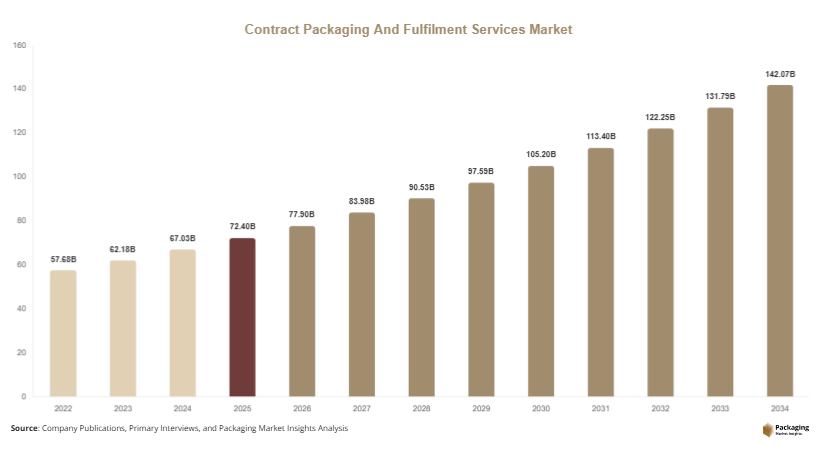
The global contract packaging and fulfilment services market size was estimated at USD 72.4 billion in 2025 and is projected to reach USD 77.9 billion in 2026. The market is forecast to grow significantly, reaching USD 142.6 billion by 2034, registering a compound annual growth rate (CAGR) of 7.8% between 2025 and 2034. Market growth is supported by increasing demand for flexible packaging operations, rising e-commerce logistics complexity, and the growing preference among brands for outsourced supply chain services.
The contract packaging and fulfilment services market is expanding steadily as brands increasingly outsource packaging, labeling, and logistics operations to specialized service providers. Contract packaging companies support manufacturers, retailers, and e-commerce businesses by managing packaging design, assembly, storage, and order fulfillment. This model enables organizations to reduce operational costs while maintaining flexibility in production and distribution.
Key Highlights
- Market size expected to reach USD 142.6 billion by 2034
- Projected CAGR of 7.8% from 2025 to 2034
- Increasing outsourcing of logistics and packaging operations
- E-commerce expansion driving fulfillment service demand
- Technology integration improving packaging efficiency and scalability
Explore more data points, trends and opportunities Download Free Sample Report
Market Trends
Expansion of E-commerce Fulfillment Partnerships
The rapid growth of global e-commerce has significantly transformed the contract packaging and fulfilment services market. Online retailers rely heavily on third-party service providers to manage order packaging, inventory handling, and distribution logistics. As customer expectations for faster delivery increase, companies are partnering with contract packaging providers that operate integrated fulfillment centers near major consumer hubs. These partnerships enable faster order processing and lower shipping costs. Many service providers now offer integrated systems that connect with e-commerce platforms to automate order tracking, packaging customization, and inventory management. The increasing complexity of omnichannel retail operations continues to accelerate demand for specialized packaging and fulfillment outsourcing.
Adoption of Sustainable Packaging Solutions
Sustainability has become an important focus area within the contract packaging and fulfilment services market. Consumer awareness regarding environmental impact has encouraged brands to adopt eco-friendly packaging materials and recyclable designs. Contract packaging providers are responding by incorporating biodegradable packaging materials, reusable containers, and optimized packaging designs that reduce waste. Service providers are also investing in energy-efficient equipment and waste reduction practices to meet sustainability targets set by their clients. As global regulations regarding packaging waste become stricter, contract packaging companies that offer sustainable solutions are gaining a competitive advantage. This shift toward environmentally responsible packaging practices is expected to influence service demand across multiple industries.
Market Drivers
Increasing Outsourcing of Supply Chain Operations
Companies across industries are increasingly outsourcing supply chain functions to specialized service providers, which is a key driver for the contract packaging and fulfilment services market. Outsourcing allows organizations to focus on core competencies such as product development, marketing, and sales while leaving packaging and logistics tasks to experienced partners. Contract packaging companies offer advanced facilities, skilled labor, and automated technologies that enable efficient packaging and distribution. Businesses benefit from reduced operational costs, improved scalability, and faster market entry. Small and medium-sized enterprises in particular rely on outsourced packaging services to compete with larger manufacturers without investing heavily in infrastructure.
Growth of Pharmaceutical and Healthcare Packaging Needs
The pharmaceutical sector plays a significant role in driving demand within the contract packaging and fulfilment services market. Strict regulatory requirements related to labeling, traceability, and product safety require specialized packaging expertise. Contract packaging companies provide serialization, tamper-evident packaging, and compliance documentation services that help pharmaceutical manufacturers meet regulatory standards. Additionally, the increasing production of biologics, vaccines, and personalized medicines requires highly controlled packaging environments. Contract packaging providers with advanced facilities and regulatory certifications are becoming preferred partners for pharmaceutical companies seeking reliable and compliant packaging solutions.
Market Restraint
High Operational Complexity and Compliance Costs
Despite steady growth, the contract packaging and fulfilment services market faces challenges related to operational complexity and regulatory compliance costs. Contract packaging companies must maintain strict quality standards across multiple industries including food, pharmaceuticals, cosmetics, and consumer goods. Each sector has specific regulatory requirements related to labeling accuracy, hygiene standards, and product traceability. Maintaining compliance across multiple product categories increases operational expenses and requires continuous investment in quality control systems and employee training.
Additionally, packaging service providers often manage products from different clients within the same facility. This requires strict inventory segregation, advanced tracking systems, and efficient workflow management. Failure to maintain accurate processes can lead to product recalls or reputational damage for both the packaging provider and its clients.
For example, pharmaceutical packaging contracts often require serialization systems that track individual product units throughout the supply chain. Implementing these technologies involves significant capital investment. Smaller service providers may struggle to meet these requirements, limiting their ability to compete for large contracts. These operational and regulatory complexities may restrain market growth, particularly for emerging service providers entering the industry.
Market Opportunities
Growth of Direct-to-Consumer Brand Distribution
Direct-to-consumer (DTC) brands are creating new opportunities in the contract packaging and fulfilment services market. Many emerging brands rely on outsourced fulfillment services to manage packaging, shipping, and inventory operations. Contract packaging providers are offering specialized services designed for DTC businesses, including subscription box assembly, customized promotional packaging, and rapid order processing. As social media marketing and digital retail channels continue to expand, the number of small and medium brands entering the market is increasing. These companies often lack in-house logistics infrastructure, creating long-term demand for flexible contract packaging services.
Integration of Smart Packaging and Digital Tracking
Technological innovation presents another growth opportunity for the contract packaging and fulfilment services market. Smart packaging technologies such as QR codes, RFID tags, and digital tracking systems allow brands to improve product traceability and consumer engagement. Contract packaging providers that integrate these technologies into their services can offer additional value to clients. Smart packaging also enables real-time monitoring of supply chains and helps reduce product loss during transportation. As industries such as pharmaceuticals and food increasingly require advanced traceability systems, contract packaging companies that invest in digital packaging capabilities are expected to gain significant market opportunities.
Report Scope
| Report Metric | Details |
|---|---|
| Market Size in 2025 | USD 72.4 Billion |
| Market Size in 2026 | USD 77.9 Billion |
| Market Size in 2034 | USD 142.6 Billion |
| CAGR | 7.8% (2026-2034) |
| Base Year for Estimation | 2025 |
| Historical Data | 2022-2024 |
| Forecast Period | 2026-2034 |
| Report Coverage | Revenue Forecast, Competitive Landscape, Supply Chain Disruption, Growth Factors, Environment & Regulatory Landscape and Trends |
| Geographies Covered | North America, Europe, APAC, Middle East and Africa, LATAM |
| Countries Covered | U.S., Canada, U.K., Germany, France, Spain, Italy, Russia, Nordic, Benelux, Rest of Europe, China, South Korea, Japan, India, Australia, Singapore, Taiwan, South East Asia, Rest of Asia-Pacific, UAE, Turky, Saudi Arabia, South Africa, Egypt, Nigeria, Rest of MEA, Brazil, Mexico, Argentina, Chile, Colombia, Rest of LATAM |
Explore more data points, trends and opportunities Download Free Sample Report
Segmental Analysis
By Service Type
The primary packaging services segment dominated the contract packaging and fulfilment services market in 2024, accounting for approximately 38% of total market share. Primary packaging involves the direct packaging of products into containers such as bottles, pouches, cartons, and blister packs. This segment holds a strong position due to high demand from industries including pharmaceuticals, food and beverages, and cosmetics. Contract packaging providers offering primary packaging services typically operate advanced production lines capable of high-volume output and strict quality control. These facilities ensure product protection, regulatory compliance, and consistent packaging standards. Companies prefer outsourcing primary packaging tasks because establishing in-house packaging facilities requires significant capital investment and specialized expertise.
The fulfillment services segment is projected to be the fastest-growing service category, with an expected CAGR of around 9.1% through 2034. Fulfillment services include order processing, inventory storage, picking and packing, and final product distribution. Growth in this segment is largely driven by the rapid expansion of online retail platforms and direct-to-consumer sales channels. Businesses increasingly rely on third-party fulfillment providers to manage high-volume orders and reduce delivery times. Contract packaging companies are expanding integrated fulfillment centers that combine packaging operations with advanced warehouse management systems. This integration allows businesses to streamline supply chain processes and improve overall operational efficiency.
By Packaging Type
The flexible packaging segment accounted for the largest share of the contract packaging and fulfilment services market in 2024, representing approximately 41% of total market revenue. Flexible packaging solutions include pouches, sachets, bags, and film wraps that provide lightweight and cost-effective packaging alternatives. These formats are widely used in food, beverage, and personal care industries because they extend product shelf life while reducing transportation costs. Contract packaging providers have invested heavily in flexible packaging equipment capable of handling high-speed production lines. The growing popularity of single-serve products and convenience packaging formats has further strengthened demand for flexible packaging services.
The sustainable packaging segment is expected to record the fastest growth with an estimated CAGR of 9.5% during the forecast period. This segment includes biodegradable materials, recyclable packaging formats, and environmentally responsible packaging processes. Increasing regulatory pressure to reduce packaging waste is encouraging companies to adopt sustainable alternatives. Contract packaging providers are developing innovative solutions such as compostable films, paper-based packaging, and reusable containers. Businesses are also seeking packaging partners that can support corporate sustainability goals. As environmental awareness continues to influence consumer purchasing decisions, sustainable packaging services are expected to become an important differentiator within the market.
By End-Use Industry
The food and beverage industry held the largest share of the contract packaging and fulfilment services market in 2024, accounting for nearly 36% of total market demand. Food manufacturers frequently outsource packaging operations to manage seasonal demand fluctuations and ensure compliance with food safety regulations. Contract packaging companies provide services such as labeling, portion packaging, and product bundling for retail distribution. These services enable food producers to maintain efficient production lines while ensuring accurate packaging standards. In addition, the increasing popularity of ready-to-eat meals and snack products has created demand for specialized packaging formats that preserve freshness and convenience.
The pharmaceutical industry is projected to experience the fastest growth, with a CAGR of approximately 8.8% through 2034. Pharmaceutical manufacturers rely on contract packaging providers to meet strict regulatory requirements related to product labeling, serialization, and tamper-evident packaging. The growing production of generic drugs, biologics, and specialty medicines has increased the need for advanced packaging services. Contract packaging companies offering cleanroom environments and regulatory compliance expertise are becoming essential partners for pharmaceutical manufacturers seeking reliable packaging and fulfillment operations.
Contract Packaging And Fulfilment Services Market Segmentations
Service Type
- Primary Packaging
- Secondary Packaging
- Kitting & Assembly
- Fulfilment Services
Packaging Type
- Rigid Packaging
- Flexible Packaging
- Sustainable Packaging
End-Use Industry
- Food & Beverage
- Pharmaceuticals
- Personal Care & Cosmetics
- Consumer Electronics
- Retail & E-commerce
Regional Analysis
North America
North America accounted for approximately 34% of the global contract packaging and fulfilment services market share in 2025, making it the largest regional market. The region is expected to grow at a CAGR of around 7.1% through 2034. The strong presence of e-commerce companies, consumer goods manufacturers, and pharmaceutical firms contributes significantly to market expansion. Additionally, the region benefits from advanced logistics infrastructure and widespread adoption of automation technologies in packaging and fulfillment operations.
The United States dominates the North American market due to its large e-commerce ecosystem and high demand for third-party logistics services. One key growth factor is the rapid expansion of omnichannel retail models. Retailers increasingly combine online and offline sales channels, creating demand for flexible fulfillment services capable of managing both store distribution and direct-to-consumer deliveries. Contract packaging providers in the U.S. are expanding regional distribution centers to meet this growing demand.
Europe
Europe represented approximately 27% of the global contract packaging and fulfilment services market share in 2025 and is projected to grow at a CAGR of 6.9% during the forecast period. The region benefits from strong manufacturing industries, particularly in pharmaceuticals, food processing, and cosmetics. Increasing outsourcing of packaging services by European manufacturers has contributed to steady demand for contract packaging providers.
Germany leads the European market due to its large industrial base and strong pharmaceutical manufacturing sector. A key growth factor in the country is the rising demand for sustainable packaging solutions. European regulations promoting recyclable materials and waste reduction are encouraging companies to collaborate with contract packaging providers that offer environmentally friendly packaging processes and materials.
Asia Pacific
Asia Pacific held around 24% of the global contract packaging and fulfilment services market share in 2025 and is forecast to register the fastest CAGR of approximately 9.2% through 2034. The region's growth is supported by expanding manufacturing industries, rapid urbanization, and increasing online retail activity. Countries such as China, India, and Japan are witnessing significant demand for third-party packaging and fulfillment services.
China dominates the regional market due to its extensive manufacturing network and rapidly expanding e-commerce industry. One major growth factor is the increasing number of export-oriented manufacturers seeking specialized packaging services for international shipping. Contract packaging companies in China are expanding large-scale facilities designed to support high-volume global distribution operations.
Middle East & Africa
The Middle East & Africa region accounted for approximately 8% of the global contract packaging and fulfilment services market share in 2025 and is expected to grow at a CAGR of 7.0% during the forecast period. Increasing investment in logistics infrastructure and industrial development is supporting market growth. Governments in several countries are promoting supply chain modernization initiatives that include advanced packaging and distribution facilities.
The United Arab Emirates leads the regional market due to its strategic position as a global logistics hub. One key growth factor is the development of free trade zones and logistics corridors that support international trade. Contract packaging companies operating in these zones provide services for multinational brands distributing products across the Middle East, Africa, and Asia.
Latin America
Latin America accounted for roughly 7% of the global contract packaging and fulfilment services market share in 2025 and is projected to grow at a CAGR of 6.7% through 2034. Increasing consumer goods production and expanding retail distribution networks are contributing to steady market growth. Many manufacturers in the region are adopting outsourced packaging services to reduce operational complexity and improve distribution efficiency.
Brazil represents the largest market in Latin America due to its sizable consumer goods and food processing industries. A unique growth factor is the rising adoption of contract packaging services among local food and beverage manufacturers seeking to expand distribution across the region. Outsourced packaging allows these companies to scale production without significant capital investments.
Competitive Landscape
The contract packaging and fulfilment services market is moderately fragmented, with a mix of global service providers and regional packaging specialists competing for contracts across multiple industries. Leading companies focus on expanding their fulfillment networks, integrating advanced automation technologies, and offering customized packaging solutions to differentiate their services.
One of the prominent leaders in the market is Jones Packaging, which maintains a strong presence across North America and Europe. The company has developed advanced packaging facilities that support pharmaceutical and consumer goods manufacturers. Recently, the company expanded its fulfillment infrastructure to accommodate increasing e-commerce demand, enabling faster order processing and improved distribution efficiency.
Other major companies are investing in automation, robotics, and digital warehouse systems to enhance operational performance. Strategic partnerships with e-commerce platforms and logistics companies are also becoming common as service providers aim to offer integrated packaging and distribution solutions. Mergers and acquisitions are another strategy used by leading companies to expand geographic reach and strengthen service portfolios.
Key Players List
- Jones Packaging
- DHL Supply Chain
- FedEx Supply Chain
- GXO Logistics
- AmeriPac Inc.
- Sharp Packaging Services
- Assemblies Unlimited
- Stamar Packaging
- Summit Packaging Solutions
- Green Packaging Asia
- Unicep Packaging
- Verst Logistics
- Packaging Coordinators Inc.
- Wepackit Inc.
- Nulogy Corporation