Consumer Packaging Market Size and Growth
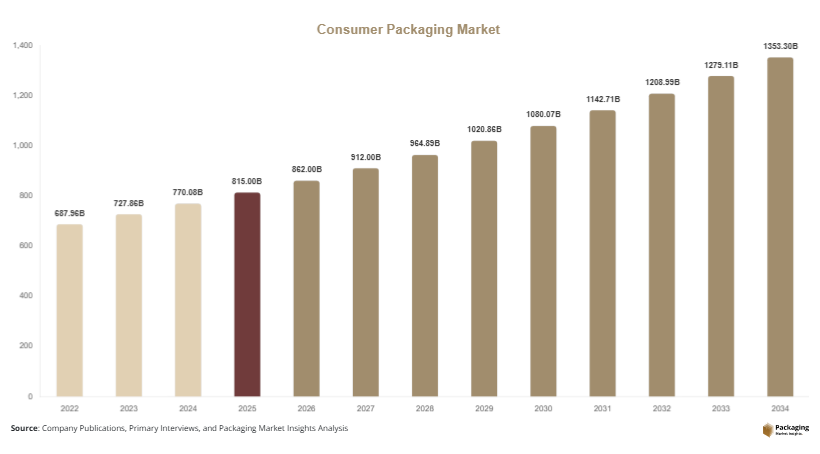
The global consumer packaging market size is estimated at USD 815 billion in 2025 and is projected to reach USD 862 billion in 2026. By 2034, the market is expected to reach approximately USD 1.24 trillion, expanding at a CAGR of 5.8% during the forecast period (2025–2034). The growth trajectory reflects a combination of shifting consumer lifestyles, sustainability requirements, and technological advancements in packaging materials and formats. The consumer packaging market is experiencing steady expansion driven by the rising consumption of packaged goods, rapid urbanization, and increasing demand from e-commerce and retail distribution networks.
One of the primary growth factors is the rapid expansion of the global FMCG sector, which heavily depends on consumer packaging for branding, protection, and product differentiation. Another key driver is the surge in e-commerce activities, where durable, lightweight, and cost-efficient packaging solutions are essential for logistics efficiency and damage prevention. Additionally, the rising adoption of sustainable packaging materials such as biodegradable plastics, recycled paperboard, and compostable polymers is reshaping industry standards and influencing procurement decisions across industries.
Key Highlights:
- Asia Pacific dominated the market with a 37.6% share in 2025.
- North America is projected to grow at the fastest CAGR of 6.8% during 2025–2034.
- GHS-Compliant Labels led the product type segment with a 44.2% share in 2025.
- Chemicals industry dominated the end-use segment with a 49.5% share in 2025.
- Polyethylene (PE) labels accounted for a 46.1% market share in 2025.
- The US remained the dominant country with a market size of USD 512.4 million in 2025 and USD 548.7 million in 2026.
Explore more data points, trends and opportunities Download Free Sample Report
Market Trends
Shift Toward Sustainable and Circular Packaging Systems
The consumer packaging industry is undergoing a structural shift toward sustainability, driven by environmental regulations and increasing consumer awareness regarding plastic waste. Companies are actively transitioning from conventional plastic packaging to recyclable, compostable, and bio-based alternatives. Governments across Europe, North America, and parts of Asia are implementing strict packaging waste regulations, pushing manufacturers to redesign packaging formats. The adoption of circular economy principles is encouraging reuse models, refillable packaging systems, and closed-loop recycling infrastructure. This trend is also influencing brand strategies, as sustainability has become a key differentiator in competitive markets. FMCG companies are increasingly adopting lightweight packaging to reduce carbon footprint and transportation costs while maintaining product integrity.
Growth of Smart and Digitally Enabled Packaging
Smart packaging is emerging as a significant trend in the consumer packaging market, supported by advancements in IoT, RFID, and QR code technologies. These solutions enable real-time tracking, authentication, and consumer engagement. Brands are integrating digital interfaces into packaging to provide product information, usage instructions, and promotional content. In the food and pharmaceutical sectors, smart packaging is also being used for temperature monitoring and shelf-life tracking, ensuring product safety and reducing waste. The rise of omnichannel retailing and direct-to-consumer distribution is further accelerating adoption. This trend is expected to reshape packaging functionality from passive protection to active communication and data exchange.
Market Drivers
Expansion of E-Commerce and Retail Distribution
The rapid growth of e-commerce platforms has significantly increased the demand for durable and cost-effective consumer packaging solutions. Online retail requires packaging that ensures product protection during long-distance shipping, reduces damage rates, and enhances customer experience. Companies are investing in corrugated boxes, protective wraps, and tamper-proof packaging designs. The rise of direct-to-consumer brands has further amplified the need for customized packaging solutions that improve brand identity and unboxing experience. Additionally, logistics companies are collaborating with packaging manufacturers to optimize packaging size and material usage, reducing shipping costs and environmental impact.
Rising Consumption of Packaged Food and Personal Care Products
The increasing global population, urbanization, and busy lifestyles are driving demand for packaged food, beverages, and personal care products. Consumers prefer convenient, ready-to-use packaged goods that offer hygiene, safety, and longer shelf life. This shift is particularly strong in emerging economies where retail modernization is expanding rapidly. The food and beverage industry remains the largest consumer of packaging materials, requiring flexible and rigid packaging solutions. Additionally, premiumization trends in personal care and cosmetics are encouraging brands to invest in high-quality, visually appealing packaging designs that enhance shelf visibility and brand recognition.
Market Restraint
Environmental Concerns and Raw Material Volatility
One of the key restraints affecting the consumer packaging market is the rising concern over environmental pollution caused by plastic waste and non-recyclable materials. Governments worldwide are imposing restrictions on single-use plastics, increasing compliance costs for manufacturers. This has led to higher investment in alternative materials, which are often more expensive and less scalable. Additionally, fluctuations in raw material prices, particularly petroleum-based plastics, paper pulp, and aluminum, create cost instability for packaging producers.
The impact of these challenges is particularly evident in small and medium-sized packaging companies that struggle to invest in sustainable technologies. For example, regulatory bans on plastic packaging in certain regions have forced companies to redesign supply chains and adopt alternative materials, increasing operational complexity. While sustainability presents opportunities, the transition phase remains a financial and technological burden for many industry participants.
Market Opportunity
Growth of Biodegradable and Bio-Based Packaging Materials
The increasing environmental awareness among consumers and regulatory pressure is creating strong opportunities for biodegradable and bio-based packaging materials. Companies are investing in plant-based plastics, starch-based polymers, and compostable films as alternatives to traditional packaging. These materials offer reduced environmental impact and align with global sustainability goals. The food and beverage sector is particularly adopting such solutions to enhance brand reputation and meet regulatory requirements. Innovation in material science is expected to further improve durability, cost efficiency, and scalability of bio-based packaging.
Expansion of Smart Packaging Technologies
Smart packaging presents a major growth opportunity in the consumer packaging market, particularly in healthcare, food safety, and retail engagement applications. Technologies such as NFC tags, RFID tracking, and sensor-enabled packaging are gaining adoption. These solutions help brands monitor product conditions, reduce counterfeiting, and improve consumer interaction. The integration of digital platforms with packaging is also enabling personalized marketing and real-time feedback collection. As digital transformation accelerates across industries, smart packaging is expected to become a standard feature in premium product categories.
Report Scope
| Report Metric | Details |
|---|---|
| Market Size in 2025 | USD 815 Billion |
| Market Size in 2026 | USD 862 Billion |
| Market Size in 2034 | USD 1.24 Billion |
| CAGR | 5.8% (2026-2034) |
| Base Year for Estimation | 2025 |
| Historical Data | 2022-2024 |
| Forecast Period | 2026-2034 |
| Report Coverage | Revenue Forecast, Competitive Landscape, Supply Chain Disruption, Growth Factors, Environment & Regulatory Landscape and Trends |
| Geographies Covered | North America, Europe, APAC, Middle East and Africa, LATAM |
| Countries Covered | U.S., Canada, U.K., Germany, France, Spain, Italy, Russia, Nordic, Benelux, Rest of Europe, China, South Korea, Japan, India, Australia, Singapore, Taiwan, South East Asia, Rest of Asia-Pacific, UAE, Turky, Saudi Arabia, South Africa, Egypt, Nigeria, Rest of MEA, Brazil, Mexico, Argentina, Chile, Colombia, Rest of LATAM |
Explore more data points, trends and opportunities Download Free Sample Report
Segmental Analysis
Packaging Type
Flexible packaging dominates the consumer packaging market with a 2024 share of around 41.2%. This dominance is due to its cost efficiency, lightweight structure, and versatility across multiple industries such as food, beverages, and personal care. Flexible packaging formats like pouches, films, and wraps are widely used due to their ability to extend shelf life, reduce transportation costs, and support branding flexibility. FMCG companies prefer flexible packaging because it enhances product visibility while reducing material consumption.
The fastest-growing subsegment is smart packaging, projected to expand at a CAGR of 7.4% during 2025–2034. Growth is driven by increasing adoption of IoT-enabled packaging systems, QR-based consumer engagement tools, and real-time product tracking solutions. Smart packaging is becoming more relevant in pharmaceuticals and premium food segments where product authentication and safety monitoring are critical. The integration of digital features is transforming packaging from a passive container into an interactive communication tool.
Material Type
Plastic remains the dominant material in the consumer packaging market with a 2024 share of 52.3%. Its dominance is supported by durability, flexibility, low cost, and wide applicability across multiple industries. Plastic packaging is extensively used in bottled beverages, ready-to-eat food, and personal care products. Despite environmental concerns, its functional advantages continue to maintain strong demand in global markets.
The fastest-growing segment is biodegradable materials, expected to grow at a CAGR of 8.1% during the forecast period. This growth is driven by increasing environmental regulations, consumer awareness, and corporate sustainability commitments. Biodegradable packaging materials derived from plant-based sources, starch blends, and compostable polymers are gaining traction. Companies are investing in R&D to improve performance, scalability, and cost efficiency of these materials, particularly in Europe and North America.
End-Use Industry
Food & beverages dominate the consumer packaging market with a 2024 share of 48.6%. This segment requires large-scale packaging solutions to support global consumption patterns, long shelf life requirements, and efficient distribution networks. Packaged food products, beverages, dairy products, and ready-to-eat meals are the primary contributors to demand. The growth of modern retail and quick-service restaurants further strengthens this segment.
Healthcare and pharmaceuticals represent the fastest-growing end-use segment with a CAGR of 6.9%. Growth is driven by increasing demand for safe, sterile, and tamper-proof packaging solutions. Pharmaceutical companies require specialized packaging for drug protection, dosage accuracy, and regulatory compliance. The expansion of global healthcare infrastructure and rising demand for vaccines and biologics are also contributing to strong packaging demand in this sector.
Consumer Packaging Market Segmentations
By Packaging Type
- Flexible Packaging
- Rigid Packaging
- Smart Packaging
- Semi-Rigid Packaging
- Eco-Friendly Packaging
By Material Type
- Plastic
- Paper & Paperboard
- Metal
- Glass
- Biodegradable Materials
By End-User Industry
- Food & Beverages
- Personal Care & Cosmetics
- Healthcare
- Household Products
- E-commerce & Retail
Regional Analysis
North America
North America accounts for around 28.4% share of the global consumer packaging market in 2025, and is projected to expand at a CAGR of 5.3% during 2025–2034. The region benefits from strong demand across FMCG, food delivery services, and organized retail chains. The United States dominates due to its large consumption base, high packaging innovation rate, and strong presence of global packaging manufacturers. Consumer demand for convenience-based packaged food and beverages continues to rise, especially in urban areas.
The US market is also witnessing strong adoption of sustainable packaging materials and smart labeling technologies. Regulatory pressure on plastic usage and corporate sustainability commitments are accelerating the shift toward recyclable and reusable packaging formats. Additionally, strong e-commerce penetration is increasing demand for protective, lightweight packaging solutions. Canada contributes steadily with rising packaged food consumption and retail modernization, while Mexico shows growth due to expanding manufacturing exports and cross-border trade integration.
Europe
Europe holds approximately 24.6% market share in 2025 and is projected to grow at a CAGR of 5.6% during the forecast period. The region is highly influenced by environmental regulations such as plastic reduction directives, packaging waste management laws, and circular economy initiatives. These policies are reshaping material usage across industries, pushing companies toward sustainable and recyclable packaging solutions.
Germany dominates the European consumer packaging market due to its strong industrial base and leadership in packaging machinery and material innovation. The country is heavily focused on bio-based packaging materials and advanced recycling systems. France and the UK also contribute significantly, driven by strong demand in food, cosmetics, and pharmaceutical packaging. Increasing consumer preference for eco-friendly products is encouraging brand owners to redesign packaging formats with reduced environmental impact.
Asia Pacific
Asia Pacific is the largest regional market, accounting for around 32.1% share in 2025, and is expected to grow at the highest CAGR of 6.7% through 2034. Rapid urbanization, population growth, and rising disposable incomes are key drivers. The region is also experiencing strong growth in retail modernization and online shopping platforms, particularly in emerging economies.
China leads the Asia Pacific consumer packaging market due to its massive FMCG production base and strong manufacturing ecosystem. India is emerging as a high-growth market supported by increasing packaged food demand and expansion of retail chains. Japan and South Korea contribute through advanced packaging technologies and high demand for premium packaged goods. The rise of digital commerce platforms and increasing cold-chain logistics is further boosting packaging demand across the region.
Middle East & Africa
The Middle East & Africa region accounts for approximately 8.5% market share in 2025, with a projected CAGR of 5.9% during 2025–2034. Growth is driven by expanding retail infrastructure, increasing urbanization, and rising demand for packaged food and beverages. The region is also witnessing a shift toward modern retail formats, which is increasing reliance on standardized packaging solutions.
Saudi Arabia leads the region due to rapid economic diversification and strong investment in retail and logistics infrastructure under national development programs. The UAE also plays a significant role due to its position as a trade and distribution hub. In Africa, South Africa and Nigeria are emerging markets driven by population growth and increasing penetration of packaged consumer goods. Demand for affordable and durable packaging formats is rising across all subregions.
Latin America
Latin America holds around 6.4% share in 2025 and is expected to grow at a CAGR of 5.7% during the forecast period. Growth is primarily driven by Brazil and Mexico, which together account for a major share of regional demand. The expansion of food processing industries and organized retail chains is a key factor supporting market growth.
Brazil dominates the region due to its large consumer base and strong food and beverage industry. Mexico benefits from export-oriented manufacturing and proximity to North American supply chains. Increasing urbanization and rising middle-class consumption are also boosting demand for packaged goods. Additionally, the growing popularity of e-commerce platforms is creating new opportunities for flexible and protective packaging solutions.
Competitive Landscape
The consumer packaging market is highly competitive with a mix of global giants and regional players. Companies are focusing on sustainability, automation, and digital packaging technologies to gain competitive advantage. Amcor plc leads the market due to its extensive global footprint, strong R&D capabilities, and focus on recyclable packaging solutions.
Recent developments include Amcor’s expansion into bio-based packaging materials and partnerships with FMCG companies to develop low-carbon packaging solutions. Other major players such as Berry Global, Sealed Air, and Mondi Group are investing heavily in innovation and capacity expansion. Strategic mergers, acquisitions, and product diversification remain key strategies across the industry.
Key Players
- Amcor plc
- Berry Global Inc.
- Sealed Air Corporation
- Mondi Group
- Smurfit Kappa Group
- WestRock Company
- Huhtamaki Oyj
- Sonoco Products Company
- International Paper Company
- Ball Corporation
- DS Smith Plc
- AptarGroup Inc.
- Coveris Holdings
- Graphic Packaging Holding Company
- Stora Enso