Consumer Packaging Labels Market Size and Growth
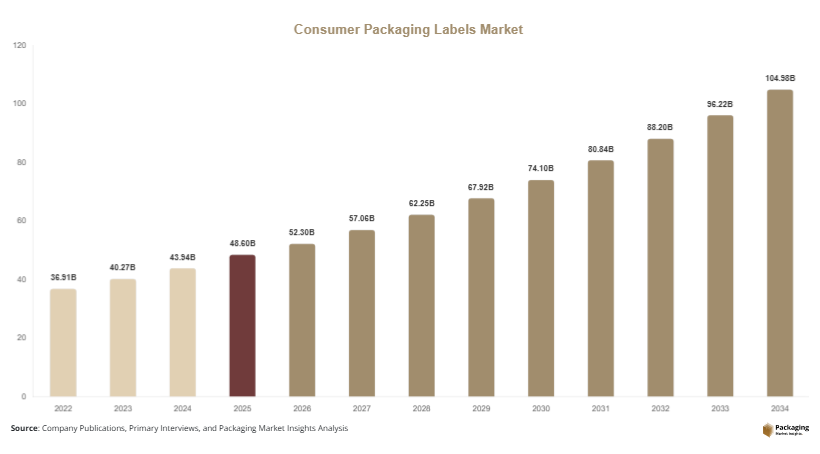
In 2025, the global Consumer Packaging Labels Market size is estimated at USD 48.6 billion, which is expected to reach USD 52.3 billion in 2026. By 2034, the market is projected to reach approximately USD 102.4 billion, growing at a CAGR of 9.1% (2025–2034). The Consumer Packaging Labels Market is expanding steadily due to rising demand for branding, product identification, regulatory compliance, and supply chain traceability across FMCG, food & beverage, pharmaceuticals, personal care, and household products. Labels play a critical role in consumer communication, providing essential product details, safety instructions, and branding visibility.
Growth in the market is primarily driven by increasing consumption of packaged goods, rising regulatory labeling requirements, and growing demand for premium branding strategies. FMCG companies are investing heavily in innovative labeling solutions to differentiate products on retail shelves. Additionally, the pharmaceutical industry is adopting advanced labeling systems to ensure serialization, anti-counterfeiting, and compliance with global regulations. The expansion of e-commerce platforms is also accelerating demand for durable and tamper-resistant labels suitable for logistics and transportation environments.
Key Highlights
- Market size (2025): The Consumer Packaging Labels Market is valued at USD 48.6 Billion in 2025, driven by strong demand from FMCG, pharmaceuticals, and food industries. Growth is supported by increasing product packaging requirements, branding needs, and regulatory compliance across global markets.
- Market size (2026): The market is expected to reach USD 52.3 Billion in 2026, reflecting steady expansion in retail, e-commerce, and packaged consumer goods sectors. Rising adoption of advanced labeling formats is further strengthening market growth.
- Forecast value (2034): By 2034, the market is projected to reach USD 102.4 Billion, supported by growing demand for sustainable packaging, digital labeling technologies, and high-performance labeling solutions across multiple industries.
- CAGR (2025–2034): The market is expected to grow at a CAGR of 9.1% during 2025–2034, driven by strong demand from FMCG, pharmaceuticals, and food industries, along with increasing adoption of digital printing and sustainable labeling solutions.
- Strong demand from FMCG, pharmaceuticals, and food industries: Demand is rising due to increasing consumption of packaged goods, strict labeling regulations, and the need for strong brand differentiation in competitive retail environments across global markets.
- Rising adoption of digital printing and sustainable labeling solutions: Manufacturers are shifting toward eco-friendly materials, recyclable labels, and digital printing technologies that enable customization, reduce waste, and improve production efficiency.
Explore more data points, trends and opportunities Download Free Sample Report
Market Trends
Expansion of Smart and Digital Labeling Technologies
The Consumer Packaging Labels Market is witnessing strong growth in smart labeling technologies, including QR codes, RFID-enabled labels, and augmented reality-based packaging communication. These advanced labeling systems allow brands to provide interactive product information, supply chain traceability, and consumer engagement features. Digital printing technologies are also transforming label production by enabling short-run customization, faster turnaround times, and cost-effective personalization. FMCG and pharmaceutical companies are increasingly adopting smart labeling solutions to enhance transparency and improve inventory tracking. This trend is particularly strong in retail and e-commerce sectors where real-time product information and authentication are critical for consumer trust and regulatory compliance.
Shift Toward Sustainable and Recyclable Label Materials
Sustainability is a major trend shaping the consumer packaging labels industry, driven by regulatory pressure and increasing consumer awareness of environmental issues. Manufacturers are shifting toward recyclable paper labels, biodegradable adhesives, and plastic-free labeling solutions to reduce environmental impact. Global brands are committing to circular economy initiatives, which require sustainable packaging components including labels. Innovations in water-based inks and low-VOC adhesives are further supporting this transition. This trend is particularly prominent in Europe and North America, where strict environmental regulations are encouraging adoption of eco-friendly labeling systems across FMCG and personal care industries.
Market Drivers
Growth in Packaged Goods Consumption and Branding Needs
The rising global consumption of packaged goods is a major driver of the Consumer Packaging Labels Market. Increasing urbanization, changing lifestyles, and growing disposable incomes are fueling demand for packaged food, beverages, and personal care products. Labels play a crucial role in product branding, shelf visibility, and consumer decision-making. Companies are investing heavily in high-quality printed labels to differentiate their products in highly competitive retail environments. Additionally, regulatory requirements for ingredient disclosure, nutritional labeling, and safety information are increasing the need for accurate and durable labeling solutions across industries.
Expansion of E-commerce and Supply Chain Complexity
The rapid expansion of e-commerce platforms is significantly driving demand for consumer packaging labels. Online retail requires detailed product identification, barcoding, tracking, and tamper-evident labeling solutions to ensure supply chain transparency and delivery accuracy. As global logistics networks become more complex, the need for durable labels that withstand temperature variations, handling stress, and long-distance transportation is increasing. The rise of direct-to-consumer (DTC) business models is also pushing brands to adopt customized labeling solutions that enhance customer experience and strengthen brand identity.
Market Restraint
High Cost of Advanced Labeling Materials and Sustainability Transition Challenges
A key restraint in the Consumer Packaging Labels Market is the increasing cost associated with advanced labeling materials and sustainable alternatives. While eco-friendly labels made from biodegradable films, recyclable substrates, and specialty adhesives offer environmental benefits, they are often more expensive than conventional materials. This creates cost pressure for small and mid-sized manufacturers, particularly in price-sensitive markets. Additionally, transitioning from traditional labeling systems to digital and smart labeling technologies requires significant investment in printing infrastructure and equipment upgrades.
For example, FMCG manufacturers in emerging economies often face challenges in adopting RFID or smart label systems due to high implementation costs and limited technical expertise. Furthermore, supply chain disruptions and raw material price volatility also affect production costs and profitability. These challenges slow down large-scale adoption of next-generation labeling solutions, particularly in developing regions where cost efficiency remains a primary purchasing factor.
Market Opportunities
Growth in Smart Packaging and Connected Labeling Systems
The integration of smart packaging technologies presents a major opportunity for the Consumer Packaging Labels Market. Connected labeling systems using QR codes, RFID tags, and NFC-enabled labels are increasingly being adopted across retail, healthcare, and logistics sectors. These technologies enable real-time tracking, authentication, and consumer engagement, improving transparency across supply chains. Brands are leveraging smart labels to provide product origin details, usage instructions, and promotional content through mobile scanning. As digital transformation accelerates across industries, demand for intelligent labeling solutions is expected to grow significantly.
Expansion in Emerging Economies and Retail Modernization
Emerging markets in Asia Pacific, Latin America, and Africa present strong growth opportunities due to rapid urbanization, rising FMCG consumption, and expansion of organized retail sectors. Increasing penetration of supermarkets, hypermarkets, and e-commerce platforms is driving demand for high-quality consumer packaging labels. Local manufacturers are upgrading labeling technologies to meet international standards and improve product competitiveness. Additionally, foreign investment in packaging infrastructure is accelerating adoption of advanced labeling systems, creating significant growth potential for global label manufacturers.
Report Scope
| Report Metric | Details |
|---|---|
| Market Size in 2025 | USD 48.6 Billion |
| Market Size in 2026 | USD 52.3 Billion |
| Market Size in 2034 | USD 102.4 Billion |
| CAGR | 9.1% (2026-2034) |
| Base Year for Estimation | 2025 |
| Historical Data | 2022-2024 |
| Forecast Period | 2026-2034 |
| Report Coverage | Revenue Forecast, Competitive Landscape, Supply Chain Disruption, Growth Factors, Environment & Regulatory Landscape and Trends |
| Geographies Covered | North America, Europe, APAC, Middle East and Africa, LATAM |
| Countries Covered | U.S., Canada, U.K., Germany, France, Spain, Italy, Russia, Nordic, Benelux, Rest of Europe, China, South Korea, Japan, India, Australia, Singapore, Taiwan, South East Asia, Rest of Asia-Pacific, UAE, Turky, Saudi Arabia, South Africa, Egypt, Nigeria, Rest of MEA, Brazil, Mexico, Argentina, Chile, Colombia, Rest of LATAM |
Explore more data points, trends and opportunities Download Free Sample Report
Segmental Analysis
By Label Type
Pressure-sensitive labels held the dominant share of approximately 44% in 2024, driven by their versatility, ease of application, and compatibility with automated labeling systems. These labels are widely used across FMCG, food, beverages, and pharmaceutical industries due to their cost efficiency and ability to adhere to multiple surface types such as plastic, glass, and metal. Their strong demand is also supported by high-speed production lines and increasing need for flexible packaging solutions.
Shrink sleeve labels are expected to grow at a CAGR of 9.8% (2025–2034), driven by increasing demand for 360-degree branding and premium packaging aesthetics. These labels are widely used in beverage, personal care, and household product packaging, where visual appeal plays a key role in consumer purchasing decisions. Their tamper-evident properties and durability under moisture and handling conditions further support adoption.
By Material
Paper-based labels dominated the market with approximately 46% share in 2024, due to their cost-effectiveness, printability, and widespread use in retail packaging. These labels are extensively used in food, beverages, and household products where short lifecycle packaging is common. Their recyclability and compatibility with traditional printing technologies further strengthen market dominance.
Film-based labels are projected to grow at a CAGR of 10.1% (2025–2034), driven by increasing demand for durable, moisture-resistant, and high-performance labeling solutions. These labels are widely used in personal care, pharmaceuticals, and premium FMCG products where shelf life, product protection, and aesthetic appeal are critical factors.
By End-Use Industry
FMCG held the dominant share of approximately 49% in 2024, driven by strong global consumption of packaged food, beverages, and personal care products. Labels play a crucial role in branding, regulatory compliance, and product differentiation in highly competitive retail environments. The segment benefits from high-volume production and continuous product launches.
Pharmaceuticals are expected to grow at a CAGR of 10.3% (2025–2034), driven by strict regulatory requirements, serialization mandates, and increasing focus on anti-counterfeiting measures. Labels in this segment must ensure traceability, safety, and compliance with global healthcare standards, driving demand for advanced labeling technologies.
Consumer Packaging Labels Market Segmentations
By Label Type
- Pressure-Sensitive Labels
- Shrink Sleeve Labels
- In-Mold Labels
By Material
- Paper-Based Labels
- Film-Based Labels
- Foil Labels
By End-Use Industry
- FMCG
- Pharmaceuticals
- Food & Beverage
- Personal Care
- Industrial
Regional Analysis
North America
North America accounted for approximately 28% share of the Consumer Packaging Labels Market in 2025, with a projected CAGR of 8.8% (2025–2034). The region is driven by strong FMCG demand, advanced printing technologies, and high adoption of smart labeling systems. The presence of major retail chains, pharmaceutical companies, and e-commerce platforms further strengthens demand for high-performance labeling solutions. Increasing focus on brand differentiation and regulatory compliance is also supporting market expansion.
The United States dominates the regional market due to its large consumer goods industry and highly developed retail ecosystem. A key growth factor is the rapid expansion of e-commerce and direct-to-consumer (DTC) brands, which require durable, trackable, and visually appealing packaging labels for logistics, branding, and customer engagement.
Europe
Europe held around 24% share in 2025, with a projected CAGR of 9.0% (2025–2034). The market is strongly influenced by sustainability regulations, circular economy initiatives, and strict packaging waste directives. Demand for recyclable, biodegradable, and low-impact labeling materials is increasing across FMCG, pharmaceutical, and personal care industries. The region also benefits from advanced packaging innovation and strong consumer preference for eco-friendly packaging.
Germany leads the European market due to its strong packaging machinery and chemical manufacturing base. A key growth factor is the implementation of EU environmental policies such as the Green Deal, which is accelerating the shift toward sustainable and recyclable labeling solutions across industries.
Asia Pacific
Asia Pacific dominated the market with approximately 32% share in 2025, and is expected to grow at the fastest CAGR of 10.2% (2025–2034). Growth is driven by rapid urbanization, expanding middle-class population, and rising consumption of packaged goods. The region also benefits from large-scale manufacturing capabilities and cost-efficient production of labeling materials.
China leads the regional market due to its massive FMCG manufacturing base and strong export-oriented packaging industry. A key growth factor is the rapid expansion of e-commerce and organized retail, which is increasing demand for high-volume, durable, and cost-effective labeling solutions.
Middle East & Africa
The Middle East & Africa accounted for approximately 7% share in 2025, with a projected CAGR of 8.5% (2025–2034). Market growth is supported by increasing retail modernization, rising packaged food consumption, and expansion of pharmaceutical distribution networks. Demand for imported FMCG products also contributes to labeling requirements in the region.
Saudi Arabia dominates the regional market due to ongoing economic diversification initiatives under Vision programs. A key growth factor is the expansion of modern retail infrastructure and logistics networks, which is increasing demand for standardized and durable packaging labels.
Latin America
Latin America held around 9% share in 2025, with a projected CAGR of 8.7% (2025–2034). Growth is supported by increasing FMCG consumption, expanding retail chains, and rising demand for packaged food and beverages. The region is also witnessing gradual modernization of packaging and labeling technologies.
Brazil leads the regional market due to its strong food processing and beverage industries. A key growth factor is the increasing adoption of packaged consumer goods in urban areas, driven by changing lifestyles and expanding supermarket penetration.
Competitive Landscape
The Consumer Packaging Labels Market is highly competitive, with key players focusing on innovation, sustainability, and digital transformation. Major companies include Avery Dennison Corporation, CCL Industries Inc., 3M Company, Huhtamaki Oyj, and Berry Global Inc. These companies invest heavily in smart labeling, sustainable materials, and advanced printing technologies.
Avery Dennison Corporation is a leading player, supported by its global production network and strong R&D capabilities. Recent developments include expansion of RFID-enabled label production and increased investment in recyclable labeling solutions for FMCG and healthcare applications.
Key Players List
- Avery Dennison Corporation
- CCL Industries Inc.
- 3M Company
- Huhtamaki Oyj
- Berry Global Inc.
- UPM Raflatac
- SATO Holdings Corporation
- Coveris Holdings
- Multi-Color Corporation
- Autajon Group
- Constantia Flexibles
- Fuji Seal International
- MCC Label
- Lintec Corporation
- Mondi Group