Connected Packaging Market Report Size and Growth
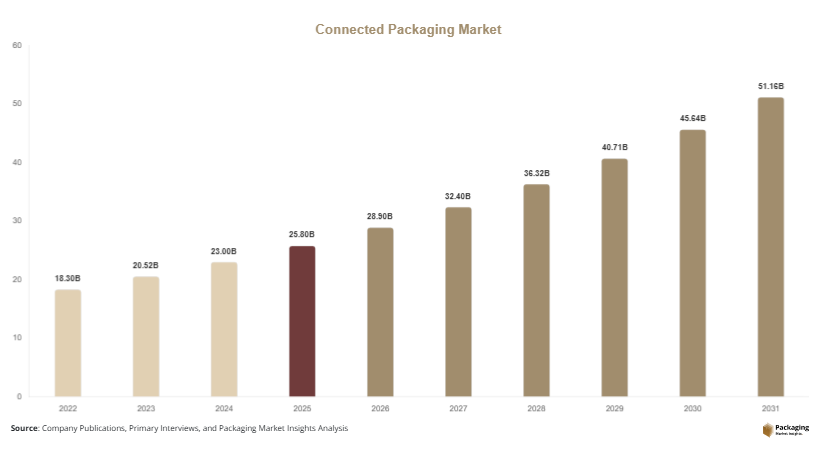
The Connected Packaging Market was valued at USD 25.8 billion in 2025 and is projected to reach USD 49.7 billion by 2030, expanding at a compound annual growth rate (CAGR) of 12.1% from 2025 to 2031. Connected packaging refers to packaging solutions embedded with digital technologies such as QR codes, RFID, NFC tags, and smart labels that enable interaction between products, brands, and consumers through digital platforms. The integration of these technologies transforms traditional packaging into a communication channel capable of delivering product authentication, traceability, marketing engagement, and supply chain visibility.
One major global factor supporting the growth of the connected packaging market is the increasing digitalisation of consumer engagement. Brands across industries such as food & beverage, pharmaceuticals, personal care, and consumer electronics are deploying connected packaging to create direct communication channels with consumers through smartphones. The ability to scan packaging and access product information, promotions, sustainability credentials, and loyalty programs has strengthened brand-consumer relationships while generating valuable data analytics for companies.
Connected packaging solutions are also gaining traction as governments and regulatory bodies encourage improved traceability, anti-counterfeiting measures, and transparency in product supply chains. As supply networks become more complex, connected packaging technologies help companies maintain product authenticity and ensure compliance with global safety standards.
Key Highlights
- North America dominated the market with approximately 36% share in 2025, while Asia Pacific is projected to grow at the fastest CAGR of 14.6% through 2031.
- QR code-enabled packaging held the leading share of 41% among technology types, while NFC-enabled packaging is projected to expand at the fastest CAGR of 15.8%.
- Food & beverage applications represented the largest segment with a 38% market share, whereas pharmaceutical applications are forecast to grow at a CAGR of 14.2%.
- The United States led the market with USD 7.2 billion in 2025 and is estimated to reach USD 7.9 billion in 2026.
Explore more data points, trends and opportunities Download Free Sample Report
Market Trends
Growth of Interactive Consumer Engagement
Connected packaging is increasingly used as a digital engagement platform between brands and consumers. Companies are embedding QR codes and NFC chips into packaging to provide product information, immersive brand stories, loyalty programs, and augmented reality experiences. When scanned through smartphones, these packaging elements allow consumers to interact directly with brands without requiring additional applications.
This trend has gained momentum across the food & beverage and personal care sectors where brands aim to create personalised consumer experiences. Connected packaging also enables brands to collect behavioural insights such as scanning frequency, consumer demographics, and purchasing patterns. These insights support targeted marketing campaigns and product innovation strategies.
Increasing Adoption for Product Authentication
Another significant trend shaping the connected packaging market is the growing adoption of smart packaging technologies for product authentication and anti-counterfeiting solutions. Industries such as pharmaceuticals, cosmetics, and luxury goods face persistent challenges related to counterfeit products.
Connected packaging technologies such as RFID and NFC allow consumers and supply chain partners to verify product authenticity through digital verification systems. These technologies also provide traceability across logistics networks. As regulatory authorities introduce stricter product verification standards, manufacturers are increasingly integrating connected packaging solutions into their packaging designs to maintain supply chain transparency and consumer trust.
Market Drivers
Expansion of Digital Marketing Strategies
The expansion of digital marketing initiatives has emerged as a key driver of the connected packaging market. Brands are increasingly viewing packaging as a digital touchpoint that extends beyond traditional product protection and identification.
Connected packaging technologies enable brands to deliver personalised digital content through packaging scans, including promotional offers, product tutorials, and sustainability disclosures. This approach helps companies enhance customer engagement while also gathering real-time consumer interaction data.
The ability to integrate packaging with omnichannel marketing strategies has encouraged companies in sectors such as beverages, personal care, and consumer goods to adopt connected packaging solutions as part of their broader digital transformation strategies.
Increasing Supply Chain Transparency Requirements
The demand for improved supply chain transparency is another factor supporting the growth of the connected packaging market. Manufacturers and retailers are seeking solutions that enable real-time product tracking and monitoring across complex logistics networks.
Connected packaging technologies such as RFID tags and smart labels allow companies to track product movement from production facilities to retail shelves. This capability improves inventory management, reduces product loss, and enhances recall management processes.
As global trade expands and supply chains become more interconnected, companies are adopting connected packaging technologies to maintain operational visibility and ensure product integrity throughout distribution channels.
Market Restraint
High Implementation and Integration Costs
Despite the growing adoption of connected packaging solutions, the high implementation and integration costs associated with these technologies remain a significant restraint for the market.
Connected packaging often requires the integration of digital technologies such as RFID chips, NFC tags, sensors, and cloud-based software platforms. These components increase the overall packaging production cost compared with traditional packaging formats.
Additionally, companies must invest in infrastructure such as scanning systems, data management platforms, and supply chain integration tools to effectively utilise connected packaging technologies. For small and medium-sized manufacturers, these investments can represent a substantial financial burden.
Another challenge lies in integrating connected packaging systems with existing enterprise resource planning (ERP) and supply chain management platforms. The need for interoperability between hardware, software, and digital marketing platforms can increase operational complexity.
Due to these cost and integration challenges, some companies—particularly in price-sensitive industries—may delay the adoption of connected packaging technologies until implementation costs decline or scalable solutions become more widely available.
Market Opportunities
Growth of Smart Retail and Digital Commerce
The expansion of smart retail environments presents significant opportunities for the connected packaging market. Retailers are increasingly integrating digital technologies such as smart shelves, automated checkout systems, and digital inventory management solutions.
Connected packaging can complement these retail innovations by enabling automated product identification and real-time inventory tracking. QR codes, RFID tags, and NFC chips allow retailers to monitor product movement and consumer interactions more effectively.
As retailers continue to adopt digital store technologies, the demand for connected packaging solutions that support seamless integration with retail infrastructure is expected to increase.
Rising Demand for Sustainable Transparency
Consumers are increasingly seeking transparency regarding the environmental impact of the products they purchase. Connected packaging technologies offer an opportunity for brands to provide digital access to sustainability data without increasing packaging material usage.
Through connected packaging, consumers can access information about product sourcing, recycling instructions, carbon footprints, and sustainability certifications. This capability enables brands to communicate sustainability initiatives directly to consumers while reducing the need for printed information.
As sustainability becomes a key purchasing factor for consumers globally, companies that integrate connected packaging solutions to communicate environmental credentials may gain competitive advantages in the market
Report Scope
| Report Metric | Details |
|---|---|
| Market Size in 2025 | USD 25.8 Billion |
| Market Size in 2026 | USD 28.9 Billion |
| Market Size in 2031 | USD Billion |
| CAGR | 12.1% (2026-2031) |
| Base Year for Estimation | 2025 |
| Historical Data | 2022-2024 |
| Forecast Period | 2026-2031 |
| Report Coverage | Revenue Forecast, Competitive Landscape, Supply Chain Disruption, Growth Factors, Environment & Regulatory Landscape and Trends |
| Geographies Covered | North America, Europe, APAC, Middle East and Africa, LATAM |
| Countries Covered | U.S., Canada, U.K., Germany, France, Spain, Italy, Russia, Nordic, Benelux, Rest of Europe, China, South Korea, Japan, India, Australia, Singapore, Taiwan, South East Asia, Rest of Asia-Pacific, UAE, Turky, Saudi Arabia, South Africa, Egypt, Nigeria, Rest of MEA, Brazil, Mexico, Argentina, Chile, Colombia, Rest of LATAM |
Explore more data points, trends and opportunities Download Free Sample Report
Segmental Analysis
By Technology
QR code-enabled packaging represented the dominant technology segment with approximately 41% market share in 2024. The widespread adoption of smartphones and the simplicity of QR code integration into packaging designs supported this segment’s growth. QR codes allow consumers to access digital content, product information, and promotional campaigns through quick scanning processes.
NFC-enabled packaging is projected to be the fastest-growing technology segment with a forecast CAGR of 15.8% through 2031. NFC technology enables secure and seamless interaction between packaging and smartphones without requiring camera scanning. This capability will support adoption in premium product categories such as cosmetics, luxury goods, and high-value pharmaceuticals where authentication and consumer engagement are essential.
By Packaging Type
Labels and tags accounted for the largest share of the connected packaging market in 2024 at approximately 45%. Smart labels containing QR codes or RFID tags are widely used due to their compatibility with existing packaging formats. Manufacturers have adopted smart labels as a cost-effective method for integrating connected technologies into packaging systems.
Smart caps and closures are expected to represent the fastest-growing packaging type with a CAGR of 14.7% during the forecast period. These packaging components can include embedded sensors or NFC chips that provide product usage data and authentication features. The growing demand for connected packaging solutions in beverage and pharmaceutical industries will support the expansion of this segment.
By Application
Food & beverage applications represented the largest segment with approximately 38% share in 2024. Companies in this sector adopted connected packaging to deliver product information, recipe content, promotional campaigns, and supply chain transparency to consumers. The ability to engage consumers directly through packaging scans has encouraged brands to integrate digital elements into product packaging.
The pharmaceutical segment will represent the fastest-growing application with a projected CAGR of 14.2% through 2031. Pharmaceutical manufacturers will increasingly adopt connected packaging technologies to enable product authentication, medication tracking, and patient engagement solutions. Connected packaging can also support digital health initiatives by providing patients with dosage instructions and treatment reminders through smartphone interactions.
Connected Packaging Market Segmentations
By Technology
- QR Codes
- RFID
- NFC
- Sensors
By Packaging Type
- Labels & Tags
- Boxes & Cartons
- Bottles & Containers
- Caps & Closures
By Application
- Food & Beverage
- Pharmaceuticals
- Personal Care & Cosmetics
- Consumer Electronics
- Others
Regional Analysis
North America
North America accounted for approximately 36% of the global connected packaging market share in 2025. The region benefited from strong adoption of digital technologies across the consumer goods, pharmaceutical, and retail industries. The market in North America will expand at a projected CAGR of 11.8% between 2025 and 2033, supported by increasing investments in smart supply chain infrastructure and advanced packaging solutions.
The United States represented the dominant country within the North American market. The presence of large consumer brands, technology providers, and packaging manufacturers has supported the adoption of connected packaging technologies. U.S. companies have increasingly integrated QR codes and NFC-enabled packaging into marketing campaigns and supply chain tracking systems. Additionally, the pharmaceutical sector in the United States has adopted connected packaging technologies to support drug authentication and compliance with traceability requirements.
Europe
Europe held around 27% of the connected packaging market share in 2025. The region has demonstrated consistent adoption of smart packaging solutions due to regulatory emphasis on product transparency and traceability. The connected packaging market in Europe is expected to grow at a CAGR of 11.3% through 2033.
Germany represented the leading country within the European market. The country’s strong manufacturing sector and advanced packaging industry have contributed to the adoption of connected packaging technologies. German manufacturers have increasingly integrated RFID and digital label technologies to enhance supply chain efficiency and product tracking capabilities. Additionally, the growing emphasis on sustainable packaging practices in Europe has encouraged companies to use connected packaging solutions that provide digital product information while reducing printed material usage.
Asia Pacific
Asia Pacific accounted for approximately 22% of the global connected packaging market share in 2025. Rapid digital adoption, expanding consumer markets, and growing e-commerce activities have supported the adoption of connected packaging technologies in the region. The Asia Pacific market is projected to grow at the fastest CAGR of 14.6% through 2033.
China emerged as the dominant country within the region. The expansion of the Chinese e-commerce ecosystem and the increasing use of QR code technologies in digital payments have supported the adoption of connected packaging solutions. Chinese consumer brands have increasingly used QR code packaging to deliver promotional content and product authentication features. Additionally, logistics companies in China have integrated RFID-enabled packaging solutions to enhance supply chain tracking and inventory management.
Middle East & Africa
The Middle East & Africa accounted for around 8% of the connected packaging market share in 2025. The adoption of connected packaging technologies in the region has been supported by the development of digital retail infrastructure and growing demand for product traceability in sectors such as pharmaceuticals and food products. The regional market is expected to expand at a CAGR of 10.5% through 2033.
The United Arab Emirates represented the leading country in the region. The country’s advanced retail sector and strong focus on digital transformation have supported the adoption of connected packaging technologies. Retailers in the UAE have increasingly implemented QR code-enabled packaging to deliver product information and promotional campaigns through mobile platforms.
Latin America
Latin America represented approximately 7% of the global connected packaging market share in 2025. The region has experienced growing adoption of digital packaging technologies in the food & beverage and retail sectors. The connected packaging market in Latin America will grow at a projected CAGR of 10.9% through 2033.
Brazil emerged as the dominant country within the region. Brazilian consumer brands have increasingly adopted QR code-enabled packaging to engage consumers through digital marketing campaigns. The expansion of smartphone penetration and digital payment platforms in Brazil has further supported the adoption of connected packaging technologies across retail and consumer goods industries.
Competitive Landscape
The connected packaging market is characterised by the presence of global packaging manufacturers, technology providers, and digital solution companies. Market participants are focusing on technology integration, strategic partnerships, and product innovation to expand their capabilities in connected packaging solutions.
Amcor plc represents one of the leading companies in the market due to its global packaging expertise and investments in digital packaging technologies. The company has recently expanded its smart packaging portfolio through collaborations with digital platform providers to integrate QR and NFC solutions into consumer product packaging.
Other major companies such as Avery Dennison Corporation, Smurfit Kappa Group, Huhtamaki Oyj, and Tetra Pak International S.A. are also actively developing connected packaging solutions. These companies are focusing on integrating digital identification technologies and data analytics platforms to enhance product traceability and consumer engagement.
Strategic partnerships between packaging manufacturers and technology firms are expected to shape future developments within the connected packaging market.
Key Players in the Connected Packaging Market
- Amcor plc
- Avery Dennison Corporation
- Smurfit Kappa Group
- Huhtamaki Oyj
- Tetra Pak International S.A.
- Thin Film Electronics ASA
- Identiv Inc.
- SATO Holdings Corporation
- Checkpoint Systems Inc.
- Zebra Technologies Corporation
- PragmatIC Semiconductor Ltd.
- Stora Enso Oyj
- Multi-Colour Corporation
- Digimarc Corporation
- Alien Technology LLC