Compounding Pharmacy Packaging Market Size and Growth
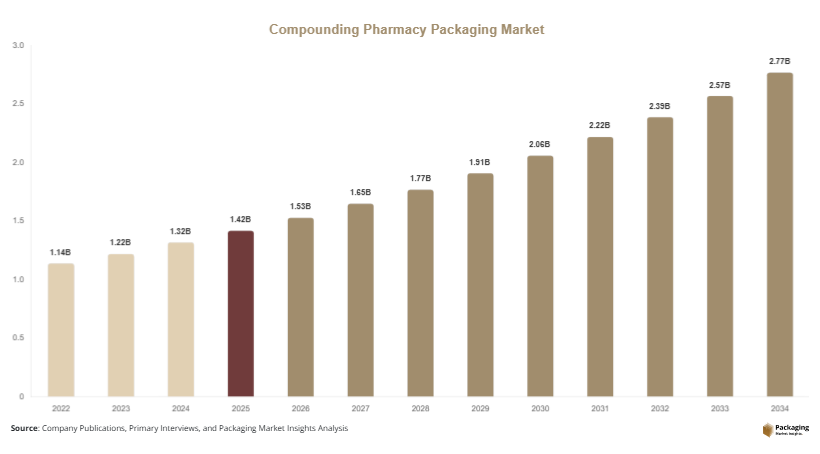
The global compounding pharmacy packaging market size was estimated at USD 1.42 billion in 2025 and is expected to reach USD 1.53 billion in 2026. Over the forecast period, the market is projected to expand steadily, reaching approximately USD 2.78 billion by 2034, registering a compound annual growth rate (CAGR) of 7.7% from 2025 to 2034. The growth trajectory reflects rising demand for customized pharmaceuticals, increasing regulatory oversight for sterile packaging, and broader adoption of specialized containers across compounding pharmacies.
The compounding pharmacy packaging market is gaining steady attention as personalized medicine becomes more common across healthcare systems. Compounding pharmacies prepare customized medications for patients who require specific dosage forms, ingredient exclusions, or alternative delivery methods. As these pharmacies expand their operations, the demand for reliable, sterile, and compliant packaging solutions continues to grow. Packaging plays a critical role in protecting compounded medications from contamination, maintaining stability, and ensuring accurate labeling and traceability.
Key Highlights
- Market size estimated at USD 1.42 billion in 2025
- Expected to reach USD 2.78 billion by 2034
- Forecast CAGR of 7.7% (2025–2034)
- Growth supported by personalized medicine adoption
- Increasing regulatory focus on sterile pharmaceutical packaging
- Expansion of hospital and specialty compounding pharmacies
Explore more data points, trends and opportunities Download Free Sample Report
Market Trends
Rising Adoption of Sterile and Tamper-Evident Packaging
Sterile packaging solutions are becoming increasingly important in the compounding pharmacy environment. Compounded medications often include injectable solutions, ophthalmic preparations, and sterile creams that must remain free from microbial contamination throughout their shelf life. As a result, pharmacies are adopting packaging systems such as sterile vials, prefilled syringes, and sealed blister packs that help maintain product integrity.
Tamper-evident packaging has also become a standard requirement in many healthcare systems. Regulatory authorities encourage pharmacies to use packaging formats that clearly indicate whether a product has been opened or altered. This trend improves patient safety while reducing risks associated with medication misuse. As compounding pharmacies scale production and distribute medications across wider geographic areas, secure packaging solutions will continue to gain relevance.
Integration of Smart Labeling and Traceability Systems
Another emerging trend in the compounding pharmacy packaging market is the integration of digital labeling and traceability technologies. Pharmacies are adopting packaging formats that incorporate barcodes, QR codes, and serialized labels. These systems improve medication tracking from preparation to dispensing and help healthcare providers maintain accurate records of compounded formulations.
Smart labeling solutions also support regulatory compliance by providing detailed product information, including ingredient composition, expiration date, storage instructions, and patient identification. Digital tracking systems enable pharmacies to reduce dispensing errors and improve recall management if safety concerns arise. As healthcare systems adopt more digital workflows, packaging formats that integrate data capture and traceability features are expected to experience increased demand.
Market Drivers
Increasing Demand for Personalized Medicine
Personalized medicine is a major driver of the compounding pharmacy packaging market. Traditional pharmaceutical manufacturing produces medications in standardized doses and formulations, which may not always meet the needs of individual patients. Compounding pharmacies address this gap by creating customized medications based on physician prescriptions.
Patients with allergies to certain ingredients, children requiring smaller doses, and individuals needing alternative dosage forms often rely on compounded medications. As personalized treatment becomes more common in therapeutic areas such as hormone therapy, dermatology, and pain management, the demand for specialized packaging solutions grows accordingly. Packaging formats must accommodate different drug forms, including liquids, capsules, creams, and sterile injectables, which encourages continuous innovation in pharmacy packaging technologies.
Expansion of Compounding Pharmacy Services in Healthcare Systems
Another significant driver is the expansion of compounding pharmacy services within hospitals and specialty clinics. Many healthcare providers are investing in in-house compounding facilities to improve patient care and reduce dependence on external pharmaceutical suppliers. This expansion creates new demand for pharmaceutical-grade packaging materials that ensure sterility, durability, and regulatory compliance.
Hospital pharmacies, in particular, require packaging solutions that support high-volume preparation of compounded medications while maintaining strict quality standards. Packaging formats such as sterile bags, infusion containers, and unit-dose packaging help healthcare providers manage medication administration more efficiently. As hospital networks expand compounding services, the need for reliable packaging solutions continues to grow.
Market Restraint
Strict Regulatory Compliance and High Packaging Validation Costs
Despite positive growth prospects, the compounding pharmacy packaging market faces challenges related to regulatory compliance and validation requirements. Pharmaceutical packaging used in compounding environments must meet stringent standards for sterility, material safety, and labeling accuracy. Regulatory agencies often require pharmacies and packaging manufacturers to conduct extensive validation procedures to ensure packaging materials do not interact with compounded formulations.
These compliance requirements can increase operational costs for compounding pharmacies and packaging suppliers. Small or independent pharmacies may find it difficult to invest in advanced packaging systems or validation processes. In some cases, pharmacies must switch packaging materials when regulations change, which can disrupt supply chains and increase expenses.
For example, new guidelines related to sterile compounding practices in several countries require pharmacies to use certified packaging materials that support controlled storage and tamper-evident features. Implementing these requirements often involves upgrading packaging equipment and sourcing specialized containers. These cost and compliance challenges may slow adoption among smaller compounding facilities and limit market expansion in certain regions.
Market Opportunities
Growth of Biologic and Specialty Drug Compounding
The increasing use of biologics and specialty medications is creating new opportunities in the compounding pharmacy packaging market. Biologic drugs often require careful handling, temperature control, and sterile storage conditions. Compounding pharmacies that prepare biologic formulations must use advanced packaging systems capable of maintaining product stability and preventing contamination.
Packaging manufacturers can address this demand by developing specialized containers, barrier materials, and protective closures designed for sensitive drug formulations. These innovations support the safe handling of biologic compounds and allow pharmacies to expand into new therapeutic areas. As biologic therapies continue to grow across global healthcare markets, the need for compatible compounding packaging solutions is expected to increase.
Expansion of Compounding Pharmacies in Emerging Markets
Emerging economies are witnessing rapid growth in pharmaceutical infrastructure, including compounding pharmacy services. Countries in Asia Pacific, Latin America, and the Middle East are investing in healthcare systems that support customized treatment options. This expansion is creating strong opportunities for packaging manufacturers to supply sterile containers, labeling solutions, and specialized pharmacy packaging materials.
As healthcare providers in these regions adopt modern pharmaceutical practices, the demand for reliable packaging solutions continues to rise. Local manufacturing initiatives and partnerships with international packaging companies are also strengthening supply chains. These developments position emerging markets as important growth areas for the compounding pharmacy packaging industry over the forecast period.
Report Scope
| Report Metric | Details |
|---|---|
| Market Size in 2025 | USD 1.42 Billion |
| Market Size in 2026 | USD 1.53 Billion |
| Market Size in 2034 | USD 2.78 Billion |
| CAGR | 7.7% (2026-2034) |
| Base Year for Estimation | 2025 |
| Historical Data | 2022-2024 |
| Forecast Period | 2026-2034 |
| Report Coverage | Revenue Forecast, Competitive Landscape, Supply Chain Disruption, Growth Factors, Environment & Regulatory Landscape and Trends |
| Geographies Covered | North America, Europe, APAC, Middle East and Africa, LATAM |
| Countries Covered | U.S., Canada, U.K., Germany, France, Spain, Italy, Russia, Nordic, Benelux, Rest of Europe, China, South Korea, Japan, India, Australia, Singapore, Taiwan, South East Asia, Rest of Asia-Pacific, UAE, Turky, Saudi Arabia, South Africa, Egypt, Nigeria, Rest of MEA, Brazil, Mexico, Argentina, Chile, Colombia, Rest of LATAM |
Explore more data points, trends and opportunities Download Free Sample Report
Segmental Analysis
By Packaging Type
The containers segment dominated the compounding pharmacy packaging market in 2024, accounting for approximately 42% of the total market share. Containers include bottles, jars, vials, and syringes used to store and dispense compounded medications in various dosage forms. These packaging solutions are widely used due to their ability to maintain sterility, protect medication from contamination, and support accurate labeling. Compounding pharmacies frequently rely on plastic and glass containers that meet pharmaceutical safety standards. In addition, containers are compatible with a wide range of formulations including liquids, capsules, and topical creams. The growing demand for customized medications across dermatology, pain management, and hormone therapy continues to drive the adoption of specialized containers designed for pharmacy compounding applications.
The blister packaging segment is expected to be the fastest-growing packaging type, registering a CAGR of around 8.4% during the forecast period. Blister packs are gaining popularity because they provide unit-dose packaging that improves medication safety and dosing accuracy. Compounding pharmacies increasingly use blister packaging for customized capsule and tablet formulations prepared for specific patients. The design also enhances protection against moisture and contamination while improving shelf life. Another growth factor is the rising demand for convenient medication packaging among elderly patients who require organized dosage schedules. As pharmacies adopt patient-centric packaging formats, blister packaging solutions are expected to experience increased demand.
By Material Type
The plastic packaging segment held the largest share of the market in 2024, representing approximately 48% of global revenue. Plastic materials such as polyethylene, polypropylene, and PET are widely used in compounding pharmacy packaging due to their durability, flexibility, and cost efficiency. These materials are suitable for producing bottles, jars, droppers, and syringes used in compounded medication preparation. Plastic packaging also offers advantages such as lightweight construction, resistance to breakage, and compatibility with sterilization processes. These characteristics make plastic materials a preferred choice for pharmacies handling a variety of medication formulations. The growing availability of high-barrier plastic materials that improve protection against oxygen and moisture further supports segment growth.
The glass packaging segment is projected to grow at a CAGR of approximately 8.1% during the forecast period. Glass containers are widely used for sterile compounded medications such as injectable drugs and ophthalmic solutions. One of the key factors driving segment growth is the chemical stability of glass, which prevents interaction between packaging materials and drug formulations. Glass also provides strong barrier properties that protect medications from contamination and environmental exposure. With the increasing demand for sterile compounded medications in hospitals and specialty clinics, the adoption of glass packaging solutions is expected to expand steadily.
By End-Use
The hospital pharmacies segment accounted for the largest share of the compounding pharmacy packaging market in 2024, capturing nearly 45% of the market. Hospital pharmacies perform a wide range of compounding activities, including sterile injections, intravenous solutions, and customized oral medications for inpatients. These facilities require packaging solutions that support strict safety and quality standards while accommodating high-volume medication preparation. Containers, infusion bags, and tamper-evident packaging formats are commonly used in hospital compounding environments. The growing number of hospitals establishing in-house compounding units is contributing to the strong demand for pharmaceutical-grade packaging materials designed specifically for healthcare institutions.
The independent compounding pharmacies segment is expected to register the fastest growth, with a CAGR of around 8.6% through 2034. Independent pharmacies often specialize in personalized medication formulations for dermatology, hormone therapy, and pediatric care. These pharmacies focus on patient-specific prescriptions that require customized packaging formats and labeling systems. One of the key growth factors is the increasing demand for personalized healthcare solutions among patients who require alternative drug formulations. As independent compounding pharmacies expand their services, the need for reliable packaging solutions tailored to small-batch production is expected to grow significantly.
Compounding Pharmacy Packaging Market Segmentations
Packaging Type
- Containers
- Blister Packaging
- Bags & Pouches
- Closures & Caps
Material Type
- Plastic
- Glass
- Aluminum
- Composite Materials
End-Use
- Hospital Pharmacies
- Independent Compounding Pharmacies
- Specialty Clinics
Regional Analysis
North America
North America held the largest share of the compounding pharmacy packaging market in 2025, accounting for approximately 38% of global revenue. The region is projected to grow at a CAGR of around 7.2% during the forecast period. Strong healthcare infrastructure, widespread use of personalized medicine, and advanced regulatory frameworks contribute to regional market expansion. The presence of large pharmaceutical packaging manufacturers also supports the availability of high-quality packaging solutions.
The United States dominates the regional market due to its extensive network of hospital and specialty compounding pharmacies. A key growth factor in the country is the increasing demand for hormone replacement therapy and dermatology formulations that require customized medication preparation. This trend drives the need for specialized packaging formats such as sterile jars, oral liquid bottles, and tamper-evident containers designed for patient-specific prescriptions.
Europe
Europe represented nearly 27% of the global market share in 2025 and is projected to expand at a CAGR of approximately 6.8% through 2034. The region benefits from strong pharmaceutical manufacturing capabilities and well-established regulatory standards for medication safety. Increasing awareness of personalized treatments and rising demand for customized drug formulations are supporting the growth of compounding pharmacies across the region.
Germany is one of the leading markets within Europe. A unique growth factor in the country is the strong collaboration between hospital pharmacies and research institutions. These partnerships support the development of specialized compounded therapies for oncology and rare diseases. As these treatments expand, the need for compliant packaging materials that preserve drug stability and maintain sterility continues to grow.
Asia Pacific
Asia Pacific accounted for roughly 21% of the global compounding pharmacy packaging market share in 2025 and is forecast to grow at the fastest rate, with a CAGR of around 8.9%. Rapid improvements in healthcare infrastructure and growing pharmaceutical manufacturing capacity are driving market expansion across the region. Increasing patient awareness of customized therapies is also encouraging the adoption of compounding pharmacy services.
China is emerging as a major contributor to regional market growth. The country’s pharmaceutical sector is expanding rapidly, supported by government initiatives aimed at strengthening healthcare accessibility. A key growth factor is the increasing investment in hospital pharmacy infrastructure, which includes sterile compounding units. These developments are boosting demand for high-quality packaging materials such as vials, blister packs, and infusion containers.
Middle East & Africa
The Middle East & Africa region held approximately 7% of the global market share in 2025 and is expected to grow at a CAGR of about 6.5% during the forecast period. Growth in the region is supported by improving healthcare systems and increasing government investments in pharmaceutical infrastructure. Hospitals are gradually expanding their compounding capabilities to support personalized medication therapies.
Saudi Arabia is a leading market within the region. A unique growth factor is the government’s focus on strengthening pharmaceutical manufacturing and healthcare services under national development initiatives. Hospitals and specialty clinics are investing in sterile compounding facilities, which is driving the demand for advanced packaging solutions capable of maintaining medication safety and stability.
Latin America
Latin America accounted for roughly 7% of the global compounding pharmacy packaging market share in 2025 and is expected to expand at a CAGR of around 7.1% through 2034. The region is experiencing gradual improvements in healthcare accessibility and pharmaceutical supply chains. Growing awareness of personalized treatment options is also encouraging the establishment of compounding pharmacies.
Brazil leads the regional market due to its large healthcare system and expanding pharmaceutical sector. A key growth factor in the country is the rising demand for customized dermatology and hormone therapy medications. These therapies require specialized packaging formats that preserve product stability and provide clear labeling for patient safety, supporting market growth.
Competitive Landscape
The compounding pharmacy packaging market is moderately fragmented, with several global and regional packaging manufacturers competing to supply specialized pharmaceutical packaging solutions. Companies focus on product innovation, regulatory compliance, and strategic partnerships with pharmaceutical distributors and healthcare providers. Packaging suppliers are investing in sterile container technologies, advanced closure systems, and tamper-evident packaging to meet the needs of compounding pharmacies.
One of the leading companies in the market is Berry Global, which provides a wide portfolio of pharmaceutical containers, closures, and specialty packaging solutions. The company has strengthened its position through investments in sustainable packaging materials and improved barrier technologies designed for sensitive pharmaceutical formulations.
Other companies are focusing on expanding manufacturing capacity and developing packaging solutions compatible with automated pharmacy dispensing systems. Collaboration with healthcare institutions and pharmaceutical distributors is also becoming a common strategy among industry participants. These initiatives help packaging suppliers improve product availability and strengthen their presence in the growing compounding pharmacy sector.
Key Players List
- Berry Global Inc.
- Gerresheimer AG
- West Pharmaceutical Services Inc.
- Amcor plc
- AptarGroup Inc.
- Bormioli Pharma
- Schott AG
- SGD Pharma
- Comar LLC
- DWK Life Sciences
- Alpha Packaging
- Drug Plastics Group
- Origin Pharma Packaging
- O.Berk Company
- Silgan Holdings Inc.