Compostable Tableware Market Size and Growth
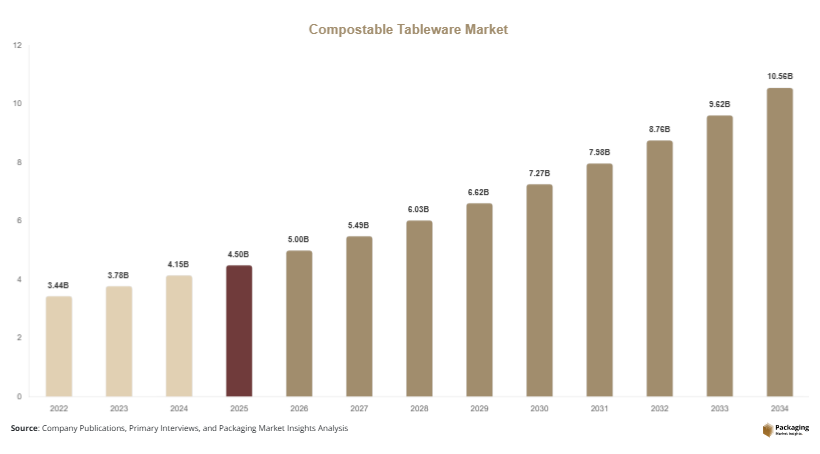
The compostable tableware market is gaining steady momentum as businesses and consumers transition toward environmentally responsible alternatives to traditional plastic tableware. The market size was valued at approximately USD 4.5 billion in 2025 and is expected to reach USD 5.0 billion in 2026. Driven by regulatory initiatives and increasing sustainability awareness, the market is projected to reach USD 11.6 billion by 2034, registering a CAGR of 9.8% during 2025–2034. This growth reflects a structural shift in the global food service and hospitality sectors toward compostable and biodegradable materials.
Compostable tableware includes disposable products such as plates, bowls, cups, trays, and cutlery made from materials like bagasse, bamboo fiber, paper pulp, and bioplastics. These products are designed to decompose under composting conditions, reducing environmental impact compared to conventional plastic alternatives. The growing concern regarding plastic waste and landfill accumulation is a major factor supporting market expansion.
Key Highlights:
- The Compostable Tableware Market is projected to reach USD 11.6 billion by 2034, growing at a CAGR of 9.8% during 2025–2034.
- Growth is driven by strong demand from food service and hospitality sectors along with increasing regulatory restrictions on plastic usage.
- Additionally, rising consumer preference for eco-friendly products is further accelerating market adoption.
Explore more data points, trends and opportunities Download Free Sample Report
Market Trends
Rising Adoption of Plant-Based Materials
The compostable tableware market is witnessing a strong trend toward the adoption of plant-based materials such as bagasse, bamboo, and palm leaves. These materials are renewable, biodegradable, and suitable for composting, making them ideal alternatives to plastic. Manufacturers are focusing on improving the strength and durability of plant-based products to meet functional requirements. The trend is particularly prominent in the food service industry, where sustainability is becoming a key purchasing criterion. As innovation in material processing continues, plant-based tableware is expected to gain wider acceptance across various applications.
Increasing Use of Customizable and Branded Compostable Tableware
Another emerging trend is the growing demand for customizable compostable tableware. Businesses are increasingly using branded tableware as a marketing tool while maintaining sustainability goals. Customization options such as printed logos and unique designs are gaining popularity in restaurants, events, and corporate settings. This trend reflects the shift toward combining functionality with brand identity. Companies are investing in printing technologies that are compatible with compostable materials, enabling them to offer visually appealing and environmentally friendly products.
Market Drivers
Stringent Government Regulations on Single-Use Plastics
Government regulations aimed at reducing plastic waste are a major driver of the compostable tableware market. Many countries have introduced bans or restrictions on single-use plastics, encouraging the adoption of compostable alternatives. These regulations are creating a favorable environment for market growth by compelling businesses to transition to eco-friendly products. Compliance with these policies is becoming essential for companies operating in the food service and retail sectors, driving demand for compostable tableware.
Growing Awareness of Environmental Sustainability
Increasing awareness of environmental sustainability is significantly influencing consumer behavior. Customers are actively seeking products that have a lower environmental impact, including compostable tableware. This shift in consumer preferences is encouraging businesses to adopt sustainable practices and offer eco-friendly products. The trend is particularly strong among younger demographics, who prioritize sustainability in their purchasing decisions. As awareness continues to grow, the demand for compostable tableware is expected to increase.
Market Restraint
Higher Cost Compared to Conventional Plastic Tableware
One of the key restraints in the compostable tableware market is the relatively higher cost of compostable products compared to traditional plastic tableware. The production of compostable materials often involves more complex processes and higher raw material costs, which can result in higher prices for end users. This cost difference can be a barrier for adoption, particularly in price-sensitive markets.
For example, small food service businesses may find it challenging to switch to compostable tableware due to budget constraints. While larger companies may absorb the additional costs as part of their sustainability initiatives, smaller enterprises may hesitate to adopt these products. Additionally, the lack of large-scale production facilities in some regions can further increase costs. Addressing these challenges will require advancements in manufacturing processes and economies of scale to reduce production costs.
Market Opportunities
Expansion in Emerging Markets
Emerging markets present significant growth opportunities for the compostable tableware market. Rapid urbanization, increasing disposable income, and expanding food service industries are driving demand for disposable tableware in these regions. As awareness of environmental issues grows, there is a rising demand for sustainable alternatives. Governments in emerging economies are also introducing policies to manage plastic waste, creating opportunities for compostable tableware manufacturers to expand their presence.
Innovation in Compostable Material Technologies
Technological advancements in compostable materials are creating new opportunities for market growth. Innovations in bioplastics and fiber-based materials are improving the performance and durability of compostable tableware. These advancements enable manufacturers to produce products that can withstand heat and moisture while maintaining compostability. The development of cost-effective materials is expected to expand the application scope of compostable tableware, driving market growth.
Report Scope
| Report Metric | Details |
|---|---|
| Market Size in 2025 | USD 4.5 Billion |
| Market Size in 2026 | USD 5.0 Billion |
| Market Size in 2034 | USD 11.6 Billion |
| CAGR | 9.8% (2026-2034) |
| Base Year for Estimation | 2025 |
| Historical Data | 2022-2024 |
| Forecast Period | 2026-2034 |
| Report Coverage | Revenue Forecast, Competitive Landscape, Supply Chain Disruption, Growth Factors, Environment & Regulatory Landscape and Trends |
| Geographies Covered | North America, Europe, APAC, Middle East and Africa, LATAM |
| Countries Covered | U.S., Canada, U.K., Germany, France, Spain, Italy, Russia, Nordic, Benelux, Rest of Europe, China, South Korea, Japan, India, Australia, Singapore, Taiwan, South East Asia, Rest of Asia-Pacific, UAE, Turky, Saudi Arabia, South Africa, Egypt, Nigeria, Rest of MEA, Brazil, Mexico, Argentina, Chile, Colombia, Rest of LATAM |
Explore more data points, trends and opportunities Download Free Sample Report
Segmental Analysis
By Material Type
The bagasse segment dominated the compostable tableware market in 2024, accounting for approximately 49% of the market share. Bagasse, a byproduct of sugarcane processing, is widely used due to its biodegradability, strength, and cost-effectiveness. It is commonly applied in the production of plates, bowls, and trays. The availability of raw materials and compatibility with existing manufacturing processes contribute to the dominance of this segment.
The bioplastics segment is expected to be the fastest-growing, with a CAGR of 10.5% during the forecast period. Bioplastics offer improved durability and resistance compared to traditional compostable materials. The growth of this segment is driven by increasing demand for high-performance compostable tableware that can withstand heat and moisture.
By Product Type
The plates segment held the largest market share in 2024, accounting for approximately 45%. Plates are widely used in food service and catering applications, driving demand for compostable alternatives. The need for durable and eco-friendly tableware is supporting the growth of this segment.
The cups segment is expected to grow at the fastest CAGR of 10.1% during the forecast period. The increasing consumption of beverages in takeaway and delivery services is driving demand for compostable cups. Innovations in material technology are improving the performance of compostable cups, supporting segment growth.
By End-Use Industry
The food service industry dominated the market in 2024, with a share of approximately 52%. Restaurants, cafes, and catering services are major consumers of compostable tableware. The need for sustainable solutions in these sectors is driving demand for compostable products.
The e-commerce and delivery segment is projected to grow at the fastest CAGR of 11.0% during the forecast period. The expansion of online food delivery services is increasing demand for disposable tableware. Compostable tableware offers a sustainable solution for this growing segment.
Compostable Tableware Market Segmentations
Material Type
- Bagasse
- Bioplastics
- Bamboo
- Others
Product Type
- Plates
- Cups
- Bowls
- Cutlery
End-Use Industry
- Food Service
- Hospitality
- E-commerce & Delivery
- Others
Regional Analysis
North America
North America accounted for approximately 26% of the compostable tableware market share in 2025 and is projected to grow at a CAGR of 9.2% during the forecast period. The region benefits from strong regulatory frameworks and increasing consumer awareness regarding sustainability. The presence of established food service industries is driving demand for compostable tableware.
The United States dominates the regional market due to its advanced packaging industry and strong focus on sustainability. A key growth factor is the increasing adoption of compostable tableware by major restaurant chains and food delivery platforms. These companies are transitioning to eco-friendly alternatives to meet consumer expectations and regulatory requirements.
Europe
Europe held a market share of around 28% in 2025 and is expected to grow at a CAGR of 10.0% through 2034. The region is characterized by strict environmental regulations and a strong emphasis on reducing plastic waste. Policies promoting circular economy practices are driving the adoption of compostable tableware.
Germany leads the European market due to its strong manufacturing base and focus on sustainability. A unique growth factor is the widespread adoption of compostable products in public events and festivals. This trend is supported by government initiatives aimed at reducing environmental impact.
Asia Pacific
Asia Pacific accounted for approximately 27% of the market share in 2025 and is expected to register the fastest CAGR of 11.2% during the forecast period. Rapid urbanization and increasing demand for disposable tableware are driving market growth in the region.
China dominates the Asia Pacific market due to its large population and expanding food service industry. A key growth factor is the implementation of government policies to reduce plastic waste, encouraging the adoption of compostable tableware solutions.
Middle East & Africa
The Middle East & Africa region held a market share of around 9% in 2025 and is projected to grow at a CAGR of 8.6% during the forecast period. The market is gradually expanding as awareness of sustainability increases. Investments in infrastructure and tourism are supporting market growth.
The United Arab Emirates is a leading country in the region, driven by its focus on sustainability and innovation. A unique growth factor is the increasing use of compostable tableware in the hospitality sector, particularly in hotels and events.
Latin America
Latin America accounted for approximately 10% of the market share in 2025 and is expected to grow at a CAGR of 9.4% through 2034. The region is experiencing steady growth due to increasing demand for eco-friendly products. Economic development and urbanization are contributing to market expansion.
Brazil dominates the regional market due to its large consumer base and growing food service industry. A key growth factor is the rising awareness of environmental sustainability among consumers, encouraging the adoption of compostable tableware.
Competitive Landscape
The compostable tableware market is characterized by moderate competition, with several global and regional players focusing on sustainability and product innovation. Companies are investing in research and development to improve material performance and reduce production costs. Strategic partnerships and product launches are common strategies used to strengthen market presence.
Huhtamaki Oyj is a leading player in the market, known for its extensive portfolio of sustainable packaging solutions. The company recently introduced new compostable tableware products designed for improved durability and environmental performance. Other key players are also expanding their product offerings to meet growing demand.
Key Players List
- Huhtamaki Oyj
- Dart Container Corporation
- Genpak LLC
- Pactiv Evergreen Inc.
- Eco-Products Inc.
- Vegware Ltd.
- Biopak Pty Ltd.
- Sabert Corporation
- Duni Group
- Hotpack Global
- Stora Enso Oyj
- Graphic Packaging International
- Detmold Group
- Be Green Packaging
- World Centric