Compostable Packaging Labels Market Size and Growth
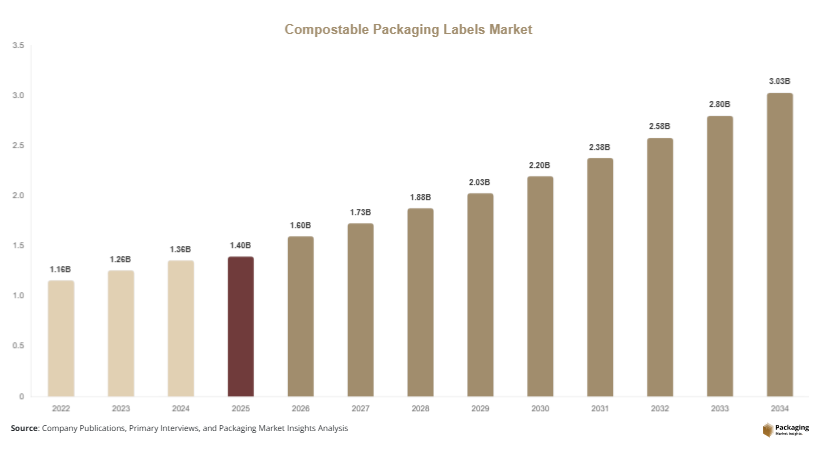
The global compostable packaging labels market size is estimated at USD 1.4 billion in 2025 and is projected to reach USD 1.6 billion in 2026. Over the forecast period from 2025 to 2034, the market is expected to grow at a CAGR of 8.3%, reaching approximately USD 3.3 billion by 2034. This growth is driven by increasing regulatory pressure, rising consumer awareness regarding eco-friendly products, and the growing adoption of compostable packaging across various industries. The compostable packaging labels market is witnessing steady growth as industries shift toward sustainable packaging solutions to reduce environmental impact.
One of the primary growth factors is the increasing demand for sustainable packaging solutions. Governments and regulatory bodies are implementing strict regulations to reduce plastic waste, encouraging manufacturers to adopt compostable materials. Compostable labels are designed to break down under composting conditions, making them an environmentally responsible alternative to conventional labels.
Key Highlights
- Asia Pacific dominated the market with a 38.2% share in 2025, while Latin America is projected to grow at the fastest CAGR of 8.9%.
- Paper-based labels led the type segment with a 41.5% share, while bio-based film labels are expected to grow at a CAGR of 8.7%.
- Compostable adhesives dominated with a 53.6% share, while water-based adhesives are forecasted to grow at a CAGR of 8.4%.
- Food & beverage applications led the segment with 46.8% share, while personal care applications are expected to grow at a CAGR of 8.6%.
- China remained the dominant country with a market size of USD 0.5 billion in 2025 and USD 0.6 billion in 2026.
Explore more data points, trends and opportunities Download Free Sample Report
Market Trends
Rising adoption of circular economy practices in packaging
The compostable packaging labels market is increasingly influenced by the shift toward circular economy practices. Companies are focusing on designing packaging systems that can be reused, recycled, or composted, reducing waste and environmental impact. Compostable labels play a key role in this transition by ensuring that the entire packaging structure can be processed together without contamination. This approach simplifies waste management and supports sustainability goals. Many brands are integrating compostable labels into their packaging to align with environmental commitments and regulatory requirements. As circular economy initiatives gain momentum across industries, the demand for compostable labeling solutions is expected to grow steadily.
Advancements in bio-based materials and printing technologies
Another important trend in the compostable packaging labels market is the development of advanced bio-based materials and printing technologies. Manufacturers are investing in research to create materials that offer improved performance while maintaining compostability. Innovations such as plant-based films and biodegradable inks are enhancing the functionality and aesthetic appeal of compostable labels. These advancements allow companies to achieve high-quality printing results without compromising environmental benefits. In addition, improvements in printing technologies are enabling efficient production processes, reducing costs and increasing scalability. As technology continues to evolve, the adoption of compostable labels is expected to expand across various applications.
Market Drivers
Increasing regulatory pressure to reduce plastic waste
Strict regulations aimed at reducing plastic waste are a major driver for the compostable packaging labels market. Governments worldwide are implementing policies to limit the use of non-biodegradable materials, encouraging the adoption of compostable alternatives. These regulations are particularly strong in regions such as Europe and North America, where sustainability is a key priority. Companies are required to comply with these standards, leading to increased demand for compostable labels. The ability of these labels to decompose under specific conditions makes them an attractive option for meeting regulatory requirements. As environmental policies continue to evolve, the market is expected to benefit from increased adoption of sustainable labeling solutions.
Growing consumer awareness and demand for eco-friendly products
Consumer awareness regarding environmental issues is significantly influencing the compostable packaging labels market. Customers are increasingly choosing products that align with their sustainability values, prompting companies to adopt eco-friendly packaging solutions. Compostable labels provide a clear indication of a brand’s commitment to sustainability, enhancing its reputation and appeal. This trend is particularly evident in industries such as food and beverage, personal care, and retail. As consumers continue to prioritize environmentally responsible products, the demand for compostable labels is expected to rise. Companies that invest in sustainable packaging solutions are likely to gain a competitive advantage in the market.
Market Restraint
Limited availability of composting infrastructure and higher costs
The compostable packaging labels market faces challenges related to the limited availability of composting infrastructure and higher production costs. Compostable labels require specific conditions to break down effectively, and not all regions have the necessary facilities to support this process. This can limit the effectiveness of compostable packaging solutions and reduce their adoption. Additionally, the cost of producing compostable labels is generally higher than that of conventional labels due to the use of specialized materials and processes. For example, small and medium-sized enterprises may find it difficult to adopt compostable labels due to budget constraints. These factors can hinder market growth, particularly in developing regions. However, ongoing investments in infrastructure and technological advancements are expected to address these challenges over time.
Market Opportunities
Expansion of sustainable packaging in emerging markets
Emerging markets present significant opportunities for the compostable packaging labels market. Countries in Asia Pacific, Latin America, and the Middle East are experiencing rapid industrialization and increasing consumer demand for packaged goods. Governments in these regions are also promoting sustainability initiatives, encouraging the adoption of eco-friendly packaging solutions. The growing awareness of environmental issues among consumers is further supporting market expansion. Companies that invest in these markets can benefit from increasing demand and favorable regulatory environments. As infrastructure and technology continue to improve, the adoption of compostable labels in emerging markets is expected to grow.
Innovation in compostable adhesives and multi-layer structures
The development of advanced compostable adhesives and multi-layer structures is creating new opportunities in the compostable packaging labels market. Manufacturers are focusing on improving the performance of compostable labels by enhancing their durability, adhesion, and compatibility with different packaging materials. Innovations in adhesive technologies are enabling better bonding while maintaining compostability. Multi-layer structures are also being developed to provide additional functionality, such as moisture resistance and barrier properties. These advancements are expanding the range of applications for compostable labels, making them suitable for more demanding environments. As innovation continues, the market is expected to witness increased adoption across various industries.
Report Scope
| Report Metric | Details |
|---|---|
| Market Size in 2025 | USD 1.4 Billion |
| Market Size in 2026 | USD 1.6 Billion |
| Market Size in 2034 | USD 3.3 Billion |
| CAGR | 8.3% (2026-2034) |
| Base Year for Estimation | 2025 |
| Historical Data | 2022-2024 |
| Forecast Period | 2026-2034 |
| Report Coverage | Revenue Forecast, Competitive Landscape, Supply Chain Disruption, Growth Factors, Environment & Regulatory Landscape and Trends |
| Geographies Covered | North America, Europe, APAC, Middle East and Africa, LATAM |
| Countries Covered | U.S., Canada, U.K., Germany, France, Spain, Italy, Russia, Nordic, Benelux, Rest of Europe, China, South Korea, Japan, India, Australia, Singapore, Taiwan, South East Asia, Rest of Asia-Pacific, UAE, Turky, Saudi Arabia, South Africa, Egypt, Nigeria, Rest of MEA, Brazil, Mexico, Argentina, Chile, Colombia, Rest of LATAM |
Explore more data points, trends and opportunities Download Free Sample Report
Segmental Analysis
By Type
Paper-based labels dominated the compostable packaging labels market in 2024, accounting for approximately 41.5% of the total share. These labels are widely used due to their biodegradability and compatibility with composting processes. They are commonly used in food and beverage packaging.
Bio-based film labels are expected to grow at a CAGR of 8.7% during the forecast period. These labels offer improved durability and moisture resistance, making them suitable for a wider range of applications. Their adoption is increasing as manufacturers seek high-performance compostable solutions.
By Adhesive Type
Compostable adhesives dominated the market in 2024, accounting for 53.6% of the total share. These adhesives are specifically designed to maintain compostability while providing strong bonding. They are widely used in various packaging applications.
Water-based adhesives are expected to grow at a CAGR of 8.4%. These adhesives offer environmental benefits and improved performance. Their adoption is increasing as companies focus on sustainable packaging solutions.
By Application
Food and beverage applications held the largest share of the compostable packaging labels market in 2024, accounting for 46.8% of the total market. The need for sustainable packaging solutions is driving demand in this segment.
Personal care applications are expected to grow at a CAGR of 8.6% during the forecast period. The increasing demand for eco-friendly products is driving the adoption of compostable labels in this segment.
Compostable Packaging Labels Market Segmentations
By Product Type
- Paper-based Labels
- Bio-based Film Labels
- Others
By Application
- Food & Beverage
- Personal Care
- Pharmaceuticals
- Retail
By Adhesive Type
- Compostable Adhesives
- Water-based Adhesives
- Others
Regional Analysis
North America
North America accounted for approximately 25.6% of the compostable packaging labels market share in 2025 and is projected to grow at a CAGR of 7.9% during the forecast period. The region benefits from strong regulatory frameworks and increasing consumer awareness regarding sustainability. The presence of established packaging companies supports market growth.
The United States dominates the regional market due to its large consumer base and advanced infrastructure. A unique growth factor is the increasing adoption of sustainable packaging practices among major brands, which is driving demand for compostable labels.
Europe
Europe held a 27.8% share of the compostable packaging labels market in 2025 and is expected to grow at a CAGR of 8.1%. The region is characterized by strict environmental regulations and a strong focus on sustainability. These factors are encouraging the adoption of compostable packaging solutions.
Germany leads the European market, supported by its advanced manufacturing capabilities. A unique growth factor is the region’s emphasis on reducing plastic waste, which is driving demand for compostable labels.
Asia Pacific
Asia Pacific dominated the compostable packaging labels market with a 38.2% share in 2025 and is projected to grow at a CAGR of 8.9%. The region’s growth is driven by rapid industrialization and increasing consumer demand for sustainable products. The expansion of the food and beverage industry further supports market growth.
China remains the dominant country in this region due to its large manufacturing base. A unique growth factor is the increasing government support for sustainable packaging initiatives, which is driving the adoption of compostable labels.
Middle East & Africa
The Middle East & Africa region accounted for 4.8% of the compostable packaging labels market share in 2025 and is expected to grow at a CAGR of 8.2%. Growth is supported by increasing awareness of environmental issues and expanding retail sectors.
Saudi Arabia leads the regional market due to its economic growth. A unique growth factor is the rising demand for eco-friendly packaging in the food and beverage industry, which is driving the adoption of compostable labels.
Latin America
Latin America held a 3.6% share of the compostable packaging labels market in 2025 and is projected to grow at the fastest CAGR of 8.9%. The region’s growth is driven by increasing consumer awareness and government initiatives promoting sustainability.
Brazil dominates the regional market due to its large population and growing packaging industry. A unique growth factor is the increasing adoption of sustainable packaging solutions, which is driving demand for compostable labels.
Competitive Landscape
The compostable packaging labels market is moderately competitive, with several global players focusing on sustainability and innovation. Companies are investing in advanced materials and technologies to improve product performance and meet regulatory requirements. Strategic partnerships and collaborations are common as firms aim to expand their market presence.
Avery Dennison Corporation is recognized as a leading player in the market, known for its sustainable labeling solutions. The company recently introduced compostable label products designed to meet environmental standards. Other players are also focusing on expanding their product portfolios and enhancing manufacturing capabilities.
Key Players List
- Avery Dennison Corporation
- UPM Raflatac
- 3M Company
- CCL Industries Inc.
- Multi-Color Corporation
- Henkel AG & Co. KGaA
- BASF SE
- Mondi Group
- Stora Enso
- SATO Holdings Corporation
- Brady Corporation
- Fuji Seal International, Inc.
- Toppan Printing Co., Ltd.
- LINTEC Corporation
- Constantia Flexibles