Compostable Food Service Packaging Market Size and Growth
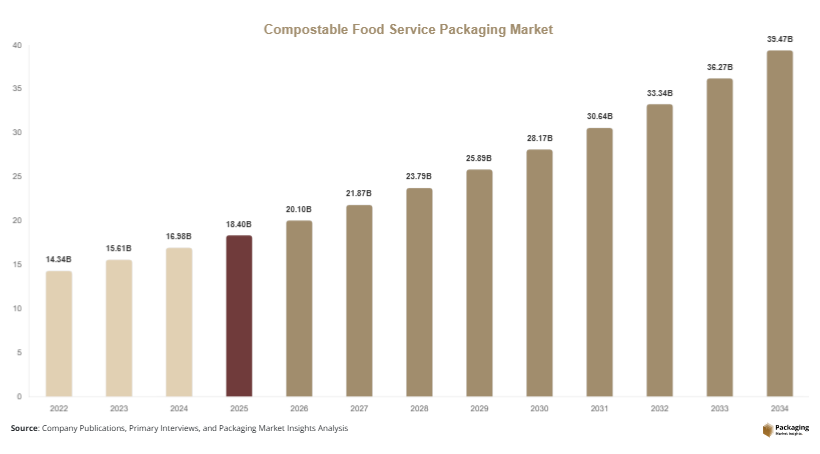
The global compostable food service packaging market size was valued at approximately USD 18.4 billion in 2025 and is projected to reach USD 20.1 billion in 2026. By 2034, the market is forecasted to expand to nearly USD 39.6 billion, registering a CAGR of 8.8% during 2025–2034. The increasing adoption of eco-friendly food packaging across restaurants, cafes, catering services, and online food delivery platforms continues to support long-term market expansion. The compostable food service packaging market is experiencing strong growth as food service operators, packaging manufacturers, and governments shift toward sustainable alternatives to traditional plastic packaging.
One of the primary growth factors driving the market is the implementation of strict regulations against single-use plastics. Governments across North America, Europe, and parts of Asia Pacific are introducing bans and restrictions on non-recyclable food containers, cutlery, and cups. These regulatory initiatives are encouraging businesses to adopt compostable packaging made from paper, bagasse, cornstarch, and biodegradable polymers.
Key Highlights
- Asia Pacific dominated the market with a 35.8% share in 2025.
- Latin America is projected to grow at the fastest CAGR of 9.3%.
- Paper & paperboard led the material segment with a 41.6% share.
- Containers dominated the product segment with a 33.5% share.
- Quick-service restaurants led the end-use segment with 38.9% share.
- The US remained the dominant country with a market size of USD 4.9 billion in 2025 and USD 5.4 billion in 2026.
Explore more data points, trends and opportunities Download Free Sample Report
Market Trends
Increasing Adoption of Fiber-Based Packaging Materials
Fiber-based compostable packaging materials are becoming increasingly popular across the food service industry due to their lower environmental impact and strong consumer acceptance. Restaurants and cafes are replacing petroleum-based packaging with molded fiber trays, paper bowls, and bagasse containers. These products offer durability and grease resistance while remaining compostable under industrial composting conditions. Food delivery companies are also integrating fiber-based packaging into operations to comply with regional sustainability regulations. Manufacturers are investing in water-resistant coatings and advanced pulp molding technologies to improve functionality. As sustainability goals become central to food service operations, demand for renewable fiber-based packaging solutions is expected to increase steadily throughout the forecast period.
Expansion of Compostable Packaging in Food Delivery Platforms
The rapid expansion of online food delivery services is accelerating the adoption of compostable food service packaging worldwide. Delivery platforms and restaurant chains are under pressure to reduce packaging waste generated by takeaway meals and beverages. Compostable containers, cups, wraps, and cutlery are increasingly being used to meet customer expectations for environmentally responsible packaging. Delivery companies are also partnering with packaging manufacturers to develop lightweight and heat-resistant solutions suitable for transportation. Many urban consumers prefer food brands that demonstrate sustainable practices, encouraging wider adoption across the industry. This trend is expected to strengthen as governments introduce stricter packaging waste regulations and delivery volumes continue to rise globally.
Market Drivers
Government Regulations on Single-Use Plastics
Government regulations restricting the use of single-use plastics are a major driver for the compostable food service packaging market. Countries across Europe, North America, and Asia Pacific are implementing policies that limit plastic straws, foam containers, and non-recyclable packaging materials. These regulations are encouraging restaurants, food chains, and catering businesses to transition toward compostable alternatives. Municipal waste reduction initiatives and landfill diversion programs are also supporting market growth. Many food service operators are proactively adopting compostable packaging to avoid penalties and align with sustainability targets. Regulatory support has accelerated investments in biodegradable material development, manufacturing expansion, and industrial composting infrastructure across several regions.
Rising Consumer Demand for Sustainable Food Packaging
Consumer demand for environmentally responsible packaging solutions continues to influence purchasing decisions across the food service industry. Customers are becoming more aware of the environmental impact of plastic waste and are increasingly supporting businesses that use compostable packaging materials. This shift in consumer behavior has encouraged quick-service restaurants, cafes, and delivery platforms to introduce sustainable packaging programs. Food brands are using compostable packaging as part of broader environmental branding strategies to improve customer retention and market positioning. Social media awareness campaigns and sustainability-focused marketing are also strengthening consumer preference for eco-friendly packaging solutions, contributing to steady market expansion worldwide.
Market Restraint
Limited Industrial Composting Infrastructure
A major restraint affecting the compostable food service packaging market is the limited availability of industrial composting infrastructure in several countries. Many compostable products require controlled composting conditions to decompose efficiently, but waste collection systems in developing and some developed regions are not fully equipped to process these materials. As a result, compostable packaging may end up in landfills, reducing its environmental advantages and discouraging adoption among businesses. Inconsistent labeling standards and consumer confusion regarding disposal methods further complicate waste management processes. For example, small restaurants in regions lacking composting facilities may continue using conventional plastic packaging because compostable alternatives offer limited disposal benefits without proper infrastructure. This challenge affects market penetration and increases operational complexity for packaging manufacturers and food service providers.
Market Opportunities
Growth of Sustainable Quick-Service Restaurant Chains
The increasing expansion of sustainability-focused quick-service restaurant chains presents a strong opportunity for compostable packaging manufacturers. Restaurant brands are integrating environmentally responsible practices into their business models to improve customer engagement and strengthen brand identity. Compostable food trays, beverage cups, lids, and takeaway containers are becoming standard offerings across many restaurant networks. Franchises are also adopting compostable packaging to comply with regional regulations and corporate sustainability commitments. As global quick-service restaurant chains continue expanding into urban markets, demand for scalable and cost-effective compostable packaging solutions is expected to rise significantly, creating long-term growth opportunities for suppliers and material developers.
Innovation in Bio-Based Packaging Materials
Continuous innovation in bio-based materials is creating new opportunities within the compostable food service packaging market. Manufacturers are developing packaging made from agricultural waste, algae-based polymers, bamboo fiber, and starch blends to improve performance and reduce production costs. These innovations are helping overcome traditional limitations related to moisture resistance, durability, and temperature tolerance. Improved product functionality is increasing adoption across food delivery and catering applications. Investments in research and development are also supporting the commercialization of home-compostable materials, which could expand consumer acceptance. As technology advances, innovative bio-based packaging products are expected to open new application areas and strengthen market competitiveness.
Report Scope
| Report Metric | Details |
|---|---|
| Market Size in 2025 | USD 18.4 Billion |
| Market Size in 2026 | USD 20.1 Billion |
| Market Size in 2034 | USD 39.6 Billion |
| CAGR | 8.8% (2026-2034) |
| Base Year for Estimation | 2025 |
| Historical Data | 2022-2024 |
| Forecast Period | 2026-2034 |
| Report Coverage | Revenue Forecast, Competitive Landscape, Supply Chain Disruption, Growth Factors, Environment & Regulatory Landscape and Trends |
| Geographies Covered | North America, Europe, APAC, Middle East and Africa, LATAM |
| Countries Covered | U.S., Canada, U.K., Germany, France, Spain, Italy, Russia, Nordic, Benelux, Rest of Europe, China, South Korea, Japan, India, Australia, Singapore, Taiwan, South East Asia, Rest of Asia-Pacific, UAE, Turky, Saudi Arabia, South Africa, Egypt, Nigeria, Rest of MEA, Brazil, Mexico, Argentina, Chile, Colombia, Rest of LATAM |
Explore more data points, trends and opportunities Download Free Sample Report
Segmental Analysis
By Material
Paper & paperboard dominated the compostable food service packaging market in 2024, accounting for approximately 41.6% of total market share. The segment benefits from strong recyclability, broad availability, and consumer preference for fiber-based sustainable packaging products. Restaurants, cafes, and takeaway food providers widely use paper bowls, trays, wraps, and cups because these materials offer acceptable durability and compostability. Technological improvements in moisture-resistant coatings have further enhanced product performance in food service applications. Food delivery operators are increasingly selecting paper-based packaging due to regulatory compliance requirements and environmental branding strategies. In addition, many governments support paper-based alternatives through packaging reduction initiatives and restrictions on expanded polystyrene products.
Bagasse-based packaging is expected to be the fastest-growing material segment, registering a CAGR of 9.7% during the forecast period. Bagasse, derived from sugarcane waste, is gaining popularity because it is renewable, biodegradable, and suitable for hot and cold food applications. Manufacturers are investing in advanced molded fiber technologies to improve structural strength and moisture resistance. The food delivery industry is increasingly adopting bagasse containers due to their heat retention properties and environmental benefits. Growing availability of agricultural waste materials in developing economies is also supporting production expansion. As sustainability regulations tighten globally, demand for durable compostable packaging made from agricultural byproducts is projected to increase significantly.
By Product Type
Containers represented the dominant product segment in 2024, holding approximately 33.5% of the overall compostable food service packaging market share. Compostable containers are widely used for takeaway meals, salads, soups, and ready-to-eat food products across restaurants and food delivery services. Their popularity is supported by rising demand for leak-resistant and temperature-tolerant packaging solutions. Manufacturers are introducing compartmentalized designs and improved locking mechanisms to enhance transportation safety and convenience. The increasing expansion of online meal delivery platforms has also strengthened demand for durable compostable containers capable of maintaining food quality during transit. Restaurants are increasingly replacing foam and plastic containers with compostable alternatives to comply with environmental regulations and strengthen sustainability positioning.
Compostable pouches are projected to witness the fastest growth, with an estimated CAGR of 9.5% over the forecast period. These products are gaining traction in snack delivery, beverage packaging, and condiment applications due to their lightweight structure and reduced material consumption. Advances in biodegradable polymer technology have improved flexibility, shelf stability, and barrier protection. Food service operators are adopting compostable pouches to reduce packaging weight and lower transportation costs. The increasing use of sustainable packaging for meal kits and beverage concentrates is further supporting demand. As manufacturers improve sealing performance and moisture resistance, compostable pouches are expected to become more common across modern food service operations.
By End Use
Quick-service restaurants dominated the end-use segment in 2024, accounting for approximately 38.9% of the global market share. These restaurants generate significant packaging waste volumes due to takeaway meals, beverages, and disposable cutlery usage. As sustainability regulations become stricter, many restaurant chains are replacing conventional plastic packaging with compostable alternatives. Major brands are integrating environmentally responsible packaging into broader corporate sustainability strategies to improve public perception and customer loyalty. Compostable cups, trays, wraps, and containers are increasingly used across dine-in and takeaway operations. Growing consumer preference for environmentally conscious food brands continues to support adoption within the quick-service restaurant industry across developed and emerging markets.
Online food delivery services are expected to grow at the fastest CAGR of 10.1% during the forecast period. The rapid increase in app-based meal ordering has generated substantial demand for sustainable takeaway packaging products. Delivery platforms are partnering with restaurants and packaging suppliers to reduce plastic waste generated through meal transportation. Compostable packaging solutions help maintain food quality while supporting sustainability objectives. Urban consumers increasingly prefer delivery brands that demonstrate responsible packaging practices, encouraging wider adoption. The expansion of cloud kitchens and digital restaurant models is also contributing to packaging demand growth. As governments implement stricter waste management policies, online food delivery providers are expected to accelerate investments in compostable packaging systems.
Compostable Food Service Packaging Market Segmentations
By Material
- Paper & Paperboard
- Bagasse
- PLA & Biopolymers
- Bamboo Fiber
- Others
By Product Type
- Containers
- Cups & Lids
- Plates & Bowls
- Pouches
- Cutlery
By End User
- Quick-Service Restaurants
- Cafes & Coffee Chains
- Catering Services
- Online Food Delivery
- Institutional Food Services
Regional Analysis
North America
North America accounted for approximately 28.6% of the global compostable food service packaging market share in 2025 and is projected to grow at a CAGR of 8.1% during the forecast period. Strong environmental regulations and increasing consumer awareness regarding plastic waste reduction are supporting regional market growth. The food delivery industry and quick-service restaurant sector continue to adopt compostable packaging solutions to align with sustainability targets and changing consumer preferences across urban markets.
The United States dominates the regional market due to widespread adoption of eco-friendly packaging among restaurant chains and food delivery companies. A unique growth factor is the growing number of state-level bans on foam and plastic food containers. These regulations are encouraging businesses to replace traditional packaging with compostable alternatives, increasing demand for molded fiber containers, biodegradable cups, and plant-based cutlery products.
Europe
Europe held around 26.9% of the global market share in 2025 and is expected to register a CAGR of 7.9% through 2034. The region benefits from strong circular economy policies and strict regulations regarding packaging waste management. European consumers are highly supportive of sustainable packaging practices, which has encouraged restaurants and catering businesses to transition toward compostable materials. Packaging manufacturers are also focusing on recyclable and compostable product innovation to comply with evolving environmental standards.
Germany remains the dominant country within the European market due to its advanced waste management systems and strong industrial composting infrastructure. A unique growth factor is the rapid expansion of environmentally certified food service businesses. Many restaurants and cafes are using compostable packaging to obtain sustainability certifications and improve environmental branding, creating stable demand for premium compostable packaging products.
Asia Pacific
Asia Pacific dominated the compostable food service packaging market with a 35.8% share in 2025 and is forecasted to grow at a CAGR of 9.2% during the assessment period. Rapid urbanization, expanding food delivery services, and increasing government action against plastic pollution are driving regional growth. Countries across the region are investing in biodegradable material manufacturing and sustainable packaging infrastructure. The growing middle-class population is also contributing to higher consumption of packaged takeaway meals.
China leads the Asia Pacific market due to its large food delivery sector and government restrictions on non-degradable plastic packaging. A unique growth factor is the expansion of domestic compostable material production facilities. Chinese manufacturers are increasing investments in bagasse, bamboo fiber, and starch-based packaging production to support domestic demand and strengthen export capabilities within the global sustainable packaging industry.
Middle East & Africa
The Middle East & Africa region represented approximately 4.7% of the market share in 2025 and is projected to grow at a CAGR of 7.4% over the forecast period. Growing environmental awareness and increasing investments in sustainable hospitality infrastructure are supporting market expansion. International restaurant chains operating in the region are adopting compostable packaging solutions to align with global sustainability commitments and improve waste reduction practices in urban centers.
The United Arab Emirates dominates the regional market due to strong government sustainability initiatives and rising tourism activity. A unique growth factor is the increasing development of green hospitality projects. Hotels, resorts, and event management companies are incorporating compostable food packaging into operations to reduce environmental impact and comply with regional sustainability frameworks supporting responsible tourism development.
Latin America
Latin America accounted for nearly 4.0% of the global market share in 2025 and is expected to grow at the fastest CAGR of 9.3% through 2034. The regional market is benefiting from rising awareness of environmental pollution and expanding food delivery applications. Governments and municipalities are implementing measures to reduce plastic waste, encouraging businesses to adopt compostable packaging products across restaurants, cafes, and catering operations.
Brazil remains the leading country in the Latin American market due to its expanding quick-service restaurant industry and increasing sustainability awareness among consumers. A unique growth factor is the availability of agricultural waste materials such as sugarcane bagasse. Local manufacturers are utilizing these renewable raw materials to produce cost-effective compostable packaging solutions for domestic and export markets.
Competitive Landscape
The compostable food service packaging market is moderately fragmented, with several international and regional players competing through product innovation, sustainable material development, and strategic partnerships. Companies are focusing on expanding manufacturing capacity and improving compostable material performance to meet rising demand from restaurants, cafes, and food delivery operators. Competitive strategies include acquisitions, product portfolio expansion, and collaborations with food service chains to strengthen market presence.
Huhtamaki remains one of the leading companies in the market due to its broad portfolio of sustainable food service packaging products and extensive global distribution network. In 2024, the company introduced a new range of fiber-based compostable takeaway containers designed for quick-service restaurants and delivery platforms. Other major companies including Vegware, Dart Container Corporation, Pactiv Evergreen, and Genpak are investing in biodegradable material innovation and recyclable barrier technologies. Manufacturers are also emphasizing certifications and compostability standards to improve customer trust and regulatory compliance across international markets.
Key Players List
- Huhtamaki
- Vegware
- Dart Container Corporation
- Pactiv Evergreen
- Genpak
- World Centric
- Eco-Products Inc.
- BioPak
- Sabert Corporation
- TIPA Corp
- StalkMarket
- GreenGood USA
- Footprint
- Be Green Packaging
- Fabri-Kal
- Novolex
- NatureWorks LLC