Compostable And Recyclable Cups Market Size and Growth
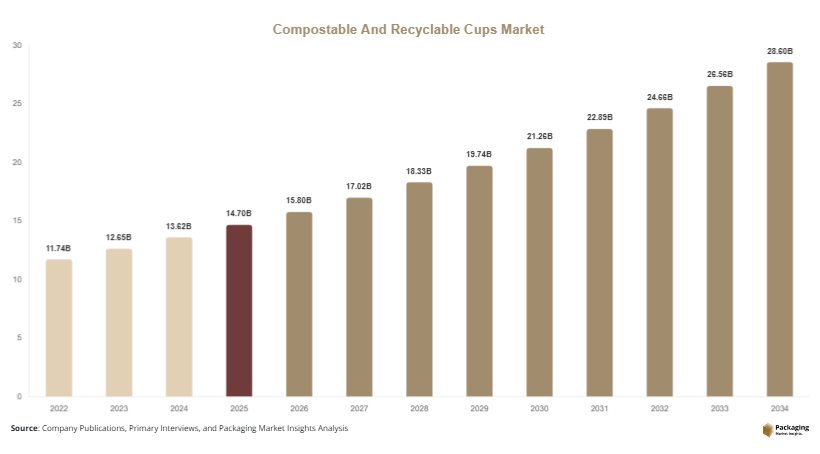
The global compostable and recyclable cups market size was valued at approximately USD 14.7 billion in 2025 and is projected to reach USD 15.8 billion in 2026. The market is forecast to reach nearly USD 28.6 billion by 2034, expanding at a CAGR of 7.7% during 2025–2034. The market is benefiting from rising consumer demand for eco-friendly food packaging, increasing government initiatives supporting circular economy practices, and rapid expansion of café culture and takeaway beverage consumption globally.
The compostable and recyclable cups market is witnessing substantial growth due to increasing environmental awareness, rising restrictions on single-use plastics, and growing adoption of sustainable foodservice packaging solutions across developed and emerging economies. Compostable and recyclable cups are widely used in coffee chains, restaurants, offices, institutional catering, and quick-service restaurants as businesses aim to reduce plastic waste and comply with evolving sustainability regulations. Manufacturers are investing in biodegradable coatings, plant-based polymers, and recyclable fiber materials to improve product performance while minimizing environmental impact.
Key Highlights
- Europe dominated the market with a 35.2% share in 2025.
- Asia Pacific is expected to grow at the fastest CAGR of 8.4%.
- Recyclable paper cups accounted for 49.1% market share in 2025.
- Foodservice applications led the market with a 53.4% share.
- Poly-lactic acid (PLA)-based compostable materials represented 38.6% market share.
- The US remained the leading country in North America with a market size of USD 3.2 billion in 2025 and USD 3.5 billion in 2026.
Explore more data points, trends and opportunities Download Free Sample Report
Market Trends
Expansion of Fiber-Based and Plastic-Free Cup Technologies
A major trend shaping the compostable and recyclable cups market is the growing shift toward fiber-based and plastic-free cup technologies. Manufacturers are increasingly replacing polyethylene linings with water-based coatings and biodegradable barrier materials to improve recyclability and compostability. Foodservice brands are adopting molded fiber cups and paper cups made from responsibly sourced raw materials to reduce environmental impact. For example, several café chains in Europe have introduced plastic-free paper cups compatible with standard recycling streams. This trend is expected to accelerate as governments strengthen packaging waste regulations and consumers demand low-impact foodservice packaging alternatives.
Rising Adoption of Closed-Loop Recycling and Reusable Cup Programs
Another key trend is the increasing implementation of closed-loop recycling systems and reusable cup initiatives across restaurants, universities, airports, and entertainment venues. Foodservice companies are partnering with recycling firms and packaging suppliers to recover used paper cups and convert them into recycled packaging materials. Several coffee chains are also introducing deposit-based reusable cup systems to reduce disposable packaging waste. For instance, large urban café networks in North America are piloting smart return stations for reusable beverage cups. The future impact of this trend includes stronger circular economy integration and reduced dependence on virgin packaging materials.
Market Drivers
Government Regulations Restricting Single-Use Plastics
The increasing implementation of government regulations restricting single-use plastic products is a major driver for the compostable and recyclable cups market. Countries across Europe, North America, and Asia Pacific are introducing packaging waste directives and sustainability mandates that encourage the use of recyclable and compostable foodservice packaging materials. Restaurants and beverage chains are replacing traditional plastic cups with paper-based and biodegradable alternatives to comply with evolving regulations. For example, several municipalities in Canada and the European Union have restricted the use of certain plastic foodservice items, creating demand for sustainable cup solutions. These regulations are expected to continue supporting market growth during the forecast period.
Increasing Consumer Preference for Sustainable Packaging
Rising consumer awareness regarding environmental sustainability and plastic pollution is another significant growth driver. Consumers increasingly prefer brands that use eco-friendly and recyclable packaging solutions. Beverage retailers, cafés, and food delivery operators are responding by adopting compostable cups and recyclable beverage containers. For instance, quick-service restaurant chains are expanding the use of recyclable paper cups with renewable fiber content to strengthen sustainability positioning. Growing consumer willingness to support environmentally responsible brands is encouraging manufacturers to invest in innovative sustainable packaging technologies and scalable recyclable cup production systems.
Market Restraint
Limited Composting and Recycling Infrastructure
One of the primary restraints affecting the compostable and recyclable cups market is the limited availability of industrial composting and advanced recycling infrastructure in several countries. Although compostable cups are designed to break down under controlled composting conditions, many regions lack the facilities required to process these materials efficiently. As a result, compostable cups may end up in landfills, reducing their environmental benefits.
Recyclable cups also face challenges due to multi-layer structures that combine paper with barrier coatings, making material separation difficult in conventional recycling systems. For example, some municipalities do not accept coated paper beverage cups in standard recycling programs because specialized processing equipment is required. This limitation creates confusion among consumers and businesses regarding proper disposal practices.
The lack of consistent labeling standards and collection systems can further affect recycling efficiency and increase contamination rates in waste streams. Small foodservice businesses may also face operational challenges when transitioning to compostable packaging due to higher procurement costs and limited waste collection partnerships. In emerging economies, insufficient waste management infrastructure and inconsistent sustainability regulations continue to limit large-scale adoption of compostable and recyclable cups. Addressing these infrastructure gaps will remain important for achieving long-term market growth and improving circular packaging outcomes.
Market Opportunities
Growth in Sustainable Food Delivery Packaging
The rapid expansion of online food delivery and takeaway beverage services is creating significant opportunities for compostable and recyclable cup manufacturers. Food delivery platforms and restaurant operators are seeking environmentally responsible packaging formats that align with sustainability commitments and consumer preferences. Compostable cold beverage cups, recyclable coffee cups, and fiber-based takeaway packaging are increasingly being adopted across urban delivery markets. For example, delivery-focused cafés are using biodegradable beverage containers with plant-based lids to reduce packaging waste. Future opportunities are expected to emerge from lightweight cup designs optimized for transport efficiency and recyclable food delivery systems.
Expansion in Emerging Markets and Institutional Catering
Emerging economies and institutional catering services represent another important opportunity area for the market. Educational institutions, hospitals, corporate cafeterias, and transportation hubs are increasingly adopting sustainable beverage packaging solutions as part of environmental responsibility programs. Governments in Asia Pacific and Latin America are encouraging businesses to reduce plastic waste through sustainable procurement initiatives. For instance, universities and public event venues are replacing traditional plastic beverage cups with recyclable paper alternatives during large-scale events. Rising investments in sustainable hospitality infrastructure and green procurement policies are expected to accelerate market penetration in these sectors.
Report Scope
| Report Metric | Details |
|---|---|
| Market Size in 2025 | USD 14.7 Billion |
| Market Size in 2026 | USD 15.8 Billion |
| Market Size in 2034 | USD 28.6 Billion |
| CAGR | 7.7% (2026-2034) |
| Base Year for Estimation | 2025 |
| Historical Data | 2022-2024 |
| Forecast Period | 2026-2034 |
| Report Coverage | Revenue Forecast, Competitive Landscape, Supply Chain Disruption, Growth Factors, Environment & Regulatory Landscape and Trends |
| Geographies Covered | North America, Europe, APAC, Middle East and Africa, LATAM |
| Countries Covered | U.S., Canada, U.K., Germany, France, Spain, Italy, Russia, Nordic, Benelux, Rest of Europe, China, South Korea, Japan, India, Australia, Singapore, Taiwan, South East Asia, Rest of Asia-Pacific, UAE, Turky, Saudi Arabia, South Africa, Egypt, Nigeria, Rest of MEA, Brazil, Mexico, Argentina, Chile, Colombia, Rest of LATAM |
Explore more data points, trends and opportunities Download Free Sample Report
Segmental Analysis
By Product Type
Recyclable paper cups dominated the compostable and recyclable cups market with approximately 49.1% share in 2024 due to their widespread use across coffee chains, restaurants, institutional catering, and convenience stores. These cups are preferred because they combine lightweight properties, cost efficiency, and compatibility with existing paper recycling systems. Foodservice operators are increasingly adopting recyclable paper cups with water-based barrier coatings to improve environmental performance while maintaining beverage insulation and durability. For example, several international café chains have introduced recyclable hot beverage cups designed for standard paper recovery processes. Manufacturers are also using responsibly sourced fiber materials and low-plastic coatings to improve sustainability compliance and strengthen consumer acceptance across retail beverage markets.
Compostable biopolymer cups are projected to register the fastest CAGR of 8.6% during the forecast period due to increasing demand for fully biodegradable foodservice packaging solutions. Growth is supported by rising investment in plant-based materials such as PLA and PHA for cold beverage and takeaway applications. Compostable cups are gaining popularity in eco-conscious cafés, festivals, educational institutions, and sustainable hospitality operations. Packaging companies are developing improved compostable barrier technologies that enhance moisture resistance and product shelf performance. Future growth opportunities are expected to emerge from certified industrial compostable cup systems and expanding organic waste collection infrastructure in urban markets.
By Material
PLA-based materials accounted for nearly 38.6% market share in 2024 due to their biodegradability, transparency, and compatibility with compostable foodservice applications. PLA materials are widely used in cold beverage cups, smoothie containers, and takeaway drink packaging because they provide functional performance while supporting sustainable packaging goals. Foodservice brands are increasingly replacing petroleum-based plastics with plant-derived biopolymers to reduce carbon emissions and improve environmental positioning. For example, several quick-service restaurant chains are deploying PLA beverage cups during sustainability-focused promotional campaigns. Manufacturers are also improving the heat resistance and structural strength of PLA materials to expand their application range across food and beverage packaging.
Recycled fiber materials are expected to witness the fastest CAGR of 8.1% during the forecast period. Growth is driven by increasing demand for low-carbon packaging solutions and stronger circular economy initiatives across retail and foodservice industries. Recycled fiber cups reduce virgin raw material consumption while supporting recyclable packaging systems. Packaging manufacturers are investing in molded fiber technology and advanced coating systems that improve liquid resistance and structural integrity. Future developments in closed-loop paper recycling systems and water-based barrier materials are expected to strengthen the adoption of recycled fiber beverage packaging globally.
By End-Use
Foodservice applications dominated the compostable and recyclable cups market with approximately 53.4% share in 2024 due to high consumption of takeaway beverages and growing sustainability commitments among cafés and restaurants. Coffee shops, quick-service restaurants, catering companies, and convenience stores are adopting recyclable and compostable beverage packaging to reduce plastic waste and improve brand image. For example, several global café chains have transitioned toward recyclable hot beverage cups and fiber-based takeaway packaging across major urban markets. Rising takeaway culture and increasing demand for environmentally responsible packaging in hospitality operations continue to support segment dominance.
Institutional and corporate catering applications are projected to grow at the fastest CAGR of 8.3% during the forecast period. Growth is supported by sustainability procurement policies across universities, hospitals, airports, and corporate offices. Large organizations are increasingly replacing disposable plastic beverage containers with recyclable paper and compostable cup systems to meet environmental targets. Catering operators are also implementing reusable and recoverable beverage packaging programs during conferences and public events. Future opportunities are expected to emerge from green building certifications and zero-waste institutional foodservice initiatives globally.
Compostable And Recyclable Cups Market Segmentations
By Product Type
- Recyclable Paper Cups
- Compostable Biopolymer Cups
- Molded Fiber Cups
- Hybrid Sustainable Cups
By Material
- PLA-Based Materials
- Recycled Fiber Materials
- Bagasse Fiber
- Water-Based Coated Paper
By End-User
- Foodservice
- Institutional Catering
- Corporate Offices
- Hospitality & Tourism
- Retail Beverage Outlets
By Distribution Channel
- Direct Sales
- Foodservice Packaging Suppliers
- Online Packaging Distributors
- Wholesale Retailers
- Hospitality Supply Networks
Regional Analysis
North America
North America accounted for approximately 28.6% of the compostable and recyclable cups market share in 2025 and is expected to grow at a CAGR of 7.1% during the forecast period. Strong environmental awareness, widespread café culture, and increasing regulatory restrictions on single-use plastics are supporting regional market growth. Major beverage chains and foodservice operators are actively transitioning toward recyclable and compostable cup formats to align with sustainability commitments and improve waste reduction performance.
The United States dominates the North American market due to its large foodservice industry and growing investment in sustainable packaging technologies. A unique growth factor is the rapid adoption of reusable and recyclable beverage cup systems by large café chains and sports venues. Businesses are integrating cup recovery programs and fiber-based packaging solutions to reduce landfill waste and strengthen circular economy initiatives.
Europe
Europe held nearly 35.2% market share in 2025 and is projected to expand at a CAGR of 7.5% during 2025–2034. Strict packaging waste regulations and strong consumer demand for environmentally responsible products are supporting market growth across the region. Countries including Germany, France, and the United Kingdom are encouraging foodservice companies to adopt recyclable and compostable packaging materials through sustainability directives and plastic reduction policies.
Germany leads the regional market due to its advanced recycling infrastructure and strong focus on circular economy development. A unique growth factor is the expansion of deposit-return and reusable beverage packaging programs across urban retail and hospitality sectors. German foodservice companies are increasingly implementing recyclable fiber-based cup systems to improve sustainability performance and reduce packaging waste generation.
Asia Pacific
Asia Pacific represented approximately 23.7% market share in 2025 and is expected to register the fastest CAGR of 8.4% during the forecast period. Rapid urbanization, increasing takeaway beverage consumption, and growing government focus on reducing plastic pollution are driving regional demand. Rising café expansion and online food delivery activity in China, India, Japan, and Southeast Asia are further contributing to market growth.
China dominates the Asia Pacific market due to its large foodservice industry and expanding sustainable packaging manufacturing capabilities. A unique growth factor is the increasing use of biodegradable beverage packaging by e-commerce food delivery platforms. Chinese packaging manufacturers are investing in compostable material production and water-based coating technologies to meet rising domestic and export demand.
Middle East & Africa
The Middle East & Africa accounted for nearly 5.4% market share in 2025 and is projected to grow at a CAGR of 6.5% during the forecast period. The region is witnessing increasing adoption of sustainable packaging solutions across hospitality, tourism, and retail foodservice industries. Governments and commercial businesses are gradually introducing packaging sustainability initiatives aimed at reducing plastic waste generation.
The United Arab Emirates dominates the regional market due to rapid hospitality sector growth and increasing environmental awareness. A unique growth factor is the expansion of sustainable tourism projects and green retail developments that prioritize recyclable foodservice packaging solutions. Hotels, airports, and entertainment venues are increasingly adopting compostable beverage cups as part of broader sustainability strategies.
Latin America
Latin America represented approximately 7.1% market share in 2025 and is expected to grow at a CAGR of 7.3% during the forecast period. Increasing environmental awareness and growing investments in sustainable packaging manufacturing are supporting regional market development. Foodservice businesses and beverage retailers are gradually transitioning toward recyclable and biodegradable cup solutions to meet changing consumer expectations.
Brazil dominates the Latin American market because of its large beverage industry and expanding café culture. A unique growth factor is the increasing adoption of compostable paper cups by quick-service restaurant chains and entertainment venues. Local packaging producers are also investing in recyclable fiber technologies to support sustainable packaging demand across retail and hospitality industries.
Competitive Landscape
The compostable and recyclable cups market is moderately competitive, with packaging companies focusing on sustainable material innovation, recyclable barrier coatings, and compostable packaging technologies. Key market participants include Huhtamaki Oyj, Dart Container Corporation, Graphic Packaging International, Pactiv Evergreen Inc., and Genpak LLC. Among these companies, Huhtamaki Oyj remains a leading player due to its strong global foodservice packaging portfolio and investment in recyclable fiber cup technologies.
Companies are expanding production capacity for recyclable paper cups and compostable beverage packaging to meet rising demand from cafés, restaurants, and institutional catering operators. Strategic partnerships with foodservice brands and recycling companies are supporting closed-loop packaging initiatives. Recent developments include the launch of plastic-free paper cups, biodegradable barrier coatings, and recyclable molded fiber beverage containers designed for high-volume commercial foodservice applications.
Key Players List
- Huhtamaki Oyj
- Dart Container Corporation
- Graphic Packaging International
- Pactiv Evergreen Inc.
- Genpak LLC
- Eco-Products Inc.
- Stora Enso Oyj
- Vegware Ltd.
- BioPak Pty Ltd.
- Georgia-Pacific LLC
- Detpak Packaging
- Sabert Corporation
- WestRock Company
- Duni Group
- Benders Paper Cups