Commercial Printing Market Size and Growth
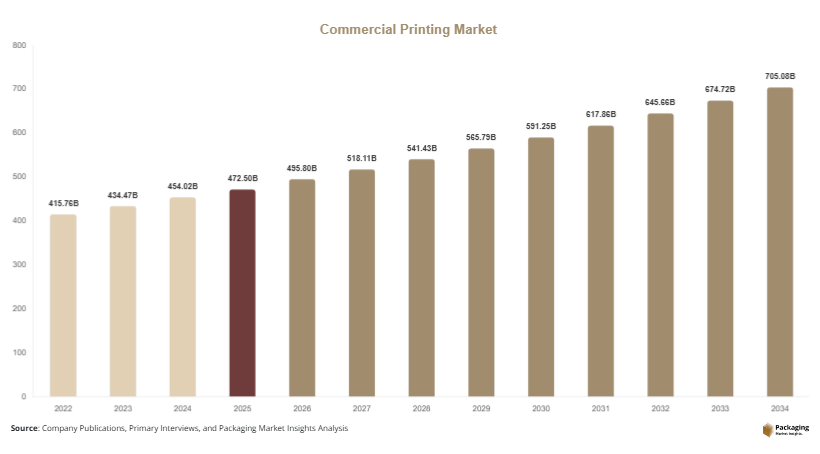
The global Commercial Printing Market size was estimated at USD 472.5 billion in 2025 and is projected to reach approximately USD 495.8 billion in 2026. Over the forecast period, the market is expected to grow to USD 705.3 billion by 2034, registering a compound annual growth rate (CAGR) of 4.5% from 2025 to 2034.The commercial printing market is witnessing steady transformation driven by technological advancements, evolving consumer demands, and expanding applications across industries such as advertising, packaging, publishing, and retail.
Commercial printing encompasses a wide range of printing services, including digital printing, offset printing, flexography, and screen printing. These methods are widely used for producing marketing materials, packaging labels, books, newspapers, catalogs, and promotional products. Despite the digital shift in communication, print continues to play a vital role due to its tangible nature and high engagement rates in targeted marketing campaigns.
Key Highlights:
- Market size reached USD 472.5 billion in 2025, reflecting steady demand across packaging, advertising, and publishing applications. The industry continues to benefit from consistent commercial and industrial printing requirements worldwide.
- Expected to grow at a CAGR of 4.5% (2025–2034), supported by rising adoption of digital printing technologies and expanding end-use industries. Growth remains stable due to increasing customization and efficiency improvements.
- Forecast value projected at USD 705.3 billion by 2034, driven by sustained investments in advanced printing equipment and packaging solutions. The market is expected to expand steadily across both developed and emerging regions.
- Packaging and labeling segments drive over 38% of total demand, largely due to rapid growth in e-commerce and FMCG sectors. Printed packaging remains essential for branding, product information, and logistics.
- Digital printing accounts for nearly 31% of total market share, gaining traction due to its flexibility and cost-effectiveness. Its ability to support short runs and personalized printing continues to accelerate adoption.
Explore more data points, trends and opportunities Download Free Sample Report
Market Trends
Shift Toward Digital and On-Demand Printing
The commercial printing market is experiencing a clear transition from traditional printing methods to digital and on-demand printing solutions. Digital printing technologies allow businesses to produce smaller print runs with faster turnaround times and reduced setup costs. This trend is particularly relevant for industries requiring customization, such as marketing, retail, and publishing. With the ability to personalize content, companies can target specific customer segments more effectively. The adoption of variable data printing (VDP) has increased by over 25% in the past five years, highlighting the growing importance of personalized communication. Furthermore, digital printing reduces waste and inventory costs, aligning with sustainability goals.
Integration of Sustainable Printing Practices
Sustainability has become a defining trend in the commercial printing market. Printing companies are increasingly adopting environmentally friendly materials, such as biodegradable substrates and soy-based inks. Regulatory pressures and consumer awareness are encouraging businesses to minimize their environmental footprint. Over 60% of commercial printers have implemented at least one eco-friendly initiative, including energy-efficient equipment and recycling programs. Additionally, certifications for sustainable printing practices are becoming a key differentiator in competitive markets. This trend is not only improving brand perception but also helping companies reduce operational costs over time.
Market Drivers
Growth of E-Commerce and Packaging Demand
The rapid expansion of the global e-commerce sector is a major driver for the commercial printing market. With millions of packages shipped daily, there is a strong demand for printed labels, packaging materials, and branding elements. Printed packaging plays a critical role in product identification, logistics, and customer experience. Approximately 72% of consumers report that packaging design influences their purchasing decisions. As a result, businesses are investing in high-quality printing solutions to enhance brand visibility. Additionally, the rise of subscription-based services and direct-to-consumer models is increasing demand for customized packaging, further driving market growth.
Technological Advancements in Printing Equipment
Continuous innovation in printing technologies is another key driver of the market. Modern printing equipment offers higher speed, precision, and efficiency compared to traditional methods. The adoption of advanced inkjet and laser printing systems has improved production capabilities, enabling printers to handle complex designs and high-volume orders. Automation and integration with digital workflows are also reducing labor costs and improving operational efficiency. Nearly 40% of printing companies have invested in automation technologies over the past three years. These advancements are making commercial printing more accessible and cost-effective, thereby expanding its applications across various industries.
Market Restraint
Decline in Traditional Print Media Demand
One of the primary restraints affecting the commercial printing market is the declining demand for traditional print media, such as newspapers, magazines, and brochures. The increasing adoption of digital platforms for advertising, communication, and information dissemination has significantly reduced the need for printed materials. For instance, global newspaper circulation has declined by nearly 20% over the past decade, impacting printing volumes. This shift has forced printing companies to restructure their operations and focus on alternative revenue streams, such as packaging and digital printing services. Additionally, the high initial investment required for advanced printing technologies can be a barrier for small and medium-sized enterprises. The transition from traditional to digital printing also requires skilled labor and technical expertise, further adding to operational challenges. As a result, companies that fail to adapt to changing market dynamics may face declining revenues and market share.
Market Opportunities
Expansion in Customized and Personalized Printing
The growing demand for customized and personalized products presents a significant opportunity for the commercial printing market. Businesses are increasingly leveraging personalized printing to enhance customer engagement and brand loyalty. From personalized marketing materials to custom packaging and promotional products, the scope for innovation is vast. The personalized printing segment is expected to grow at a CAGR of over 6.2% during the forecast period, driven by advancements in digital printing technologies. Companies are using data analytics and customer insights to create targeted print campaigns, improving conversion rates and return on investment.
Growth in Emerging Markets
Emerging economies offer substantial growth opportunities for the commercial printing market. Rapid urbanization, rising disposable incomes, and expanding industrial sectors are driving demand for printed materials in regions such as Asia Pacific, Latin America, and Africa. The increasing penetration of e-commerce and retail chains is further boosting the need for packaging and labeling solutions. In countries like India and Brazil, the printing industry is witnessing significant investments in modern printing infrastructure. Additionally, government initiatives supporting local manufacturing and small businesses are creating a favorable environment for market growth. These factors are expected to drive strong demand for commercial printing services in emerging markets over the next decade.
Report Scope
| Report Metric | Details |
|---|---|
| Market Size in 2025 | USD 472.5 Billion |
| Market Size in 2026 | USD 495.8 Billion |
| Market Size in 2034 | USD 705.3 Billion |
| CAGR | 4.5% (2026-2034) |
| Base Year for Estimation | 2025 |
| Historical Data | 2022-2024 |
| Forecast Period | 2026-2034 |
| Report Coverage | Revenue Forecast, Competitive Landscape, Supply Chain Disruption, Growth Factors, Environment & Regulatory Landscape and Trends |
| Geographies Covered | North America, Europe, APAC, Middle East and Africa, LATAM |
| Countries Covered | U.S., Canada, U.K., Germany, France, Spain, Italy, Russia, Nordic, Benelux, Rest of Europe, China, South Korea, Japan, India, Australia, Singapore, Taiwan, South East Asia, Rest of Asia-Pacific, UAE, Turky, Saudi Arabia, South Africa, Egypt, Nigeria, Rest of MEA, Brazil, Mexico, Argentina, Chile, Colombia, Rest of LATAM |
Explore more data points, trends and opportunities Download Free Sample Report
Segmental Analysis
By Type
The offset printing segment dominated the commercial printing market, accounting for approximately 42% of the market share in 2024. Offset printing is widely used for high-volume production due to its cost efficiency and consistent print quality. It is commonly used for newspapers, magazines, catalogs, and brochures. The ability to produce large quantities at lower costs makes it a preferred choice for businesses with extensive printing needs. Additionally, advancements in offset printing technology have improved efficiency and reduced waste, further supporting its dominance in the market.
Digital printing is the fastest-growing segment, with a projected CAGR of 6.1% during the forecast period. The growth of this segment is driven by increasing demand for short-run and customized printing solutions. Digital printing eliminates the need for printing plates, reducing setup time and costs. It also enables variable data printing, allowing businesses to personalize content for individual customers. The growing adoption of digital marketing strategies and the need for targeted advertising are further driving demand for digital printing services.
By Application
The packaging segment held the largest share of the commercial printing market, accounting for around 38% in 2024. The demand for printed packaging materials is driven by the growth of e-commerce, retail, and FMCG industries. Packaging plays a crucial role in product branding, protection, and information dissemination. High-quality printing enhances the visual appeal of packaging, influencing consumer purchasing decisions. Additionally, regulatory requirements for labeling and product information are contributing to the growth of this segment.
The advertising segment is expected to grow at the fastest CAGR of 5.4% during the forecast period. The increasing use of print media in integrated marketing campaigns is driving demand for advertising materials such as banners, posters, and direct mail. Businesses are combining print and digital channels to reach a wider audience and improve engagement. The rise of experiential marketing and outdoor advertising is also contributing to the growth of this segment.
By End-Use
The retail sector dominated the market, accounting for approximately 30% of the market share in 2024. Retail businesses rely heavily on printed materials for branding, promotions, and packaging. From in-store displays to product packaging and promotional flyers, commercial printing plays a vital role in enhancing customer experience. The growth of organized retail and e-commerce is further driving demand for printing services in this sector.
The healthcare sector is expected to grow at the fastest CAGR of 5.8% during the forecast period. The increasing need for printed materials such as medical packaging, labels, and informational brochures is driving demand in this segment. Strict regulatory requirements for labeling and patient information are also contributing to market growth. Additionally, the expansion of the pharmaceutical industry and healthcare infrastructure is creating new opportunities for commercial printing companies.
Commercial Printing Market Segmentations
By Type
- Offset Printing
- Digital Printing
- Flexographic Printing
- Screen Printing
By Application
- Packaging
- Advertising
- Publishing
- Others
By End-Use
- Retail
- Healthcare
- Food & Beverage
- Manufacturing
- Others
Regional Analysis
North America
North America accounted for approximately 28% of the commercial printing market share in 2025, with a projected CAGR of 3.8% through 2034. The region benefits from a well-established printing industry and high adoption of advanced technologies. The presence of major market players and strong demand from the packaging and advertising sectors contribute to steady growth. Additionally, the shift toward digital printing and sustainable practices is reshaping the market landscape in this region.
The United States dominates the North American market due to its large-scale commercial printing infrastructure and high demand for customized marketing materials. A unique growth factor in this region is the increasing use of data-driven marketing campaigns, which rely on personalized print materials to enhance customer engagement. This trend is expected to sustain demand for high-quality printing solutions.
Europe
Europe held around 24% market share in 2025 and is expected to grow at a CAGR of 3.5% during the forecast period. The region's market is driven by strong demand for packaging and labeling solutions, particularly in the food and beverage industry. Stringent environmental regulations are also encouraging the adoption of eco-friendly printing practices.
Germany is the leading country in the European market, supported by its advanced manufacturing sector and strong focus on sustainability. A unique growth factor is the region’s emphasis on circular economy practices, which promotes recycling and reuse of printed materials. This approach is driving innovation in sustainable printing technologies.
Asia Pacific
Asia Pacific dominated the market with a 34% share in 2025 and is projected to grow at the highest CAGR of 5.6% through 2034. Rapid industrialization, urbanization, and the expansion of e-commerce are key factors driving market growth. The region is also witnessing significant investments in digital printing technologies.
China leads the Asia Pacific market, supported by its large manufacturing base and growing consumer market. A unique growth factor is the rapid expansion of online retail platforms, which is increasing demand for printed packaging and labels. This trend is expected to drive sustained growth in the region.
Middle East & Africa
The Middle East & Africa region accounted for approximately 7% of the market share in 2025, with a CAGR of 4.2% during the forecast period. The market is driven by growing demand for advertising and promotional materials, particularly in urban areas. Infrastructure development and economic diversification are also contributing to market growth.
The United Arab Emirates is a key market in this region, benefiting from its strategic location and strong logistics sector. A unique growth factor is the increasing demand for luxury packaging and high-end print materials, driven by the region’s affluent consumer base and tourism industry.
Latin America
Latin America held about 7% market share in 2025 and is expected to grow at a CAGR of 4.0% through 2034. The region’s market is supported by the growth of the retail and packaging industries. Increasing consumer spending and urbanization are also driving demand for printed materials.
Brazil dominates the Latin American market, supported by its large population and expanding industrial base. A unique growth factor is the rise of local manufacturing and SMEs, which are driving demand for cost-effective printing solutions. This trend is expected to support market growth in the region.
Competitive Landscape
The commercial printing market is moderately fragmented, with several global and regional players competing based on technology, pricing, and service offerings. Leading companies are focusing on expanding their digital printing capabilities and adopting sustainable practices to gain a competitive edge. Strategic partnerships, mergers, and acquisitions are also common in this market.
One of the leading players, Quad/Graphics Inc., has strengthened its position through investments in advanced digital printing technologies and integrated marketing solutions. The company recently introduced automated workflow systems to improve efficiency and reduce turnaround times. Other major players are also focusing on innovation and customer-centric solutions to maintain their market position.
Key Players List
- Quad/Graphics Inc.
- RR Donnelley & Sons Company
- Cimpress plc
- Xerox Holdings Corporation
- HP Inc.
- Canon Inc.
- Ricoh Company Ltd.
- Konica Minolta Inc.
- Dai Nippon Printing Co. Ltd.
- Toppan Printing Co. Ltd.
- Heidelberger Druckmaschinen AG
- Shutterfly Inc.
- TC Transcontinental Inc.
- LSC Communications Inc.
- WestRock Company