Commercial Packaging Market Size and Growth
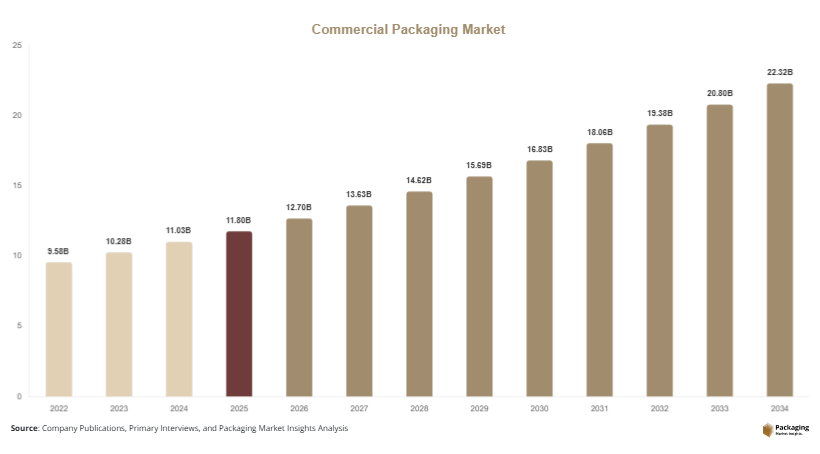
The global commercial packaging market size reached USD 11.8 billion in 2025 and is estimated to grow to USD 12.7 billion in 2026, reflecting consistent adoption of packaging solutions across global supply chains. By 2034, the market is projected to reach USD 23.9 billion, expanding at a CAGR of 7.3% from 2025 to 2034. This growth trajectory highlights the increasing importance of packaging in ensuring product safety, shelf life, and brand differentiation.
One of the key growth factors driving the commercial packaging market is the rapid expansion of the e-commerce sector. With increasing online retail penetration, the need for durable, protective, and lightweight packaging has intensified. Companies are investing in innovative packaging formats that ensure safe transit while minimizing costs and environmental impact.
Key Highlights:
- The market size reached USD 11.8 billion in 2025, reflecting steady demand across multiple industries. This growth is supported by increasing adoption of efficient and protective packaging solutions globally.
- The market is forecast to reach USD 23.9 billion by 2034, indicating strong long-term expansion. Rising industrialization and global trade are expected to contribute significantly to this growth trajectory.
- The market is expected to grow at a CAGR of 7.3% from 2025 to 2034. This consistent growth rate highlights increasing investments and innovation in packaging technologies.
- Rising demand from e-commerce and industrial sectors is driving market expansion. The need for safe, durable, and cost-effective packaging solutions is increasing across supply chains.
- There is a strong shift toward sustainable and recyclable packaging materials. Companies are focusing on eco-friendly alternatives to meet regulatory requirements and consumer expectations.
- Technological advancements in smart and protective packaging are transforming the market. Innovations such as tracking features and high-performance materials are improving efficiency and product safety.
Explore more data points, trends and opportunities Download Free Sample Report
Market Trends
Rising Adoption of Sustainable Packaging Solutions
Sustainability has become a central trend in the commercial packaging market, driven by regulatory pressures and changing consumer preferences. Companies are increasingly adopting recyclable, compostable, and biodegradable materials to reduce environmental impact. Paper-based packaging, bio-based plastics, and reusable formats are gaining traction across industries. Businesses are also focusing on reducing packaging weight and material usage without compromising performance. This trend is particularly prominent in retail and e-commerce sectors, where packaging waste is a major concern. As sustainability continues to influence purchasing decisions, companies investing in eco-friendly packaging solutions are expected to gain a competitive advantage.
Integration of Smart and Functional Packaging Technologies
The integration of smart packaging technologies is transforming the commercial packaging landscape. Features such as QR codes, RFID tags, and sensors are being incorporated to enhance product tracking, authentication, and consumer engagement. Smart packaging enables real-time monitoring of product conditions, including temperature and humidity, which is critical for pharmaceuticals and perishable goods. Additionally, interactive packaging is improving customer experience by providing product information and promotional content. As digital transformation accelerates, the demand for intelligent packaging solutions is expected to grow significantly, contributing to improved supply chain efficiency and product safety.
Market Drivers
Growth of E-commerce and Logistics Industry
The rapid growth of the e-commerce sector is a major driver of the commercial packaging market. Online retail platforms require efficient packaging solutions to ensure safe delivery of products across long distances. This has led to increased demand for corrugated boxes, protective packaging, and flexible packaging materials. The expansion of last-mile delivery networks has further amplified the need for lightweight and durable packaging. Additionally, the rise in cross-border trade has increased the complexity of logistics, requiring packaging that can withstand varying environmental conditions. As e-commerce continues to grow globally, it will remain a key contributor to market expansion.
Increasing Demand for Product Safety and Shelf Life Extension
Ensuring product safety and extending shelf life are critical factors driving the adoption of commercial packaging solutions. Industries such as food and beverage and pharmaceuticals require packaging that protects products from contamination, moisture, and physical damage. Advanced barrier materials and tamper-evident packaging are being widely adopted to maintain product integrity. Moreover, regulatory standards related to food safety and pharmaceutical packaging are becoming more stringent, encouraging companies to invest in high-quality packaging solutions. This growing focus on safety and quality is expected to drive sustained demand in the commercial packaging market.
Market Restraint
Volatility in Raw Material Prices and Environmental Regulations
One of the primary restraints affecting the commercial packaging market is the volatility in raw material prices. Materials such as plastics, paper, and metals are subject to fluctuations due to changes in supply-demand dynamics, geopolitical factors, and energy costs. This volatility can impact production costs and profit margins for packaging manufacturers. Additionally, stringent environmental regulations aimed at reducing plastic waste are posing challenges for companies relying on traditional materials. Compliance with these regulations often requires significant investment in research and development, as well as changes in manufacturing processes. For example, restrictions on single-use plastics in several regions have forced companies to shift toward alternative materials, which may be more expensive or less readily available. These factors can hinder market growth, particularly for small and medium-sized enterprises.
Market Opportunities
Expansion of Sustainable and Circular Packaging Solutions
The transition toward a circular economy presents significant opportunities for the commercial packaging market. Companies are increasingly focusing on designing packaging that can be reused, recycled, or composted. Innovations in bio-based materials and recycling technologies are enabling the development of sustainable packaging solutions that meet both regulatory requirements and consumer expectations. This shift is creating opportunities for companies to differentiate their offerings and capture new market segments. Additionally, partnerships between packaging manufacturers and recycling organizations are facilitating the development of closed-loop systems, further enhancing sustainability.
Growth in Emerging Markets and Industrial Applications
Emerging markets in Asia Pacific, Latin America, and Africa offer substantial growth opportunities for the commercial packaging market. Rapid urbanization, industrialization, and rising disposable incomes are driving demand for packaged goods in these regions. The expansion of manufacturing and automotive industries is also increasing the need for specialized packaging solutions. Furthermore, infrastructure development and improvements in logistics networks are supporting market growth. Companies that invest in localized production and distribution capabilities are well-positioned to capitalize on these opportunities and expand their global presence.
Report Scope
| Report Metric | Details |
|---|---|
| Market Size in 2025 | USD 11.8 Billion |
| Market Size in 2026 | USD 12.7 Billion |
| Market Size in 2034 | USD 23.9 Billion |
| CAGR | 7.3% (2026-2034) |
| Base Year for Estimation | 2025 |
| Historical Data | 2022-2024 |
| Forecast Period | 2026-2034 |
| Report Coverage | Revenue Forecast, Competitive Landscape, Supply Chain Disruption, Growth Factors, Environment & Regulatory Landscape and Trends |
| Geographies Covered | North America, Europe, APAC, Middle East and Africa, LATAM |
| Countries Covered | U.S., Canada, U.K., Germany, France, Spain, Italy, Russia, Nordic, Benelux, Rest of Europe, China, South Korea, Japan, India, Australia, Singapore, Taiwan, South East Asia, Rest of Asia-Pacific, UAE, Turky, Saudi Arabia, South Africa, Egypt, Nigeria, Rest of MEA, Brazil, Mexico, Argentina, Chile, Colombia, Rest of LATAM |
Explore more data points, trends and opportunities Download Free Sample Report
Segmental Analysis
By Material Type
The plastic packaging segment dominated the market in 2024, accounting for approximately 42% of the total share. Plastics are widely used due to their versatility, durability, and cost-effectiveness. They offer excellent barrier properties, making them suitable for a wide range of applications, including food, pharmaceuticals, and industrial goods. The availability of various plastic types, such as polyethylene and polypropylene, further supports their widespread adoption.
The paper and paperboard segment is expected to be the fastest-growing, with a CAGR of 8.1% during the forecast period. The increasing focus on sustainability and environmental regulations is driving the shift toward paper-based packaging. Companies are adopting recyclable and biodegradable materials to reduce their environmental footprint.
By Application
The food and beverage segment held the largest market share in 2024, accounting for around 38%. The demand for packaged food products, driven by changing consumer lifestyles and urbanization, is a key factor supporting this segment. Packaging plays a critical role in preserving freshness, extending shelf life, and ensuring product safety.
The pharmaceutical segment is projected to grow at the highest CAGR of 7.9%. The increasing demand for healthcare products and stringent regulatory requirements are driving the adoption of advanced packaging solutions. Innovations in tamper-evident and temperature-sensitive packaging are further supporting growth.
By End-Use Industry
The retail and e-commerce segment dominated the market in 2024, with a share of approximately 35%. The rapid expansion of online shopping has increased the demand for protective and lightweight packaging solutions. Companies are focusing on optimizing packaging designs to reduce costs and improve efficiency.
The automotive and industrial segment is expected to grow at a CAGR of 7.5%. The need for durable and customized packaging solutions for transporting heavy and sensitive components is driving demand. Advancements in high-strength materials are further supporting growth in this segment.
Commercial Packaging Market Segmentations
By Material Type
- Plastic
- Paper & Paperboard
- Metal
- Glass
By Application
- Food & Beverage
- Pharmaceutical
- Consumer Goods
- Industrial
By End-Use Industry
- Retail & E-commerce
- Automotive
- Healthcare
- Logistics & Warehousing
Regional Analysis
North America
North America accounted for a significant share of the commercial packaging market in 2025, with an estimated share of around 28%. The region is expected to grow at a CAGR of 6.8% during the forecast period. The presence of established packaging companies and advanced manufacturing infrastructure supports market growth. Additionally, the strong e-commerce sector in the United States and Canada drives demand for efficient packaging solutions.
The United States dominates the North American market, driven by high consumer demand and technological innovation. A key growth factor in this region is the increasing adoption of automation in packaging processes, which enhances efficiency and reduces operational costs.
Europe
Europe held approximately 24% of the global market share in 2025 and is projected to grow at a CAGR of 6.5% through 2034. The region’s focus on sustainability and strict environmental regulations are shaping the packaging industry. Companies are investing in recyclable and biodegradable materials to comply with regulatory standards.
Germany leads the European market, supported by its strong industrial base and advanced packaging technologies. A unique growth factor is the region’s emphasis on circular economy practices, which encourages innovation in sustainable packaging solutions.
Asia Pacific
Asia Pacific is the fastest-growing region, accounting for around 32% of the market share in 2025 and expected to grow at a CAGR of 8.2%. Rapid industrialization, urbanization, and population growth are driving demand for packaging across various sectors. The expansion of e-commerce platforms further supports market growth.
China dominates the Asia Pacific market, with significant contributions from India and Japan. A key growth factor is the increasing investment in manufacturing and logistics infrastructure, which boosts demand for commercial packaging solutions.
Middle East & Africa
The Middle East & Africa region held a smaller share of approximately 8% in 2025 but is expected to grow at a CAGR of 6.9%. The market is driven by expanding retail and food industries, as well as increasing investments in infrastructure development.
Saudi Arabia is a leading market in the region, supported by economic diversification initiatives. A unique growth factor is the growing demand for packaged food products, which drives the need for reliable and efficient packaging solutions.
Latin America
Latin America accounted for around 8% of the global market share in 2025 and is projected to grow at a CAGR of 7.0%. The region’s growth is supported by increasing consumer demand for packaged goods and improving economic conditions.
Brazil dominates the Latin American market, driven by its large population and expanding retail sector. A key growth factor is the rise of e-commerce platforms, which increases demand for packaging solutions across the region.
Competitive Landscape
The commercial packaging market is characterized by intense competition, with several global and regional players striving to expand their market presence. Key companies are focusing on product innovation, strategic partnerships, and mergers and acquisitions to strengthen their position. The market is moderately fragmented, with a mix of large multinational corporations and small to medium-sized enterprises.
International Paper Company is one of the leading players in the market, known for its extensive product portfolio and strong global presence. The company has recently invested in sustainable packaging solutions, focusing on recyclable materials and energy-efficient production processes. Other major players are also adopting similar strategies to meet evolving consumer demands and regulatory requirements.
Companies are increasingly investing in research and development to introduce advanced packaging technologies. The integration of automation and digital solutions is helping manufacturers improve efficiency and reduce costs. Additionally, collaborations with end-use industries are enabling companies to develop customized packaging solutions that meet specific requirements.
Key Players List
- International Paper Company
- WestRock Company
- Smurfit Kappa Group
- DS Smith Plc
- Mondi Group
- Amcor Plc
- Berry Global Inc.
- Sealed Air Corporation
- Sonoco Products Company
- Huhtamaki Oyj
- Packaging Corporation of America
- Georgia-Pacific LLC
- Rengo Co., Ltd.
- Klabin S.A.
- Stora Enso Oyj