Colour Changing Packaging Market Size and Growth
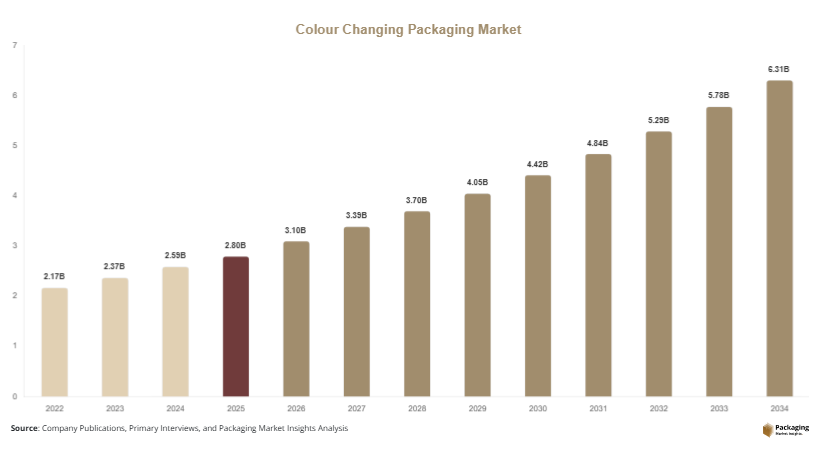
he global Colour Changing Packaging Market size was valued at USD 2.8 billion in 2025 and is projected to reach USD 3.1 billion in 2026, further expanding to approximately USD 6.9 billion by 2034, registering a CAGR of 9.3% during 2025–2034. The increasing demand for intelligent and interactive packaging solutions is a primary factor driving this growth trajectory. The colour changing packaging market is witnessing steady expansion as industries increasingly adopt innovative packaging technologies that enhance product visibility, safety, and consumer engagement. Colour changing packaging refers to packaging materials embedded with thermochromic, photochromic, or pH-sensitive inks and coatings that alter color in response to environmental conditions such as temperature, light, or chemical exposure. T
One of the key growth factors is the rising demand for food safety and freshness indicators. Colour changing packaging provides a visual cue to consumers regarding product quality and shelf life, especially in perishable food items. For instance, thermochromic labels can indicate whether a product has been exposed to unsuitable temperatures during transportation or storage. This functionality enhances consumer trust and reduces the risk of consuming spoiled products.
Key Highlights:
- Asia Pacific dominated the market with a 37.2% share in 2025, while Latin America is projected to grow at the fastest CAGR of 10.1%.
- Flexible packaging led the type segment with a 46.8% share, while rigid packaging is expected to grow at a CAGR of 8.5%.
- Plastic materials dominated with a 52.6% share, while biodegradable materials are forecasted to grow at a CAGR of 10.4%.
- Food and beverage applications led the segment with 41.3% share, while healthcare is expected to grow at a CAGR of 9.8%.
- China remained the dominant country with a market size of USD 0.9 billion in 2025 and USD 1.0 billion in 2026.
Explore more data points, trends and opportunities Download Free Sample Report
Market Trends
Increasing Adoption of Thermochromic and Smart Ink Technologies
The colour changing packaging market is experiencing a notable shift toward thermochromic and smart ink technologies that enable real-time visual communication with consumers. These inks change color based on temperature variations, making them suitable for applications such as beverage cans, dairy packaging, and pharmaceutical products. For example, cold-activated labels on beverage containers indicate optimal drinking temperature, improving user experience. In addition, smart inks are being integrated with indicators that monitor freshness and contamination. The demand for such technologies is rising due to their ability to enhance product safety and transparency. As printing techniques improve, the scalability and cost-efficiency of these inks are expected to further accelerate adoption.
Growing Demand for Interactive and Brand-Driven Packaging Designs
Brands are increasingly using colour changing packaging as a tool for differentiation and consumer engagement. Interactive packaging that responds to touch, light, or temperature creates a unique user experience and strengthens brand recall. This trend is particularly prominent in premium product segments such as cosmetics, beverages, and luxury goods. Companies are investing in creative packaging designs that incorporate dynamic visual elements to capture consumer attention in competitive retail environments. Additionally, marketing campaigns are leveraging these features to create memorable product interactions. As consumer expectations evolve, the integration of aesthetic and functional elements in packaging is expected to remain a key trend in the market.
Market Drivers
Rising Demand for Food Safety and Quality Monitoring Solutions
The increasing focus on food safety and quality assurance is a major driver of the colour changing packaging market. Consumers are becoming more aware of product freshness and storage conditions, leading to higher demand for packaging solutions that provide real-time information. Colour changing indicators can detect temperature fluctuations, spoilage, and contamination, offering a reliable method for monitoring product quality. This is particularly important in the cold chain logistics of perishable goods such as dairy, seafood, and meat products. By providing visual cues, these packaging solutions reduce the risk of foodborne illnesses and enhance consumer confidence, thereby driving market growth.
Expansion of Premium and Value-Added Packaging in Consumer Goods
The growth of premium and value-added packaging in industries such as cosmetics, beverages, and personal care is contributing to the expansion of the colour changing packaging market. Companies are focusing on innovative packaging designs to differentiate their products and enhance brand perception. Colour changing features add a layer of sophistication and interactivity, making products more appealing to consumers. This is especially relevant in competitive markets where packaging plays a crucial role in influencing purchasing decisions. The increasing willingness of consumers to pay for enhanced product experiences is supporting the adoption of advanced packaging solutions.
Market Restraint
High Cost of Advanced Materials and Limited Scalability
The high cost associated with advanced materials and technologies used in colour changing packaging poses a significant restraint to market growth. Thermochromic and photochromic inks, as well as specialized coatings, require complex manufacturing processes and high-quality raw materials. This increases production costs and limits adoption among small and medium-sized enterprises. Additionally, scalability remains a challenge, as maintaining consistent performance across large production volumes can be difficult. For example, ensuring uniform color change sensitivity in mass-produced packaging requires precise control over material composition and application techniques. These factors can hinder widespread adoption, particularly in price-sensitive markets, and may slow the overall growth of the colour changing packaging market.
Market Opportunities
Integration with Smart and Digital Packaging Technologies
The integration of colour changing features with smart and digital packaging technologies presents a significant opportunity for market growth. Combining visual indicators with digital elements such as QR codes and sensors can enhance functionality and provide additional value to consumers. For instance, packaging that changes color and also provides digital information about product origin and usage can improve transparency and traceability. This integration is particularly beneficial in industries such as pharmaceuticals and food, where safety and compliance are critical. Companies investing in hybrid packaging solutions are likely to gain a competitive advantage in the evolving market landscape.
Expansion in Emerging Markets and E-commerce Channels
Emerging markets and the growth of e-commerce platforms offer substantial opportunities for the colour changing packaging market. Increasing urbanization, rising disposable incomes, and changing consumer preferences are driving demand for innovative packaging solutions in regions such as Asia Pacific and Latin America. Additionally, e-commerce requires packaging that ensures product integrity during transportation while enhancing customer experience. Colour changing packaging can provide visual indicators of product condition upon delivery, reducing returns and improving customer satisfaction. The expansion of online retail channels is expected to create new avenues for market growth.
Report Scope
| Report Metric | Details |
|---|---|
| Market Size in 2025 | USD 2.8 Billion |
| Market Size in 2026 | USD 3.1 Billion |
| Market Size in 2034 | USD 6.9 Billion |
| CAGR | 9.3% (2026-2034) |
| Base Year for Estimation | 2025 |
| Historical Data | 2022-2024 |
| Forecast Period | 2026-2034 |
| Report Coverage | Revenue Forecast, Competitive Landscape, Supply Chain Disruption, Growth Factors, Environment & Regulatory Landscape and Trends |
| Geographies Covered | North America, Europe, APAC, Middle East and Africa, LATAM |
| Countries Covered | U.S., Canada, U.K., Germany, France, Spain, Italy, Russia, Nordic, Benelux, Rest of Europe, China, South Korea, Japan, India, Australia, Singapore, Taiwan, South East Asia, Rest of Asia-Pacific, UAE, Turky, Saudi Arabia, South Africa, Egypt, Nigeria, Rest of MEA, Brazil, Mexico, Argentina, Chile, Colombia, Rest of LATAM |
Explore more data points, trends and opportunities Download Free Sample Report
Segmental Analysis
By Type
Flexible packaging dominated the market, accounting for 46.8% share in 2024. Its lightweight nature, cost efficiency, and adaptability make it suitable for integrating colour changing features. Flexible formats are widely used in food and beverage applications.
Rigid packaging is expected to be the fastest-growing segment, with a CAGR of 8.5%. Its durability and premium appearance make it suitable for high-value products, driving its growth.
By Material
Plastic materials dominated the market with a 52.6% share in 2024, due to their versatility and compatibility with colour changing technologies. Plastics are widely used across various applications.
Biodegradable materials are the fastest-growing segment, with a CAGR of 10.4%. The increasing focus on sustainability is driving the adoption of eco-friendly materials.
By Application
Food and beverage applications dominated the market, accounting for 41.3% share in 2024. The need for freshness indicators and safety features is driving demand.
Healthcare applications are expected to be the fastest-growing segment, with a CAGR of 9.8%. The demand for safe and reliable packaging solutions is contributing to growth.
Colour Changing Packaging Market Segmentations
By Type
- Flexible Packaging
- Rigid Packaging
By Material
- Plastic
- Paper & Paperboard
- Glass
- Biodegradable Materials
By Application
- Food & Beverage
- Healthcare
- Personal Care
- Industrial
Regional Analysis
North America
North America accounted for approximately 28.4% of the market share in 2025 and is expected to grow at a CAGR of 8.7% during the forecast period. The region benefits from advanced packaging technologies and strong demand from food, beverage, and healthcare industries. The presence of established market players and high consumer awareness regarding product safety further support market growth.
The United States dominates the regional market due to its large consumer base and strong focus on innovation. A unique growth factor is the increasing adoption of smart packaging solutions in the pharmaceutical and food sectors, driven by stringent safety regulations.
Europe
Europe held a market share of 22.9% in 2025 and is projected to grow at a CAGR of 8.9%. The region is characterized by strict environmental regulations and a strong emphasis on sustainability. The demand for eco-friendly colour changing packaging solutions is driving innovation and market expansion.
Germany is the leading country in the European market, supported by its robust manufacturing sector. A unique growth factor is the increasing adoption of recyclable and biodegradable materials in packaging.
Asia Pacific
Asia Pacific accounted for 37.2% of the market share in 2025 and is expected to grow at the fastest CAGR of 9.8%. Rapid urbanization, industrialization, and rising consumer demand are key factors driving market growth in the region.
China is the dominant country in the region, driven by its large population and expanding manufacturing base. A unique growth factor is the increasing demand for packaged food and beverages.
Middle East & Africa
The Middle East & Africa region accounted for a 5.8% share in 2025 and is expected to grow at a CAGR of 9.1%. The market is expanding due to increasing investments in retail and logistics infrastructure.
The United Arab Emirates leads the regional market, supported by its growing retail sector. A unique growth factor is the rising demand for premium packaging solutions in luxury goods.
Latin America
Latin America held a market share of 5.7% in 2025 and is projected to grow at a CAGR of 10.1%. The region is witnessing increasing demand for innovative packaging solutions.
Brazil is the dominant country in the region, supported by its large consumer base. A unique growth factor is the growth of e-commerce and modern retail channels.
Competitive Landscape
The colour changing packaging market is moderately competitive, with companies focusing on innovation, material development, and strategic collaborations. Key players are investing in research and development to enhance the functionality and cost efficiency of colour changing technologies.
Chromatic Technologies Inc. is a leading player in the market, known for its advanced thermochromic ink solutions. The company recently expanded its product portfolio with new temperature-sensitive packaging solutions. Other major players such as LCR Hallcrest, OliKrom, Sun Chemical, and Flint Group are also strengthening their market presence through product innovation and partnerships.
Key Players List
- Chromatic Technologies Inc.
- LCR Hallcrest LLC
- OliKrom
- Sun Chemical Corporation
- Flint Group
- Sappi Limited
- DIC Corporation
- Toyo Ink SC Holdings Co., Ltd.
- Sensient Technologies Corporation
- NanoMatriX Technologies Limited
- Chromatic Technologies Asia
- Kaleidoscope Imaging Inc.
- Thin Film Electronics ASA
- Amcor plc
- Avery Dennison Corporation