Collapsible Rigid Containers Market Size and Growth
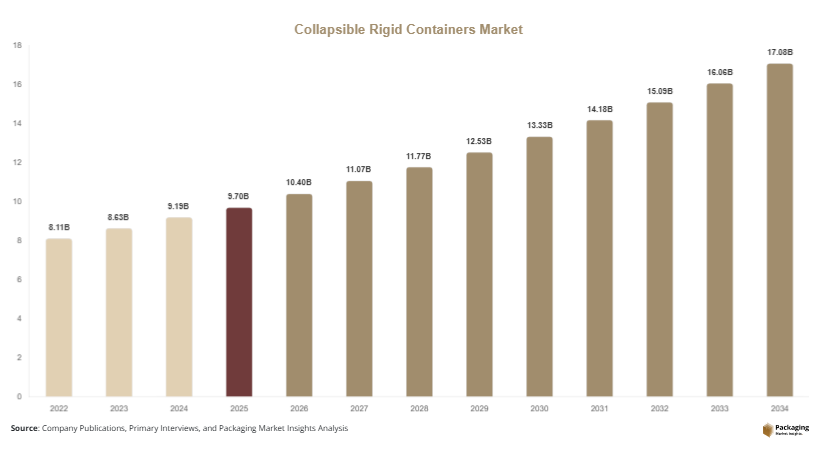
The global collapsible rigid containers market size was valued at USD 9.7 billion in 2025 and is projected to reach USD 10.4 billion in 2026. Over the forecast period from 2025 to 2034, the market is expected to expand at a CAGR of 6.4%, reaching approximately USD 18.1 billion by 2034. This growth reflects the rising demand for efficient storage and transportation solutions across industries such as automotive, retail, agriculture, and manufacturing. The collapsible rigid containers market is gaining steady traction as industries increasingly prioritize space optimization, cost efficiency, and sustainable logistics solutions.
One of the primary growth factors driving the collapsible rigid containers market is the increasing focus on reducing logistics costs. These containers can be folded when not in use, significantly reducing storage space and transportation expenses. Another important factor is the growth of global supply chains and e-commerce, which require efficient and reusable packaging systems to handle large volumes of goods. Additionally, sustainability concerns are encouraging the adoption of reusable packaging solutions, as collapsible rigid containers help reduce single-use packaging waste.
Key Highlights
- Asia Pacific dominated the market with a 39.2% share in 2025, while Latin America is projected to grow at the fastest CAGR of 7.1%.
- Plastic containers led the type segment with a 47.8% share, while metal containers are expected to grow at a CAGR of 6.8%.
- Reusable containers dominated with a 64.3% share, while foldable hybrid designs are forecasted to grow at a CAGR of 6.6%.
- Automotive applications led the segment with 36.5% share, while e-commerce logistics are expected to grow at a CAGR of 7.3%.
- China remained the dominant country with a market size of USD 2.6 billion in 2025 and USD 2.9 billion in 2026.
Explore more data points, trends and opportunities Download Free Sample Report
Market Trends
Rising adoption of reusable and returnable packaging systems
The collapsible rigid containers market is experiencing a shift toward reusable and returnable packaging systems. Companies across industries are focusing on reducing packaging waste and improving sustainability by adopting containers that can be used multiple times. Collapsible rigid containers are particularly suitable for closed-loop supply chains, where goods are transported between fixed locations. This trend is driven by both environmental concerns and cost savings, as reusable containers reduce the need for continuous procurement of single-use packaging materials. As sustainability regulations become stricter, the adoption of such systems is expected to increase further.
Integration of smart technologies for supply chain optimization
The integration of smart technologies is emerging as a significant trend in the collapsible rigid containers market. Manufacturers are incorporating RFID tags, GPS tracking, and IoT-enabled sensors into containers to improve visibility and tracking across supply chains. These technologies allow companies to monitor container location, usage, and condition in real time, enhancing operational efficiency. The ability to track assets reduces losses and improves inventory management. As digital transformation continues to reshape logistics operations, the demand for smart collapsible containers is expected to grow.
Market Drivers
Expansion of global supply chains and logistics networks
The expansion of global supply chains is a key driver of the collapsible rigid containers market. As businesses operate across multiple regions, there is a growing need for efficient packaging solutions that can withstand long-distance transportation. Collapsible rigid containers provide durability and flexibility, making them suitable for various logistics applications. The growth of international trade and e-commerce is further increasing the demand for such containers. Companies are adopting these solutions to improve supply chain efficiency and reduce operational costs.
Increasing focus on cost efficiency and space optimization
Cost efficiency and space optimization are critical factors driving the adoption of collapsible rigid containers. These containers can be folded when empty, reducing the space required for storage and transportation. This feature is particularly beneficial for companies dealing with large volumes of goods. By minimizing storage space and transportation costs, businesses can improve their overall profitability. The demand for such cost-effective solutions is expected to drive market growth.
Market Restraint
High initial investment and maintenance requirements
One of the primary challenges in the collapsible rigid containers market is the high initial investment required for purchasing these containers. While they offer long-term cost savings, the upfront cost can be a barrier for small and medium-sized enterprises. Additionally, maintenance and repair of these containers can add to operational expenses. For example, containers used in harsh industrial environments may require frequent maintenance to ensure durability and performance. These factors can limit adoption, particularly in cost-sensitive markets, and may slow market growth.
Market Opportunities
Growth of e-commerce and retail logistics
The rapid growth of e-commerce and retail logistics presents significant opportunities for the collapsible rigid containers market. Online retailers require efficient packaging solutions to handle large volumes of goods and ensure safe delivery. Collapsible containers offer durability and ease of handling, making them suitable for e-commerce applications. As online shopping continues to grow, the demand for such containers is expected to increase.
Development of advanced materials and lightweight designs
The development of advanced materials and lightweight designs is creating new opportunities in the market. Manufacturers are focusing on reducing the weight of containers while maintaining strength and durability. Lightweight containers reduce transportation costs and improve handling efficiency. The use of advanced materials such as high-performance plastics and composites is enabling the production of innovative container designs. These developments are expected to drive market growth.
Report Scope
| Report Metric | Details |
|---|---|
| Market Size in 2025 | USD 9.7 Billion |
| Market Size in 2026 | USD 10.4 Billion |
| Market Size in 2034 | USD 18.1 Billion |
| CAGR | 6.4% (2026-2034) |
| Base Year for Estimation | 2025 |
| Historical Data | 2022-2024 |
| Forecast Period | 2026-2034 |
| Report Coverage | Revenue Forecast, Competitive Landscape, Supply Chain Disruption, Growth Factors, Environment & Regulatory Landscape and Trends |
| Geographies Covered | North America, Europe, APAC, Middle East and Africa, LATAM |
| Countries Covered | U.S., Canada, U.K., Germany, France, Spain, Italy, Russia, Nordic, Benelux, Rest of Europe, China, South Korea, Japan, India, Australia, Singapore, Taiwan, South East Asia, Rest of Asia-Pacific, UAE, Turky, Saudi Arabia, South Africa, Egypt, Nigeria, Rest of MEA, Brazil, Mexico, Argentina, Chile, Colombia, Rest of LATAM |
Explore more data points, trends and opportunities Download Free Sample Report
Segmental Analysis
By Type
Plastic containers dominated the market in 2024, accounting for approximately 47.8% of the total share. These containers are widely used due to their durability, lightweight nature, and cost-effectiveness. Plastic collapsible containers are suitable for a wide range of applications, including logistics and industrial use. The demand for plastic containers is supported by their versatility and ease of handling.
Metal containers are expected to grow at the fastest CAGR of 6.8% during the forecast period. These containers offer higher strength and durability, making them suitable for heavy-duty applications. The increasing demand for robust packaging solutions is driving the growth of this segment.
By Design
Reusable containers accounted for the largest share of 64.3% in 2024, driven by their cost efficiency and environmental benefits. These containers can be used multiple times, reducing the need for single-use packaging. The demand for reusable containers is supported by sustainability initiatives.
Foldable hybrid designs are expected to grow at a CAGR of 6.6% during the forecast period. These designs offer flexibility and improved functionality, making them suitable for various applications. The increasing demand for innovative packaging solutions is driving the growth of this segment.
By Application
Automotive applications held the largest share of 36.5% in 2024, driven by the need for efficient transportation of components. Collapsible rigid containers are widely used in the automotive industry to reduce logistics costs and improve efficiency. The growth of the automotive sector is supporting the demand for these containers.
E-commerce logistics are expected to grow at the fastest CAGR of 7.3% during the forecast period. The rapid growth of online retail is driving demand for efficient packaging solutions. Collapsible containers offer durability and ease of handling, making them suitable for e-commerce applications.
Collapsible Rigid Containers Market Segmentations
By Product Type
- Plastic Containers
- Metal Containers
- Composite Containers
By Application
- Automotive
- E-commerce Logistics
- Agriculture
- Industrial Manufacturing
By Design
- Reusable Containers
- Foldable Containers
- Hybrid Designs
Regional Analysis
North America
North America accounted for 23.5% of the collapsible rigid containers market share in 2025 and is projected to grow at a CAGR of 6.0% during the forecast period. The region benefits from a well-established logistics and supply chain infrastructure. The presence of major e-commerce companies and industrial manufacturers is driving demand for efficient packaging solutions. Increasing focus on sustainability is also supporting market growth.
The United States is the dominant country in North America, supported by its advanced logistics network. A key growth factor is the increasing adoption of reusable packaging solutions in the retail and automotive sectors. This trend is driving demand for collapsible rigid containers in the region.
Europe
Europe held a market share of 21.8% in 2025 and is expected to grow at a CAGR of 5.9% through 2034. The region is characterized by strict environmental regulations and a strong focus on sustainability. Companies are adopting reusable packaging solutions to comply with regulatory requirements. The demand for collapsible rigid containers is also supported by the growth of industrial and automotive sectors.
Germany leads the European market due to its strong manufacturing base. A unique growth factor is the increasing adoption of circular economy practices, which is driving demand for reusable packaging solutions.
Asia Pacific
Asia Pacific dominated the collapsible rigid containers market with a 39.2% share in 2025 and is projected to grow at a CAGR of 6.8%. The region benefits from rapid industrialization and expanding logistics networks. The growth of e-commerce and manufacturing sectors is driving demand for efficient packaging solutions.
China is the leading country in the region, supported by its large manufacturing capacity. A key growth factor is the increasing demand for cost-effective logistics solutions, which is driving the adoption of collapsible rigid containers.
Middle East & Africa
The Middle East & Africa accounted for 6.9% of the market share in 2025 and is expected to grow at a CAGR of 6.2%. The region is witnessing growth in logistics and industrial sectors, supported by increasing investment in infrastructure. The demand for collapsible rigid containers is also driven by the expansion of retail and e-commerce sectors.
The United Arab Emirates is a key market in the region, driven by its strategic location as a logistics hub. A unique growth factor is the increasing development of smart logistics solutions, which is supporting market growth.
Latin America
Latin America held a market share of 8.6% in 2025 and is projected to grow at the fastest CAGR of 7.1%. The region is experiencing growth in industrial and agricultural sectors, which is driving demand for packaging solutions. Increasing investment in logistics infrastructure is also supporting market growth.
Brazil is the dominant country in Latin America, supported by its large industrial base. A key growth factor is the increasing adoption of efficient packaging solutions in agriculture and manufacturing.
Competitive Landscape
The collapsible rigid containers market is characterized by the presence of several global and regional players focusing on innovation and sustainability. Companies are investing in advanced materials and designs to improve product performance. Schoeller Allibert is considered a leading player due to its extensive product portfolio and strong global presence. The company has recently introduced new collapsible container solutions to enhance logistics efficiency.
Other key players are focusing on strategic partnerships and capacity expansion to strengthen their market position. Companies are also investing in research and development to develop innovative packaging solutions. The competitive landscape is expected to remain dynamic, with sustainability and technological advancements driving competition.
Key Players List
- Schoeller Allibert
- ORBIS Corporation
- SSI Schaefer Group
- DS Smith Plc
- Georg Utz Holding AG
- Myers Industries, Inc.
- IPL Plastics Inc.
- Nefab Group
- Brambles Limited
- Tosca Ltd.
- CABKA Group
- Bulk Handling Australia Group
- Rehrig Pacific Company
- Monoflo International
- TranPak Inc.