Cold Form Blister Packaging Market Size and Growth
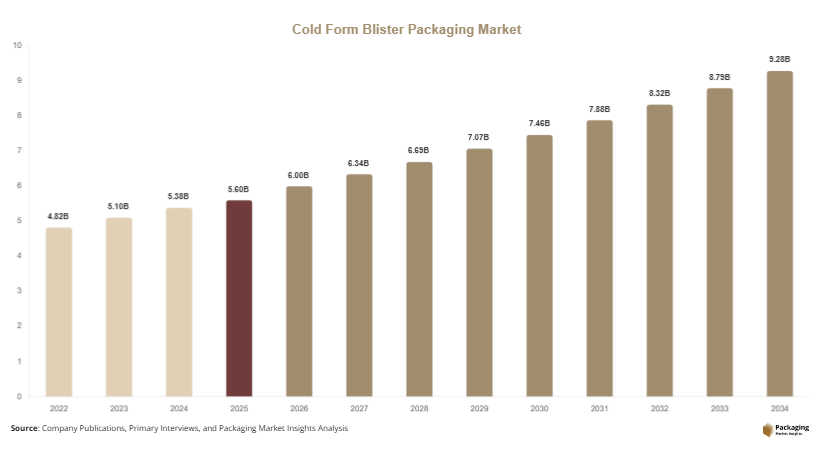
The global cold form blister packaging market size is estimated at USD 5.6 billion in 2025, increasing to approximately USD 6.0 billion in 2026. The market is projected to reach USD 9.8 billion by 2034, expanding at a compound annual growth rate (CAGR) of 5.6% from 2025 to 2034. Market expansion is primarily supported by the rapid growth of the pharmaceutical industry, increasing demand for advanced drug protection packaging, and the rising prevalence of chronic diseases requiring long-term medication.
The cold form blister packaging market has gained strong momentum due to the rising demand for protective pharmaceutical packaging and improved barrier solutions. Cold form blister packaging is widely used for medicines that require strong moisture, oxygen, and light protection. The technology uses aluminum-based laminate materials that form cavities without heat, ensuring higher barrier properties compared to traditional thermoformed blister packaging. This characteristic has made it a preferred packaging method for sensitive pharmaceutical products, particularly tablets and capsules with strict stability requirements.
Key Highlights
- Market size estimated at USD 5.6 billion in 2025
- Expected to reach USD 9.8 billion by 2034
- CAGR of 5.6% (2025–2034)
- Pharmaceuticals remain the dominant application segment
- Asia Pacific emerging as the fastest-growing regional market
Explore more data points, trends and opportunities Download Free Sample Report
Market Trends
Increasing Adoption of High-Barrier Pharmaceutical Packaging
One notable trend shaping the cold form blister packaging market is the increasing adoption of high-barrier packaging solutions in the pharmaceutical industry. Drug manufacturers are prioritizing packaging technologies that protect sensitive formulations from moisture, oxygen, and light exposure. Cold form blister packaging uses aluminum-based laminates that provide strong barrier performance, helping pharmaceutical companies maintain drug stability during long distribution cycles. This trend is especially important for biologically sensitive medicines and export products that must remain stable in varying climatic conditions. As regulatory authorities place greater emphasis on drug safety and product quality, pharmaceutical companies are investing in packaging formats that improve product protection. Consequently, cold form blister packaging is gaining wider acceptance across global pharmaceutical supply chains.
Rising Focus on Sustainable and Recyclable Packaging Materials
Another important trend in the market is the increasing focus on sustainability in pharmaceutical packaging. Manufacturers are working to develop eco-friendly cold form blister laminates that reduce material usage while maintaining barrier properties. Many packaging companies are introducing thinner aluminum layers and recyclable polymer components to improve environmental performance. This shift is supported by government regulations and corporate sustainability goals across healthcare and pharmaceutical sectors. As pharmaceutical companies adopt environmentally responsible packaging practices, cold form blister packaging manufacturers are investing in research and development to create recyclable multilayer materials. These innovations aim to balance product protection, regulatory compliance, and sustainability objectives while maintaining packaging efficiency.
Market Drivers
Expanding Global Pharmaceutical Manufacturing
A major driver supporting the cold form blister packaging market growth is the rapid expansion of global pharmaceutical manufacturing. Increasing healthcare demand, aging populations, and rising chronic disease prevalence are driving large-scale drug production. Pharmaceutical manufacturers require packaging solutions that provide reliable protection against environmental conditions. Cold form blister packaging offers strong barrier properties that help maintain product quality during storage and transportation. In addition, pharmaceutical companies exporting medicines to international markets must meet strict packaging regulations. Cold form blister packs support compliance with stability and safety requirements, which strengthens their adoption among pharmaceutical manufacturers worldwide.
Increasing Demand for Extended Shelf Life Packaging
Another key factor driving market growth is the rising need for packaging solutions that extend product shelf life. Many medicines are sensitive to moisture and oxygen exposure, which can affect chemical stability and efficacy. Cold form blister packaging significantly reduces the risk of degradation by creating a protective aluminum barrier around individual doses. This capability allows pharmaceutical companies to extend product shelf life and improve inventory management across distribution networks. As pharmaceutical supply chains become more globalized, the demand for packaging solutions that maintain drug integrity during long transit periods continues to increase.
Market Restraint
High Material and Production Costs
One major restraint affecting the cold form blister packaging market is the relatively higher cost of materials and production processes compared with thermoformed blister packaging. Cold form blister packaging uses aluminum-based laminates that provide strong barrier protection, but these materials are more expensive than standard plastic films used in thermoforming processes. In addition, cold forming requires specialized machinery and manufacturing processes, which increases capital investment for packaging manufacturers.
The cost factor becomes particularly significant for pharmaceutical companies producing large volumes of low-cost generic medicines. In such cases, manufacturers often prefer thermoformed blister packaging because it provides acceptable protection at a lower production cost. This price difference can limit the adoption of cold form blister solutions in cost-sensitive markets.
For example, generic drug manufacturers in emerging economies may prioritize cost efficiency over advanced barrier protection when packaging standard medications. As a result, thermoformed blister packaging remains widely used for certain pharmaceutical products. However, for medicines that require strict environmental protection, cold form blister packaging continues to remain essential despite the higher cost structure.
Market Opportunities
Growth of Generic Drug Manufacturing in Emerging Markets
One major opportunity for the cold form blister packaging market lies in the rapid expansion of generic drug manufacturing across emerging economies. Countries such as India, China, and Brazil have become major pharmaceutical manufacturing hubs due to lower production costs and strong export demand. Generic drug producers are increasingly adopting cold form blister packaging to ensure product stability during international distribution. Many export markets require strict pharmaceutical packaging standards, which encourage manufacturers to use high-barrier packaging solutions. As generic drug production continues to expand globally, demand for cold form blister packaging is expected to increase significantly.
Increasing Demand for Biologic and Sensitive Medicines
Another promising opportunity is the rising development of biologic drugs and sensitive pharmaceutical formulations. Many modern medicines require advanced packaging technologies that prevent moisture, oxygen, and light exposure. Cold form blister packaging provides the necessary barrier protection for these high-value drugs. Pharmaceutical companies developing complex therapies are increasingly focusing on packaging systems that ensure long-term product stability. As the global pharmaceutical industry continues to invest in advanced drug development, the need for reliable protective packaging solutions will grow, creating favorable growth opportunities for the cold form blister packaging market.
Report Scope
| Report Metric | Details |
|---|---|
| Market Size in 2025 | USD 5.6 Billion |
| Market Size in 2026 | USD 6.0 Billion |
| Market Size in 2034 | USD 9.8 Billion |
| CAGR | 5.6% (2026-2034) |
| Base Year for Estimation | 2025 |
| Historical Data | 2022-2024 |
| Forecast Period | 2026-2034 |
| Report Coverage | Revenue Forecast, Competitive Landscape, Supply Chain Disruption, Growth Factors, Environment & Regulatory Landscape and Trends |
| Geographies Covered | North America, Europe, APAC, Middle East and Africa, LATAM |
| Countries Covered | U.S., Canada, U.K., Germany, France, Spain, Italy, Russia, Nordic, Benelux, Rest of Europe, China, South Korea, Japan, India, Australia, Singapore, Taiwan, South East Asia, Rest of Asia-Pacific, UAE, Turky, Saudi Arabia, South Africa, Egypt, Nigeria, Rest of MEA, Brazil, Mexico, Argentina, Chile, Colombia, Rest of LATAM |
Explore more data points, trends and opportunities Download Free Sample Report
Segmental Analysis
By Type
The aluminum-based cold form blister packaging segment held the dominant share of the market in 2024, accounting for nearly 68% of total revenue. Aluminum laminates provide superior protection against moisture, oxygen, and light exposure, making them the preferred choice for pharmaceutical manufacturers. Cold form blister packs created from aluminum laminates offer excellent barrier performance and extended shelf life, which is essential for sensitive medicines. Pharmaceutical companies prefer aluminum-based packaging because it helps maintain product stability during long distribution cycles and international shipping. As the pharmaceutical industry continues to prioritize product safety and compliance with packaging regulations, the aluminum laminate segment is expected to maintain a strong market presence.
The aluminum-plastic laminate segment is projected to be the fastest-growing category, expanding at a CAGR of approximately 6.4% during the forecast period. This segment is gaining attention due to its balance between barrier protection and material flexibility. Aluminum-plastic laminates combine the protective properties of aluminum with the durability of polymer films. These materials allow packaging manufacturers to produce lighter and more flexible blister packs while maintaining strong protective characteristics. Pharmaceutical companies are increasingly adopting these laminates for medicines that require moderate barrier protection but also need cost-efficient packaging solutions.
By Application
The tablets segment accounted for the largest share of the cold form blister packaging market in 2024, representing approximately 54% of total market revenue. Tablets are one of the most widely used pharmaceutical dosage forms due to their convenience, stability, and ease of production. Cold form blister packaging is widely used for tablet packaging because it provides strong protection against environmental factors that may affect drug stability. Individual cavity packaging also allows precise dosage control and reduces contamination risks. Pharmaceutical companies prefer blister packaging for tablets because it enhances patient compliance and supports safe medication storage.
The capsules segment is expected to grow at the fastest pace, registering a CAGR of around 6.1% during the forecast period. Capsule formulations are becoming increasingly popular in the pharmaceutical and nutraceutical industries due to their ease of consumption and rapid absorption properties. Many capsule-based medicines require enhanced protection from moisture and oxygen exposure. Cold form blister packaging provides reliable protection that helps maintain capsule integrity throughout the product lifecycle. As the demand for capsule-based pharmaceuticals and dietary supplements increases, the adoption of cold form blister packaging in this segment is expected to rise.
By End-Use
The pharmaceutical manufacturing segment dominated the market in 2024, accounting for nearly 72% of the overall market share. Pharmaceutical manufacturers rely heavily on blister packaging to ensure drug stability and regulatory compliance. Cold form blister packaging offers strong barrier protection, making it suitable for medicines that are sensitive to environmental conditions. The packaging also allows manufacturers to create unit-dose formats that improve medication adherence and reduce the risk of contamination. As pharmaceutical companies continue to expand global drug production, the demand for advanced packaging solutions remains strong.
The contract packaging organizations (CPOs) segment is expected to witness the fastest growth, with a projected CAGR of 6.6% between 2025 and 2034. Pharmaceutical companies are increasingly outsourcing packaging operations to specialized service providers to reduce operational costs and improve efficiency. Contract packaging organizations offer advanced packaging technologies and flexible production capabilities that help pharmaceutical companies scale their operations. These organizations are investing in modern blister packaging equipment to meet growing industry demand. As outsourcing trends increase across the pharmaceutical sector, the role of contract packaging providers in the cold form blister packaging market is expected to expand.
Cold Form Blister Packaging Market Segmentations
Type
- Aluminum-Based Cold Form Blister
- Aluminum-Plastic Laminate Blister
- Other Cold Form Laminates
Application
- Tablets
- Capsules
- Nutraceutical Products
- Other Pharmaceutical Products
End-Use
- Pharmaceutical Manufacturers
- Contract Packaging Organizations
- Nutraceutical Manufacturers
Region
- North America
- Europe
- Asia Pacific
- Middle East & Africa
- Latin America
Regional Analysis
North America
North America held a significant share of the cold form blister packaging market in 2025, accounting for approximately 30% of global revenue. The region is expected to grow at a CAGR of around 5.1% during the forecast period. The presence of a large pharmaceutical manufacturing base and strong regulatory standards for drug packaging continue to support market growth. Pharmaceutical companies in the United States and Canada increasingly prefer high-barrier packaging solutions to ensure product safety during long distribution cycles.
The United States remains the dominant market in the region. A key growth factor is the strong focus on drug safety and regulatory compliance. Pharmaceutical manufacturers must meet strict stability and packaging requirements set by regulatory authorities. This environment encourages the adoption of cold form blister packaging for sensitive medicines and specialty pharmaceutical products.
Europe
Europe accounted for nearly 27% of the global cold form blister packaging market share in 2025. The market is expected to grow at a CAGR of approximately 4.9% from 2025 to 2034. Growth is driven by the region’s well-established pharmaceutical industry and increasing demand for advanced packaging technologies. Pharmaceutical companies across Europe are investing in packaging systems that maintain drug stability and support long-term storage requirements.
Germany represents the leading country within the European market. One key growth factor is the region’s strong pharmaceutical export industry. European drug manufacturers export medicines worldwide, requiring packaging solutions that provide high-barrier protection during long transportation periods. Cold form blister packaging supports these export activities by ensuring product quality and shelf life.
Asia Pacific
Asia Pacific is expected to be the fastest-growing region in the cold form blister packaging market, holding nearly 25% of global share in 2025 and projected to grow at a CAGR of 6.7% during the forecast period. Rapid pharmaceutical manufacturing expansion and increasing healthcare demand are supporting regional growth. Many international pharmaceutical companies are also establishing manufacturing facilities in the region.
India is the dominant country in the Asia Pacific market. A major growth factor is the rapid expansion of generic drug production and export activities. Indian pharmaceutical manufacturers export medicines to numerous global markets that require high-barrier packaging. As a result, the adoption of cold form blister packaging continues to increase across the country.
Middle East & Africa
The Middle East & Africa accounted for approximately 10% of the global cold form blister packaging market share in 2025. The market is expected to expand at a CAGR of about 5.0% between 2025 and 2034. Growth is supported by increasing pharmaceutical imports and the development of regional healthcare infrastructure. Governments across the region are investing in pharmaceutical manufacturing capabilities to reduce dependency on imported medicines.
Saudi Arabia is emerging as a leading market in the region. One key growth factor is the expansion of domestic pharmaceutical production supported by government initiatives. As the country strengthens its pharmaceutical manufacturing sector, demand for reliable packaging solutions such as cold form blister packaging is expected to grow steadily.
Latin America
Latin America represented nearly 8% of the global cold form blister packaging market in 2025 and is expected to grow at a CAGR of around 5.3% during the forecast period. The region’s pharmaceutical sector is expanding due to increasing healthcare demand and improved drug manufacturing capabilities. Pharmaceutical companies are adopting advanced packaging technologies to maintain drug quality during distribution.
Brazil dominates the regional market. A significant growth factor is the rising demand for generic medicines and improved pharmaceutical distribution networks. As pharmaceutical companies expand their manufacturing operations, the demand for high-barrier packaging solutions such as cold form blister packaging continues to increase.
Competitive Landscape
The cold form blister packaging market is moderately competitive, with several global and regional packaging companies operating across pharmaceutical supply chains. Market participants focus on product innovation, material development, and expansion of manufacturing capabilities to strengthen their market position. Companies are investing in advanced laminate technologies that improve barrier performance while reducing material consumption.
Large packaging manufacturers are also forming strategic partnerships with pharmaceutical companies to develop customized packaging solutions. These collaborations help companies meet strict pharmaceutical packaging standards while improving operational efficiency.
One of the leading players in the market is Amcor plc, which holds a significant share due to its extensive portfolio of pharmaceutical packaging materials and global manufacturing presence. The company continues to invest in sustainable packaging innovations and high-barrier laminate technologies.
Another notable development in the market includes the expansion of production facilities by several packaging manufacturers to meet rising pharmaceutical demand. Companies are also increasing investments in research and development to introduce recyclable blister packaging materials. These innovations aim to address environmental concerns while maintaining strong barrier protection required for pharmaceutical products.
Key Players List
- Amcor plc
- Constantia Flexibles
- UFlex Limited
- Bilcare Limited
- Honeywell International Inc.
- ACG Pharmapack Pvt. Ltd.
- Essentra plc
- Tekni-Plex Inc.
- Winpak Ltd.
- Huhtamaki Oyj
- WestRock Company
- Sonoco Products Company
- Klockner Pentaplast Group
- Perlen Packaging AG
- Wasdell Packaging Group