Cohesive Packaging Market Report Size and Growth
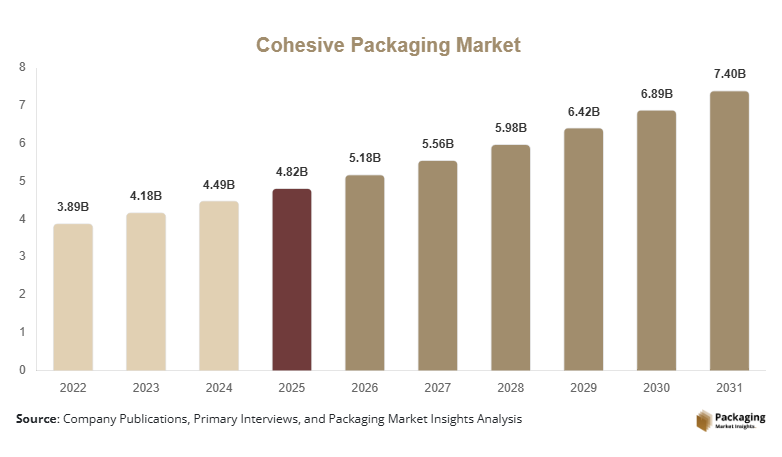
The Cohesive Packaging Market was valued at USD 4.82 billion in 2025 and is projected to reach USD 7.41 billion by 2031, expanding at a CAGR of 7.4% during the forecast period (2025–2031). Cohesive packaging refers to packaging materials that adhere to themselves without the need for adhesives, tapes, or heat sealing. These solutions are widely used in industries such as e-commerce, food packaging, pharmaceuticals, and logistics where tamper resistance, efficiency, and product protection are essential.
One of the primary global factors supporting the growth of the cohesive packaging market is the rapid expansion of e-commerce logistics and automated packaging lines. Cohesive packaging materials offer improved operational efficiency by eliminating the need for additional sealing materials, thereby reducing packaging time and operational costs. As supply chains become more automated and fulfillment centers scale operations, cohesive packaging solutions are increasingly preferred for secure and efficient product handling.
In addition, the growing emphasis on sustainable packaging practices has supported market expansion. Cohesive packaging materials reduce excess packaging waste, minimize the use of adhesives, and improve recyclability compared with traditional packaging methods. Companies across retail, food delivery, and logistics sectors are therefore adopting cohesive packaging solutions to meet environmental targets and enhance operational productivity.
Key Highlights
- North America dominated the cohesive packaging market with 36.4% share in 2025, while Asia Pacific is projected to grow fastest at a CAGR of 8.6%.
- By Type, Cohesive Wraps led the market with 42.7% share, while Cohesive Mailers are projected to grow fastest at 8.9% CAGR.
- By Material, Polyethylene-based cohesive materials dominated with 48.5% share, while biodegradable materials are expected to grow fastest at 9.3% CAGR.
- The United States remained the dominant country market, valued at USD 1.21 billion in 2025 and estimated to reach USD 1.29 billion in 2026.
Explore more data points, trends and opportunities Download Free Sample Report
Market Trends
Integration of Automation-Friendly Packaging Solutions
Automated fulfillment and packaging lines are becoming increasingly common across logistics and e-commerce sectors. This trend has encouraged manufacturers to adopt cohesive packaging materials that are compatible with automated wrapping and sealing equipment. Cohesive films and wraps provide consistent sealing performance without the need for heat or adhesives, improving efficiency in high-speed packaging environments. Companies are increasingly integrating cohesive packaging with automated machinery to reduce labor costs and enhance packaging throughput. This trend is expected to shape product development as manufacturers design cohesive materials specifically optimized for automated packaging systems.
Development of Sustainable Cohesive Materials
Sustainability is becoming a defining trend in the cohesive packaging market. Packaging manufacturers are investing in recyclable and biodegradable cohesive materials that reduce environmental impact. Many suppliers are introducing plant-based films and recyclable polyethylene blends designed to maintain cohesive bonding properties while improving sustainability performance. As global brands adopt stricter sustainability targets and regulatory frameworks emphasize waste reduction, the adoption of eco-friendly cohesive packaging materials is accelerating. This trend is expected to reshape product portfolios as companies develop sustainable cohesive packaging solutions suitable for multiple industries including food delivery, consumer goods, and pharmaceuticals.
Market Drivers
Expansion of Global E-commerce Logistics
The rapid expansion of online retail platforms has significantly increased demand for secure and efficient packaging solutions. Cohesive packaging materials are widely used in e-commerce logistics because they simplify the packaging process and improve shipment security. Unlike traditional packaging methods that rely on adhesives or tapes, cohesive packaging bonds only to itself, reducing the risk of product contamination and packaging errors. E-commerce fulfillment centers increasingly adopt cohesive mailers and wraps to streamline packaging operations and reduce packaging time. As global online retail continues to grow, the demand for cohesive packaging solutions is expected to increase steadily.
Operational Efficiency in Packaging Processes
Manufacturers and logistics providers are prioritizing packaging solutions that improve operational efficiency and reduce costs. Cohesive packaging eliminates the need for additional sealing materials, allowing faster packaging processes and reduced material consumption. This advantage makes cohesive packaging particularly valuable in high-volume industries such as consumer goods distribution and pharmaceutical packaging. By simplifying the packaging workflow, cohesive materials help companies reduce labor requirements and packaging errors while maintaining product protection. As businesses focus on improving supply chain productivity, cohesive packaging solutions are gaining greater adoption across industrial and commercial packaging operations.
Market Restraint
Higher Initial Material and Production Costs
Despite its operational advantages, the cohesive packaging market faces challenges related to higher production costs compared with conventional packaging materials. Cohesive films and wraps require specialized coating technologies and manufacturing processes to achieve consistent bonding properties. These advanced production techniques increase manufacturing costs, which can result in higher prices for cohesive packaging materials.
Small and medium-sized businesses may hesitate to adopt cohesive packaging solutions due to these cost considerations, particularly in price-sensitive industries such as retail packaging and small-scale logistics operations. In addition, the availability of low-cost conventional packaging materials such as adhesive tapes and standard plastic films continues to limit the adoption of cohesive packaging in certain markets.
Another challenge arises from the limited availability of cohesive packaging suppliers in some regions. The production of cohesive materials often requires specialized expertise and equipment, which restricts market entry for new manufacturers. As a result, the cohesive packaging market remains relatively concentrated compared with other packaging sectors.
Addressing these cost barriers will require technological advancements that improve manufacturing efficiency and reduce material costs. Over time, innovations in coating technologies and sustainable material development are expected to help mitigate these restraints and expand the accessibility of cohesive packaging solutions.
Market Opportunities
Growth of Sustainable Packaging Regulations
Governments and regulatory bodies around the world are introducing stricter regulations aimed at reducing packaging waste and improving recyclability. These policies create opportunities for cohesive packaging solutions that reduce the need for additional adhesives and sealing materials. Manufacturers are increasingly developing recyclable cohesive films and biodegradable materials that align with sustainability requirements. As regulatory frameworks continue to evolve, cohesive packaging solutions designed for environmental compliance are expected to gain wider adoption across industries including food packaging, consumer goods, and logistics.
Expansion in Pharmaceutical and Medical Packaging
The pharmaceutical and healthcare sectors are creating new growth opportunities for the cohesive packaging market. Cohesive packaging materials offer tamper-evident sealing and contamination protection, making them suitable for packaging medical supplies and pharmaceutical products. Hospitals and pharmaceutical distributors are adopting cohesive packaging to improve product safety and simplify packaging processes. In addition, the increasing global demand for healthcare products is supporting the expansion of pharmaceutical packaging infrastructure. These factors are expected to create new growth opportunities for cohesive packaging manufacturers focused on medical and healthcare applications.
Report Scope
| Report Metric | Details |
|---|---|
| Market Size in 2025 | USD 4.82 Billion |
| Market Size in 2026 | USD 5.18 Billion |
| Market Size in 2031 | USD 7.41 Billion |
| CAGR | 7.4% (2026-2031) |
| Base Year for Estimation | 2025 |
| Historical Data | 2022-2024 |
| Forecast Period | 2026-2031 |
| Report Coverage | Revenue Forecast, Competitive Landscape, Supply Chain Disruption, Growth Factors, Environment & Regulatory Landscape and Trends |
| Geographies Covered | North America, Europe, APAC, Middle East and Africa, LATAM |
| Countries Covered | U.S., Canada, U.K., Germany, France, Spain, Italy, Russia, Nordic, Benelux, Rest of Europe, China, South Korea, Japan, India, Australia, Singapore, Taiwan, South East Asia, Rest of Asia-Pacific, UAE, Turky, Saudi Arabia, South Africa, Egypt, Nigeria, Rest of MEA, Brazil, Mexico, Argentina, Chile, Colombia, Rest of LATAM |
Explore more data points, trends and opportunities Download Free Sample Report
Segmental Analysis
By Type
The Cohesive Wraps segment dominated the cohesive packaging market and accounted for 42.7% share in 2024. Cohesive wraps are widely used in logistics and pallet packaging because they provide secure bundling without requiring adhesives or heat sealing. These materials are particularly suitable for industrial and warehouse packaging applications where efficient product handling and protection are essential.
The Cohesive Mailers segment will grow at the fastest CAGR of 8.9% during the forecast period. Cohesive mailers are increasingly used in e-commerce packaging due to their tamper-evident properties and ease of use. As online retailers seek packaging solutions that improve operational efficiency and product security, the demand for cohesive mailers will increase significantly.
By Material
The Polyethylene-based materials segment dominated the market with 48.5% share in 2024. Polyethylene cohesive films provide strong durability, flexibility, and consistent bonding properties. These characteristics make them suitable for packaging applications requiring reliable product protection during transportation and storage.
The Biodegradable materials segment will experience the fastest growth at a CAGR of 9.3%. Packaging manufacturers are developing biodegradable cohesive films that maintain performance while reducing environmental impact. As sustainability regulations and environmental awareness continue to increase, demand for biodegradable cohesive packaging materials will expand significantly.
By Application
The E-commerce packaging segment held the largest 40.6% market share in 2024. The rapid growth of online retail platforms has created strong demand for packaging materials capable of protecting products during shipment. Cohesive packaging solutions offer reliable sealing and tamper resistance, making them highly suitable for e-commerce applications.
The Pharmaceutical packaging segment will grow at the fastest CAGR of 8.7% during the forecast period. Pharmaceutical companies are adopting cohesive packaging materials to ensure secure packaging of medical supplies and healthcare products. The increasing demand for safe and efficient pharmaceutical packaging will
Cohesive Packaging Market Segmentations
By Type
- Cohesive Wraps
- Cohesive Mailers
- Cohesive Bags
- Cohesive Sheets
By Material
- Polyethylene
- Polypropylene
- Biodegradable Materials
- Paper-based Cohesive Materials
By Application
- E-commerce Packaging
- Industrial Packaging
- Pharmaceutical Packaging
- Consumer Goods Packaging
By End-Use Industry
- Logistics & Transportation
- Retail & E-commerce
- Healthcare & Pharmaceuticals
- Food & Beverage
Regional Analysis
North America
North America accounted for 36.4% of the cohesive packaging market share in 2025, making it the largest regional market. The region will continue to grow at a forecast CAGR of 6.8% between 2025 and 2033. The strong presence of advanced logistics infrastructure and large-scale e-commerce fulfillment networks contributed significantly to the region’s market dominance. Companies across retail, consumer goods, and pharmaceutical industries have adopted cohesive packaging solutions to improve packaging efficiency and reduce operational complexity.
The United States remained the dominant country within the region. The growth of automated fulfillment centers and large distribution networks created strong demand for cohesive packaging materials. Many packaging manufacturers in the country are investing in advanced packaging technologies designed for automated packaging lines. In addition, the presence of major packaging solution providers and strong technological capabilities continues to support innovation in cohesive packaging materials. These factors have contributed to the continued expansion of the cohesive packaging market in North America.
Europe
Europe represented 25.8% of the cohesive packaging market share in 2025. The region is expected to grow at a CAGR of 6.9% during the forecast period. The adoption of sustainable packaging solutions has been a key factor shaping the regional market. European companies are increasingly adopting packaging materials that reduce waste and support circular economy initiatives.
Germany emerged as the leading country market within Europe. The country’s strong industrial packaging sector and advanced manufacturing capabilities supported the adoption of cohesive packaging materials across logistics and manufacturing industries. German packaging companies are actively investing in research and development to create innovative packaging solutions that improve operational efficiency while meeting environmental regulations. This focus on technological innovation and sustainability continues to drive market expansion within the region.
Asia Pacific
Asia Pacific held 22.6% share of the cohesive packaging market in 2025 and will grow at the fastest CAGR of 8.6% through 2033. Rapid industrialization and the expansion of e-commerce platforms across the region have created significant demand for efficient packaging solutions. The increasing presence of large manufacturing hubs and logistics networks is also supporting the adoption of cohesive packaging materials.
China dominated the Asia Pacific cohesive packaging market. The country’s expanding e-commerce ecosystem and high manufacturing output have increased the need for advanced packaging solutions capable of handling large shipment volumes. Logistics providers and retailers are increasingly adopting cohesive packaging materials to improve packaging efficiency and reduce packaging waste. The continued growth of the e-commerce sector in China is expected to remain a major driver of market expansion in the region.
Middle East & Africa
The Middle East & Africa accounted for 8.1% of the cohesive packaging market share in 2025. The region is expected to grow at a CAGR of 6.4% during the forecast period. The development of logistics infrastructure and expanding trade activities have supported demand for packaging solutions across the region.
The United Arab Emirates emerged as the dominant country market within the region. The country’s position as a global logistics hub has created strong demand for efficient packaging solutions used in trade and distribution activities. Additionally, the expansion of e-commerce platforms and logistics services has encouraged businesses to adopt cohesive packaging materials for secure and efficient product shipments.
Latin America
Latin America held 7.1% share of the cohesive packaging market in 2025 and is projected to grow at a CAGR of 6.6% through 2033. The expansion of regional retail and logistics networks has supported the demand for advanced packaging materials.
Brazil represented the leading country market in the region. The country’s growing retail sector and expanding distribution networks have increased demand for packaging solutions capable of protecting products during transportation. Companies are increasingly adopting cohesive packaging materials to improve packaging efficiency and reduce material waste, supporting the gradual expansion of the cohesive packaging market in Latin America.
Competitive Landscape
The cohesive packaging market is characterized by the presence of several global and regional packaging manufacturers focusing on product innovation and operational efficiency. Companies are investing in research and development to create cohesive materials compatible with automated packaging systems and sustainable packaging initiatives.
3M Company is considered one of the leading participants in the market due to its extensive portfolio of adhesive and packaging technologies. The company has recently introduced advanced cohesive films designed for automated packaging lines, improving packaging efficiency for logistics and e-commerce operations.
Other companies are also focusing on expanding their product portfolios through technological advancements and partnerships with logistics providers. These strategies enable manufacturers to strengthen their market presence and address the growing demand for efficient packaging solutions.
Key Players in the Cohesive Packaging Market
- 3M Company
- Pregis LLC
- Sealed Air Corporation
- Mondi Group
- Smurfit Kappa Group
- Berry Global Inc.
- Intertape Polymer Group
- Coveris Holdings
- Amcor plc
- WestRock Company
- DS Smith Plc
- Uline Inc.
- Ranpak Holdings Corp.
- ProAmpac LLC
- Crawford Packaging