Cling Films Market Size and Growth
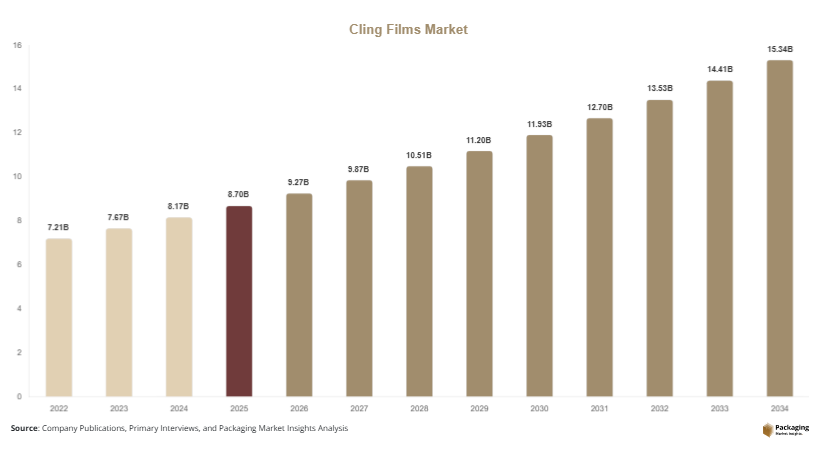
The global cling films market is projected to witness substantial growth over the forecast period, reaching an estimated market size of USD 14.8 billion by 2034, up from USD 8.7 billion in 2025. The market is anticipated to expand at a CAGR of 6.5% during 2025–2034, driven by increasing demand across the food, retail, and industrial sectors. The versatility of cling films, including their barrier properties, ease of use, and cost-effectiveness, makes them a preferred solution for packaging, storage, and preservation purposes.
The rising consumer demand for food safety and hygiene is one of the primary factors supporting market growth. Supermarkets and hypermarkets are increasingly adopting pre-packaged and ready-to-eat food products, which require protective films to maintain freshness and prevent contamination. Additionally, the surge in e-commerce and online grocery sales has boosted the need for packaging solutions that ensure durability during transport and delivery.
Key Highlights
- The global cling films market is projected to reach USD 14.8 billion by 2034, growing steadily at a CAGR of 6.5% from 2025 to 2034, reflecting consistent demand across multiple industries.
- Rising demand from food, retail, and e-commerce sectors is fueling market expansion, as cling films play a key role in preserving products, enhancing presentation, and supporting efficient logistics.
- There is an increasing focus on sustainable and recyclable cling film materials, driven by regulatory pressure and consumer preference for eco-friendly packaging solutions.
- Technological advancements in film production are enhancing durability, barrier properties, and transparency, enabling cling films to maintain product quality over longer storage periods.
- The expansion of applications across pharmaceuticals, cosmetics, and industrial sectors is further boosting market growth, as these industries adopt cling films for safety, hygiene, and product integrity.
Explore more data points, trends and opportunities Download Free Sample Report
Market Trends
Shift Towards Biodegradable and Compostable Films
In response to growing environmental concerns, manufacturers are increasingly producing biodegradable and compostable cling films derived from renewable sources. This trend addresses consumer preferences for sustainable packaging while helping companies comply with environmental regulations aimed at reducing plastic waste. Biodegradable films are gradually replacing conventional polyethylene-based films in many regions, particularly in Europe and North America, where legislation and public awareness are strongest. Companies are investing in research to improve the performance of these eco-friendly films, ensuring they offer comparable barrier properties, strength, and sealing capabilities to traditional options.
Integration of Smart and Active Packaging Technologies
Cling films are evolving beyond traditional protective uses with the integration of smart and active packaging technologies. These innovations include oxygen-scavenging layers, antimicrobial coatings, and temperature-sensitive indicators, which enhance the functionality of packaging. The food and pharmaceutical industries are particularly adopting such films to maintain product quality, extend shelf life, and improve safety. The trend toward smart packaging aligns with growing consumer demand for freshness, convenience, and real-time information about product conditions, creating new opportunities for high-value film solutions.
Market Drivers
Expanding Food and Beverage Industry
The rapid growth of the global food and beverage sector is a significant driver for the cling films market. Processed foods, ready-to-eat meals, and packaged beverages require reliable packaging solutions to maintain hygiene, freshness, and shelf life. Supermarkets, online grocery platforms, and convenience stores are increasingly offering packaged items, boosting demand for cling films. Additionally, rising consumer awareness regarding food safety and quality drives the adoption of films with superior barrier properties, transparency, and sealing performance. This trend is expected to maintain steady market expansion across regions.
Growth of E-Commerce and Logistics Channels
The exponential growth of e-commerce and online grocery delivery services has created substantial demand for cling films as protective packaging solutions. These films provide cushioning, tamper-evidence, and barrier protection, ensuring products remain safe and intact during transit. Retailers and logistics providers are increasingly adopting cling films to optimize packaging efficiency, reduce waste, and enhance customer satisfaction. The surge in DTC (direct-to-consumer) sales also fuels the need for lightweight, durable, and reusable film solutions suitable for shipping fragile or perishable items.
Market Restraint
A major restraint in the cling films market is the environmental concern associated with conventional plastic films. Polyethylene and PVC-based films contribute to plastic pollution, which has led to stringent regulatory measures in regions such as the European Union, North America, and parts of Asia Pacific. Bans on single-use plastics, recycling mandates, and rising disposal costs challenge manufacturers and slow market adoption in some areas. For instance, companies reliant on conventional films must invest in alternative biodegradable solutions or face penalties, increasing production costs. This dynamic limits market growth unless manufacturers innovate sustainable, high-performance alternatives.
Market Opportunities
Development of Eco-Friendly and Recyclable Films
The increasing focus on sustainability presents a significant opportunity for the development of recyclable, biodegradable, and compostable cling films. Consumers are actively seeking environmentally responsible products, and retailers are responding by prioritizing eco-friendly packaging. Innovations in material science, such as plant-based polymers and multi-layered recyclable films, provide manufacturers with a chance to capture new market segments while reducing environmental impact.
Expansion into Industrial and Pharmaceutical Applications
Beyond food packaging, cling films are increasingly being adopted in industrial, pharmaceutical, and personal care applications. For example, pharmaceutical products require sterile and protective packaging, while electronics and cosmetics use cling films for dust-proof and tamper-evident protection. By diversifying applications, manufacturers can unlock higher-value markets and reduce reliance on the highly competitive food packaging sector. This presents opportunities for premium pricing, product differentiation, and enhanced profitability.
Report Scope
| Report Metric | Details |
|---|---|
| Market Size in 2025 | USD 8.7 Billion |
| Market Size in 2026 | USD 9.27 Billion |
| Market Size in 2034 | USD 14.8 Billion |
| CAGR | 6.5% (2026-2034) |
| Base Year for Estimation | 2025 |
| Historical Data | 2022-2024 |
| Forecast Period | 2026-2034 |
| Report Coverage | Revenue Forecast, Competitive Landscape, Supply Chain Disruption, Growth Factors, Environment & Regulatory Landscape and Trends |
| Geographies Covered | North America, Europe, APAC, Middle East and Africa, LATAM |
| Countries Covered | U.S., Canada, U.K., Germany, France, Spain, Italy, Russia, Nordic, Benelux, Rest of Europe, China, South Korea, Japan, India, Australia, Singapore, Taiwan, South East Asia, Rest of Asia-Pacific, UAE, Turky, Saudi Arabia, South Africa, Egypt, Nigeria, Rest of MEA, Brazil, Mexico, Argentina, Chile, Colombia, Rest of LATAM |
Explore more data points, trends and opportunities Download Free Sample Report
Segmental Analysis
Type
Polyethylene (PE) films dominate the market with a share of approximately 60% in 2024. PE films are preferred for their excellent barrier properties, flexibility, transparency, and affordability. These films are widely used in food packaging, catering, and retail applications. Their adaptability to various thicknesses and widths makes them suitable for diverse consumer and industrial requirements. The ease of heat sealing and compatibility with automated packaging lines further strengthens their adoption globally.
Biodegradable and compostable films are the fastest-growing subsegment, with a projected CAGR of 8.2% during 2025–2034. Growth is fueled by stringent environmental regulations and increasing consumer demand for sustainable alternatives. Manufacturers are developing bio-based cling films that maintain comparable barrier properties and durability, creating opportunities for environmentally conscious brands.
Application
Food packaging dominates the application segment, accounting for nearly 70% of the market in 2024. Cling films are extensively used for fresh produce, baked goods, dairy, and ready-to-eat meals. They offer convenience, hygiene, and extended shelf life, making them indispensable for both retail and foodservice industries. Transparent films allow consumers to inspect products visually, enhancing purchasing confidence.
Industrial and medical applications are the fastest-growing subsegments, expected to expand at a CAGR of 7.8%. These applications include protective wrapping for pharmaceutical products, electronics, and cosmetic items. Specialized films with antimicrobial or tamper-evident properties are increasingly adopted, driven by quality and safety requirements.
End-Use
Retail and foodservice sectors dominate end-use applications, accounting for 65% of market share in 2024. Supermarkets, convenience stores, and restaurants rely heavily on cling films for packaging fresh and processed foods. Their versatility, ease of use, and affordability make them preferred solutions for end-users seeking efficiency and hygiene.
E-commerce and online grocery services are the fastest-growing end-use segment, with a CAGR of 8.0%. The rapid adoption of online food and grocery platforms necessitates durable, tamper-evident, and lightweight packaging solutions. Cling films offer protective benefits and convenience, supporting safe product delivery in the growing DTC retail ecosystem.
Cling Films Market Segmentations
Type
- Polyethylene (PE) Films
- Polyvinyl Chloride (PVC) Films
- Biodegradable/Compostable Films
Application
- Food Packaging
- Industrial Packaging
- Medical/Pharmaceutical Packaging
End-Use
- Retail
- Foodservice
- E-commerce & Online Grocery
Regional Analysis
North America
In 2025, North America accounts for approximately 28% of the global cling films market, supported by strong demand from foodservice, retail, and e-commerce sectors. The region is expected to expand at a CAGR of 5.9% during 2025–2034, driven by the adoption of innovative packaging solutions and rising awareness of food safety standards. The convenience food market is particularly large, supporting the continuous growth of cling film consumption.
The United States dominates the regional market due to the rapid growth of online grocery and food delivery services. Consumer preferences for convenience, freshness, and ready-to-eat meals contribute to sustained demand for high-quality cling films. Retailers and food processors increasingly invest in packaging solutions with improved sealing, transparency, and barrier properties, fostering innovation and expansion in this sector.
Europe
Europe accounted for nearly 24% of the global market in 2025 and is projected to grow at a CAGR of 6.2% during the forecast period. Growth is fueled by rising demand for packaged and processed food, stringent food safety regulations, and a strong focus on sustainable packaging solutions. Consumers in Western Europe are highly conscious of environmental impact, which encourages manufacturers to produce recyclable and biodegradable films.
Germany holds a dominant position in the European market due to strict regulatory policies on food safety and plastic waste management. The country’s focus on eco-friendly packaging adoption drives innovation in multi-layered, high-performance cling films. Additionally, the presence of leading food and retail companies ensures sustained demand for advanced cling film products with enhanced functionality and sustainability features.
Asia Pacific
Asia Pacific represents approximately 30% of the global market in 2025 and is projected to expand at a CAGR of 7.1% from 2025 to 2034. Rapid urbanization, rising disposable income, and increasing penetration of organized retail chains are key factors driving market growth. Countries in the region are witnessing a surge in ready-to-eat and processed foods, which directly supports the demand for cling films.
China dominates the Asia Pacific market, driven by rapid urban population growth, rising e-commerce adoption, and increasing demand for packaged foods. Food manufacturers are investing heavily in high-quality, transparent, and tamper-evident films to cater to modern retail requirements. The government’s initiatives promoting food safety and hygiene standards further accelerate adoption in this market.
Middle East & Africa
In 2025, the Middle East & Africa region holds around 8% of the global market, expected to grow at a CAGR of 5.6% during 2025–2034. Growth is fueled by the expanding foodservice and retail sectors, along with increased adoption of processed foods in urban centers. E-commerce penetration and demand for convenient packaging also contribute to regional growth.
Saudi Arabia leads the regional market, supported by government initiatives in food security and modern retail infrastructure development. The region’s growing tourism and hospitality industries create demand for packaged foods and beverages, increasing reliance on cling films for preservation, hygiene, and consumer convenience.
Latin America
Latin America accounts for approximately 10% of the global market in 2025, with an expected CAGR of 6.0% through 2034. Market growth is supported by the expansion of modern retail chains, increasing food exports, and rising awareness of food safety standards. The demand for cling films is further supported by the growing processed food and frozen food sectors.
Brazil is the dominant country in Latin America, driven by urbanization, rapid growth in supermarkets, and rising disposable income. Food manufacturers and retailers are increasingly adopting cling films for packaging, storage, and transportation of perishable items. Government initiatives to improve food quality and hygiene standards also support market adoption in the country.
Competitive Landscape
The global cling films market is moderately consolidated, with top players accounting for a significant share. Leading companies focus on product innovation, sustainability, and expansion into new markets to maintain competitiveness. Key companies include Berry Global Inc., Amcor plc, Sealed Air Corporation, SCG Packaging, and Klöckner Pentaplast.
Berry Global Inc. holds a leadership position due to its extensive product portfolio and investments in sustainable film solutions. Recent developments include the launch of biodegradable and recyclable cling films designed for industrial and retail applications. Companies are leveraging R&D and strategic partnerships to enhance product offerings, comply with environmental regulations, and meet growing consumer demand.
Key Players List
- Berry Global Inc.
- Amcor plc
- Sealed Air Corporation
- SCG Packaging
- Klöckner Pentaplast
- Winpak Ltd.
- Uflex Ltd.
- Inteplast Group
- Innovia Films
- Polyplex Corporation Ltd.
- F. Kuester GmbH & Co. KG
- ExxonMobil Chemical Company
- Prolamina GmbH
- Flex Films Ltd.
- Covestro AG