Cleanroom Packaging Market Size and Growth
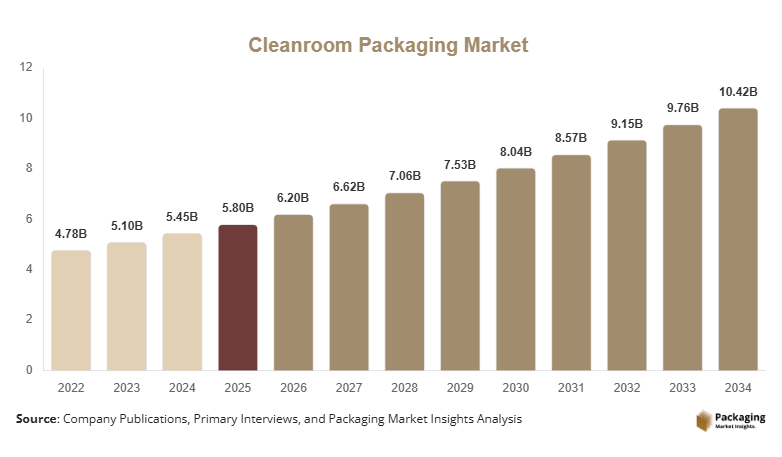
The global cleanroom packaging market size is estimated at USD 5.8 billion in 2025, while the market is projected to reach approximately USD 6.2 billion in 2026. By 2034, the market is forecasted to attain nearly USD 10.4 billion, registering a CAGR of 6.7% during 2025–2034. The cleanroom packaging market is experiencing stable growth due to increasing demand for contamination-free packaging solutions across pharmaceutical, biotechnology, semiconductor, medical device, and electronics industries. Cleanroom packaging products are specifically designed and manufactured in controlled environments to minimize particulate contamination and maintain sterile conditions during storage, transportation, and processing. These packaging solutions include cleanroom bags, pouches, films, trays, bottles, and containers that comply with strict cleanliness and regulatory standards. The growing importance of sterile manufacturing and contamination control in healthcare and high-precision industries is significantly supporting market expansion.
One of the major growth factors driving the market is the rapid expansion of pharmaceutical and biotechnology manufacturing activities worldwide. Increasing production of sterile medicines, biologics, and injectable products requires advanced cleanroom packaging solutions capable of maintaining product integrity throughout the supply chain. Another important growth factor is the growing semiconductor and electronics manufacturing industry, where contamination-free packaging is critical for protecting highly sensitive electronic components. In addition, increasing investments in healthcare infrastructure and medical device production are creating substantial demand for sterile and high-purity packaging products.
Key Highlights
- Asia Pacific dominated the market with a 39.8% share in 2025.
- Latin America is projected to grow at the fastest CAGR of 7.1%.
- Cleanroom bags & pouches led the product segment with a 44.6% share.
- Plastic-based materials dominated with a 57.2% share.
- Pharmaceutical applications led the market with a 41.3% share.
- The US remained the dominant country with a market size of USD 1.3 billion in 2025 and USD 1.4 billion in 2026.
Explore more data points, trends and opportunities Download Free Sample Report
Market Trends
Increasing Adoption of Sustainable Cleanroom Packaging Materials
Sustainability is becoming an important trend in the cleanroom packaging market as manufacturers seek environmentally responsible packaging solutions without compromising contamination control standards. Companies are increasingly investing in recyclable plastics, reusable packaging systems, and reduced-material packaging designs to minimize environmental impact. Pharmaceutical and electronics manufacturers are also adopting eco-friendly cleanroom packaging to support corporate sustainability goals and comply with evolving environmental regulations. In addition, advancements in material science are enabling the development of low-particle recyclable films and cleanroom-compatible biodegradable materials. These innovations are helping manufacturers balance contamination prevention with sustainability requirements across healthcare and industrial applications.
Rising Demand for Anti-Static and High-Barrier Packaging Solutions
The growing semiconductor and electronics industries are driving demand for anti-static and high-barrier cleanroom packaging solutions. Sensitive electronic components require protection against electrostatic discharge, moisture, dust, and contamination during manufacturing and transportation. Manufacturers are increasingly using advanced cleanroom films, conductive bags, and moisture-resistant packaging systems to improve product safety and operational reliability. In addition, growth in precision medical devices and biotechnology products is increasing the need for high-barrier sterile packaging capable of maintaining controlled conditions throughout the supply chain. This trend is encouraging packaging companies to develop multi-functional cleanroom packaging materials with improved protective performance.
Market Drivers
Expansion of Pharmaceutical and Biotechnology Manufacturing
The rapid expansion of pharmaceutical and biotechnology manufacturing is one of the major drivers supporting the growth of the cleanroom packaging market. Increasing production of sterile injectables, biologics, vaccines, and specialty medicines requires contamination-free packaging solutions that comply with strict healthcare regulations. Cleanroom packaging products help maintain product purity and sterility during manufacturing, storage, and transportation processes. Pharmaceutical companies are also investing in advanced cleanroom facilities and high-purity packaging systems to reduce contamination risks and improve operational efficiency. Furthermore, rising global healthcare demand and expanding pharmaceutical exports are contributing to higher consumption of cleanroom packaging materials across international supply chains.
Growth in Semiconductor and Electronics Industries
The semiconductor and electronics industries are significantly driving demand for cleanroom packaging solutions due to the need for contamination-sensitive manufacturing environments. Electronic components such as microchips, sensors, and integrated circuits require highly controlled packaging systems that protect against particles, moisture, and electrostatic discharge. Growth in consumer electronics, electric vehicles, data centers, and telecommunications equipment is increasing semiconductor production worldwide. In response, manufacturers are adopting anti-static cleanroom bags, barrier films, and precision packaging materials to improve product quality and reduce manufacturing losses. Expanding investments in semiconductor fabrication facilities are expected to support long-term market growth.
Market Restraint
High Production Costs and Regulatory Compliance Challenges
One of the key restraints affecting the cleanroom packaging market is the high production cost associated with contamination-controlled manufacturing environments and regulatory compliance requirements. Cleanroom packaging products require specialized raw materials, advanced filtration systems, sterilization processes, and controlled manufacturing facilities, which significantly increase operational expenses for manufacturers. In addition, maintaining strict cleanliness standards and obtaining certifications for pharmaceutical and electronics applications can create financial challenges for small and medium-sized companies. For example, manufacturers supplying sterile pharmaceutical packaging must comply with multiple regulatory standards related to particulate control, material traceability, and sterilization validation. Failure to meet these requirements can result in production delays, product recalls, and restricted market access. These factors can limit market entry for new participants and increase product pricing, particularly in cost-sensitive emerging markets.
Market Opportunities
Growth in Biologics and Advanced Drug Delivery Systems
The increasing development of biologics, cell therapies, and advanced drug delivery systems is creating strong opportunities for the cleanroom packaging market. These healthcare products require highly sterile and contamination-free packaging solutions to maintain stability and therapeutic effectiveness. Pharmaceutical manufacturers are investing in specialized cleanroom packaging systems with enhanced barrier properties and sterilization compatibility to support biologics production and distribution. Growth in personalized medicine and injectable therapies is also increasing demand for cleanroom-compatible packaging materials. Companies developing innovative sterile packaging technologies are expected to benefit from expanding healthcare manufacturing activities and rising global biologics demand.
Expansion of Semiconductor Manufacturing in Emerging Economies
The expansion of semiconductor manufacturing facilities in emerging economies presents significant growth opportunities for cleanroom packaging suppliers. Countries across Asia Pacific, the Middle East, and Latin America are investing heavily in semiconductor fabrication plants and electronics manufacturing infrastructure to strengthen domestic production capabilities. These facilities require advanced contamination-control packaging systems for wafers, microchips, and sensitive electronic components. Cleanroom packaging manufacturers are therefore expanding regional production capacity and developing anti-static packaging products tailored to semiconductor industry requirements. Rising government support for domestic electronics manufacturing is expected to create additional demand for high-performance cleanroom packaging solutions.
Report Scope
| Report Metric | Details |
|---|---|
| Market Size in 2025 | USD 5.8 Billion |
| Market Size in 2026 | USD 6.2 Billion |
| Market Size in 2034 | USD 10.4 Billion |
| CAGR | 6.7% (2026-2034) |
| Base Year for Estimation | 2025 |
| Historical Data | 2022-2024 |
| Forecast Period | 2026-2034 |
| Report Coverage | Revenue Forecast, Competitive Landscape, Supply Chain Disruption, Growth Factors, Environment & Regulatory Landscape and Trends |
| Geographies Covered | North America, Europe, APAC, Middle East and Africa, LATAM |
| Countries Covered | U.S., Canada, U.K., Germany, France, Spain, Italy, Russia, Nordic, Benelux, Rest of Europe, China, South Korea, Japan, India, Australia, Singapore, Taiwan, South East Asia, Rest of Asia-Pacific, UAE, Turky, Saudi Arabia, South Africa, Egypt, Nigeria, Rest of MEA, Brazil, Mexico, Argentina, Chile, Colombia, Rest of LATAM |
Explore more data points, trends and opportunities Download Free Sample Report
Segmental Analysis
By Product Type
Cleanroom bags & pouches dominated the cleanroom packaging market in 2024, accounting for approximately 44.6% of the total market share. These products are widely used for packaging pharmaceutical ingredients, medical devices, semiconductor components, and laboratory materials due to their contamination-resistant properties and operational flexibility. Cleanroom bags and pouches are manufactured using low-particle-emission materials that maintain product purity throughout storage and transportation processes. Their lightweight structure and compatibility with sterilization procedures make them suitable for healthcare and electronics applications. Increasing pharmaceutical production and semiconductor manufacturing activities are significantly driving demand for high-purity cleanroom bags and pouch packaging systems across global industries.
Anti-static packaging products are projected to be the fastest-growing subsegment, expanding at a CAGR of 7.4% during the forecast period. The rapid growth of semiconductor fabrication and electronics manufacturing industries is increasing demand for packaging solutions capable of preventing electrostatic discharge damage. Anti-static cleanroom bags, films, and trays help protect sensitive electronic components during production and transportation operations. Growth in electric vehicles, telecommunications equipment, and data processing systems is further supporting demand for anti-static packaging materials. Manufacturers are increasingly developing multi-layer conductive packaging products with improved contamination resistance and moisture barrier properties to meet industry performance requirements.
By Material
Plastic-based materials dominated the market in 2024 with a share of approximately 57.2%. Polyethylene, polypropylene, and polyester materials are widely used in cleanroom packaging because they provide strong barrier protection, chemical resistance, and compatibility with sterile manufacturing processes. These materials are suitable for pharmaceutical packaging, laboratory applications, and semiconductor component protection. Plastic-based cleanroom packaging products also offer flexibility, lightweight characteristics, and cost efficiency, making them suitable for large-scale industrial use. In addition, improvements in polymer processing technologies are enhancing packaging durability and contamination resistance while supporting advanced sterile packaging applications across healthcare and electronics industries.
Recyclable cleanroom materials are expected to witness the fastest growth, registering a CAGR of 7.0% during the forecast period. Increasing environmental regulations and sustainability initiatives are encouraging companies to adopt recyclable packaging products without compromising contamination control standards. Manufacturers are developing recyclable polyethylene films, reusable packaging containers, and low-particle recyclable materials for cleanroom environments. Pharmaceutical and electronics companies are also implementing sustainability targets that encourage reduced packaging waste and improved material recovery processes. Technological advancements in recyclable barrier films and sterilization-compatible materials are supporting wider commercial adoption across industrial applications.
By End-Use Industry
Pharmaceutical applications accounted for the dominant market share of approximately 41.3% in 2024 within the cleanroom packaging market. Pharmaceutical companies rely heavily on contamination-free packaging systems for sterile medicines, vaccines, injectable drugs, and biologics manufacturing. Cleanroom packaging products help maintain product integrity and regulatory compliance during storage and transportation operations. Rising global healthcare demand and increasing pharmaceutical exports are significantly contributing to higher packaging consumption. In addition, expansion of sterile manufacturing facilities and biologics production centers is driving demand for advanced cleanroom-compatible packaging materials designed for healthcare supply chains.
Semiconductor applications are expected to register the fastest CAGR of 7.3% during the forecast period. Semiconductor manufacturing requires highly controlled environments where packaging plays a critical role in preventing contamination and electrostatic discharge. Increasing production of microchips, integrated circuits, and electronic sensors is supporting demand for anti-static and high-barrier cleanroom packaging products. Investments in semiconductor fabrication facilities across Asia Pacific and North America are also strengthening market demand. Packaging manufacturers are focusing on conductive films, moisture-resistant bags, and advanced contamination-control packaging systems tailored to electronics industry requirements.
Cleanroom Packaging Market Segmentations
By Product Type
- Cleanroom Bags & Pouches
- Cleanroom Films
- Cleanroom Trays
- Bottles & Containers
- Anti-Static Packaging Products
By Material
- Polyethylene
- Polypropylene
- Polyester
- Plastic-Based Materials
- Recyclable Cleanroom Materials
By End-Use Industry
- Pharmaceuticals
- Biotechnology
- Semiconductor & Electronics
- Medical Devices
- Laboratories & Research Centers
Regional Analysis
North America
North America accounted for approximately 29.1% of the global cleanroom packaging market share in 2025 and is projected to grow at a CAGR of 6.1% during the forecast period. The region benefits from a strong pharmaceutical manufacturing base, advanced biotechnology research activities, and extensive semiconductor production capabilities. Increasing demand for sterile packaging solutions in healthcare and electronics industries is supporting market growth. In addition, stringent regulatory standards related to contamination control and product safety are encouraging companies to adopt advanced cleanroom packaging technologies across industrial sectors.
The United States dominates the North American market due to its large pharmaceutical industry and growing investment in semiconductor fabrication facilities. One unique growth factor is the increasing adoption of biologics manufacturing requiring highly sterile packaging systems with enhanced contamination control features. Pharmaceutical companies across the country are expanding cleanroom operations and investing in high-barrier packaging materials to improve product integrity and regulatory compliance.
Europe
Europe represented nearly 24.8% of the global market share in 2025 and is expected to expand at a CAGR of 5.9% during the forecast period. Growth in pharmaceutical production, medical device manufacturing, and advanced healthcare infrastructure is supporting regional market expansion. European industries are increasingly focusing on sterile packaging compliance and sustainable manufacturing practices. In addition, rising demand for contamination-sensitive electronics and laboratory products is contributing to greater adoption of cleanroom packaging solutions across the region.
Germany remains the dominant country in the European market because of its advanced pharmaceutical and industrial manufacturing sectors. A unique growth factor is the increasing investment in precision medical device production requiring contamination-free packaging environments. German packaging manufacturers are focusing on recyclable cleanroom materials and automated sterile packaging systems to improve production efficiency and environmental sustainability.
Asia Pacific
Asia Pacific dominated the cleanroom packaging market with a 39.8% share in 2025 and is projected to register a CAGR of 7.0% during the forecast period. Rapid industrialization, expanding pharmaceutical manufacturing, and growing semiconductor production are major drivers supporting regional market growth. Countries such as China, Japan, South Korea, and India are witnessing increasing investments in cleanroom facilities and sterile production infrastructure. Rising healthcare demand and growth in electronics exports are further contributing to higher consumption of cleanroom packaging products.
China dominates the regional market due to its extensive electronics manufacturing industry and expanding pharmaceutical production capacity. One unique growth factor is the rapid growth of semiconductor fabrication plants requiring anti-static and contamination-resistant packaging materials. Chinese manufacturers are increasingly adopting advanced cleanroom packaging systems to improve product quality and support international export standards for healthcare and electronics products.
Middle East & Africa
The Middle East & Africa region accounted for approximately 3.6% of the global market share in 2025 and is projected to grow at a CAGR of 6.3% during the forecast period. Expanding healthcare infrastructure, rising pharmaceutical imports, and increasing industrial manufacturing activities are supporting market growth across the region. Governments are investing in local pharmaceutical production and sterile medical supply chains to improve healthcare access. In addition, growth in laboratory and biotechnology research facilities is contributing to higher demand for cleanroom packaging products.
Saudi Arabia leads the regional market due to increasing investments in pharmaceutical manufacturing and healthcare modernization projects. One unique growth factor is the expansion of domestic vaccine production facilities requiring sterile cleanroom packaging systems. Packaging companies are focusing on high-barrier medical packaging materials designed to support regional healthcare supply chain requirements and temperature-sensitive product distribution.
Latin America
Latin America represented nearly 2.7% of the global cleanroom packaging market share in 2025 and is expected to grow at the fastest CAGR of 7.1% during the forecast period. Rising pharmaceutical manufacturing activities, increasing medical device imports, and growing industrial automation are supporting regional market development. Countries across the region are investing in healthcare infrastructure and contamination-control manufacturing environments to strengthen domestic production capabilities. Demand for cleanroom packaging products is also increasing within food testing laboratories and electronics assembly operations.
Brazil dominates the Latin American market because of its expanding healthcare manufacturing sector and growing pharmaceutical exports. A unique growth factor is the increasing establishment of biotechnology research centers requiring sterile and contamination-free packaging materials for laboratory applications. Regional packaging suppliers are expanding production capacity to support healthcare industry demand and improve local availability of certified cleanroom packaging products.
Competitive Landscape
The cleanroom packaging market is moderately competitive, with major companies focusing on contamination-control innovation, sustainable materials, and advanced sterile packaging technologies. Market participants are investing in cleanroom-certified manufacturing facilities, recyclable packaging materials, and anti-static product development to strengthen their industry presence. Strategic collaborations with pharmaceutical manufacturers, biotechnology firms, and semiconductor companies are also supporting market expansion across global regions.
DuPont remains one of the leading companies in the market due to its broad portfolio of cleanroom-compatible packaging materials and contamination-control solutions. In 2024, the company introduced an advanced recyclable cleanroom packaging film designed for pharmaceutical and semiconductor applications. Other key market participants include Nelipak Corporation, TekniPlex Healthcare, Berkshire Corporation, and Oliver Healthcare Packaging. These companies are actively focusing on capacity expansion, sterile packaging innovation, and compliance with evolving contamination-control regulations to strengthen their competitive positioning within the global cleanroom packaging industry.
Key Players List
- DuPont
- Nelipak Corporation
- TekniPlex Healthcare
- Berkshire Corporation
- Oliver Healthcare Packaging
- Purity Flexpack Ltd.
- UFP Technologies, Inc.
- Riverside Medical Packaging Company Ltd.
- Nefab Group
- Cleanroom Film & Bags
- Thermo Fisher Scientific Inc.
- PPC Flexible Packaging LLC
- SteriPack Group
- Eagle Flexible Packaging
- Azenta Life Sciences