Cigarette Packaging Market Size and Growth
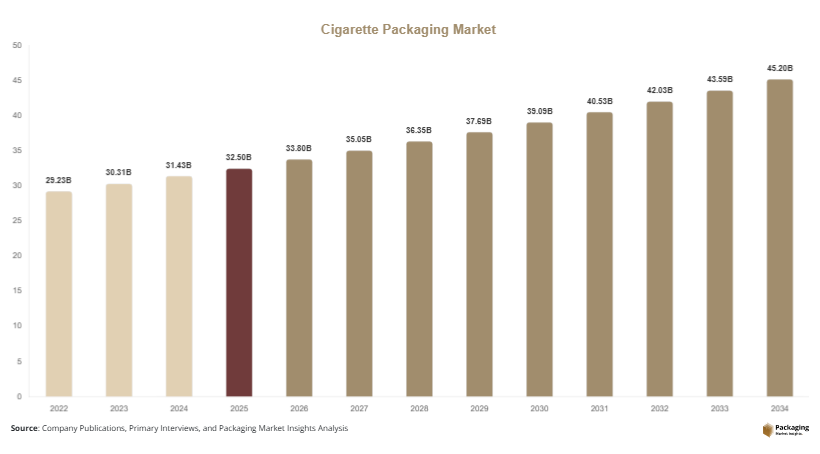
The cigarette packaging market plays a critical role in the global tobacco industry by ensuring product protection, regulatory compliance, and brand differentiation. The market size was valued at approximately USD 32.5 billion in 2025 and is expected to reach USD 33.8 billion in 2026. Despite increasing regulatory pressures and declining smoking rates in certain regions, the market is projected to reach USD 45.2 billion by 2034, expanding at a CAGR of 3.7% during 2025–2034. The steady growth reflects ongoing demand in emerging economies and the continuous need for packaging innovation to meet evolving regulatory requirements.
Cigarette packaging includes primary packaging such as boxes, cartons, and soft packs, as well as secondary packaging used for distribution. Packaging serves multiple purposes, including protecting cigarettes from environmental factors, preserving freshness, and complying with strict labeling regulations. In many regions, cigarette packaging is heavily regulated, requiring health warnings, standardized designs, and anti-counterfeiting measures.
Key Highlights:
- The Cigarette Packaging Market is projected to reach USD 45.2 billion by 2034, growing at a CAGR of 3.7% during 2025–2034.
- Growth is driven by strong demand from emerging markets along with increasing implementation of anti-counterfeiting technologies.
- Additionally, the growing focus on regulatory compliance and sustainability is further shaping market development.
Explore more data points, trends and opportunities Download Free Sample Report
Market Trends
Shift Toward Standardized and Plain Packaging
The cigarette packaging market is experiencing a significant shift toward standardized or plain packaging, particularly in regions with strict tobacco control policies. Governments are implementing regulations that limit branding elements, requiring uniform colors, fonts, and large health warnings. This trend is reshaping packaging strategies, as companies must comply with regulations while maintaining operational efficiency. The adoption of plain packaging reduces brand differentiation but increases the importance of material quality and printing precision. As more countries introduce similar regulations, this trend is expected to influence global packaging practices and drive demand for compliant packaging solutions.
Integration of Anti-Counterfeiting and Smart Packaging Technologies
Another key trend in the market is the integration of anti-counterfeiting and smart packaging technologies. Cigarette manufacturers are increasingly adopting features such as holographic labels, digital codes, and RFID-enabled tracking systems to combat counterfeit products. These technologies enhance supply chain transparency and help protect brand integrity. The trend is particularly important in regions where illicit trade is prevalent. As technology advances, smart packaging solutions are becoming more accessible and cost-effective, encouraging wider adoption across the industry.
Market Drivers
Rising Demand in Emerging Economies
The growth of the cigarette packaging market is supported by increasing demand in emerging economies. Countries in Asia Pacific, Latin America, and parts of Africa are experiencing stable or growing tobacco consumption due to population growth and urbanization. This demand creates a need for efficient and cost-effective packaging solutions. Manufacturers are focusing on expanding production capacities in these regions to meet rising demand. The availability of low-cost labor and raw materials further supports market growth in these economies.
Increasing Focus on Product Authentication and Security
The growing prevalence of counterfeit tobacco products is driving the adoption of advanced packaging solutions. Cigarette packaging now incorporates various security features to ensure product authenticity and prevent illegal trade. These features include tamper-evident seals, holograms, and digital tracking systems. Governments and manufacturers are collaborating to implement track-and-trace systems that enhance supply chain visibility. This focus on security is a significant driver of innovation and investment in the cigarette packaging market.
Market Restraint
Stringent Regulations and Declining Smoking Rates in Developed Regions
One of the major restraints affecting the cigarette packaging market is the increasing stringency of tobacco regulations, particularly in developed regions. Governments are implementing policies aimed at reducing tobacco consumption, including higher taxes, advertising restrictions, and plain packaging requirements. These measures are contributing to declining smoking rates, which in turn reduces demand for cigarette packaging.
For example, countries such as Australia and the United Kingdom have introduced strict plain packaging laws that limit branding opportunities. While these regulations aim to improve public health outcomes, they also create challenges for packaging manufacturers. Companies must invest in compliance while facing reduced volumes in certain markets. Additionally, the shift toward alternative nicotine products such as e-cigarettes further impacts demand for traditional cigarette packaging.
Market Opportunities
Development of Sustainable Packaging Solutions
The increasing focus on environmental sustainability presents opportunities for innovation in cigarette packaging. Manufacturers are exploring recyclable and biodegradable materials to reduce environmental impact. This shift is driven by regulatory requirements and consumer expectations for sustainable products. The development of eco-friendly packaging solutions can help companies differentiate themselves and meet sustainability goals. As environmental concerns continue to grow, this opportunity is expected to drive investment in new materials and technologies.
Expansion of Digital Printing and Customization Technologies
Advancements in digital printing technologies offer opportunities for improved efficiency and flexibility in cigarette packaging. Digital printing enables manufacturers to produce high-quality packaging with shorter production cycles and lower costs. This technology is particularly useful for meeting regulatory requirements that vary across regions. Additionally, digital printing allows for the integration of security features and unique identifiers, enhancing product authentication. The adoption of these technologies is expected to support market growth and innovation.
Report Scope
| Report Metric | Details |
|---|---|
| Market Size in 2025 | USD 32.5 Billion |
| Market Size in 2026 | USD 33.8 Billion |
| Market Size in 2034 | USD 45.2 Billion |
| CAGR | 3.7% (2026-2034) |
| Base Year for Estimation | 2025 |
| Historical Data | 2022-2024 |
| Forecast Period | 2026-2034 |
| Report Coverage | Revenue Forecast, Competitive Landscape, Supply Chain Disruption, Growth Factors, Environment & Regulatory Landscape and Trends |
| Geographies Covered | North America, Europe, APAC, Middle East and Africa, LATAM |
| Countries Covered | U.S., Canada, U.K., Germany, France, Spain, Italy, Russia, Nordic, Benelux, Rest of Europe, China, South Korea, Japan, India, Australia, Singapore, Taiwan, South East Asia, Rest of Asia-Pacific, UAE, Turky, Saudi Arabia, South Africa, Egypt, Nigeria, Rest of MEA, Brazil, Mexico, Argentina, Chile, Colombia, Rest of LATAM |
Explore more data points, trends and opportunities Download Free Sample Report
Segmental Analysis
By Material Type
The paperboard segment dominated the cigarette packaging market in 2024, accounting for approximately 58% of the market share. Paperboard is widely used due to its durability, printability, and cost-effectiveness. It is commonly applied in the production of cigarette boxes and cartons, providing structural integrity and compliance with labeling requirements. The availability of recyclable paperboard materials also supports its widespread adoption.
The biodegradable materials segment is expected to be the fastest-growing, with a CAGR of 4.8% during the forecast period. The growth is driven by increasing demand for sustainable packaging solutions. Manufacturers are exploring alternatives such as biodegradable coatings and eco-friendly inks to reduce environmental impact. This segment is gaining traction as companies align with sustainability goals and regulatory requirements.
By Packaging Type
The rigid boxes segment held the largest market share in 2024, accounting for approximately 62%. Rigid boxes provide superior protection and are widely used for premium cigarette products. They offer better durability and are suitable for incorporating advanced printing and security features.
The soft packs segment is expected to grow at the fastest CAGR of 4.2% during the forecast period. Soft packs are lightweight and cost-effective, making them popular in price-sensitive markets. The demand for affordable packaging solutions is driving the growth of this segment, particularly in emerging economies.
By End-Use
The conventional cigarette segment dominated the market in 2024, with a share of approximately 85%. Traditional cigarettes remain the primary product category, driving demand for packaging solutions. The need for compliance with regulatory requirements further supports segment growth.
The premium cigarette segment is projected to grow at the fastest CAGR of 4.6% during the forecast period. The increasing demand for premium products is driving the adoption of high-quality packaging solutions. Manufacturers are focusing on innovative designs and materials to enhance product appeal and differentiation.
Cigarette Packaging Market Segmentations
Material Type
- Paperboard
- Plastic
- Aluminum Foil
- Biodegradable Materials
Packaging Type
- Rigid Boxes
- Soft Packs
- Cartons
End-Use
- Conventional Cigarettes
- Premium Cigarettes
Regional Analysis
North America
North America accounted for approximately 22% of the cigarette packaging market share in 2025 and is projected to grow at a CAGR of 3.1% during the forecast period. The region is characterized by strict regulatory frameworks and declining smoking rates, which impact overall market growth. However, demand for compliant packaging solutions remains steady due to ongoing consumption.
The United States dominates the regional market, supported by its established tobacco industry and advanced packaging infrastructure. A key growth factor is the increasing adoption of anti-counterfeiting technologies, which enhance supply chain security and ensure compliance with regulatory requirements.
Europe
Europe held a market share of around 25% in 2025 and is expected to grow at a CAGR of 3.4% through 2034. The region is known for its stringent tobacco control policies, including plain packaging regulations and high taxation. These factors influence packaging design and demand.
Germany leads the European market due to its strong manufacturing capabilities and focus on innovation. A unique growth factor is the widespread implementation of standardized packaging, which drives demand for high-quality printing and compliance solutions.
Asia Pacific
Asia Pacific accounted for approximately 34% of the market share in 2025 and is expected to register the fastest CAGR of 4.5% during the forecast period. The region benefits from large population bases and relatively stable tobacco consumption levels.
China dominates the Asia Pacific market, driven by its significant tobacco production and consumption. A key growth factor is the expansion of domestic tobacco companies, which increases demand for packaging solutions. The availability of cost-effective manufacturing further supports market growth.
Middle East & Africa
The Middle East & Africa region held a market share of around 9% in 2025 and is projected to grow at a CAGR of 3.8% during the forecast period. The market is expanding due to increasing tobacco consumption in certain areas.
The United Arab Emirates is a leading country in the region, supported by its strong retail sector. A unique growth factor is the increasing focus on anti-illicit trade measures, which drives demand for secure packaging solutions.
Latin America
Latin America accounted for approximately 10% of the market share in 2025 and is expected to grow at a CAGR of 3.6% through 2034. The region shows steady demand due to consistent tobacco consumption patterns.
Brazil dominates the regional market due to its large consumer base and established tobacco industry. A key growth factor is the rising adoption of advanced packaging technologies to enhance product security and compliance.
Competitive Landscape
The cigarette packaging market is moderately competitive, with key players focusing on innovation, compliance, and sustainability. Companies are investing in advanced printing technologies and security features to enhance product offerings. Strategic partnerships and regional expansions are common strategies used to strengthen market presence.
Amcor Plc is a leading player in the market, known for its comprehensive packaging solutions. The company recently introduced new sustainable packaging options designed to meet regulatory requirements and reduce environmental impact. Other players are also focusing on developing eco-friendly materials and improving production efficiency to remain competitive.
Key Players List
- Amcor Plc
- WestRock Company
- International Paper Company
- ITC Limited
- Mondi Group
- Smurfit Kappa Group
- Siegwerk Druckfarben AG & Co. KGaA
- Mayr-Melnhof Karton AG
- AR Packaging Group
- Innovia Films
- Uflex Ltd.
- Stora Enso Oyj
- Nippon Paper Industries Co., Ltd.
- Graphic Packaging International
- DS Smith Plc