Child Resistant Packaging Market Report Size and Growth
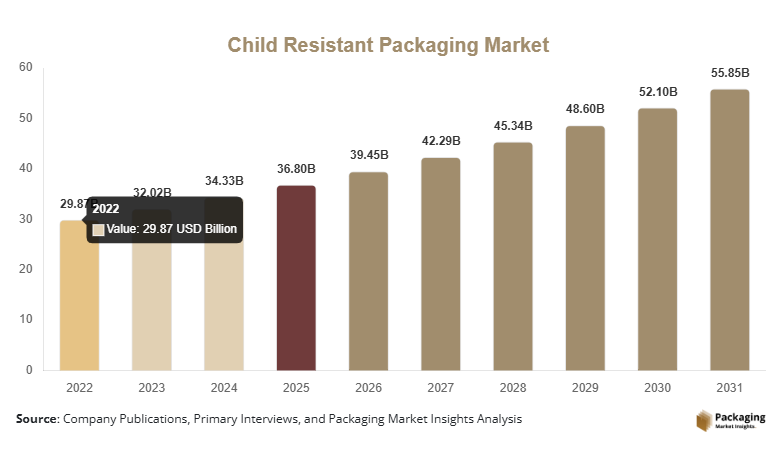
The Child Resistant Packaging Market was valued at USD 36.8 billion in 2025 and is projected to reach USD 55.9 billion by 2030, expanding at a compound annual growth rate (CAGR) of 7.2% between 2025 and 2031. The market has experienced steady expansion due to increasing safety regulations in pharmaceutical, household chemical, and cannabis packaging. Governments and regulatory bodies across developed and emerging economies have mandated the use of child-resistant closures and packaging formats to reduce accidental ingestion of hazardous substances by children.
A significant global factor supporting the growth of the Child Resistant Packaging Market has been the rise in pharmaceutical consumption worldwide. As prescription and over-the-counter drug usage increases, pharmaceutical companies are increasingly adopting certified child-resistant packaging formats such as push-and-turn closures, blister packs, and specialized caps to comply with safety standards. Regulatory frameworks introduced by safety authorities have also pushed manufacturers to innovate packaging solutions that balance safety, accessibility, and sustainability.
In addition, the expansion of legalized cannabis products in several regions has created new demand for certified child-resistant packaging solutions. Cannabis edibles, oils, and concentrates require protective packaging to prevent accidental consumption by children, further driving innovation within the industry.
Key Highlights
- North America dominated the Child Resistant Packaging Market with approximately 38% share in 2025, supported by strict regulatory standards and strong pharmaceutical production.
- Asia Pacific will be the fastest-growing region with an expected CAGR of 9.1% during the forecast period.
- By type, reclosable child-resistant packaging accounted for nearly 61% of the market share in 2024, while blister-based child-resistant packaging is expected to grow at a CAGR of 8.4% through 2031.
- By material, plastic dominated with about 56% share in 2024, while paper-based solutions will grow fastest at a CAGR of 8.9%.
- The pharmaceutical application segment held nearly 48% share in 2024, while cannabis packaging will grow at a CAGR of 10.2%.
- The United States remained the dominant country, with the market valued at USD 9.4 billion in 2025 and USD 10.1 billion in 2026.
Explore more data points, trends and opportunities Download Free Sample Report
Market Trends
Expansion of Sustainable Child-Resistant Packaging
Sustainability initiatives are influencing the development of child-resistant packaging solutions. Manufacturers are investing in recyclable, biodegradable, and paper-based packaging designs that maintain safety while reducing environmental impact. This trend has gained momentum as governments and consumer groups demand environmentally responsible packaging materials.
Paper-based blister packs and recyclable polymer closures are increasingly replacing traditional multi-material structures. Packaging manufacturers are also redesigning closure systems to reduce plastic usage while maintaining compliance with child safety regulations. The integration of eco-friendly materials into the Child Resistant Packaging Market is expected to support long-term innovation and help companies align with global sustainability goals.
Growth of Cannabis and Nutraceutical Packaging
The legalization of cannabis in several regions has created new opportunities for child-resistant packaging manufacturers. Cannabis edibles, tinctures, and concentrates require specialized packaging formats designed to prevent children from accessing potentially harmful products.
Companies are developing resealable pouches, push-and-slide boxes, and certified blister packs specifically for cannabis and nutraceutical applications. These solutions must meet strict regulatory testing standards, including child resistance and senior-friendly usability. As the cannabis and wellness industries continue to expand globally, demand for compliant packaging formats will strengthen the overall growth outlook of the Child Resistant Packaging Market.
Market Drivers
Increasing Global Pharmaceutical Consumption
The rising prevalence of chronic diseases and expanding access to healthcare have increased pharmaceutical consumption worldwide. Prescription medicines, over-the-counter drugs, and supplements are widely distributed through pharmacies and retail outlets, requiring packaging solutions that prevent accidental ingestion by children.
Child-resistant closures and blister packaging are widely adopted to comply with safety standards established by regulatory authorities. Pharmaceutical manufacturers continue to invest in advanced packaging formats that combine safety features with convenient usability for elderly patients. This ongoing demand from the pharmaceutical industry remains a core driver of growth for the Child Resistant Packaging Market.
Stringent Safety Regulations and Compliance Standards
Governments and regulatory bodies across the world have introduced strict safety standards for packaging of hazardous products. These regulations mandate the use of certified child-resistant packaging for pharmaceuticals, cleaning products, chemicals, and cannabis products.
Compliance requirements encourage manufacturers to develop packaging solutions that meet testing criteria such as child-resistance performance and adult usability. The increasing enforcement of such regulations has significantly expanded the adoption of certified packaging solutions across industries, supporting the steady growth of the Child Resistant Packaging Market.
Market Restraint
High Design Complexity and Production Costs
The development of child-resistant packaging solutions involves extensive testing, certification, and engineering design. Manufacturers must ensure that packaging is difficult for children to open while remaining accessible for adults, especially elderly users.
These design requirements increase production costs and extend product development timelines. Specialized molds, testing procedures, and compliance certifications contribute to higher operational expenses for packaging manufacturers. Small and mid-sized companies may face challenges in adopting advanced child-resistant packaging technologies due to these cost constraints, which may limit market expansion in certain regions.
Market Opportunities
Rising Demand for Smart and Digital Packaging
Smart packaging technologies are gradually entering the child-resistant packaging segment. Digital authentication features such as QR codes, RFID tags, and tamper-evident indicators are being integrated into packaging designs to improve product tracking and safety monitoring.
These innovations are particularly relevant in pharmaceutical packaging, where medication adherence and supply chain transparency are critical. The adoption of smart packaging technologies is expected to create new growth opportunities for the Child Resistant Packaging Market during the forecast period.
Expansion in Emerging Healthcare Markets
Emerging economies are witnessing rapid growth in healthcare infrastructure and pharmaceutical manufacturing. Countries in Asia Pacific, Latin America, and the Middle East are expanding drug production and distribution networks.
This expansion is increasing demand for compliant packaging solutions that meet international safety standards. Packaging manufacturers entering these emerging markets can benefit from rising pharmaceutical consumption and growing regulatory frameworks that encourage the use of child-resistant packaging systems.
Report Scope
| Report Metric | Details |
|---|---|
| Market Size in 2025 | USD 36.8 Billion |
| Market Size in 2026 | USD 39.45 Billion |
| Market Size in 2031 | USD 55.96 Billion |
| CAGR | 7.2% (2026-2031) |
| Base Year for Estimation | 2025 |
| Historical Data | 2022-2024 |
| Forecast Period | 2026-2031 |
| Report Coverage | Revenue Forecast, Competitive Landscape, Supply Chain Disruption, Growth Factors, Environment & Regulatory Landscape and Trends |
| Geographies Covered | North America, Europe, APAC, Middle East and Africa, LATAM |
| Countries Covered | U.S., Canada, U.K., Germany, France, Spain, Italy, Russia, Nordic, Benelux, Rest of Europe, China, South Korea, Japan, India, Australia, Singapore, Taiwan, South East Asia, Rest of Asia-Pacific, UAE, Turky, Saudi Arabia, South Africa, Egypt, Nigeria, Rest of MEA, Brazil, Mexico, Argentina, Chile, Colombia, Rest of LATAM |
Explore more data points, trends and opportunities Download Free Sample Report
Segmental Analysis
By Type
Reclosable child-resistant packaging dominated the segment, accounting for approximately 61% of the global market share in 2024. These packaging formats include push-and-turn caps, squeeze-and-turn closures, and locking lids commonly used in pharmaceutical containers and chemical bottles. Their widespread adoption is linked to their ability to provide repeated access while maintaining safety standards. Pharmaceutical manufacturers prefer reclosable packaging because it supports multiple-dose medication formats and ensures consistent child-resistant functionality.
Blister-based child-resistant packaging will be the fastest-growing segment with a projected CAGR of 8.4% during the forecast period. Blister packs require coordinated actions such as pushing tablets through foil or peeling layers, which makes them difficult for children to open. Pharmaceutical companies are expected to increase the use of child-resistant blister packaging for prescription medicines due to its strong protection and product visibility.
By Material
Plastic dominated the material segment, holding around 56% of the market share in 2024. Plastic materials such as polypropylene and polyethylene have been widely used due to their durability, lightweight properties, and compatibility with various closure mechanisms. Plastic packaging also supports mass production and cost efficiency, which makes it a preferred material in pharmaceutical and chemical packaging.
Paper-based packaging will register the fastest growth with a projected CAGR of 8.9% through 2031. Sustainability initiatives and regulatory pressures to reduce plastic waste will encourage manufacturers to adopt recyclable paperboard blister cards and cartons. These solutions combine child-resistant mechanisms with environmentally responsible materials, making them attractive to pharmaceutical and consumer product companies.
By Application
The pharmaceutical segment dominated the application category, representing approximately 48% of the Child Resistant Packaging Market share in 2024. Prescription drugs, over-the-counter medications, and supplements require packaging that prevents accidental ingestion by children. Pharmaceutical companies have widely implemented certified packaging solutions to comply with safety regulations and ensure patient protection.
The cannabis segment will be the fastest-growing application with a projected CAGR of 10.2% during the forecast period. The legalization of cannabis products in various regions will increase demand for certified packaging solutions that prevent unauthorized access. Cannabis packaging must meet strict regulatory testing standards, encouraging manufacturers to develop innovative packaging formats.
By End-Use Industry
The healthcare industry dominated the segment with nearly 52% share in 2024. Hospitals, pharmacies, and pharmaceutical companies require packaging solutions that ensure product safety and regulatory compliance. The widespread distribution of medications has contributed to strong demand for certified packaging formats.
The household chemicals segment will grow at a CAGR of 7.8% during the forecast period. Cleaning products and hazardous chemicals require protective packaging to reduce accidental exposure among children. Manufacturers will increasingly adopt certified child-resistant closures for chemical products to comply with consumer safety regulations.
Child Resistant Packaging Market Segmentations
By Type
- Reclosable Packaging
- Blister Packaging
- Flexible Packaging
By Material
- Plastic
- Paper & Paperboard
- Glass
- Metal
By Application
- Pharmaceuticals
- Cannabis Products
- Household Chemicals
- Personal Care Products
By End-Use Industry
- Healthcare
- Consumer Goods
- Chemical Industry
Regional Analysis
North America
North America accounted for 38% of the global Child Resistant Packaging Market share in 2025. The region has maintained a strong presence due to the established pharmaceutical industry, strict packaging regulations, and widespread adoption of safety standards. Regulatory frameworks have encouraged manufacturers to integrate certified child-resistant mechanisms into pharmaceutical, chemical, and cannabis packaging. The region will grow at a CAGR of 6.4% between 2025 and 2033, supported by ongoing innovation in packaging materials and safety technologies.
The United States dominated the regional market, driven by large pharmaceutical production and strong regulatory oversight. Federal safety guidelines require child-resistant packaging for many prescription medicines and household chemicals. In addition, the expanding legal cannabis market has created new demand for compliant packaging formats such as resealable containers and push-and-turn closures. These factors have positioned the country as a key contributor to the regional growth of the Child Resistant Packaging Market.
Europe
Europe represented 27% of the global Child Resistant Packaging Market share in 2025. The region has maintained steady demand for certified packaging solutions due to strict consumer safety regulations and well-established pharmaceutical industries. Packaging manufacturers across the region have increasingly adopted recyclable and sustainable materials to meet environmental targets. The market will expand at a CAGR of 6.8% during the forecast period as regulatory frameworks continue to evolve.
Germany emerged as the dominant country in the European market. The country’s advanced pharmaceutical manufacturing sector and strong export capabilities have supported demand for high-quality packaging solutions. German packaging manufacturers are also investing in innovative materials and automated production technologies to enhance safety and efficiency in child-resistant packaging.
Asia Pacific
Asia Pacific accounted for 22% of the global Child Resistant Packaging Market share in 2025. Rapid industrialization and expanding pharmaceutical manufacturing across emerging economies have contributed to rising demand for protective packaging solutions. The region will record the fastest growth with a CAGR of 9.1% through 2033 due to increasing healthcare access and growing regulatory awareness.
China dominated the regional market due to its large pharmaceutical production capacity and expanding packaging industry. The country has invested significantly in manufacturing infrastructure and export-oriented pharmaceutical production. As regulatory frameworks strengthen and healthcare consumption rises, the demand for certified child-resistant packaging solutions is expected to increase further.
Middle East & Africa
The Middle East & Africa held 7% of the global Child Resistant Packaging Market share in 2025. Demand for protective packaging solutions has been increasing due to growing pharmaceutical distribution networks and improving healthcare infrastructure across the region. The market will grow at a CAGR of 7.0% through 2033, supported by expanding healthcare investments.
Saudi Arabia emerged as the dominant country in the region. Government initiatives aimed at strengthening domestic pharmaceutical production have encouraged investments in packaging technologies and manufacturing facilities. These initiatives are supporting the gradual adoption of certified child-resistant packaging systems across pharmaceutical supply chains.
Latin America
Latin America accounted for 6% of the global Child Resistant Packaging Market share in 2025. The region has experienced moderate growth due to expanding pharmaceutical distribution channels and rising consumer safety awareness. The market will grow at a CAGR of 7.3% through 2033 as regulatory frameworks continue to evolve.
Brazil dominated the regional market due to its large pharmaceutical manufacturing base and growing healthcare expenditure. The country’s packaging industry has expanded in response to increasing demand for compliant pharmaceutical packaging solutions, supporting the overall growth outlook for the Child Resistant Packaging Market.
Competitive Landscape
The Child Resistant Packaging Market is characterized by the presence of several global packaging manufacturers focusing on safety innovation, material development, and regulatory compliance. Companies are investing in research and development to improve packaging usability while maintaining certified child-resistant mechanisms.
Berry Global Inc. remains one of the leading companies in the market due to its extensive portfolio of child-resistant closures and pharmaceutical packaging solutions. The company recently introduced advanced recyclable packaging designs aimed at reducing plastic usage while maintaining safety standards.
Other key players such as Amcor plc, WestRock Company, Gerresheimer AG, and AptarGroup Inc. are actively expanding production capacity and introducing innovative packaging formats. Strategic collaborations with pharmaceutical companies and cannabis product manufacturers have become a common approach to strengthen market presence and accelerate product innovation.
Key Players in the Child Resistant Packaging Market
- Berry Global Inc.
- Amcor plc
- WestRock Company
- Gerresheimer AG
- AptarGroup Inc.
- Sonoco Products Company
- Becton Dickinson and Company
- Alpha Packaging
- O.Berk Company
- Weener Plastics Group
- Bilcare Limited
- Comar LLC
- Körber Pharma Packaging
- SGD Pharma
- Pretium Packaging
- Rieke Packaging Systems