Chemical Repackaging Market Size and Growth
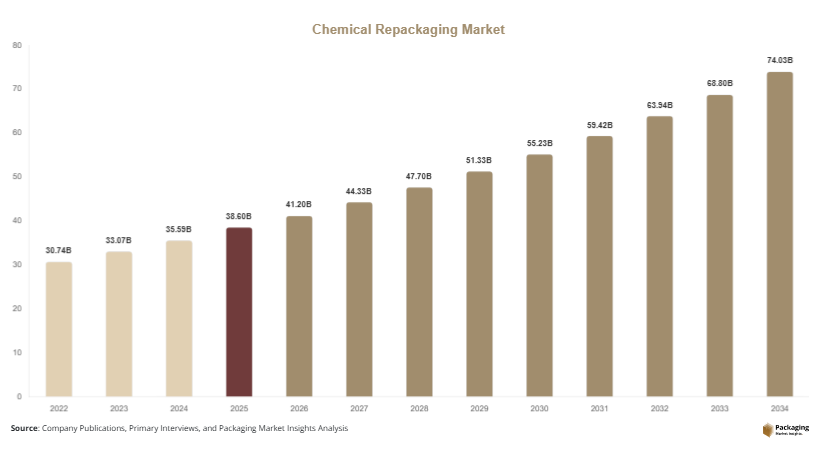
In 2025, the Chemical Repackaging Market size is estimated at USD 38.6 billion, and it is projected to reach USD 41.2 billion in 2026. With increasing industrial demand and regulatory compliance requirements, the market is forecast to reach approximately USD 79.5 billion by 2034, growing at a CAGR of 7.6% from 2025 to 2034.
Chemical repackaging involves transferring bulk chemicals into smaller, customized containers for distribution, storage, or end-use applications. This process is essential across industries such as pharmaceuticals, agriculture, automotive, and specialty chemicals. Companies rely on repackaging services to improve logistics efficiency, reduce waste, and comply with safety standards.
Key Highlights:
- The Chemical Repackaging Market was valued at approximately USD 38.6 billion in 2025, reflecting strong demand across industrial and specialty chemical supply chains. Growth is supported by increasing global chemical production and expanding end-use applications.
- The market is projected to reach around USD 79.5 billion by 2034, indicating sustained expansion over the forecast period. This growth is driven by rising outsourcing of packaging operations and the need for efficient distribution systems.
- The market is expected to register a CAGR of 7.6% from 2025 to 2034, highlighting steady long-term growth potential. This rate is supported by continuous industrial demand and regulatory-driven compliance requirements.
- Rising demand from the pharmaceuticals and specialty chemicals sectors is significantly boosting market expansion. These industries require precise, safe, and compliant repackaging solutions for sensitive chemical materials.
- Increasing regulatory compliance requirements globally are also shaping market growth. Strict safety, labeling, and transportation standards are encouraging companies to adopt professional repackaging services.
Explore more data points, trends and opportunities Download Free Sample Report
Market Trends
Increasing Adoption of Sustainable Packaging Practices
Sustainability has become a central focus in the chemical repackaging market, with companies shifting toward eco-friendly materials and processes. Repackaging providers are increasingly using recyclable containers, biodegradable materials, and reusable drums to minimize environmental impact. This trend is driven by regulatory pressures as well as corporate sustainability goals across industries. Additionally, customers are demanding environmentally responsible solutions, pushing service providers to innovate. The integration of closed-loop systems, where packaging materials are reused multiple times, is gaining traction. These practices not only reduce waste but also lower long-term operational costs, making sustainability a key competitive differentiator in the market.
Integration of Automation and Digital Technologies
Automation and digitalization are transforming chemical repackaging operations. Advanced technologies such as automated filling lines, robotic handling systems, and IoT-enabled monitoring tools are improving efficiency and accuracy. These systems reduce human error, enhance safety, and enable real-time tracking of chemical batches. Digital labeling solutions are also helping companies comply with complex regulatory requirements across different regions. Furthermore, data analytics is being used to optimize supply chain operations and predict demand patterns. This trend is particularly significant for large-scale operations where precision and compliance are critical. As a result, companies investing in automation are gaining a competitive edge.
Market Drivers
Growing Demand from End-Use Industries
The expansion of key end-use industries such as pharmaceuticals, agriculture, and automotive is significantly driving the chemical repackaging market. These sectors require customized packaging solutions to ensure safe handling and efficient distribution of chemicals. For instance, pharmaceutical companies need precise quantities of active ingredients packaged under strict regulatory conditions. Similarly, the agricultural sector relies on repackaged fertilizers and pesticides for distribution to small-scale farmers. The increasing demand for specialty chemicals in manufacturing processes further boosts the need for repackaging services. This growing industrial demand is creating consistent revenue streams for service providers.
Stringent Safety and Regulatory Standards
Regulatory compliance is a major driver for the chemical repackaging market. Governments and international organizations have implemented strict guidelines for handling, labeling, and transporting chemicals. These regulations require companies to ensure accurate labeling, proper container selection, and adherence to safety protocols. Repackaging service providers help businesses meet these requirements efficiently. For example, hazardous chemicals must be repackaged into approved containers with specific labeling standards. Failure to comply can result in penalties and operational disruptions. As regulations continue to evolve, companies are increasingly outsourcing repackaging services to specialized providers.
Market Restraint
High Operational and Compliance Costs
One of the primary challenges in the chemical repackaging market is the high cost associated with operations and regulatory compliance. Repackaging facilities require significant investment in specialized equipment, safety systems, and trained personnel. Additionally, maintaining compliance with international standards involves continuous monitoring, audits, and documentation. These costs can be particularly burdensome for small and medium-sized enterprises. For instance, handling hazardous chemicals requires advanced containment systems and protective equipment, which increases operational expenses. Furthermore, fluctuations in raw material prices and transportation costs add to the financial burden. These factors can limit market entry and reduce profit margins for service providers.
Market Opportunities
Expansion in Emerging Markets
Emerging economies present significant growth opportunities for the chemical repackaging market. Rapid industrialization in regions such as Asia Pacific and Latin America is increasing the demand for chemicals across various sectors. As local industries expand, the need for efficient distribution and packaging solutions also grows. Repackaging services enable companies to cater to diverse market requirements by offering customized packaging sizes. Additionally, the development of infrastructure and logistics networks in these regions is facilitating market growth. Companies that establish operations in emerging markets can benefit from lower operational costs and high demand potential.
Growth of Specialty Chemicals Segment
The increasing demand for specialty chemicals is creating new opportunities in the chemical repackaging market. Specialty chemicals often require precise packaging and handling due to their unique properties and applications. Industries such as electronics, healthcare, and advanced manufacturing rely heavily on these chemicals. Repackaging providers can offer value-added services such as custom labeling, blending, and quality control. This not only enhances product value but also strengthens customer relationships. As the demand for high-performance materials continues to grow, the need for specialized repackaging solutions is expected to increase significantly.
Report Scope
| Report Metric | Details |
|---|---|
| Market Size in 2025 | USD 38.6 Billion |
| Market Size in 2026 | USD 41.2 Billion |
| Market Size in 2034 | USD 79.5 Billion |
| CAGR | 7.6% (2026-2034) |
| Base Year for Estimation | 2025 |
| Historical Data | 2022-2024 |
| Forecast Period | 2026-2034 |
| Report Coverage | Revenue Forecast, Competitive Landscape, Supply Chain Disruption, Growth Factors, Environment & Regulatory Landscape and Trends |
| Geographies Covered | North America, Europe, APAC, Middle East and Africa, LATAM |
| Countries Covered | U.S., Canada, U.K., Germany, France, Spain, Italy, Russia, Nordic, Benelux, Rest of Europe, China, South Korea, Japan, India, Australia, Singapore, Taiwan, South East Asia, Rest of Asia-Pacific, UAE, Turky, Saudi Arabia, South Africa, Egypt, Nigeria, Rest of MEA, Brazil, Mexico, Argentina, Chile, Colombia, Rest of LATAM |
Explore more data points, trends and opportunities Download Free Sample Report
Segmental Analysis
By Type
The bulk repackaging segment dominated the market in 2024, accounting for nearly 58% of the total share. This dominance is attributed to the high volume of chemicals transported in bulk across industries. Bulk repackaging allows companies to optimize logistics and reduce transportation costs. Industries such as oil and gas, manufacturing, and agriculture rely heavily on bulk packaging for efficiency. Additionally, advancements in container technology have improved safety and durability, further supporting segment growth. The ability to handle large quantities while maintaining safety standards makes this segment a key contributor to overall market revenue.
The small-scale repackaging segment is expected to be the fastest-growing, with a CAGR of 8.2% during the forecast period. This growth is driven by the increasing demand for customized packaging solutions in sectors such as pharmaceuticals and specialty chemicals. Small-scale repackaging enables precise quantity distribution and enhances product accessibility. The rise of e-commerce and direct-to-consumer models is also contributing to this growth. Companies are focusing on providing flexible packaging options to meet diverse customer needs, which is accelerating the adoption of small-scale repackaging services.
By Application
The industrial chemicals segment held the largest share in 2024, accounting for approximately 46% of the market. This segment includes chemicals used in manufacturing, construction, and energy sectors. The high demand for these chemicals requires efficient repackaging solutions to ensure safe transportation and storage. Companies are investing in advanced repackaging technologies to handle large volumes and maintain product integrity. The growth of infrastructure projects and industrial activities further supports this segment’s dominance. Additionally, the need for compliance with safety regulations drives the demand for professional repackaging services.
The specialty chemicals segment is projected to grow at the fastest CAGR of 8.7%. This growth is driven by increasing applications in industries such as electronics, healthcare, and automotive. Specialty chemicals require precise handling and packaging due to their unique properties. Repackaging providers are offering value-added services such as custom labeling and quality assurance to meet these requirements. The rising demand for high-performance materials is further boosting this segment. Companies are focusing on innovation and customization to capture growth opportunities in this segment.
By End-Use
The manufacturing sector dominated the market in 2024, accounting for around 42% of the total share. This sector requires large volumes of chemicals for various processes, including production and maintenance. Repackaging services help manufacturers optimize their supply chains and reduce waste. The integration of automation in manufacturing processes is also increasing the demand for efficient repackaging solutions. Companies are focusing on improving operational efficiency and compliance, which drives the adoption of repackaging services.
The pharmaceutical sector is expected to be the fastest-growing, with a CAGR of 9.1%. This growth is driven by the increasing demand for precise and compliant packaging solutions. Pharmaceutical companies require strict adherence to safety and quality standards, which makes repackaging a critical process. The rise of personalized medicine and small-batch production is further boosting demand. Repackaging providers are offering specialized services such as sterile packaging and advanced labeling to meet industry requirements.
Chemical Repackaging Market Segmentations
By Type
- Bulk Repackaging
- Small-Scale Repackaging
By Application
- Industrial Chemicals
- Specialty Chemicals
By End-Use
- Manufacturing
- Pharmaceutical
- Agriculture
- Automotive
By Region
- North America
- Europe
- Asia Pacific
- Middle East & Africa
- Latin America
Regional Analysis
North America
North America accounted for approximately 28% of the market share in 2025 and is expected to grow at a CAGR of around 6.8% during the forecast period. The region’s mature industrial base and strong regulatory framework support steady demand for chemical repackaging services. The presence of advanced logistics infrastructure and high adoption of automation technologies further enhances operational efficiency.
The United States dominates the regional market due to its extensive chemical manufacturing sector. A unique growth factor is the increasing demand for customized packaging solutions in the pharmaceutical industry. Companies are focusing on precision packaging to meet stringent regulatory standards, which drives the demand for specialized repackaging services.
Europe
Europe held nearly 24% market share in 2025 and is projected to grow at a CAGR of 6.5%. The region is characterized by strict environmental regulations and a strong emphasis on sustainability. These factors are driving the adoption of eco-friendly repackaging solutions across industries.
Germany is the leading country in Europe, supported by its robust industrial base. A unique growth factor is the region’s focus on circular economy practices. Companies are investing in reusable and recyclable packaging solutions, which is boosting the demand for sustainable repackaging services.
Asia Pacific
Asia Pacific led the market with a 32% share in 2025 and is expected to register the highest CAGR of 8.5%. Rapid industrialization, urbanization, and expanding manufacturing sectors are driving market growth. The region also benefits from lower operational costs and a large consumer base.
China dominates the Asia Pacific market due to its large-scale chemical production capacity. A unique growth factor is the increasing demand for chemicals in the electronics and automotive industries. This demand is driving the need for efficient and scalable repackaging solutions.
Middle East & Africa
The Middle East & Africa region accounted for about 8% market share in 2025 and is projected to grow at a CAGR of 7.2%. The region’s growth is supported by the expansion of the oil and gas sector, which requires extensive chemical handling and distribution.
Saudi Arabia leads the regional market, driven by its strong petrochemical industry. A unique growth factor is the increasing investment in industrial diversification, which is creating new opportunities for chemical repackaging services.
Latin America
Latin America held approximately 8% of the market share in 2025 and is expected to grow at a CAGR of 7.0%. The region’s growth is driven by the expansion of agriculture and manufacturing sectors, which require efficient chemical distribution systems.
Brazil is the dominant country in this region, supported by its large agricultural industry. A unique growth factor is the rising demand for fertilizers and agrochemicals, which require repackaging into smaller, user-friendly formats for distribution.
Competitive Landscape
The chemical repackaging market is moderately fragmented, with a mix of global and regional players competing based on service quality, compliance capabilities, and technological advancements. Leading companies are focusing on expanding their service portfolios and investing in automation to enhance efficiency. Strategic partnerships and acquisitions are also common as companies aim to strengthen their market presence.
One of the leading players in the market is Univar Solutions, which has established a strong global presence through its extensive distribution network. The company focuses on providing customized repackaging solutions and has recently invested in advanced automation technologies to improve operational efficiency. Other key players are also adopting similar strategies, emphasizing sustainability and digitalization to remain competitive. Continuous innovation and adherence to regulatory standards are critical factors for success in this market.
Key Players List
- Univar Solutions
- Brenntag AG
- IMCD Group
- Avantor Inc.
- Thermo Fisher Scientific
- Quadra Chemicals
- Hawkins Inc.
- Redox Pty Ltd
- Hydrite Chemical Co.
- ICC Chemicals Corporation
- Seidler Chemical Co.
- Alpha Chemicals
- ACME-Hardesty Co.
- GFS Chemicals Inc.
- LabChem Inc.