Cement Sacks Market Size
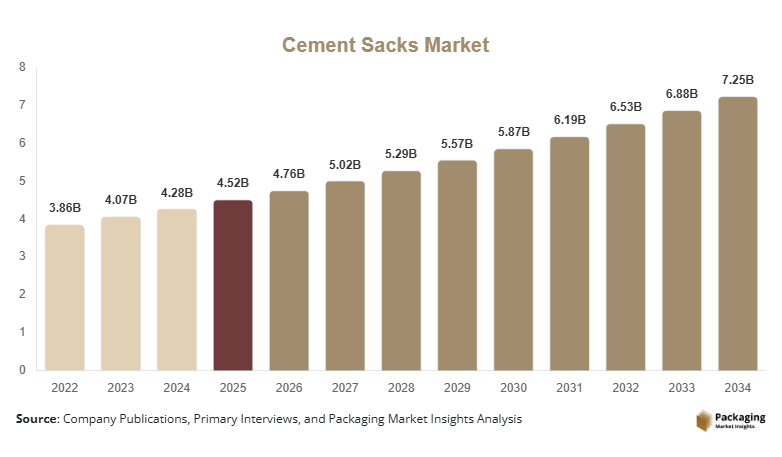
The cement sacks market size is projected at USD 4.76 billion in 2026 and is expected to hit USD 7.24 billion by 2034 with a CAGR of 5.4%. The report evaluates historical market performance from 2022 to 2024, considers 2025 as the base year, and provides comprehensive insights into production capacity, consumption trends, market segmentation, pricing dynamics, and the competitive landscape across key global regions.
Cement sacks are specialized industrial packaging solutions designed to safely store, transport, and protect cement and dry construction materials from moisture, contamination, and product loss. Global production exceeded 82 billion cement sacks in 2025, supported by worldwide cement production of more than 4.2 billion metric tons. Polypropylene sacks accounted for nearly 52% of total shipments, paper sacks contributed 34%, while plastic composite sacks represented approximately 14%, reinforcing long-term cement sack market expansion.
Explore more data points, trends and opportunities Download Free Sample Report
Cement Sacks Trends
Rising Adoption of Sustainable and High-Strength Packaging
Manufacturers are increasingly introducing lightweight, recyclable, and high-strength cement sacks to reduce packaging waste while improving transportation efficiency. Production of recyclable cement sacks exceeded 31 billion units during 2025, representing annual growth of 10.2%. Advanced multilayer lamination technologies improved moisture resistance by approximately 18%, while automated sack manufacturing lines increased productivity by nearly 15%, strengthening industry competitiveness.
Construction companies continue demanding durable packaging capable of minimizing product leakage during transportation and storage. Digital printing technologies have been adopted by more than 58% of organized manufacturers for product identification and branding, while valve sack usage exceeded 44% across bulk cement packaging applications. Increasing infrastructure investment continues supporting cement sacks' market development.
Cement Sacks Drivers
Rapid Growth in Global Construction and Infrastructure Activities
Expanding residential housing, commercial developments, and infrastructure investments remain the primary drivers for cement sack consumption. Global infrastructure expenditure exceeded USD 3.7 trillion during 2025, while cement demand increased by approximately 5.8% year-over-year. Cement manufacturers produced more than 84 billion sacks, supported by growing urbanization and government investments in transportation, industrial, and housing projects, driving cement sacks' market performance.
Cement Sacks Restraints
Volatility in Raw Material Prices
Price fluctuations in kraft paper, polypropylene resin, and polymer additives continue to influence production costs across the packaging industry. Polypropylene prices fluctuated by over 14%, while kraft paper costs increased by approximately 9% during recent years. Rising energy and logistics expenses further increased manufacturing costs by nearly 6–8%, creating profitability challenges for regional producers.
Cement Sacks Opportunities
Expansion of Eco-Friendly Industrial Packaging
Growing sustainability initiatives encourage manufacturers to develop recyclable paper sacks and reusable industrial packaging solutions. Investments in sustainable cement packaging exceeded USD 410 million globally during 2025, while demand for biodegradable industrial sacks increased by approximately 12% annually. Advanced barrier coatings and reinforced paper technologies continue creating attractive commercial opportunities across construction packaging applications.
Challenges in Cement Sacks Market
Maintaining Durability While Reducing Material Consumption
Manufacturers face increasing pressure to reduce packaging weight without compromising load-bearing capacity and moisture protection. Lightweight sacks reduce raw material usage by nearly 10% but require enhanced fiber strength and multilayer construction. Maintaining production speeds exceeding 220 sacks per minute while meeting international quality standards remains a major operational challenge for cement sack market participants.
Report Scope
| Report Metric | Details |
|---|---|
| Market Size in 2025 | USD 4.52 Billion |
| Market Size in 2026 | USD 4.76 Billion |
| Market Size in 2034 | USD 7.24 Billion |
| CAGR | 5.4% (2026-2034) |
| Base Year for Estimation | 2025 |
| Historical Data | 2022-2024 |
| Forecast Period | 2026-2034 |
| Report Coverage | Revenue Forecast, Competitive Landscape, Supply Chain Disruption, Growth Factors, Environment & Regulatory Landscape and Trends |
| Geographies Covered | North America, Europe, APAC, Middle East and Africa, LATAM |
| Countries Covered | U.S., Canada, U.K., Germany, France, Spain, Italy, Russia, Nordic, Benelux, Rest of Europe, China, South Korea, Japan, India, Australia, Singapore, Taiwan, South East Asia, Rest of Asia-Pacific, UAE, Turky, Saudi Arabia, South Africa, Egypt, Nigeria, Rest of MEA, Brazil, Mexico, Argentina, Chile, Colombia, Rest of LATAM |
Explore more data points, trends and opportunities Download Free Sample Report
Cement Sacks Market Segmentation
The market is segmented by material and end use to evaluate demand across construction activities. Polypropylene sacks dominate with approximately 52% market share, followed by paper at 34% and plastic composite sacks at 14%. Infrastructure projects remain the leading end-use segment, accounting for nearly 43% of global demand.
By Material
Paper cement sacks continue gaining popularity due to recyclability, printability, and environmental benefits. Annual production exceeded 28 billion units during 2025, while multilayer kraft paper technology improved tear resistance by approximately 20%. These sacks are widely used for premium cement grades and environmentally conscious construction projects.
Polypropylene remains the dominant material because of its superior tensile strength, moisture resistance, and cost efficiency. Global production exceeded 43 billion units, while woven sack technology reduced product loss during transportation by nearly 15%. High durability makes polypropylene suitable for bulk cement distribution.
Plastic composite sacks combine polymer films with woven materials to improve puncture resistance and shelf life. Production exceeded 11 billion units annually, with increasing adoption in export-oriented cement packaging requiring enhanced protection against humidity and handling damage.
By End Use
Residential construction accounts for approximately 31% of global demand. More than 25 billion cement sacks were consumed annually for housing developments, renovations, and small-scale infrastructure projects. Increasing urban housing demand continues supporting market expansion.
Commercial construction contributes nearly 26% of total consumption, supported by office buildings, industrial facilities, shopping complexes, and hospitality projects. Demand exceeded 21 billion sacks, while ready-mix concrete applications continue expanding.
Infrastructure projects dominate with approximately 43% market share, consuming over 35 billion sacks annually. Roads, bridges, railways, airports, dams, and public infrastructure developments continue generating substantial packaging demand worldwide.
Cement Sacks Market Segmentations
Material
- Paper
- Polypropylene
- Plastic Composite
End Use
- Residential Construction
- Commercial Construction
- Infrastructure Projects
Cement Sacks Regional Outlook
North America
North America accounts for approximately 18% of global revenue, supported by residential renovation, commercial development, and infrastructure modernization. The United States contributes nearly 84% of regional demand, while Canada continues investing in sustainable industrial packaging.
Europe
Europe represents approximately 22% of worldwide consumption. Germany, France, Italy, and the United Kingdom contribute more than 69% of regional production, driven by advanced construction standards and increasing adoption of recyclable industrial packaging.
Asia-Pacific
The Asia-Pacific leads the global market with approximately a 46% share. China, India, Japan, and Southeast Asian countries collectively account for over 72% of regional cement sack production. Rapid urbanization, government infrastructure investments, and expanding cement manufacturing capacity continue driving regional growth.
Latin America
Latin America contributes approximately 8% of global demand, led by Brazil and Mexico. Increasing housing construction and transportation infrastructure investments continue supporting regional cement packaging requirements.
Middle East & Africa
The Middle East & Africa account for nearly 6% of worldwide consumption. Saudi Arabia, the UAE, South Africa, and Egypt remain key contributors, supported by large-scale infrastructure projects, industrial expansion, and urban development initiatives.
Top Players in Cement Sacks Market
- Mondi plc
- Billerud AB,
- LC Packaging International BV,
- United Bags Inc.,
- ProAmpac LLC
- , Smurfit, Westrock
- NNZ Group
- Global-Pak Inc.
- UFlex Limited
- Hood Packaging Corporation
- Nordpack GmbH
- Shenzhen Longma Industrial Co., Ltd.
Mondi plc Estimated global market presence of approximately 11–13%. Leading supplier of industrial paper packaging solutions serving cement, chemicals, agriculture, and construction industries. Extensive manufacturing operations across Europe, Asia, Africa, and the Americas ensure stable supply and efficient logistics. Continuous investments in sustainable kraft paper technologies, recyclable industrial packaging, and high-performance sack solutions strengthen its competitive position while supporting global environmental initiatives. Billerud AB estimated market presence of approximately 8–10%. Recognized for premium kraft paper and industrial packaging products with strong moisture resistance and durability. Operates advanced paper manufacturing facilities supplying cement packaging producers worldwide. Ongoing investments in renewable fiber technologies, lightweight packaging, and recyclable industrial sack materials improve operational efficiency and reinforce its leadership within the global cement sacks industry.