Cell Culture Media Storage Containers Market Size and Growth
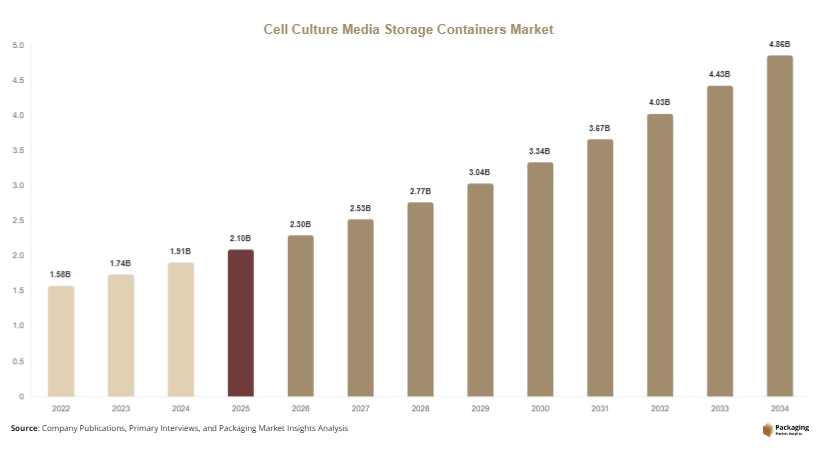
In 2025, the global cell culture media storage containers market size is estimated at USD 2.1 billion, rising to approximately USD 2.3 billion in 2026. The market is projected to reach USD 4.9 billion by 2034, registering a compound annual growth rate (CAGR) of 9.8% during the forecast period (2025–2034). This growth reflects increasing investments in biotechnology infrastructure and the rising need for contamination-free storage solutions. The cell culture media storage containers market is experiencing steady expansion driven by the rapid growth of biopharmaceutical manufacturing, cell-based research, and regenerative medicine applications.
One of the primary growth factors is the increasing demand for biologics and advanced therapies such as monoclonal antibodies, vaccines, and cell and gene therapies. These therapies require highly controlled environments and reliable storage containers that maintain sterility and chemical integrity. As a result, manufacturers are focusing on developing containers with improved barrier properties, chemical resistance, and compatibility with diverse media compositions.
Key Highlights:
- The market size was valued at USD 2.1 billion in 2025 and is projected to reach USD 4.9 billion by 2034. This growth reflects increasing demand across biopharmaceutical manufacturing and research applications.
- The market is expected to grow at a CAGR of 9.8% during the forecast period from 2025 to 2034. Consistent expansion is supported by technological advancements and rising investments in life sciences infrastructure.
- Rising demand for biologics and advanced therapies is a key factor driving market growth. These applications require highly controlled storage solutions to maintain product stability and sterility.
- The increasing adoption of single-use storage solutions in bioprocessing is accelerating market expansion. These systems reduce contamination risks and improve operational efficiency in manufacturing processes.
- Expanding research activities in biotechnology and life sciences sectors are further supporting demand. Growing laboratory investments and research projects are increasing the need for reliable storage containers.
Explore more data points, trends and opportunities Download Free Sample Report
Market Trends
One prominent trend in the cell culture media storage containers market is the growing shift toward single-use and disposable container systems. Manufacturers are increasingly focusing on developing lightweight, pre-sterilized containers made from advanced polymer materials. These containers eliminate the need for cleaning validation and reduce turnaround time in production processes. The trend is particularly significant in biopharmaceutical manufacturing, where operational efficiency and contamination control are critical. Furthermore, disposable systems are compatible with closed processing environments, which enhances safety and regulatory compliance. This trend is expected to gain further traction as companies prioritize flexibility and scalability in their production workflows.
Another significant trend is the integration of smart technologies and monitoring systems into storage containers. Advanced containers are now being designed with embedded sensors and tracking capabilities that monitor temperature, pressure, and contamination risks in real time. This innovation helps maintain optimal storage conditions for sensitive cell culture media and reduces the likelihood of product degradation. Additionally, digital tracking systems enable better inventory management and traceability, which are essential for regulatory compliance. As laboratories and manufacturing facilities increasingly adopt digital transformation strategies, the demand for smart storage containers is anticipated to rise steadily.
Market Drivers
A major driver of the cell culture media storage containers market is the rapid expansion of the biopharmaceutical industry. The increasing development of biologics, including vaccines and cell therapies, has created a strong demand for reliable storage solutions. These products require strict temperature and contamination control, making high-quality storage containers essential. Pharmaceutical companies are investing heavily in advanced manufacturing facilities, which further boosts the demand for specialized containers. Additionally, the rise in clinical trials for novel therapies has increased the need for efficient storage and transportation systems, supporting overall market growth.
Another key driver is the growing focus on laboratory efficiency and cost optimization. Research institutions and pharmaceutical companies are seeking solutions that reduce operational complexity and improve productivity. Single-use storage containers address these needs by eliminating cleaning processes and reducing downtime. Moreover, these containers minimize the risk of cross-contamination, which is crucial in multi-product facilities. The increasing adoption of automated systems and standardized processes in laboratories also contributes to the demand for compatible and high-performance storage containers.
Market Restraint
One significant restraint affecting the cell culture media storage containers market is the high cost associated with advanced storage solutions. While single-use and smart containers offer several operational advantages, their initial costs can be relatively high compared to traditional storage methods. Small and medium-sized laboratories may find it challenging to adopt these solutions due to budget constraints. Additionally, the recurring cost of disposable containers can increase overall operational expenses over time, especially in large-scale production environments.
The impact of this restraint is particularly evident in emerging markets, where funding for research and infrastructure may be limited. For example, academic institutions in developing regions often rely on conventional storage methods due to cost considerations. This limits the adoption of advanced technologies and slows market penetration. Furthermore, concerns regarding environmental sustainability and waste generation from disposable containers also pose challenges, prompting manufacturers to invest in recyclable and eco-friendly alternatives.
Market Opportunities
One promising opportunity in the cell culture media storage containers market lies in the development of sustainable and eco-friendly storage solutions. With increasing environmental awareness, manufacturers are focusing on creating biodegradable or recyclable containers that reduce environmental impact. This approach not only addresses regulatory concerns but also aligns with the sustainability goals of pharmaceutical companies. The introduction of green materials and innovative manufacturing processes is expected to open new growth avenues and attract environmentally conscious customers.
Another key opportunity is the expansion of the market in emerging economies. Countries in Asia Pacific, Latin America, and the Middle East are witnessing significant growth in biotechnology and pharmaceutical sectors. Governments in these regions are investing in research infrastructure and encouraging local manufacturing. This creates a favorable environment for the adoption of advanced storage containers. Additionally, the increasing presence of contract manufacturing organizations (CMOs) and CROs in these regions further boosts demand, providing manufacturers with new revenue opportunities.
Report Scope
| Report Metric | Details |
|---|---|
| Market Size in 2025 | USD 2.1 Billion |
| Market Size in 2026 | USD 2.3 Billion |
| Market Size in 2034 | USD 4.9 Billion |
| CAGR | 9.8% (2026-2034) |
| Base Year for Estimation | 2025 |
| Historical Data | 2022-2024 |
| Forecast Period | 2026-2034 |
| Report Coverage | Revenue Forecast, Competitive Landscape, Supply Chain Disruption, Growth Factors, Environment & Regulatory Landscape and Trends |
| Geographies Covered | North America, Europe, APAC, Middle East and Africa, LATAM |
| Countries Covered | U.S., Canada, U.K., Germany, France, Spain, Italy, Russia, Nordic, Benelux, Rest of Europe, China, South Korea, Japan, India, Australia, Singapore, Taiwan, South East Asia, Rest of Asia-Pacific, UAE, Turky, Saudi Arabia, South Africa, Egypt, Nigeria, Rest of MEA, Brazil, Mexico, Argentina, Chile, Colombia, Rest of LATAM |
Explore more data points, trends and opportunities Download Free Sample Report
Segmental Analysis
By Type
The dominant subsegment in the type category is single-use storage containers, which accounted for approximately 58% of the market share in 2024. These containers are widely used due to their convenience, sterility, and compatibility with modern bioprocessing systems. They eliminate the need for cleaning and sterilization, reducing operational costs and downtime. Additionally, single-use containers are designed to meet strict regulatory standards, making them suitable for pharmaceutical applications. Their flexibility and scalability further contribute to their widespread adoption across research and manufacturing facilities.
The fastest-growing subsegment is reusable storage containers, expected to register a CAGR of 10.5% during the forecast period. This growth is driven by increasing concerns regarding environmental sustainability and waste management. Reusable containers offer long-term cost benefits and are being designed with advanced materials that ensure durability and chemical resistance. The growing focus on reducing environmental impact is encouraging manufacturers to develop innovative reusable solutions, driving their adoption across various industries.
By Application
Biopharmaceutical production is the dominant subsegment, accounting for around 62% of the market share in 2024. The increasing production of biologics and advanced therapies has created a strong demand for reliable storage solutions. These containers play a crucial role in maintaining the integrity of cell culture media during storage and transportation. The adoption of advanced manufacturing techniques further supports the demand for high-quality storage containers in this segment.
Research laboratories represent the fastest-growing subsegment, with a projected CAGR of 10.8%. The growth is driven by increasing research activities in academic institutions and CROs. Laboratories require cost-effective and flexible storage solutions to support diverse research applications. The rising number of research projects focused on cell biology and regenerative medicine is expected to drive demand for advanced storage containers.
By End-Use
Pharmaceutical and biotechnology companies dominate the end-use segment, holding approximately 65% of the market share in 2024. These companies require high-performance storage solutions to support large-scale production of biologics. The increasing focus on quality and regulatory compliance further drives the demand for advanced storage containers. Additionally, the adoption of single-use technologies enhances efficiency and reduces operational costs.
Contract research and manufacturing organizations are the fastest-growing subsegment, expected to grow at a CAGR of 11.0%. The increasing outsourcing of research and manufacturing activities is a key factor driving this growth. CROs and CMOs require scalable and cost-effective storage solutions to handle multiple projects. This trend is expected to create significant opportunities for market players.
Cell Culture Media Storage Containers Market Segmentations
Type
- Single-use Storage Containers
- Reusable Storage Containers
Application
- Biopharmaceutical Production
- Research Laboratories
End-Use
- Pharmaceutical & Biotechnology Companies
- Contract Research & Manufacturing Organizations
Regional Analysis
North America
North America accounted for the largest share of the cell culture media storage containers market in 2025, contributing approximately 38% of the global market. The region is expected to maintain its dominance, with a projected CAGR of 9.2% during the forecast period. The presence of a well-established biopharmaceutical industry and advanced research infrastructure supports market growth. Additionally, strong regulatory frameworks ensure the adoption of high-quality storage solutions across laboratories and manufacturing facilities.
The United States remains the dominant country in this region, driven by extensive research activities and significant investments in biotechnology. A unique growth factor is the increasing adoption of personalized medicine, which requires specialized storage solutions for small-batch production. This trend is encouraging manufacturers to develop flexible and scalable storage containers tailored to specific applications.
Europe
Europe held a significant market share of around 27% in 2025 and is expected to grow at a CAGR of 8.7% through 2034. The region benefits from a strong pharmaceutical industry and increasing focus on research and development activities. Government initiatives supporting innovation and sustainability further contribute to market expansion. Additionally, the adoption of advanced manufacturing technologies enhances demand for efficient storage solutions.
Germany is a key contributor to the European market, driven by its robust pharmaceutical manufacturing sector. A unique growth factor in this region is the emphasis on sustainable practices, which has led to increased demand for eco-friendly storage containers. Manufacturers are focusing on developing recyclable materials to meet regulatory requirements and environmental standards.
Asia Pacific
Asia Pacific is expected to witness the fastest growth in the cell culture media storage containers market, with a CAGR of 11.2% during the forecast period. The region accounted for approximately 22% of the global market in 2025. Rapid industrialization, expanding biotechnology sectors, and increasing healthcare investments are key factors driving growth. Additionally, the presence of a large patient population supports demand for advanced therapies.
China dominates the Asia Pacific market due to its growing pharmaceutical manufacturing capabilities. A unique growth factor is the increasing number of contract manufacturing organizations, which require efficient and scalable storage solutions. This trend is expected to drive significant demand for advanced storage containers in the region.
Middle East & Africa
The Middle East & Africa region accounted for around 7% of the global market in 2025 and is projected to grow at a CAGR of 8.3% through 2034. The market is driven by increasing investments in healthcare infrastructure and rising awareness of advanced medical technologies. Government initiatives aimed at improving research capabilities also contribute to market growth.
Saudi Arabia is a leading country in this region, supported by its focus on healthcare modernization. A unique growth factor is the development of biotechnology hubs and research centers, which require reliable storage solutions. This is expected to create new opportunities for market players.
Latin America
Latin America held a market share of approximately 6% in 2025 and is expected to grow at a CAGR of 8.5% during the forecast period. The region is witnessing gradual growth due to increasing investments in pharmaceutical manufacturing and research activities. The expansion of healthcare infrastructure further supports market development.
Brazil dominates the Latin American market, driven by its growing biotechnology sector. A unique growth factor is the rising demand for locally manufactured biologics, which requires efficient storage systems. This trend is expected to boost the adoption of advanced storage containers in the region.
Competitive Landscape
The cell culture media storage containers market is moderately competitive, with several established players focusing on product innovation and strategic collaborations. Leading companies are investing in research and development to introduce advanced storage solutions that meet evolving industry requirements. The market is characterized by the presence of both global and regional players, each aiming to expand their market share through product differentiation and geographic expansion.
A leading company in the market is Thermo Fisher Scientific, known for its extensive product portfolio and strong global presence. The company has recently introduced advanced single-use storage solutions designed for high-performance bioprocessing applications. Other key players are focusing on partnerships and acquisitions to strengthen their market position and expand their customer base.
Key Players List
- Thermo Fisher Scientific Inc.
- Sartorius AG
- Merck KGaA
- Corning Incorporated
- Avantor Inc.
- Danaher Corporation
- Eppendorf AG
- Lonza Group AG
- Greiner Bio-One International GmbH
- Saint-Gobain Life Sciences
- DWK Life Sciences
- VWR International LLC
- Nalgene (Thermo Fisher brand)
- Meissner Filtration Products
- Parker Hannifin Corporation