Cartoning Machine Market Size and Growth
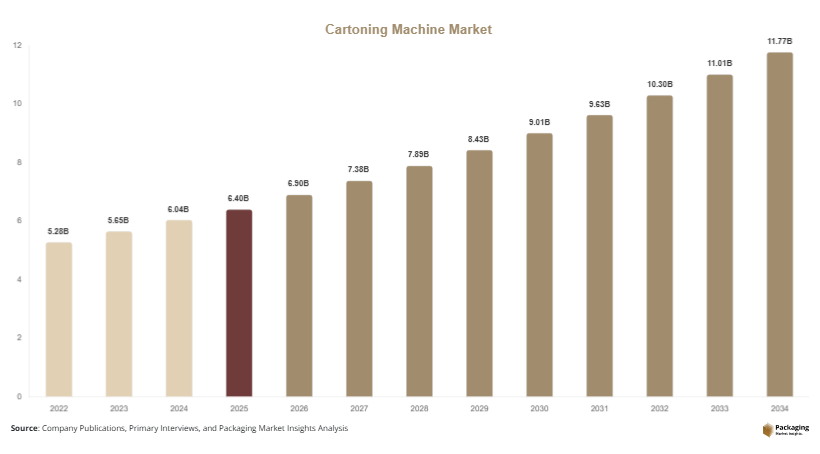
The cartoning machine market size was valued at approximately USD 6.4 billion in 2025 and is expected to reach USD 6.9 billion in 2026, with projections indicating growth to around USD 11.8 billion by 2034, registering a CAGR of 6.9% during 2025–2034. Cartoning machines are widely used for erecting, filling, and closing cartons, making them essential equipment in industries such as food & beverage, pharmaceuticals, personal care, and consumer goods. The cartoning machine market is witnessing steady expansion driven by increasing automation across packaging industries and the rising demand for efficient secondary packaging solutions.
A key growth factor influencing the cartoning machine market is the increasing demand for automated packaging systems. Manufacturers are focusing on improving operational efficiency, reducing labor costs, and enhancing production speed. Cartoning machines offer consistent performance, accuracy, and scalability, making them suitable for high-volume production environments. This shift toward automation is particularly evident in developed economies and is gradually expanding in emerging markets.
Key Highlights:
- Asia Pacific dominated the market with a 38.6% share in 2025, while Latin America is projected to grow at the fastest CAGR of 7.3%.
- Horizontal cartoning machines led the type segment with a 55.2% share, while vertical cartoning machines are expected to grow at a CAGR of 7.1%.
- Automatic machines dominated with a 62.4% share, while semi-automatic machines are forecasted to grow at a CAGR of 6.5%.
- Food & beverage applications led the segment with 41.7% share, while pharmaceutical applications are expected to grow at a CAGR of 7.0%.
- China remained the dominant country with a market size of USD 1.4 billion in 2025 and USD 1.5 billion in 2026.
Explore more data points, trends and opportunities Download Free Sample Report
Market Trends
Rising Integration of Smart and Connected Packaging Equipment
The cartoning machine market is increasingly influenced by the adoption of smart technologies and connected systems. Manufacturers are integrating advanced control systems, sensors, and real-time monitoring capabilities into cartoning machines to improve efficiency and reduce downtime. These smart machines enable predictive maintenance, allowing companies to identify potential issues before they lead to production interruptions. Additionally, connectivity with centralized systems helps streamline operations and improve overall productivity. The adoption of Industry 4.0 technologies is enabling manufacturers to optimize packaging processes, enhance quality control, and reduce operational costs, making smart cartoning machines a growing trend in the market.
Growing Demand for Flexible and Multi-Format Packaging Solutions
Another notable trend is the increasing demand for flexible cartoning machines capable of handling multiple product types and packaging formats. As consumer preferences evolve, manufacturers are required to offer a wide range of products in different sizes and packaging styles. This has led to the development of versatile cartoning machines that can be easily adjusted for different applications. These machines provide greater operational flexibility, reducing the need for multiple equipment setups. The ability to switch between different packaging formats quickly is becoming essential for manufacturers aiming to stay competitive in dynamic markets.
Market Drivers
Expansion of Food and Beverage Industry
The rapid growth of the food and beverage industry is a major driver of the cartoning machine market. Increasing consumer demand for packaged and processed food products is driving the need for efficient packaging solutions. Cartoning machines play a critical role in ensuring product safety, maintaining hygiene standards, and enhancing shelf appeal. The rise of convenience foods and ready-to-eat meals is further contributing to the demand for advanced packaging equipment. As food manufacturers expand their production capacities, the adoption of cartoning machines is expected to increase significantly.
Increasing Adoption of Automation in Packaging
Automation is transforming the packaging industry, and cartoning machines are at the forefront of this shift. Companies are investing in automated solutions to improve efficiency, reduce labor dependency, and minimize errors. Automated cartoning machines offer high-speed operations and consistent performance, making them suitable for large-scale production. The growing focus on cost optimization and operational efficiency is driving the adoption of these machines. This trend is expected to continue as industries seek to enhance productivity and remain competitive.
Market Restraint
High Initial Investment and Maintenance Costs
One of the key challenges in the cartoning machine market is the high initial investment required for advanced machines. Automated and technologically advanced cartoning systems can be expensive, making them less accessible for small and medium-sized enterprises. In addition to the initial cost, maintenance and operational expenses can also be significant. For example, companies may need to invest in skilled personnel and regular servicing to ensure optimal performance. This can limit the adoption of cartoning machines in cost-sensitive markets. Despite the long-term benefits, the high upfront costs remain a barrier for many businesses.
Market Opportunities
Growth in Pharmaceutical Packaging Demand
The pharmaceutical industry presents significant growth opportunities for the cartoning machine market. The increasing demand for medicines and healthcare products is driving the need for efficient and compliant packaging solutions. Cartoning machines are widely used for packaging tablets, capsules, and medical devices. The emphasis on product safety, traceability, and regulatory compliance is encouraging pharmaceutical companies to adopt advanced packaging technologies. As healthcare demand continues to rise globally, the market for cartoning machines is expected to expand.
Rising Demand in Emerging Economies
Emerging economies are creating new opportunities for market growth due to rapid industrialization and increasing consumer demand. Countries in Asia Pacific, Latin America, and the Middle East are witnessing growth in manufacturing and retail sectors. This is driving the adoption of packaging machinery, including cartoning machines. The expansion of e-commerce and organized retail is further supporting this trend. As businesses in these regions invest in modern packaging solutions, the demand for cartoning machines is expected to increase.
Report Scope
| Report Metric | Details |
|---|---|
| Market Size in 2025 | USD 6.4 Billion |
| Market Size in 2026 | USD 6.9 Billion |
| Market Size in 2034 | USD 11.8 Billion |
| CAGR | 6.9% (2026-2034) |
| Base Year for Estimation | 2025 |
| Historical Data | 2022-2024 |
| Forecast Period | 2026-2034 |
| Report Coverage | Revenue Forecast, Competitive Landscape, Supply Chain Disruption, Growth Factors, Environment & Regulatory Landscape and Trends |
| Geographies Covered | North America, Europe, APAC, Middle East and Africa, LATAM |
| Countries Covered | U.S., Canada, U.K., Germany, France, Spain, Italy, Russia, Nordic, Benelux, Rest of Europe, China, South Korea, Japan, India, Australia, Singapore, Taiwan, South East Asia, Rest of Asia-Pacific, UAE, Turky, Saudi Arabia, South Africa, Egypt, Nigeria, Rest of MEA, Brazil, Mexico, Argentina, Chile, Colombia, Rest of LATAM |
Explore more data points, trends and opportunities Download Free Sample Report
Segmental Analysis
By Type
Horizontal cartoning machines dominated the market in 2024 with a share of approximately 55.2%. These machines are widely used due to their efficiency in handling a variety of products. They are suitable for high-speed operations and are commonly used in food and pharmaceutical industries. The ability to handle complex packaging requirements is supporting their growth.
Vertical cartoning machines are expected to grow at the fastest CAGR of 7.1%. These machines are ideal for packaging products that require gravity-based filling. The increasing demand for flexible packaging solutions is driving their adoption.
By Automation Level
Automatic cartoning machines accounted for the largest share of approximately 62.4% in 2024. These machines offer high efficiency and are suitable for large-scale production. The increasing focus on automation is driving their adoption.
Semi-automatic machines are projected to grow at a CAGR of 6.5%. These machines are preferred by small and medium enterprises due to lower costs. The demand for cost-effective solutions is supporting their growth.
By End-Use Industry
The food and beverage industry dominated the market in 2024 with a share of approximately 41.7%. The demand for packaged food products is driving the adoption of cartoning machines. These machines help maintain product quality and improve shelf life.
The pharmaceutical industry is expected to grow at the fastest CAGR of 7.0%. The need for safe and compliant packaging solutions is driving demand. The growth of the healthcare sector is supporting this trend.
Cartoning Machine Market Segmentations
By Type
- Horizontal Cartoning Machines
- Vertical Cartoning Machines
By Automation Level
- Automatic
- Semi-Automatic
By End-Use Industry
- Food & Beverage
- Pharmaceutical
- Personal Care
- Consumer Goods
Regional Analysis
North America
North America accounted for approximately 24.5% of the cartoning machine market share in 2025 and is projected to grow at a CAGR of 6.3% during the forecast period. The region benefits from advanced manufacturing infrastructure and high adoption of automation technologies. The presence of established food and pharmaceutical industries is driving demand for cartoning machines.
The United States dominates the regional market due to its strong industrial base. A unique growth factor is the increasing adoption of smart packaging technologies, which is driving demand for advanced cartoning machines. This trend is expected to support market growth.
Europe
Europe held a market share of around 22.7% in 2025 and is expected to grow at a CAGR of 6.2%. The region is characterized by strict regulatory standards and a focus on sustainability, influencing packaging practices.
Germany leads the European market due to its strong manufacturing sector. A unique growth factor is the emphasis on sustainable packaging solutions, which is driving innovation in cartoning machines. This is expected to boost market growth.
Asia Pacific
Asia Pacific dominated the market with a 38.6% share in 2025 and is expected to grow at the highest CAGR of 7.2%. Rapid industrialization and expanding manufacturing activities are key drivers in this region.
China is the leading country in the region due to its large production capacity. A unique growth factor is the expansion of e-commerce, which is increasing demand for efficient packaging solutions. This is supporting market growth.
Middle East & Africa
The Middle East & Africa region accounted for approximately 6.9% of the market share in 2025 and is projected to grow at a CAGR of 6.1%. The growth is supported by increasing investments in industrial sectors.
Saudi Arabia is a key contributor to the regional market. A unique growth factor is the diversification of the economy, which is driving demand for packaging machinery. This is expected to boost market growth.
Latin America
Latin America held a market share of around 7.3% in 2025 and is expected to grow at the fastest CAGR of 7.3%. The region is witnessing growth in manufacturing and retail sectors.
Brazil dominates the regional market due to its expanding industrial base. A unique growth factor is the growth of the food processing industry, which is driving demand for cartoning machines. This trend is expected to support market growth.
Competitive Landscape
The cartoning machine market is characterized by the presence of several global and regional players focusing on innovation and product development. Companies are investing in advanced technologies to enhance machine performance and efficiency. The market is moderately competitive, with players adopting strategies such as partnerships, mergers, and product launches to strengthen their position.
IMA Group is considered a leading player due to its strong global presence and advanced product portfolio. The company recently introduced a new generation of automated cartoning machines with enhanced efficiency and digital integration. Other companies are also focusing on similar innovations to remain competitive.
Key Players List
- IMA Group
- Marchesini Group
- Bosch Packaging Technology
- Krones AG
- Coesia Group
- Tetra Pak International
- Fuji Machinery Co., Ltd.
- Bradman Lake Group
- Douglas Machine Inc.
- Econocorp Inc.
- Mpac Group plc
- ACG Worldwide
- Uhlmann Group
- Romaco Group
- PMI Cartoning Inc.