Carton Packaging Market Report Size and Growth
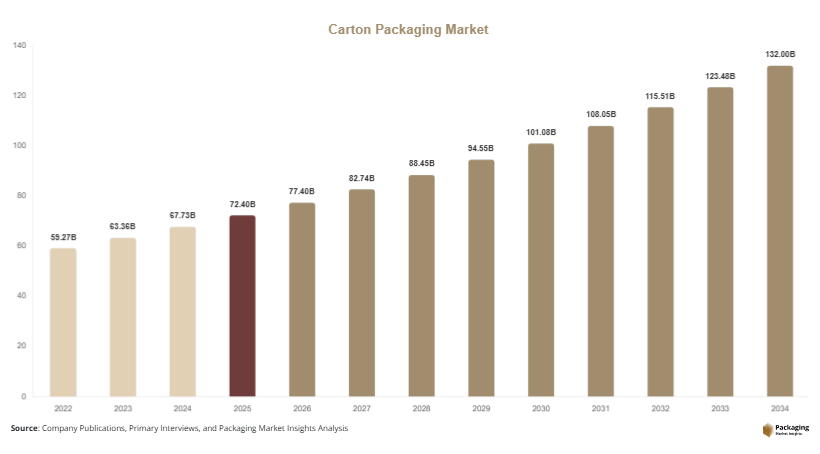
The Carton Packaging Market size was valued at USD 72.4 billion in 2025 and is projected to reach USD 108.6 billion by 2030, expanding at a compound annual growth rate (CAGR) of 6.9% during 2025–2031. Carton packaging is widely used across food, beverage, pharmaceutical, personal care, and consumer goods industries due to its lightweight structure, printability, and recyclability. Folding cartons and liquid cartons remain key formats used in retail packaging and logistics distribution.
One major global factor supporting the growth of the Carton Packaging Market has been the rising shift toward sustainable packaging solutions. Governments and multinational brands are increasingly prioritizing recyclable and fiber-based packaging materials to reduce plastic waste. Carton packaging, typically manufactured from paperboard sourced from renewable forestry resources, offers strong environmental credentials. This has encouraged companies in the food and beverage industry to replace rigid plastic containers with carton-based packaging solutions.
In addition, advancements in digital printing, barrier coatings, and lightweight paperboard materials have improved carton packaging performance. These innovations are enabling extended shelf life, improved branding capabilities, and enhanced product protection, which supports broader adoption across retail and e-commerce distribution channels.
Key Highlights
- Dominant Region: Asia Pacific accounted for 38.6% market share in 2025 due to strong manufacturing output and expanding retail sectors.
- Fastest-Growing Region: Latin America is expected to grow at a CAGR of 7.8% through 2033.
- Leading Type Segment: Folding cartons held the largest share in 2024.
- Fastest-Growing Type Segment: Aseptic cartons are projected to grow at a CAGR of 8.1%.
- Dominant Application Segment: Food & beverage packaging remained the largest application segment.
- Fastest-Growing Application Segment: Pharmaceutical packaging is forecast to grow at 7.5% CAGR.
- Dominant Country: The United States accounted for USD 14.2 billion in 2025, reaching USD 15.0 billion in 2026.
Explore more data points, trends and opportunities Download Free Sample Report
Market Trends
Expansion of Sustainable Fiber-Based Packaging
A major trend shaping the Carton Packaging Market is the increasing adoption of fiber-based sustainable packaging. Brands across food, beverage, and personal care sectors are shifting toward recyclable and biodegradable packaging materials to meet environmental targets. Carton packaging is widely considered a suitable alternative to plastic packaging due to its renewable raw materials and compatibility with recycling infrastructure.
Major consumer goods companies are committing to using packaging that is fully recyclable or reusable. As a result, carton manufacturers are investing in improved paperboard materials, water-based coatings, and barrier technologies that maintain product safety while improving sustainability. This trend is accelerating demand for recyclable folding cartons and liquid cartons globally.
Growth of Digital Printing and Smart Packaging
Another emerging trend in the Carton Packaging Market is the adoption of digital printing technologies and smart packaging features. Brands are increasingly using advanced printing techniques to enhance shelf visibility and deliver personalized packaging designs.
Digital printing allows shorter production runs, faster design changes, and improved color accuracy compared to traditional printing methods. In addition, smart packaging features such as QR codes, traceability labels, and product authentication systems are being integrated into carton packaging. These technologies support supply chain transparency and consumer engagement, particularly in premium consumer goods and pharmaceutical products.
Market Drivers
Growth of the Food and Beverage Industry
The expanding global food and beverage sector is a key driver of the Carton Packaging Market growth. Carton packaging offers excellent product protection, extended shelf life, and strong branding capabilities, making it suitable for packaged foods, dairy products, and beverages.
The increasing demand for convenience foods, ready-to-eat meals, and packaged beverages has significantly boosted the use of folding cartons and liquid cartons. Additionally, the expansion of organized retail and supermarket chains worldwide has further supported the use of carton packaging in product displays and shelf packaging.
Expansion of E-Commerce and Retail Distribution
The rapid growth of e-commerce and omnichannel retailing is another important driver of the Carton Packaging Market size. Online retail requires packaging formats that ensure product safety during transportation while maintaining cost efficiency.
Carton packaging provides lightweight protection and structural integrity, making it suitable for shipping consumer goods, electronics, cosmetics, and healthcare products. Retailers also prefer carton packaging because it can be easily customized with branding and product information. As global online shopping continues to expand, demand for carton packaging solutions is expected to increase steadily.
Market Restraint
Volatility in Raw Material Prices
One major restraint affecting the Carton Packaging Market is the volatility in paperboard and pulp prices. Paperboard is the primary raw material used in carton manufacturing, and its cost is influenced by factors such as wood pulp availability, energy prices, and global supply chain fluctuations.
Changes in raw material costs can significantly impact production expenses for carton packaging manufacturers. In periods of high pulp prices, companies often face reduced profit margins unless they pass the cost increases to end users.
Furthermore, transportation and logistics costs also affect the supply chain for paperboard materials. Global disruptions in shipping and manufacturing capacity may create supply shortages, which further contributes to price instability.
These challenges may slow market expansion in certain regions, particularly where packaging manufacturers operate with tight cost structures. To address this issue, companies are focusing on improving material efficiency and adopting lightweight paperboard technologies to reduce raw material consumption.
Market Opportunities
Development of Barrier Coated Cartons
One promising opportunity in the Carton Packaging Market is the development of advanced barrier coatings for carton packaging. Traditional cartons may face limitations when packaging liquid or moisture-sensitive products.
Innovations in barrier coatings, including bio-based polymers and water-resistant materials, are enabling cartons to protect sensitive food products and beverages more effectively. These technologies help extend product shelf life while maintaining recyclability, making them attractive for manufacturers seeking sustainable packaging alternatives.
Growth of Pharmaceutical Carton Packaging
Another emerging opportunity is the expanding pharmaceutical packaging sector. Carton packaging plays a vital role in protecting medicines, medical devices, and healthcare products during storage and distribution.
Pharmaceutical companies increasingly require packaging that supports regulatory labeling, traceability, and tamper-evident features. Carton packaging can accommodate these requirements through advanced printing technologies and structural design.
With global healthcare demand increasing and pharmaceutical manufacturing expanding across emerging markets, carton packaging manufacturers are expected to benefit from growing demand in this sector.
Report Scope
| Report Metric | Details |
|---|---|
| Market Size in 2025 | USD 72.4 Billion |
| Market Size in 2026 | USD 77.4 Billion |
| Market Size in 2034 | USD 108.0 Billion |
| CAGR | 6.9% (2026-2034) |
| Base Year for Estimation | 2025 |
| Historical Data | 2022-2024 |
| Forecast Period | 2026-2034 |
| Report Coverage | Revenue Forecast, Competitive Landscape, Supply Chain Disruption, Growth Factors, Environment & Regulatory Landscape and Trends |
| Geographies Covered | North America, Europe, APAC, Middle East and Africa, LATAM |
| Countries Covered | U.S., Canada, U.K., Germany, France, Spain, Italy, Russia, Nordic, Benelux, Rest of Europe, China, South Korea, Japan, India, Australia, Singapore, Taiwan, South East Asia, Rest of Asia-Pacific, UAE, Turky, Saudi Arabia, South Africa, Egypt, Nigeria, Rest of MEA, Brazil, Mexico, Argentina, Chile, Colombia, Rest of LATAM |
Explore more data points, trends and opportunities Download Free Sample Report
Segmental Analysis
By Type
Folding cartons represented the dominant subsegment in 2024, accounting for approximately 52.8% of the global Carton Packaging Market share. Folding cartons had been widely used across food, personal care, and pharmaceutical packaging due to their lightweight structure and cost efficiency. These cartons are easy to print and customize, making them suitable for retail product packaging.
Aseptic cartons are expected to be the fastest-growing type segment, expanding at a CAGR of 8.1% through 2031. These cartons are designed to store liquid food and beverages without refrigeration for extended periods. Their ability to preserve product quality while reducing storage costs will support strong demand in the beverage and dairy industries.
By Material
Paperboard remained the dominant material segment in 2024, accounting for around 64.5% of the Carton Packaging Market share. Paperboard cartons had been widely used due to their recyclability, printability, and structural strength. The availability of various paperboard grades has enabled manufacturers to produce cartons suitable for different applications.
Coated paperboard is projected to become the fastest-growing material segment, expanding at a CAGR of 7.3%. Coated paperboard provides enhanced moisture resistance and improved surface quality for printing. These characteristics make it suitable for premium packaging applications and food products requiring additional protection.
By Application
Food and beverage packaging held the largest share of the Carton Packaging Market in 2024, representing 58.2% of total demand. Carton packaging has been widely used for cereals, frozen foods, dairy products, beverages, and packaged snacks. The strong demand for packaged food products has significantly contributed to the growth of this segment.
Pharmaceutical packaging will likely emerge as the fastest-growing application segment, expanding at a CAGR of 7.5% during the forecast period. Increasing pharmaceutical production and strict regulatory requirements for product labeling and protection are expected to drive demand for carton packaging in healthcare applications.
Carton Packaging Market Segmentations
By Type
- Folding Cartons
- Aseptic Cartons
- Gable Top Cartons
- Rigid Cartons
By Material
- Paperboard
- Coated Paperboard
- Kraft Paperboard
- Recycled Paperboard
By Application
- Food & Beverage
- Pharmaceuticals
- Personal Care & Cosmetics
- Household Products
- Consumer Electronics
Regional Analysis
North America
North America accounted for 26.4% of the global Carton Packaging Market share in 2025. The region’s packaging industry had been well developed due to strong consumer goods manufacturing and advanced retail infrastructure. The market will likely expand at a CAGR of 6.2% between 2025 and 2033.
The United States remained the dominant country in the region due to its large food and beverage sector. Demand for carton packaging has been supported by the presence of major packaged food brands and strong e-commerce distribution networks. Companies in the region are focusing on recyclable packaging materials and lightweight paperboard designs to meet sustainability targets.
Europe
Europe represented 23.1% of the Carton Packaging Market in 2025. The market has been influenced by strict environmental regulations and strong consumer awareness regarding sustainable packaging. The region is expected to grow at a CAGR of 5.8% during the forecast period.
Germany emerged as the leading country in the European market. The country’s strong manufacturing base and advanced packaging technology sector supported the demand for carton packaging. German packaging companies are also investing in fiber-based materials and recyclable packaging innovations.
Asia Pacific
Asia Pacific held the largest share of 38.6% in the Carton Packaging Market in 2025. Rapid industrialization, expanding retail markets, and growing consumer populations have supported strong demand for carton packaging solutions. The region will likely grow at a CAGR of 7.4% through 2033.
China dominated the Asia Pacific market due to its large-scale manufacturing sector and strong demand for packaged food and consumer goods. The growth of online retail platforms in the country has also increased the need for efficient packaging materials, including carton packaging.
Middle East & Africa
The Middle East & Africa accounted for 6.3% of the Carton Packaging Market in 2025. The region’s packaging industry has been expanding as food processing and retail sectors grow. The market is projected to grow at a CAGR of 6.7% during the forecast period.
The United Arab Emirates emerged as a key country in the region due to its expanding retail infrastructure and logistics hubs. Demand for packaged consumer goods and imported food products has supported the adoption of carton packaging solutions.
Latin America
Latin America represented 5.6% of the Carton Packaging Market share in 2025. The region’s packaging sector has been growing due to expanding food and beverage production. The market is expected to grow at a CAGR of 7.8% between 2025 and 2033.
Brazil dominated the regional market due to its large consumer base and growing food processing industry. The increasing presence of multinational food companies in the country has supported the demand for carton packaging in retail distribution.
Competitive Landscape
The Carton Packaging Market is moderately consolidated, with several global and regional packaging companies competing through product innovation, sustainability initiatives, and strategic partnerships.
International Paper remains one of the leading companies in the market due to its extensive paperboard manufacturing capacity and global distribution network. The company has recently invested in sustainable packaging solutions to meet rising demand for recyclable materials.
Other key companies include WestRock Company, Smurfit Kappa Group, Graphic Packaging Holding Company, and DS Smith Plc. These companies focus on expanding their carton packaging portfolios and developing lightweight materials to improve packaging efficiency.
Many manufacturers are also investing in digital printing technologies and sustainable material innovations to strengthen their competitive position in the global packaging industry.
Key Players in the Carton Packaging Market
- International Paper Company
- WestRock Company
- Smurfit Kappa Group
- DS Smith Plc
- Graphic Packaging Holding Company
- Stora Enso Oyj
- Mondi Group
- Tetra Pak International
- Mayr-Melnhof Karton AG
- Nippon Paper Industries
- Oji Holdings Corporation
- Rengo Co., Ltd.
- Pratt Industries
- UPM-Kymmene Corporation
- Billerud AB