Carded Packaging Market Size and Growth
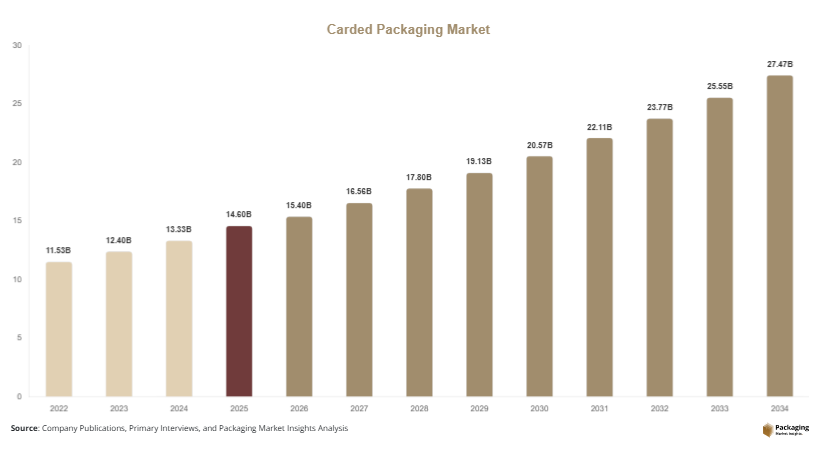
The global carded packaging market size is estimated at approximately USD 14.6 billion in 2025, reflecting strong adoption of thermoformed and paperboard-based carded packaging formats. By 2026, the market is projected to reach around USD 15.4 billion, supported by increasing retail shelf visibility requirements and growing e-commerce packaging needs. Looking ahead, the market is expected to attain a value of USD 27.9 billion by 2034, registering a CAGR of 7.5% from 2025 to 2034. The carded packaging market is experiencing steady expansion driven by rising demand for cost-effective, lightweight, and visually appealing retail packaging solutions across food, pharmaceuticals, personal care, and consumer goods industries.
Growth in the carded packaging market is primarily driven by three key factors: rising demand for retail-ready packaging solutions, increasing adoption of sustainable paperboard materials, and rapid expansion of organized retail and e-commerce channels. Manufacturers are focusing on improving packaging strength, product visibility, and branding efficiency, which is significantly boosting the use of blister cards and clamshell carded formats.
Key Highlights:
- Asia Pacific dominated the market with a 37.4% share in 2025.
- Latin America is projected to grow at the fastest CAGR of 6.2%.
- HDPE containers led the material segment with a 42.6% share in 2025.
- Bottles & jerry cans dominated with a 48.1% share in 2025.
- Crop protection applications led with a 51.3% share in 2025.
- The US remained the dominant country with a market size of USD 132.6 million in 2025 and USD 141.2 million in 2026.
Explore more data points, trends and opportunities Download Free Sample Report
Market Trends
Shift Toward Sustainable Paperboard Carded Packaging
The carded packaging market is witnessing a strong transition toward sustainable and recyclable paperboard materials. Manufacturers are increasingly replacing plastic-based blister packs with fiber-based carded alternatives to comply with environmental regulations and consumer sustainability preferences. This trend is particularly strong in Europe and North America, where regulatory frameworks are pushing for reduced plastic usage. Companies are investing in advanced coating technologies to improve moisture resistance and durability of paperboard cards. This shift is also helping brands enhance their eco-friendly image while maintaining strong product protection and shelf visibility in competitive retail environments.
Growth of High-Visibility Retail Packaging Designs
Another major trend is the increasing demand for high-visibility and aesthetically enhanced packaging formats. Retailers and brands are focusing on carded packaging that allows consumers to view the product while ensuring security and tamper resistance. Innovations in transparent blister sealing and printed card backings are improving product presentation and brand differentiation. This trend is especially prominent in personal care, toys, and electronics accessories segments. The integration of digital printing technologies is enabling customized packaging designs, allowing brands to improve shelf appeal and strengthen consumer engagement.
Market Drivers
Expansion of Organized Retail and E-commerce Channels
The rapid expansion of organized retail and e-commerce platforms is a major driver of the carded packaging market. Retailers require packaging solutions that are durable, space-efficient, and visually appealing for shelf display and logistics handling. Carded packaging provides excellent product protection while maintaining strong branding visibility, making it highly suitable for modern retail environments. E-commerce growth is further increasing demand for secure packaging formats that prevent damage during transportation. As online shopping continues to expand globally, manufacturers are increasingly adopting carded packaging solutions for small consumer goods and accessories.
Rising Demand from Pharmaceutical and Personal Care Industries
The pharmaceutical and personal care sectors are significantly driving market growth due to the need for tamper-evident, hygienic, and regulated packaging solutions. Carded packaging is widely used for blister packs of tablets, medical devices, and personal care kits. Increasing healthcare awareness and aging populations are boosting pharmaceutical consumption, further supporting demand. Additionally, personal care brands are using carded packaging to improve product presentation and ensure safety. Regulatory requirements for child-resistant and tamper-proof packaging are also strengthening adoption across these industries.
Market Restraint
High Cost of Advanced Carded Packaging Materials and Machinery
A key restraint in the carded packaging market is the relatively high cost associated with advanced packaging materials and automated machinery systems. While carded packaging offers strong visual appeal and product protection, the production process often requires specialized thermoforming equipment, precision sealing systems, and high-quality paperboard or plastic substrates. These requirements increase initial capital investment for manufacturers, especially small and medium-sized enterprises. Additionally, the cost of sustainable and recyclable materials remains higher compared to conventional plastic packaging solutions.
Fluctuations in raw material prices, particularly paperboard and polymer films, further impact production costs and profit margins. In price-sensitive markets, companies may hesitate to adopt premium carded packaging formats due to cost constraints. This can slow down market penetration in developing economies. Moreover, maintenance and operational costs of high-speed packaging machinery add additional financial burden, limiting scalability for smaller producers despite growing demand for sustainable and attractive packaging solutions.
Market Opportunities
Growth in Sustainable and Recyclable Packaging Solutions
The increasing global focus on sustainability presents a significant opportunity for the carded packaging market. Companies are actively investing in recyclable paperboard and bio-based coatings to replace traditional plastic blister packaging. Governments and regulatory bodies are promoting eco-friendly packaging alternatives, encouraging manufacturers to innovate in material design. This shift creates opportunities for packaging companies to develop fully recyclable carded formats that meet environmental compliance standards while maintaining durability and product protection.
Expansion of Customized and Smart Packaging Technologies
Another major opportunity lies in the integration of smart and customized packaging solutions. Digital printing technologies and smart labeling systems are enabling brands to create personalized carded packaging designs that enhance consumer engagement. QR codes, authentication tags, and interactive packaging features are being increasingly used in pharmaceuticals and consumer goods. These innovations not only improve traceability but also provide marketing advantages. As brands seek differentiation in competitive retail environments, demand for customized and technologically enhanced carded packaging is expected to grow significantly.
Report Scope
| Report Metric | Details |
|---|---|
| Market Size in 2025 | USD 14.6 Billion |
| Market Size in 2026 | USD 15.4 Billion |
| Market Size in 2034 | USD 27.9 Billion |
| CAGR | 7.5% (2026-2034) |
| Base Year for Estimation | 2025 |
| Historical Data | 2022-2024 |
| Forecast Period | 2026-2034 |
| Report Coverage | Revenue Forecast, Competitive Landscape, Supply Chain Disruption, Growth Factors, Environment & Regulatory Landscape and Trends |
| Geographies Covered | North America, Europe, APAC, Middle East and Africa, LATAM |
| Countries Covered | U.S., Canada, U.K., Germany, France, Spain, Italy, Russia, Nordic, Benelux, Rest of Europe, China, South Korea, Japan, India, Australia, Singapore, Taiwan, South East Asia, Rest of Asia-Pacific, UAE, Turky, Saudi Arabia, South Africa, Egypt, Nigeria, Rest of MEA, Brazil, Mexico, Argentina, Chile, Colombia, Rest of LATAM |
Explore more data points, trends and opportunities Download Free Sample Report
Segmental Analysis
By Material Type
The material type segment plays a crucial role in shaping the carded packaging market, with paperboard dominating the segment with approximately 46.3% share in 2024. Paperboard is widely used due to its excellent printability, recyclability, and structural strength, making it suitable for blister cards, folding cartons, and retail packaging applications. It is extensively used in pharmaceuticals, personal care, and consumer goods packaging due to its ability to enhance brand visibility while ensuring product protection.
Plastic films continue to hold a significant share, especially in thermoformed blister packaging and clamshell designs, where transparency and durability are essential. However, environmental concerns are pushing manufacturers to reduce plastic usage in favor of sustainable alternatives. The demand for bio-based and coated paperboard materials is increasing as companies seek eco-friendly packaging solutions that comply with regulatory standards.
The fastest-growing subsegment is bio-based and sustainable coated materials, projected to grow at a CAGR of 8.0% through 2034. This growth is driven by increasing environmental regulations and consumer demand for plastic-free packaging solutions. Manufacturers are developing advanced barrier coatings and biodegradable materials that maintain durability while improving recyclability. This transition is expected to significantly reshape material selection strategies in the carded packaging market over the forecast period.
By Packaging Type
The packaging type segment is led by blister card packaging, accounting for approximately 52.1% market share in 2024. Blister cards are widely used in pharmaceuticals, electronics accessories, and small consumer goods due to their ability to provide product visibility, tamper resistance, and strong structural support. Their widespread use in unit-dose pharmaceutical packaging further strengthens demand across healthcare applications.
Clamshell packaging also holds a notable share, particularly in retail applications where product protection and display visibility are essential. Folding cartons and hybrid carded packaging formats are increasingly used for premium products, offering enhanced branding opportunities and structural flexibility. The demand for visually appealing packaging continues to drive innovation in printing and sealing technologies.
The fastest-growing subsegment is clamshell carded packaging, expected to grow at a CAGR of 7.9% through 2034, driven by increasing demand for tamper-evident and reusable packaging formats. Growth is further supported by rising e-commerce sales, where product protection during transit is critical. Manufacturers are investing in lightweight yet durable clamshell solutions that improve logistics efficiency while maintaining product integrity.
By End Use
The end-use segment is dominated by the pharmaceutical industry, accounting for approximately 39.4% share in 2024. Carded packaging is extensively used in blister packs for tablets, capsules, and medical devices due to its ability to ensure hygiene, dosage accuracy, and tamper resistance. Increasing global healthcare spending and rising demand for over-the-counter medicines continue to support strong growth in this segment.
The consumer goods segment also holds a significant share, driven by demand for attractive and retail-friendly packaging formats in toys, electronics accessories, and personal care products. Food packaging applications are growing steadily due to increasing demand for convenience-based and portion-controlled packaging formats.
The fastest-growing subsegment is consumer goods packaging, projected to grow at a CAGR of 8.2% through 2034, driven by retail expansion, e-commerce growth, and increasing demand for visually appealing packaging solutions. Brands are increasingly focusing on packaging as a marketing tool, leading to higher adoption of customized and printed carded packaging formats that enhance shelf presence and consumer engagement.
Carded Packaging Market Segmentations
By Material Type
- Paperboard
- Plastic Films
- Bio-based Materials
By Packaging Type
- Blister Cards
- Clamshell Cards
- Folding Cartons
- Others
By End User
- Pharmaceuticals
- Personal Care
- Consumer Goods
- Food & Beverage
- Electronics Accessories
Regional Analysis
North America
North America holds a significant position in the carded packaging market, accounting for approximately 24.5% market share in 2025, with a projected CAGR of 7.2% from 2025 to 2034. The region benefits from a well-established retail ecosystem, advanced packaging technologies, and strong demand from pharmaceutical and consumer goods industries. The United States and Canada collectively drive market expansion through high adoption of blister card packaging, clamshell packaging, and premium retail-ready packaging formats. The presence of leading packaging manufacturers and strong R&D investment further supports innovation in recyclable and sustainable carded packaging materials.
The demand in North America is strongly influenced by the pharmaceutical sector, where carded packaging is widely used for blister packs, medical kits, and over-the-counter drugs. Additionally, the personal care and electronics accessories industries are contributing to steady growth due to increasing demand for protective and visually appealing packaging. A key growth factor in the region is the rising shift toward sustainable packaging solutions driven by regulatory pressure and consumer awareness regarding plastic waste reduction. The United States dominates the regional market due to its advanced manufacturing infrastructure and rapid adoption of eco-friendly packaging technologies, particularly in retail and healthcare applications.
Europe
Europe accounts for approximately 27.8% market share in 2025, with a projected CAGR of 7.6% through 2034, making it one of the most mature and environmentally driven regions in the carded packaging market. The region is highly influenced by strict environmental regulations under the European Union’s sustainability frameworks, which encourage the adoption of recyclable and fiber-based packaging solutions. Countries such as Germany, France, the United Kingdom, Italy, and Spain are leading contributors to market growth, supported by strong retail systems and advanced packaging innovation capabilities.
A key characteristic of the European market is its strong emphasis on circular economy principles. Manufacturers are increasingly shifting from plastic-heavy packaging formats to paperboard-based carded packaging solutions. Germany leads the region due to its advanced packaging machinery industry and high recycling efficiency systems. A unique growth factor in Europe is the widespread implementation of Extended Producer Responsibility (EPR) regulations, which require companies to manage packaging waste throughout its lifecycle. This regulatory environment is accelerating innovation in biodegradable coatings, recyclable blister cards, and sustainable sealing technologies, making Europe a global leader in eco-friendly carded packaging adoption.
Asia Pacific
Asia Pacific dominates the global carded packaging market with approximately 31.2% share in 2025, and is projected to grow at the fastest CAGR of 8.1% through 2034. The region’s dominance is driven by rapid industrialization, expanding retail networks, and strong growth in manufacturing sectors such as pharmaceuticals, electronics, and consumer goods. China, India, Japan, and South Korea are the key contributors to regional market expansion, with China leading due to its massive production capabilities and export-oriented packaging industry.
The demand for carded packaging in Asia Pacific is fueled by increasing urbanization, rising disposable incomes, and growing consumption of packaged goods. Retail expansion and e-commerce penetration are also boosting demand for visually attractive and protective packaging solutions. A major growth factor in the region is the increasing adoption of cost-effective packaging formats that enhance product visibility while reducing material usage. India is emerging as a fast-growing market due to rapid pharmaceutical expansion and increasing demand for retail-ready packaging solutions. Additionally, local manufacturers are increasingly investing in automated thermoforming and printing technologies to meet rising demand efficiently.
Middle East & Africa
The Middle East & Africa (MEA) region holds approximately 7.5% market share in 2025, with a projected CAGR of 6.4% through 2034 in the carded packaging market. Although smaller compared to other regions, MEA is witnessing steady growth driven by increasing imports of packaged goods, expanding retail infrastructure, and rising pharmaceutical consumption. Countries such as the United Arab Emirates, Saudi Arabia, South Africa, and Egypt are key contributors to regional demand.
The United Arab Emirates leads the regional market due to its strong retail and hospitality sectors, which require high-quality and visually appealing packaging solutions. A key growth factor in MEA is the increasing demand for pharmaceutical packaging, particularly blister packs and tamper-evident carded packaging formats. Additionally, economic diversification efforts in Gulf countries are supporting the development of local manufacturing industries, which is gradually boosting demand for advanced packaging solutions. Rising consumer awareness regarding product safety and quality is also encouraging adoption of durable and protective carded packaging formats across various industries.
Latin America
Latin America accounts for approximately 9% market share in 2025, with a projected CAGR of 7.4% through 2034, driven by increasing consumer goods consumption, retail modernization, and pharmaceutical industry expansion. Brazil, Mexico, Argentina, and Chile are the major contributors to regional market growth. Brazil dominates the market due to its large consumer base and strong manufacturing capabilities in packaged goods and pharmaceuticals.
A key growth factor in Latin America is the rising adoption of modern retail packaging formats, including blister cards and clamshell packaging, to improve product presentation and shelf appeal. Additionally, increasing awareness of sustainable packaging solutions is encouraging manufacturers to adopt recyclable and fiber-based materials. Mexico is also emerging as a strong market due to its expanding export-oriented manufacturing sector and proximity to North American supply chains. The growth of e-commerce platforms in the region is further increasing demand for durable and visually attractive carded packaging solutions that ensure product protection during transportation.
Competitive Landscape
The carded packaging market is moderately fragmented with strong competition among global packaging companies focusing on sustainability and innovation. Key players include Amcor, Berry Global, Huhtamaki, WestRock, and Sonoco Products Company. These companies are investing in recyclable materials, advanced thermoforming technologies, and digital printing solutions.
Amcor is a leading player due to its strong global presence and continuous innovation in sustainable packaging. Recently, the company expanded its recyclable paperboard blister packaging portfolio to meet growing regulatory requirements and consumer demand for eco-friendly solutions.
Key Players List
- Amcor plc
- Sonoco Products Company
- WestRock Company
- Mondi Group
- Sealed Air Corporation
- DS Smith Plc
- Huhtamaki Oyj
- Berry Global Inc.
- Smurfit Kappa Group
- Graphic Packaging International
- Stora Enso Oyj
- Constantia Flexibles Group GmbH
- Coveris Holdings S.A.
- Placon Corporation
- Winpak Ltd.