Cardboard Sheet Market Size and Growth
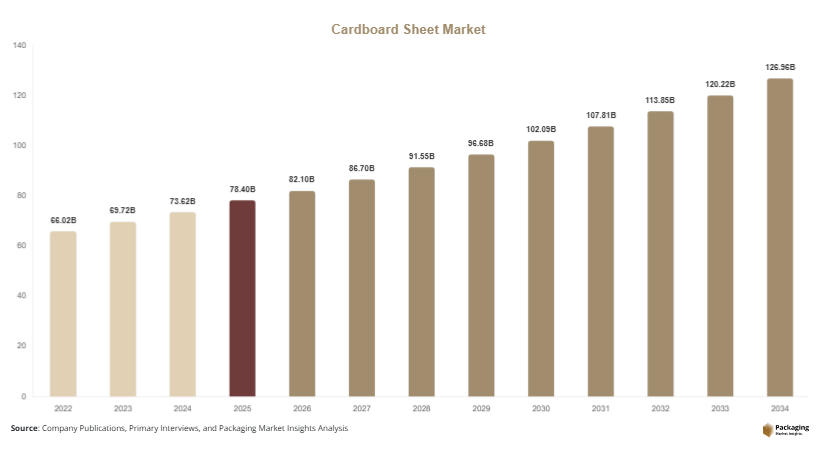
The Cardboard Sheet Market is experiencing steady expansion, driven by increasing demand across packaging, logistics, and industrial applications. The global market size was valued at approximately USD 78.4 billion in 2025 and is projected to reach USD 82.1 billion in 2026. Over the forecast period from 2025 to 2034, the market is expected to grow at a compound annual growth rate (CAGR) of 5.6%, reaching an estimated USD 132.7 billion by 2034.
Cardboard sheets, known for their lightweight structure, recyclability, and cost efficiency, are widely used in packaging solutions for consumer goods, electronics, food products, and e-commerce shipments. The rapid expansion of global trade and the increasing penetration of online retail platforms are contributing significantly to market growth. Additionally, environmental concerns and regulatory frameworks encouraging sustainable packaging materials are accelerating the shift from plastic to cardboard-based solutions.
Key Highlights:
- Market size: USD 78.4 billion (2025) to USD 132.7 billion (2034)
- CAGR (2025–2034): 5.6%
- Strong demand from e-commerce and retail sectors
- Increasing focus on sustainable and recyclable packaging
- Technological improvements enhancing product durability
Explore more data points, trends and opportunities Download Free Sample Report
Market Trends
Shift Toward Sustainable Packaging Solutions
The cardboard sheet market is witnessing a significant shift toward sustainable packaging as industries prioritize environmentally responsible materials. Governments and regulatory bodies across multiple regions are enforcing stricter rules on single-use plastics, prompting manufacturers to adopt recyclable and biodegradable alternatives such as cardboard sheets. This trend is particularly prominent in the food and beverage, personal care, and consumer electronics sectors, where brands are actively redesigning packaging to reduce environmental impact.
Consumers are increasingly aware of sustainability issues, which is influencing purchasing decisions and encouraging companies to adopt eco-friendly packaging strategies. Cardboard sheets, being recyclable and often produced from renewable resources, align well with these expectations. Additionally, advancements in recycled fiber processing are improving the quality and strength of cardboard materials, making them more competitive with traditional packaging options. This trend is expected to continue as sustainability remains a key focus for both businesses and policymakers.
Integration of Smart and Custom Packaging
Another notable trend in the cardboard sheet market is the growing adoption of customized and smart packaging solutions. Manufacturers are increasingly offering tailored cardboard sheets designed to meet specific industry requirements, such as enhanced durability, moisture resistance, or structural strength. This customization enables companies to optimize packaging efficiency and reduce material waste.
In addition, the integration of smart packaging features, such as QR codes and tracking systems, is gaining traction. These features enhance supply chain visibility and improve customer engagement by providing product information and traceability. The e-commerce sector, in particular, is driving demand for innovative packaging designs that ensure product safety while enhancing the unboxing experience. As digitalization continues to evolve, the demand for intelligent and adaptable cardboard sheet solutions is expected to increase significantly.
Market Drivers
Growth of E-commerce and Logistics Industry
The rapid expansion of the e-commerce sector is a major driver for the cardboard sheet market. With increasing online shopping activities worldwide, there is a growing need for efficient and protective packaging solutions. Cardboard sheets are widely used in shipping boxes, protective layering, and cushioning materials, making them essential for logistics operations.
E-commerce companies require packaging materials that are lightweight, cost-effective, and capable of protecting products during transit. Cardboard sheets meet these requirements while also being easy to handle and store. The surge in cross-border trade and last-mile delivery services further amplifies the demand for packaging materials. Additionally, seasonal sales events and promotional campaigns are increasing shipment volumes, thereby boosting the consumption of cardboard sheets across the logistics sector.
Increasing Demand for Sustainable Materials
The growing emphasis on sustainability is another key factor driving the cardboard sheet market. Businesses are actively seeking alternatives to plastic packaging to comply with environmental regulations and meet consumer expectations. Cardboard sheets, being recyclable and biodegradable, are gaining widespread acceptance as a sustainable packaging solution.
Many companies are investing in sustainable packaging initiatives, including the use of recycled materials and reduction of carbon emissions. Cardboard sheets contribute to these goals by offering a lower environmental footprint compared to plastic and other non-recyclable materials. This shift is particularly evident in industries such as retail, food and beverage, and electronics, where packaging plays a crucial role in brand perception and environmental responsibility.
Market Restraints
Vulnerability to Moisture and Environmental Conditions
One of the primary restraints in the cardboard sheet market is the material’s susceptibility to moisture and adverse environmental conditions. Unlike plastic or metal packaging, cardboard sheets can lose structural integrity when exposed to high humidity, water, or extreme temperatures. This limitation restricts their application in industries that require moisture-resistant or waterproof packaging solutions.
For instance, in the food and beverage industry, especially in the packaging of perishable goods, exposure to moisture can compromise product safety and quality. Similarly, in the logistics sector, shipments that encounter wet conditions during transportation may experience packaging failure, leading to product damage and financial losses. This issue is particularly relevant in regions with high humidity levels or unpredictable weather conditions.
To address this challenge, manufacturers are investing in coatings and treatments that enhance the water resistance of cardboard sheets. However, these solutions often increase production costs and may impact recyclability, creating a trade-off between performance and sustainability. As a result, while cardboard sheets remain a preferred packaging option, their limitations in moisture-prone environments continue to pose challenges for market growth.
Market Opportunities
Expansion in Emerging Economies
Emerging economies present significant growth opportunities for the cardboard sheet market due to rapid industrialization, urbanization, and increasing consumer spending. Countries in Asia Pacific, Latin America, and Africa are witnessing a surge in manufacturing activities and retail expansion, which is driving demand for packaging materials.
The growth of organized retail and e-commerce platforms in these regions is creating a strong need for cost-effective and sustainable packaging solutions. Cardboard sheets, with their affordability and versatility, are well-suited to meet these requirements. Additionally, government initiatives promoting local manufacturing and sustainable practices are further supporting market growth. As infrastructure improves and supply chains become more efficient, the demand for cardboard sheets is expected to rise significantly in emerging markets.
Technological Advancements in Material Innovation
Technological advancements in material science are opening new avenues for the cardboard sheet market. Innovations such as water-resistant coatings, enhanced strength formulations, and lightweight designs are expanding the application scope of cardboard sheets across various industries.
These advancements enable manufacturers to address traditional limitations associated with cardboard materials, such as moisture sensitivity and limited durability. For example, the development of multi-layered cardboard sheets with improved structural integrity allows their use in heavy-duty packaging applications. Additionally, digital printing technologies are enabling high-quality customization, which is particularly valuable for branding and marketing purposes. As research and development activities continue, the introduction of advanced cardboard sheet products is expected to create new growth opportunities in the market.
Report Scope
| Report Metric | Details |
|---|---|
| Market Size in 2025 | USD 78.4 Billion |
| Market Size in 2026 | USD 82.1 Billion |
| Market Size in 2034 | USD 132.7 Billion |
| CAGR | 5.6% (2026-2034) |
| Base Year for Estimation | 2025 |
| Historical Data | 2022-2024 |
| Forecast Period | 2026-2034 |
| Report Coverage | Revenue Forecast, Competitive Landscape, Supply Chain Disruption, Growth Factors, Environment & Regulatory Landscape and Trends |
| Geographies Covered | North America, Europe, APAC, Middle East and Africa, LATAM |
| Countries Covered | U.S., Canada, U.K., Germany, France, Spain, Italy, Russia, Nordic, Benelux, Rest of Europe, China, South Korea, Japan, India, Australia, Singapore, Taiwan, South East Asia, Rest of Asia-Pacific, UAE, Turky, Saudi Arabia, South Africa, Egypt, Nigeria, Rest of MEA, Brazil, Mexico, Argentina, Chile, Colombia, Rest of LATAM |
Explore more data points, trends and opportunities Download Free Sample Report
Segmental Analysis
By Type
The corrugated cardboard sheet segment dominated the cardboard sheet market, accounting for approximately 62% of the market share in 2024. Corrugated sheets are widely used due to their superior strength, durability, and cushioning properties, making them ideal for packaging and shipping applications. These sheets consist of fluted layers that provide enhanced protection against impact and compression, which is particularly important in the logistics and e-commerce sectors.
The dominance of corrugated sheets is further supported by their versatility and cost-effectiveness. They can be easily customized in terms of size, thickness, and design, allowing manufacturers to meet specific packaging requirements. Additionally, the widespread availability of raw materials and established production processes contribute to the strong market position of this segment.
The paperboard sheet segment is expected to be the fastest-growing, with a projected CAGR of 6.2% during the forecast period. Paperboard sheets are increasingly used in lightweight packaging applications, such as food packaging and consumer goods. Their smooth surface and printability make them suitable for branding and marketing purposes.
The growth of this segment is driven by the increasing demand for aesthetically appealing and eco-friendly packaging solutions. Paperboard sheets offer a balance between functionality and visual appeal, making them a preferred choice for retail packaging. Additionally, advancements in coating technologies are enhancing their durability and resistance to moisture, further supporting their adoption.
By Application
The packaging segment dominated the market, holding approximately 68% share in 2024. Cardboard sheets are extensively used in packaging applications due to their protective properties and cost efficiency. They are widely used in shipping boxes, protective inserts, and cushioning materials, making them essential for the logistics and e-commerce industries.
The dominance of the packaging segment is driven by the increasing volume of goods transported globally. As supply chains become more complex, the need for reliable and durable packaging solutions is growing. Cardboard sheets provide an effective solution by offering protection against physical damage while being lightweight and easy to handle.
The industrial application segment is expected to grow at the fastest rate, with a CAGR of 5.9%. This segment includes the use of cardboard sheets in manufacturing processes, such as protective layering, pallet sheets, and separators. The growth is driven by increasing industrial activities and the need for efficient material handling solutions.
Cardboard sheets are being increasingly used in industrial settings due to their versatility and cost-effectiveness. They can be customized to meet specific requirements, such as size and strength, making them suitable for various applications. Additionally, their recyclability aligns with sustainability goals, further supporting their adoption in industrial applications.
By End-Use Industry
The e-commerce and retail segment dominated the cardboard sheet market, accounting for approximately 55% of the market share in 2024. The rapid growth of online shopping and retail activities is driving the demand for packaging materials, including cardboard sheets. These sheets are used in shipping boxes, protective packaging, and display packaging, making them essential for the retail sector.
The dominance of this segment is supported by the increasing number of online orders and the need for efficient packaging solutions. Cardboard sheets offer a cost-effective and sustainable option for packaging, making them a preferred choice for retailers and e-commerce companies. Additionally, the ability to customize packaging designs enhances brand visibility and customer experience.
The food and beverage segment is expected to be the fastest-growing, with a CAGR of 6.5%. This growth is driven by the increasing demand for packaged food products and the need for sustainable packaging solutions. Cardboard sheets are widely used in food packaging due to their recyclability and ability to maintain product integrity.
The growth of this segment is further supported by changing consumer preferences and increasing awareness of environmental issues. Food and beverage companies are adopting eco-friendly packaging solutions to meet regulatory requirements and enhance brand image. As a result, the demand for cardboard sheets in this segment is expected to increase significantly.
Cardboard Sheet Market Segmentations
Type
- Corrugated Cardboard Sheets
- Paperboard Sheets
Application
- Packaging
- Industrial
- Others
End-Use Industry
- E-commerce & Retail
- Food & Beverage
- Electronics
- Automotive
- Others
Regional Analysis
North America
North America accounted for approximately 26% of the global cardboard sheet market share in 2025, supported by strong demand from the e-commerce and retail sectors. The region is expected to grow at a CAGR of 5.1% during the forecast period, driven by increasing adoption of sustainable packaging solutions and technological advancements in manufacturing processes. The presence of established logistics networks and high consumer awareness regarding environmental issues further contribute to market expansion.
The United States dominates the North American market due to its advanced retail infrastructure and strong e-commerce penetration. A unique growth factor in this region is the increasing adoption of automated packaging systems, which require standardized and high-quality cardboard sheets. These systems enhance operational efficiency and reduce labor costs, thereby boosting demand for precision-engineered cardboard materials.
Europe
Europe held around 24% market share in 2025, with a projected CAGR of 4.8% from 2025 to 2034. The region’s growth is largely influenced by stringent environmental regulations and a strong emphasis on sustainability. European countries are actively reducing plastic usage, which is driving the adoption of recyclable materials such as cardboard sheets across various industries.
Germany leads the European market, supported by its robust manufacturing sector and focus on sustainable practices. A unique growth factor in this region is the implementation of circular economy initiatives, which promote recycling and reuse of materials. These initiatives are encouraging the use of cardboard sheets as a preferred packaging solution, thereby supporting market growth.
Asia Pacific
Asia Pacific is the fastest-growing region in the cardboard sheet market, accounting for approximately 32% of the global share in 2025 and expected to grow at a CAGR of 6.8%. Rapid industrialization, expanding e-commerce activities, and increasing consumer demand are key factors driving market growth in this region.
China dominates the Asia Pacific market due to its large manufacturing base and strong export activities. A unique growth factor is the rapid expansion of online retail platforms, which is increasing the demand for packaging materials. Additionally, government initiatives promoting sustainable packaging are further supporting the adoption of cardboard sheets in the region.
Middle East & Africa
The Middle East & Africa region accounted for around 9% of the global market share in 2025, with a projected CAGR of 5.3%. The market is driven by growing industrial activities and increasing investments in infrastructure development. The rising demand for packaged goods is also contributing to the growth of the cardboard sheet market in this region.
The United Arab Emirates is a key market within this region, driven by its strong logistics and trade sector. A unique growth factor is the expansion of retail and tourism industries, which is increasing the demand for packaging materials. The region’s strategic location as a trade hub further supports market growth.
Latin America
Latin America held approximately 9% of the global cardboard sheet market share in 2025, with an expected CAGR of 5.0% during the forecast period. The region is experiencing steady growth due to increasing urbanization and expanding retail sectors. The demand for cost-effective packaging solutions is also driving market growth.
Brazil leads the Latin American market, supported by its large consumer base and growing industrial sector. A unique growth factor is the increasing adoption of sustainable packaging practices, driven by government regulations and consumer awareness. This trend is encouraging the use of cardboard sheets across various industries.
Competitive Landscape
The cardboard sheet market is moderately fragmented, with several global and regional players competing based on product quality, innovation, and pricing strategies. Leading companies are focusing on expanding their production capacities, investing in sustainable materials, and enhancing their distribution networks to strengthen their market position.
One of the leading players in the market is International Paper Company, which holds a significant share due to its extensive product portfolio and global presence. The company has been actively investing in sustainable packaging solutions and expanding its manufacturing capabilities. A recent development includes the launch of advanced recyclable cardboard products designed for e-commerce packaging applications.
Other major players are focusing on strategic collaborations, mergers, and acquisitions to expand their market reach. Companies are also investing in research and development to introduce innovative products that meet evolving customer demands. The competitive landscape is expected to remain dynamic, with increasing emphasis on sustainability and technological advancements.
Key Players List
- International Paper Company
- WestRock Company
- Smurfit Kappa Group
- DS Smith Plc
- Mondi Group
- Stora Enso Oyj
- Packaging Corporation of America
- Nippon Paper Industries Co., Ltd.
- Oji Holdings Corporation
- Georgia-Pacific LLC
- Pratt Industries Inc.
- Cascades Inc.
- Klabin S.A.
- Rengo Co., Ltd.
- Sappi Limited