Cardboard Boxes Market Size and Growth
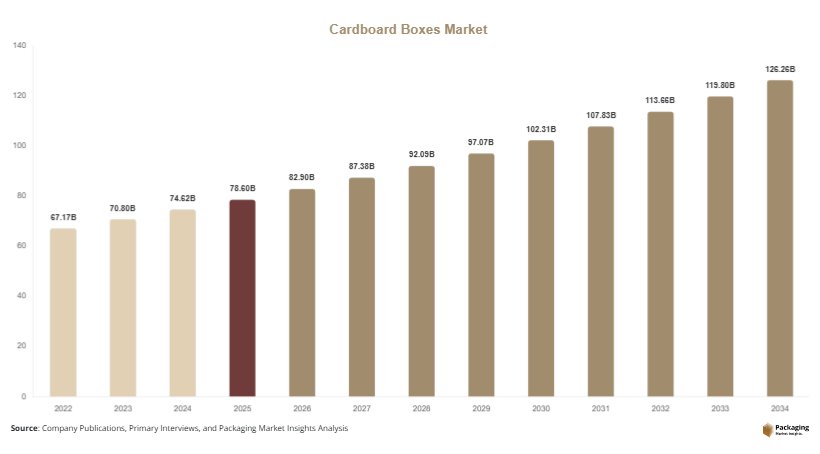
The Cardboard Boxes Market is witnessing steady expansion due to increasing demand across e-commerce, food & beverage, and industrial packaging sectors. In 2025, the global cardboard boxes market size is estimated at USD 78.6 billion and is projected to reach USD 82.9 billion in 2026. The market is expected to grow significantly and reach USD 126.4 billion by 2034, expanding at a CAGR of 5.4% during the forecast period (2025–2034).
The growth of the cardboard boxes market is largely driven by the rapid rise of e-commerce platforms, which rely heavily on corrugated packaging for shipping and logistics. Additionally, the increasing emphasis on sustainable and recyclable packaging materials has strengthened the demand for cardboard solutions. Cardboard boxes are biodegradable, lightweight, and cost-effective, making them a preferred choice across multiple industries.
Key Highlights
- Market size in 2025: USD 78.6 billion
- Forecast size by 2034: USD 126.4 billion
- CAGR (2025–2034): 5.4%
- Strong demand from e-commerce and food delivery sectors
- Rising adoption of sustainable and recyclable packaging materials
- Increasing use across industrial and logistics applications
Explore more data points, trends and opportunities Download Free Sample Report
Market Trends
Growing Adoption of Sustainable Packaging Solutions
Sustainability is becoming a central theme in the cardboard boxes market. Businesses are increasingly shifting toward environmentally responsible packaging materials to reduce their carbon footprint. Cardboard boxes, made from renewable resources and recyclable fibers, align with sustainability goals and regulatory requirements. Companies are adopting recycled content and eco-friendly inks to enhance the environmental profile of packaging products.
This trend is further supported by consumer awareness regarding environmental issues. Many customers prefer brands that use recyclable or biodegradable packaging. As a result, companies are redesigning packaging formats to reduce material usage and improve recyclability. Lightweighting strategies and minimalist designs are gaining popularity. These developments are expected to shape the long-term growth of the cardboard boxes market.
Increasing Customization and Digital Printing
Customization and branding have become important factors in packaging design. The cardboard boxes market is witnessing a shift toward digitally printed and customized packaging solutions. Companies are using high-quality printing techniques to enhance product visibility and brand identity. Personalized packaging is particularly common in e-commerce, where unboxing experiences play a key role in customer satisfaction.
Digital printing technologies allow for short production runs and faster turnaround times, making them suitable for small and medium enterprises. Additionally, QR codes, augmented reality elements, and smart labeling are being integrated into cardboard packaging to provide interactive experiences. This trend reflects the growing importance of packaging as a marketing tool rather than just a protective medium.
Market Drivers
Expansion of E-commerce and Logistics Industry
The rapid growth of e-commerce platforms is a major driver of the cardboard boxes market. Online shopping requires secure, lightweight, and cost-effective packaging solutions for shipping goods. Cardboard boxes are widely used due to their strength, durability, and ability to protect products during transit. The increasing number of online orders has led to a surge in demand for corrugated boxes.
Logistics companies also rely heavily on cardboard packaging for efficient storage and transportation. The rise of same-day and next-day delivery services has increased the need for standardized packaging solutions. Additionally, the growth of cross-border e-commerce has further boosted the demand for durable packaging materials. This trend is expected to continue, driving consistent growth in the cardboard boxes market.
Rising Demand from Food and Beverage Industry
The food and beverage industry is another key driver of the cardboard boxes market. Cardboard packaging is widely used for transporting packaged foods, beverages, and takeaway meals. Its ability to provide insulation and protection makes it suitable for perishable products. With the growing demand for ready-to-eat meals and food delivery services, the use of cardboard packaging has increased significantly.
Restaurants and food delivery platforms are adopting cardboard boxes for packaging due to their eco-friendly properties. Additionally, regulatory bodies are encouraging the use of biodegradable packaging materials, which further supports market growth. Innovations in food-grade coatings and moisture-resistant materials have enhanced the performance of cardboard packaging, making it suitable for a wide range of applications.
Market Restraint
Volatility in Raw Material Prices
One of the primary challenges in the cardboard boxes market is the fluctuation in raw material prices. Cardboard is primarily produced from paper pulp, which is derived from wood fibers. Changes in the availability and cost of raw materials can impact production costs and profit margins for manufacturers. Factors such as deforestation regulations, supply chain disruptions, and energy costs contribute to price volatility.
For instance, during periods of high demand or limited supply, the cost of paper pulp can increase significantly. This can lead to higher prices for cardboard boxes, affecting both manufacturers and end-users. Small and medium-sized enterprises are particularly vulnerable to these fluctuations, as they may have limited resources to absorb cost increases.
Additionally, the recycling process, although beneficial for sustainability, involves operational costs that can further impact pricing. Companies must invest in efficient supply chain management and alternative sourcing strategies to mitigate these challenges. Despite the growing demand for cardboard packaging, price volatility remains a critical restraint that could hinder market growth in certain regions.
Market Opportunities
Growth in Sustainable and Circular Economy Initiatives
The shift toward a circular economy presents significant opportunities for the cardboard boxes market. Governments and organizations are promoting recycling and reuse of materials to reduce waste and environmental impact. Cardboard boxes, being highly recyclable, fit well within this framework. Companies are investing in closed-loop recycling systems to enhance sustainability and reduce dependency on virgin materials.
This opportunity is further supported by regulatory policies that encourage the use of eco-friendly packaging. Businesses that adopt sustainable practices can gain a competitive advantage and improve brand reputation. The development of biodegradable coatings and water-resistant materials also expands the application scope of cardboard packaging. As sustainability continues to gain importance, the demand for cardboard boxes is expected to increase.
Technological Advancements in Packaging Design
Technological innovations in packaging design are creating new growth opportunities in the cardboard boxes market. Advanced manufacturing techniques, such as automation and robotics, are improving production efficiency and reducing costs. Smart packaging solutions, including RFID tags and sensors, are being integrated into cardboard boxes to enhance tracking and monitoring capabilities.
These innovations are particularly beneficial for industries such as pharmaceuticals and electronics, where product safety and traceability are critical. Additionally, the use of artificial intelligence in packaging design allows for optimization of material usage and structural strength. As technology continues to evolve, the cardboard boxes market is likely to benefit from improved functionality and expanded applications.
Report Scope
| Report Metric | Details |
|---|---|
| Market Size in 2025 | USD 78.6 Billion |
| Market Size in 2026 | USD 82.9 Billion |
| Market Size in 2034 | USD 126.4 Billion |
| CAGR | 5.4% (2026-2034) |
| Base Year for Estimation | 2025 |
| Historical Data | 2022-2024 |
| Forecast Period | 2026-2034 |
| Report Coverage | Revenue Forecast, Competitive Landscape, Supply Chain Disruption, Growth Factors, Environment & Regulatory Landscape and Trends |
| Geographies Covered | North America, Europe, APAC, Middle East and Africa, LATAM |
| Countries Covered | U.S., Canada, U.K., Germany, France, Spain, Italy, Russia, Nordic, Benelux, Rest of Europe, China, South Korea, Japan, India, Australia, Singapore, Taiwan, South East Asia, Rest of Asia-Pacific, UAE, Turky, Saudi Arabia, South Africa, Egypt, Nigeria, Rest of MEA, Brazil, Mexico, Argentina, Chile, Colombia, Rest of LATAM |
Explore more data points, trends and opportunities Download Free Sample Report
Segmental Analysis
By Type
Corrugated cardboard boxes dominated the market in 2024, accounting for approximately 68% of the total share. These boxes are widely used due to their strength, durability, and cost-effectiveness. They are suitable for transporting heavy and fragile items, making them a preferred choice in industries such as electronics and automotive. The versatility of corrugated boxes allows them to be customized for various applications, further enhancing their demand.
Folding cartons are expected to be the fastest-growing subsegment, with a CAGR of 5.9% during the forecast period. Their growth is driven by increasing demand in the food and beverage and pharmaceutical industries. Folding cartons are lightweight, easy to store, and provide excellent printing capabilities. The rising focus on branding and product differentiation is also contributing to their growth.
By Application
Food and beverage packaging held the largest market share in 2024, accounting for around 40%. The demand for cardboard boxes in this segment is driven by the need for safe and hygienic packaging solutions. Cardboard packaging provides protection and insulation, making it suitable for transporting perishable goods.
E-commerce packaging is projected to be the fastest-growing segment, with a CAGR of 6.5%. The rapid expansion of online shopping platforms has increased the demand for durable and cost-effective packaging solutions. Cardboard boxes are widely used for shipping goods due to their strength and recyclability. The growth of this segment is expected to drive the overall market.
By End-Use Industry
The retail industry dominated the market in 2024, accounting for approximately 35% of the total share. Cardboard boxes are widely used in retail for packaging and transporting goods. Their ability to provide protection and enhance product presentation makes them a preferred choice.
The pharmaceutical industry is expected to be the fastest-growing segment, with a CAGR of 6.1%. The need for secure and tamper-proof packaging solutions is driving the demand for cardboard boxes in this sector. Additionally, the growth of the healthcare industry and increasing demand for medicines are contributing to the expansion of this segment.
Cardboard Boxes Market Segmentations
Product Type
- Corrugated Boxes
- Folding Cartons
- Rigid Boxes
- Others
Application
- Food & Beverage
- Electronics
- E-commerce
- Pharmaceuticals
- Others
End-Use Industry
- Retail
- Manufacturing
- Healthcare
- Logistics
- Others
Regional Analysis
North America
North America accounted for approximately 32% of the cardboard boxes market share in 2025 and is expected to grow at a CAGR of 4.8% during the forecast period. The region’s growth is driven by a well-established e-commerce sector and strong demand from the food and beverage industry. The presence of advanced logistics infrastructure further supports the widespread use of cardboard packaging solutions.
The United States dominates the North American market due to its large consumer base and high online shopping penetration. A key growth factor in the region is the increasing adoption of sustainable packaging practices. Companies are focusing on reducing plastic usage and shifting toward recyclable materials, which is boosting the demand for cardboard boxes.
Europe
Europe held a market share of around 27% in 2025 and is projected to grow at a CAGR of 4.6%. The region is characterized by strict environmental regulations and a strong emphasis on sustainability. These factors have encouraged the adoption of eco-friendly packaging solutions, including cardboard boxes, across various industries.
Germany is a leading market in Europe, driven by its robust manufacturing sector and export-oriented economy. A unique growth factor in the region is the implementation of circular economy initiatives. Governments and organizations are promoting recycling and waste reduction, which supports the use of cardboard packaging.
Asia Pacific
Asia Pacific accounted for approximately 29% of the market share in 2025 and is expected to grow at a CAGR of 6.3%. The region is experiencing rapid industrialization and urbanization, leading to increased demand for packaging solutions. The expansion of e-commerce platforms in countries such as China and India is a major growth driver.
China dominates the Asia Pacific market due to its large manufacturing base and high production capacity. A key growth factor in the region is the rising middle-class population, which is driving consumption and increasing demand for packaged goods. This trend is expected to boost the cardboard boxes market significantly.
Middle East & Africa
The Middle East & Africa region held a market share of around 6% in 2025 and is projected to grow at a CAGR of 5.1%. The region’s growth is supported by the expansion of retail and logistics sectors. Increasing investments in infrastructure development are also contributing to the demand for packaging solutions.
The United Arab Emirates is a dominant market in the region, driven by its strategic location and strong trade activities. A unique growth factor is the growth of the tourism and hospitality sector, which increases the demand for packaged goods and, consequently, cardboard boxes.
Latin America
Latin America accounted for approximately 6% of the market share in 2025 and is expected to grow at a CAGR of 5.0%. The region is witnessing steady growth in the retail and food industries, which supports the demand for cardboard packaging solutions.
Brazil is the leading market in Latin America due to its large population and expanding consumer base. A key growth factor in the region is the increasing adoption of e-commerce platforms. This has led to higher demand for shipping and packaging materials, including cardboard boxes.
Competitive Landscape
The cardboard boxes market is moderately fragmented, with several global and regional players competing based on product quality, innovation, and pricing strategies. Leading companies are focusing on expanding their production capacities and investing in sustainable packaging solutions to meet evolving consumer demands.
International Paper Company is a key leader in the market, known for its extensive product portfolio and strong global presence. The company recently announced an investment in advanced recycling technologies to enhance sustainability and reduce environmental impact. Other major players include WestRock Company, Smurfit Kappa Group, DS Smith Plc, and Mondi Group.
These companies are adopting strategies such as mergers, acquisitions, and partnerships to strengthen their market position. Additionally, they are investing in research and development to introduce innovative packaging solutions. The focus on digital printing and customization is also helping companies differentiate their products in a competitive market.
Key Players List
- International Paper Company
- WestRock Company
- Smurfit Kappa Group plc
- DS Smith Plc
- Mondi Group
- Stora Enso Oyj
- Packaging Corporation of America
- Georgia-Pacific LLC
- Oji Holdings Corporation
- Nine Dragons Paper Holdings Limited
- Pratt Industries, Inc.
- Rengo Co., Ltd.
- Nippon Paper Industries Co., Ltd.
- Klabin S.A.
- Cascades Inc.