Canned Glass Packaging Market Size and Growth
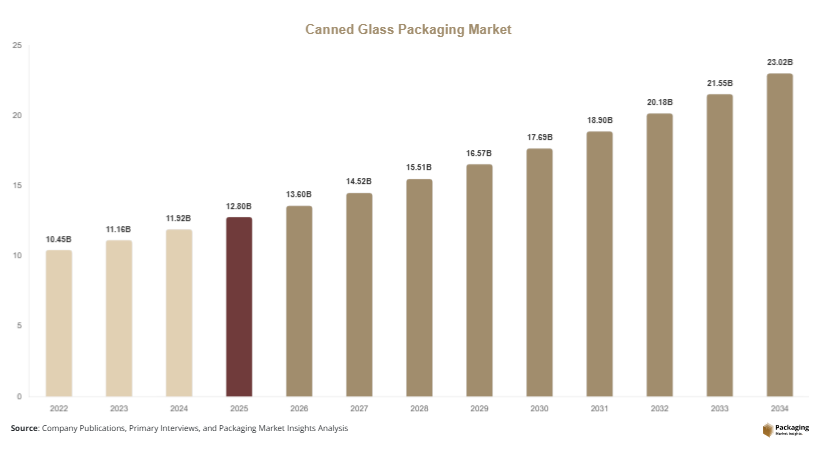
The canned glass packaging market size is witnessing steady expansion driven by increasing demand for sustainable and premium packaging solutions across food, beverage, and pharmaceutical industries. In 2025, the global market size is estimated at USD 12.8 billion, and it is projected to reach approximately USD 13.6 billion in 2026. Over the forecast period from 2025 to 2034, the market is expected to grow at a compound annual growth rate (CAGR) of 6.8%, reaching nearly USD 23.5 billion by 2034.
The market is evolving due to a combination of environmental regulations, shifting consumer preferences, and technological advancements in packaging manufacturing. Glass packaging offers benefits such as chemical inertness, recyclability, and product preservation, making it highly suitable for premium and sensitive products. Additionally, growing awareness regarding plastic waste and the environmental impact of alternative packaging materials has accelerated the adoption of glass-based solutions.
Key Highlights:
- The market is projected to grow from USD 12.8 billion in 2025 to USD 23.5 billion by 2034, at a CAGR of 6.8%.
- Growth is driven by rising demand for sustainable, recyclable packaging across food, beverage, and pharmaceutical sectors.
- Technological advancements are enhancing cost efficiency, durability, and overall adoption of glass packaging solutions.
Explore more data points, trends and opportunities Download Free Sample Report
Market Trends
Rising Adoption of Sustainable and Circular Packaging Solutions
The shift toward sustainable packaging is one of the most prominent trends shaping the canned glass packaging market . Manufacturers and consumers alike are prioritizing environmentally responsible materials that can be reused or recycled without degradation. Glass packaging stands out as it is 100% recyclable and can be reused multiple times without losing quality. Companies are increasingly integrating circular economy principles into their operations, focusing on closed-loop recycling systems and reducing carbon footprints. This trend is particularly strong in Europe and North America, where environmental regulations are stringent and consumer awareness is high. Additionally, brands are using glass packaging to enhance their sustainability image, which is becoming a critical factor in purchasing decisions.
Premiumization and Brand Differentiation Through Packaging Design
Another significant trend is the growing emphasis on premium packaging aesthetics and functionality. Glass containers are widely associated with quality, purity, and luxury, making them a preferred choice for premium food, beverages, and cosmetics. Companies are investing in innovative designs, embossing, and customization to create distinctive packaging that enhances brand identity. This trend is especially visible in the alcoholic beverage industry, where visually appealing glass packaging influences consumer perception and purchasing behavior. Moreover, advancements in printing and labeling technologies are enabling manufacturers to offer high-quality finishes without compromising recyclability, further supporting market growth.
Market Drivers
Increasing Demand for Eco-Friendly Packaging Materials
The growing global concern over environmental sustainability is a major driver of the canned glass packaging market . Governments and regulatory authorities are implementing policies to reduce plastic usage and promote recyclable alternatives. Glass packaging aligns well with these regulations due to its non-toxic nature and ability to be recycled indefinitely. Consumers are also becoming more conscious of their environmental impact, leading to a shift in purchasing behavior toward sustainable products. This trend is particularly strong among younger demographics, who prefer brands that demonstrate environmental responsibility. As a result, manufacturers are expanding their glass packaging portfolios to meet this rising demand.
Expansion of the Food and Beverage Industry
The rapid growth of the global food and beverage industry is significantly contributing to the demand for canned glass packaging. Glass containers are widely used for packaging beverages, sauces, jams, and ready-to-eat meals due to their ability to preserve taste, aroma, and nutritional value. The increasing consumption of packaged and convenience foods, driven by urbanization and busy lifestyles, is further boosting demand. Additionally, the rise of premium and organic food products has increased the need for high-quality packaging solutions that align with brand positioning. Glass packaging meets these requirements, making it a preferred choice among manufacturers.
Market Restraints
High Production and Transportation Costs
One of the primary challenges faced by the canned glass packaging market is the relatively high cost associated with production and transportation. Glass manufacturing requires significant energy consumption, which increases operational expenses. Additionally, glass is heavier compared to alternative materials such as plastic or aluminum, leading to higher transportation costs and logistical complexities. These factors can limit the adoption of glass packaging, particularly among small and medium-sized enterprises with constrained budgets.
The impact of this restraint is evident in price-sensitive markets, where manufacturers may opt for cheaper packaging alternatives despite environmental concerns. For example, in developing regions, plastic packaging continues to dominate due to its affordability and lightweight properties. Furthermore, fluctuations in raw material prices, such as silica and soda ash, can affect production costs and profit margins. To address this challenge, companies are investing in energy-efficient manufacturing technologies and exploring lightweight glass solutions to reduce costs and improve competitiveness.
Market Opportunities
Growth in Emerging Economies
Emerging economies present significant growth opportunities for the canned glass packaging market . Rapid urbanization, rising disposable incomes, and changing consumer lifestyles are driving demand for packaged goods in regions such as Asia Pacific, Latin America, and the Middle East & Africa. As consumers in these regions become more aware of environmental issues, the demand for sustainable packaging solutions is expected to increase. Additionally, the expansion of retail and e-commerce sectors is creating new avenues for glass packaging manufacturers to reach a broader customer base. Companies that invest in local production facilities and distribution networks can capitalize on these opportunities.
Technological Advancements in Lightweight Glass Packaging
Technological innovations in glass manufacturing are opening new growth avenues for the market. The development of lightweight glass packaging reduces material usage and transportation costs, making glass more competitive with alternative materials. Advanced manufacturing techniques, such as improved molding and annealing processes, are enhancing the strength and durability of glass containers while reducing weight. These innovations not only lower costs but also improve sustainability by reducing carbon emissions. As a result, manufacturers are increasingly adopting lightweight glass solutions to meet both economic and environmental objectives.
Report Scope
| Report Metric | Details |
|---|---|
| Market Size in 2025 | USD 12.8 Billion |
| Market Size in 2026 | USD 13.6 Billion |
| Market Size in 2034 | USD 23.5 Billion |
| CAGR | 6.8% (2026-2034) |
| Base Year for Estimation | 2025 |
| Historical Data | 2022-2024 |
| Forecast Period | 2026-2034 |
| Report Coverage | Revenue Forecast, Competitive Landscape, Supply Chain Disruption, Growth Factors, Environment & Regulatory Landscape and Trends |
| Geographies Covered | North America, Europe, APAC, Middle East and Africa, LATAM |
| Countries Covered | U.S., Canada, U.K., Germany, France, Spain, Italy, Russia, Nordic, Benelux, Rest of Europe, China, South Korea, Japan, India, Australia, Singapore, Taiwan, South East Asia, Rest of Asia-Pacific, UAE, Turky, Saudi Arabia, South Africa, Egypt, Nigeria, Rest of MEA, Brazil, Mexico, Argentina, Chile, Colombia, Rest of LATAM |
Explore more data points, trends and opportunities Download Free Sample Report
Segmental Analysis
By Type
The bottles segment dominated the canned glass packaging market in 2024, accounting for approximately 55% of the total market share. Bottles are widely used across beverage and pharmaceutical industries due to their durability, transparency, and ability to preserve product quality. Their versatility in size and design makes them suitable for a wide range of applications, from carbonated drinks to medicinal syrups. Additionally, the increasing demand for premium packaging has further strengthened the dominance of this segment. Manufacturers are focusing on enhancing bottle designs to improve functionality and aesthetics, which is driving their widespread adoption.
The jars segment is expected to be the fastest-growing subsegment, with a projected CAGR of 7.5% during the forecast period. This growth is driven by increasing demand for packaged food products such as jams, sauces, and ready-to-eat meals. Jars offer convenience and reusability, making them a preferred choice among consumers. Furthermore, the rise of home cooking and organic food consumption has boosted demand for glass jars, as they are perceived as safer and more environmentally friendly compared to plastic alternatives.
By Application
The food and beverages segment held the largest share in 2024, accounting for nearly 62% of the market. Glass packaging is extensively used in this segment due to its ability to maintain product freshness and prevent contamination. The growing demand for packaged and processed foods, coupled with the increasing popularity of premium beverages, has significantly contributed to the segment’s dominance. Additionally, glass packaging enhances product visibility, which is an important factor influencing consumer purchasing decisions.
The pharmaceuticals segment is anticipated to be the fastest-growing application, with a CAGR of 7.2% over the forecast period. This growth is driven by the increasing demand for safe and sterile packaging solutions for medicines and vaccines. Glass packaging is preferred in the pharmaceutical industry due to its chemical stability and resistance to contamination. The expansion of the global healthcare sector and rising investments in pharmaceutical manufacturing are further supporting the growth of this segment.
By End-Use
The beverage industry dominated the market in 2024, accounting for approximately 48% of the total share. Glass packaging is widely used for alcoholic and non-alcoholic beverages due to its ability to preserve taste and carbonation. The increasing consumption of premium and craft beverages has further strengthened the dominance of this segment. Additionally, the trend toward sustainable packaging is encouraging beverage manufacturers to adopt glass containers as an alternative to plastic and aluminum.
The cosmetics and personal care segment is projected to grow at the fastest rate, with a CAGR of 7.8% during the forecast period. This growth is driven by the increasing demand for premium and organic beauty products. Glass packaging is preferred in this segment due to its aesthetic appeal and ability to preserve product integrity. Moreover, the rising focus on sustainability in the cosmetics industry is encouraging brands to adopt recyclable packaging solutions, further boosting demand.
Canned Glass Packaging Market Segmentations
Type
- Bottles
- Jars
- Other Glass Containers
Application
- Food & Beverages
- Pharmaceuticals
- Cosmetics & Personal Care
End-Use Industry
- Beverage Industry
- Food Industry
- Healthcare Industry
- Personal Care & Cosmetics
Regional Analysis
North America
North America accounted for approximately 28% of the global canned glass packaging market share in 2025 and is expected to grow at a CAGR of 5.9% during the forecast period. The region benefits from strong demand across the food and beverage sector, particularly in premium and organic product segments. Increasing environmental awareness and regulatory support for sustainable packaging solutions are further driving market growth. The presence of established manufacturers and advanced production technologies also contributes to the region’s steady expansion.
The United States dominates the North American market due to its well-developed food and beverage industry and high consumer awareness regarding sustainability. A unique growth factor in the region is the increasing demand for craft beverages, including artisanal juices and alcoholic drinks, which often use glass packaging to enhance brand perception and product quality.
Europe
Europe held a market share of around 30% in 2025 and is projected to grow at a CAGR of 6.2% through 2034. The region is a leader in sustainable packaging adoption due to stringent environmental regulations and strong recycling infrastructure. Countries across Europe are actively promoting the use of recyclable materials, which supports the growth of glass packaging. Additionally, consumer preference for eco-friendly products is significantly higher compared to other regions.
Germany is the dominant country in the European market, driven by its advanced manufacturing capabilities and strong focus on sustainability. A unique growth factor is the widespread implementation of deposit return schemes, which encourage the reuse and recycling of glass containers, thereby increasing demand for glass packaging solutions.
Asia Pacific
Asia Pacific is the fastest-growing region, with a market share of 24% in 2025 and a projected CAGR of 8.1% during the forecast period. Rapid urbanization, population growth, and increasing disposable incomes are driving demand for packaged food and beverages. The region also benefits from expanding manufacturing capabilities and rising investments in packaging infrastructure.
China leads the Asia Pacific market due to its large consumer base and robust manufacturing sector. A unique growth factor is the rapid expansion of the e-commerce industry, which is driving demand for durable and high-quality packaging solutions, including glass containers.
Middle East & Africa
The Middle East & Africa region accounted for approximately 9% of the market share in 2025 and is expected to grow at a CAGR of 6.5% through 2034. The market is driven by increasing urbanization and growing demand for packaged goods. Additionally, the rising focus on sustainability is encouraging the adoption of glass packaging in the region.
The United Arab Emirates is a key market within the region, supported by its strong retail and hospitality sectors. A unique growth factor is the increasing demand for premium food and beverage products, which require high-quality packaging solutions such as glass containers.
Latin America
Latin America held a market share of about 9% in 2025 and is projected to grow at a CAGR of 6.7% during the forecast period. The region is experiencing steady growth due to rising consumer demand for packaged goods and increasing awareness of sustainable packaging solutions. Economic development and improving living standards are also contributing to market expansion.
Brazil dominates the Latin American market due to its large population and growing food and beverage industry. A unique growth factor is the increasing adoption of recyclable packaging materials, driven by government initiatives and consumer awareness regarding environmental sustainability.
Competitive Landscape
The canned glass packaging market is characterized by the presence of several established players competing based on product quality, innovation, and sustainability initiatives. Companies are focusing on expanding their production capacities, investing in research and development, and forming strategic partnerships to strengthen their market position.
One of the leading players in the market is Owens-Illinois Inc., which holds a significant share due to its extensive product portfolio and global presence. The company has recently invested in advanced manufacturing technologies to improve efficiency and reduce carbon emissions. Other key players are also adopting similar strategies, including the development of lightweight glass packaging and the use of recycled materials. The competitive landscape is expected to remain dynamic, with companies continuously innovating to meet evolving consumer demands and regulatory requirements.
Key Players List
- Owens-Illinois Inc.
- Ardagh Group
- Verallia
- Vetropack Holding Ltd.
- Piramal Glass Pvt. Ltd.
- Gerresheimer AG
- Stolzle Glass Group
- Vidrala S.A.
- Beatson Clark
- Bormioli Rocco
- Saverglass
- Consol Glass
- Vitro Packaging
- Toyo Glass Co., Ltd.
- HNGIL (Hindusthan National Glass & Industries Limited)