Can Coatings Market Size and Growth
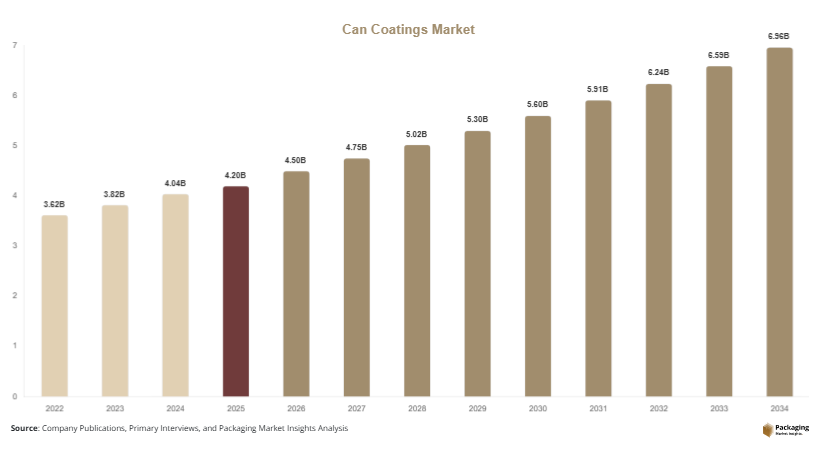
In 2025, the global can coatings market size is estimated at approximately USD 4.2 billion, and it is projected to reach around USD 4.5 billion in 2026. Over the forecast period, the market is expected to grow significantly, reaching nearly USD 7.1 billion by 2034, registering a CAGR of 5.6% during 2025–2034.
Can coatings play a critical role in protecting metal packaging from corrosion, preserving product quality, and ensuring compliance with food safety standards. These coatings are widely used in aluminum and steel cans for beverages, processed foods, aerosols, and industrial products. The increasing consumption of canned beverages, including carbonated drinks, beer, and ready-to-drink beverages, is one of the major contributors to market growth.
Key Highlights:
- Market size is projected to reach USD 7.1 billion by 2034, driven by increasing demand for packaged food and beverages across global markets. The growth reflects rising consumption of canned products and the need for durable and safe packaging solutions.
- The market is expected to grow at a CAGR of 5.6% during 2025–2034, supported by continuous advancements in coating technologies. Innovations in material formulations are improving performance, safety, and environmental compliance.
- Rising demand for corrosion-resistant and food-safe packaging solutions is a key growth driver. Can coatings play a crucial role in protecting metal surfaces and maintaining product quality over extended shelf life.
- Strong growth in beverage and food industries is boosting demand for can coatings globally. Increasing consumption of ready-to-drink beverages and processed foods is accelerating market expansion.
- Increasing adoption of BPA-free and sustainable coatings is shaping future market trends. Manufacturers are focusing on eco-friendly solutions to meet regulatory standards and changing consumer preferences.
Explore more data points, trends and opportunities Download Free Sample Report
Market Trends
Shift Toward BPA-Free and Sustainable Coatings
A significant trend in the can coatings market is the transition toward BPA-free and environmentally friendly coating solutions. Regulatory bodies and consumer awareness regarding health concerns associated with bisphenol-A (BPA) have led manufacturers to develop alternative formulations. Companies are investing in innovative coating technologies that eliminate harmful chemicals while maintaining performance characteristics such as corrosion resistance and adhesion. Additionally, water-based and solvent-free coatings are gaining traction due to their reduced environmental impact. This trend is influencing product development strategies and encouraging companies to adopt sustainable practices, thereby reshaping the competitive landscape of the market.
Increasing Use of Advanced Functional Coatings
Another important trend is the growing adoption of advanced functional coatings that enhance the performance of metal cans. These coatings provide improved resistance to high temperatures, chemical reactions, and mechanical stress. The demand for such coatings is increasing in applications such as ready-to-eat meals and processed foods that require thermal processing. Moreover, innovations in nanotechnology and polymer science are enabling the development of coatings with superior barrier properties. These advancements are helping manufacturers improve product quality, reduce material usage, and enhance overall packaging efficiency, contributing to the steady growth of the market.
Market Drivers
Growth of Beverage and Food Packaging Industry
The expansion of the beverage and food packaging industry is a major driver of the can coatings market. The increasing consumption of canned beverages such as soft drinks, energy drinks, and alcoholic beverages is driving demand for high-performance coatings. Similarly, the growing popularity of canned food products, including soups, vegetables, and ready meals, is supporting market growth. Can coatings play a crucial role in maintaining product freshness and preventing contamination. The rising demand for convenient and long-lasting packaging solutions is encouraging manufacturers to invest in advanced coating technologies, thereby driving market expansion.
Rising Demand for Corrosion-Resistant Packaging
Another key driver is the increasing need for corrosion-resistant packaging materials. Metal cans are susceptible to corrosion when exposed to moisture and acidic contents, making protective coatings essential. Can coatings act as a barrier between the metal surface and the product, preventing chemical reactions and ensuring product safety. The growing use of metal packaging in industries such as food, beverages, and chemicals is driving the demand for effective coating solutions. Additionally, stringent regulations related to packaging safety are further supporting the adoption of high-quality can coatings.
Market Restraint
Environmental Concerns and Regulatory Challenges
A major restraint in the can coatings market is the growing concern over environmental impact and regulatory compliance. Traditional coatings often contain chemicals that may pose environmental and health risks. Regulatory authorities are imposing strict guidelines on the use of certain substances, such as BPA, which has led to increased compliance costs for manufacturers. For example, companies are required to reformulate their products to meet safety standards, which can involve significant research and development expenses. Additionally, the disposal of coated cans presents challenges due to the complexity of recycling multilayer materials. These factors can limit market growth and create barriers for new entrants.
Market Opportunities
Development of Eco-Friendly Coating Technologies
The development of eco-friendly coating technologies presents a significant opportunity for market growth. Manufacturers are focusing on creating sustainable solutions that reduce environmental impact while maintaining performance. Innovations in water-based coatings, bio-based materials, and recyclable formulations are gaining traction. These advancements are helping companies meet regulatory requirements and cater to environmentally conscious consumers. The increasing demand for green packaging solutions is expected to drive investment in research and development, creating new opportunities in the market.
Expansion in Emerging Markets
Expansion in emerging markets offers another major opportunity for the can coatings market. Rapid urbanization, increasing disposable income, and growing consumption of packaged food and beverages are driving demand in regions such as Asia Pacific and Latin America. The development of retail infrastructure and changing consumer preferences are further supporting market growth. Companies can capitalize on these opportunities by offering cost-effective and high-performance coating solutions tailored to local market needs. This expansion is expected to contribute significantly to overall market growth during the forecast period.
Report Scope
| Report Metric | Details |
|---|---|
| Market Size in 2025 | USD 4.2 Billion |
| Market Size in 2026 | USD 4.5 Billion |
| Market Size in 2034 | USD 7.1 Billion |
| CAGR | 5.6% (2026-2034) |
| Base Year for Estimation | 2025 |
| Historical Data | 2022-2024 |
| Forecast Period | 2026-2034 |
| Report Coverage | Revenue Forecast, Competitive Landscape, Supply Chain Disruption, Growth Factors, Environment & Regulatory Landscape and Trends |
| Geographies Covered | North America, Europe, APAC, Middle East and Africa, LATAM |
| Countries Covered | U.S., Canada, U.K., Germany, France, Spain, Italy, Russia, Nordic, Benelux, Rest of Europe, China, South Korea, Japan, India, Australia, Singapore, Taiwan, South East Asia, Rest of Asia-Pacific, UAE, Turky, Saudi Arabia, South Africa, Egypt, Nigeria, Rest of MEA, Brazil, Mexico, Argentina, Chile, Colombia, Rest of LATAM |
Explore more data points, trends and opportunities Download Free Sample Report
Segmental Analysis
By Type
Epoxy coatings dominated the market in 2024, accounting for approximately 48% of the total share. These coatings are widely used due to their excellent adhesion, corrosion resistance, and chemical stability. They provide a strong barrier against moisture and contaminants, making them suitable for food and beverage applications. The demand for epoxy coatings is driven by their ability to maintain product integrity and extend shelf life. However, concerns related to BPA content are influencing the development of alternative formulations.
Acrylic coatings are expected to be the fastest-growing segment, with a CAGR of 6.2% during the forecast period. This growth is driven by increasing demand for BPA-free and environmentally friendly solutions. Acrylic coatings offer good flexibility and resistance to external conditions, making them suitable for various applications. The shift toward sustainable packaging is encouraging manufacturers to adopt acrylic coatings, supporting their rapid growth.
By Application
Beverage cans dominated the market in 2024, accounting for approximately 60% of the market share. The high consumption of carbonated drinks, beer, and energy drinks is driving demand for can coatings in this segment. These coatings ensure product safety and prevent corrosion, making them essential for beverage packaging. The increasing popularity of ready-to-drink beverages is further supporting the growth of this segment.
Food cans are expected to be the fastest-growing segment, with a CAGR of 6.0% during the forecast period. The growth is driven by rising demand for packaged and processed food products. Can coatings provide protection against contamination and extend shelf life, making them suitable for food packaging. The expansion of the food processing industry is contributing to the growth of this segment.
By End-Use
Food and beverage industry dominated the market in 2024, holding approximately 75% of the total share. The need for safe and durable packaging solutions is driving this segment. Can coatings play a crucial role in preserving product quality and preventing contamination. The increasing consumption of packaged food and beverages is supporting market growth in this segment.
Industrial applications are expected to be the fastest-growing segment, with a CAGR of 5.8% during the forecast period. The growth is driven by the use of metal cans for storing chemicals, paints, and lubricants. Can coatings provide protection against corrosion and chemical reactions, ensuring product safety. The expansion of industrial activities is supporting the growth of this segment.
Can Coatings Market Segmentations
Type
- Epoxy Coatings
- Acrylic Coatings
- Polyester Coatings
- Others
Application
- Beverage Cans
- Food Cans
- Aerosol Cans
- General Line Cans
End-Use
- Food & Beverage Industry
- Industrial
- Personal Care
Regional Analysis
North America
North America accounted for approximately 28% of the global market share in 2025, supported by strong demand for packaged beverages and processed foods. The region is expected to grow at a CAGR of 5.3% during the forecast period, driven by technological advancements in coating materials and established manufacturing infrastructure. The presence of major beverage companies and increasing consumption of canned products are further contributing to market growth across the region.
The United States dominates the regional market due to its advanced food and beverage industry. A unique growth factor is the increasing demand for BPA-free coatings driven by strict regulatory standards. Consumers are becoming more aware of food safety and packaging materials, encouraging manufacturers to adopt safer coating solutions. This trend is expected to support continued market expansion in the region.
Europe
Europe held around 25% of the market share in 2025 and is projected to grow at a CAGR of 5.5% during the forecast period. The region’s growth is driven by stringent environmental regulations and increasing demand for sustainable packaging solutions. The shift toward recyclable and eco-friendly coatings is influencing market dynamics, encouraging innovation in coating technologies.
Germany is a key market in Europe, supported by its strong industrial base and packaging sector. A unique growth factor is the emphasis on reducing environmental impact through sustainable materials. Manufacturers are investing in research and development to create coatings that comply with regulatory requirements while maintaining performance standards, contributing to steady market growth.
Asia Pacific
Asia Pacific accounted for approximately 30% of the global market share in 2025, making it the largest regional market. The region is expected to grow at a CAGR of 6.4%, driven by rapid urbanization and increasing consumption of packaged food and beverages. Expanding retail networks and rising disposable income levels are supporting market growth.
China dominates the market due to its large manufacturing base and growing food processing industry. A unique growth factor is the increasing demand for convenient and affordable packaging solutions. The rising consumption of canned beverages and processed foods is driving the adoption of can coatings, supporting market expansion.
Middle East & Africa
The Middle East & Africa region held about 8% of the market share in 2025 and is expected to grow at a CAGR of 5.7% during the forecast period. The market is expanding due to increasing demand for packaged food and beverages. Urbanization and improving living standards are contributing to the growth of the packaging industry.
Saudi Arabia is a key market, supported by investments in food processing and packaging infrastructure. A unique growth factor is the need for durable packaging solutions in high-temperature environments. Can coatings provide protection against corrosion and heat, making them essential for maintaining product quality in the region.
Latin America
Latin America accounted for around 9% of the global market share in 2025 and is projected to grow at a CAGR of 5.9% during the forecast period. The region is experiencing steady growth due to increasing consumption of packaged beverages and food products. Expanding urban populations and improving retail infrastructure are supporting market growth.
Brazil dominates the regional market, driven by its strong beverage industry. A unique growth factor is the demand for cost-effective packaging solutions. The increasing popularity of canned drinks is encouraging manufacturers to adopt advanced coating technologies, supporting market expansion.
Competitive Landscape
The can coatings market is moderately competitive, with several global and regional players focusing on innovation and product development. Leading companies are investing in research and development to introduce sustainable and high-performance coating solutions. The market is characterized by strategic partnerships, mergers, and expansions aimed at strengthening market presence.
A key leader in the market is PPG Industries, which has a strong portfolio of advanced coating solutions. The company has recently introduced BPA-free coatings to meet regulatory requirements and consumer demand for safer packaging materials. Other major players are focusing on expanding production capacity and developing eco-friendly products to gain a competitive edge.
Key Players List
- PPG Industries Inc.
- Akzo Nobel N.V.
- Sherwin-Williams Company
- Valspar Corporation
- Axalta Coating Systems Ltd.
- Kansai Paint Co., Ltd.
- Toyochem Co., Ltd.
- Nippon Paint Holdings Co., Ltd.
- BASF SE
- Jotun Group
- Hempel A/S
- Berger Paints India Limited
- RPM International Inc.
- ALTANA AG
- TIGER Coatings GmbH & Co. KG