Bulk Container Packaging Market Size and Growth
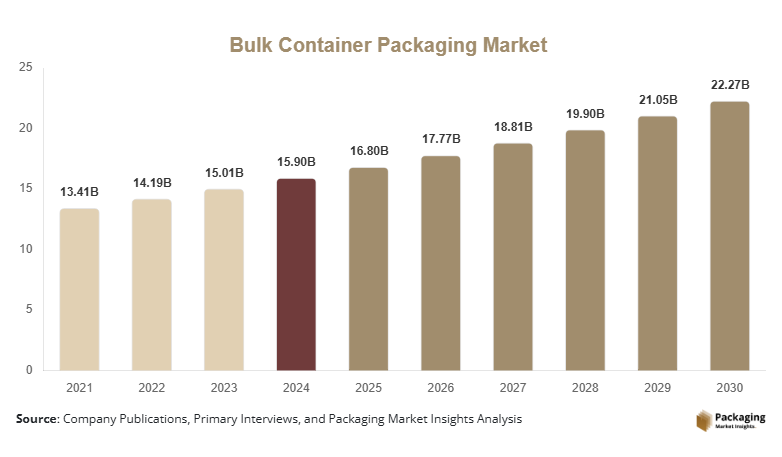
The global bulk container packaging market size was valued at approximately USD 15.9 billion in 2024 and is projected to grow from around USD 16.8 billion in 2025 to reach nearly USD 22.4 billion by 2030, expanding at a CAGR of about 5.8% during the forecast period (2025–2030).
The bulk container packaging market covers large-format industrial packaging designed to move and store high volumes of liquids, powders, and granules safely and efficiently. It includes rigid intermediate bulk containers (IBCs), flexible intermediate bulk containers (FIBCs or jumbo bags), drums and barrels, flexitanks, and container liners. These solutions protect materials, reduce handling, and lower logistics costs through higher payloads and improved stacking, draining, and discharge performance. Bulk containers serve chemicals, food and beverage ingredients, pharmaceuticals, agriculture and fertilizers, oil and gas, and building materials. The market supports long-distance transport, export shipments, and on-site storage across warehouses, terminals, and plants, and it enables compliance with UN/DOT and food-contact standards. Growth is influenced by industrial production, cross-border trade in commodities, hygiene and quality standards in food and pharma supply chains, and the shift toward reusable, reconditioned, and recyclable packaging systems.
Executive Summary
|
Market Size & Outlook |
Global market valued at USD 16.8 billion in 2025; projected to reach USD 22.4 billion by 2030, implying a 5.8% CAGR during 2026–2030 with stable demand across liquid and dry bulk flows. |
|
What the Market Does |
Provides large-format industrial containers for safe, compliant movement and storage of liquids, powders, and granules across chemicals, food, pharma, agriculture, oil and gas, and construction. |
|
Key Drivers |
Recovery in merchandise trade and industrial output; resilient food and fertilizer supply chains requiring certified, hygienic bulk packaging with traceability features. |
|
Core Restraint |
Resin and steel price volatility and higher compliance costs increase total cost of ownership, extending replacement cycles and tempering near-term unit growth. |
|
Top Opportunities |
Circular packaging and reconditioning services; food/pharma hygiene and traceability upgrades; export-led use of flexitanks and container liners near port hubs. |
|
Segments – Product |
Rigid IBCs lead at USD 5.9 billion (2025); FIBCs to grow at 6.6% CAGR on agri and minerals flows, while liners and flexitanks benefit from export efficiency gains. |
|
Segments – Material |
Plastics dominate at USD 11.3 billion; woven PP textiles expand at 6.3% CAGR as FIBCs penetrate food and industrial dry bulk applications. |
|
Segments – Capacity & Application |
201–1,000 liters leads at USD 7.1 billion; liquid bulk at USD 9.8 billion; dry bulk grows at 6.0% CAGR on strong agriculture and minerals handling. |
|
End-Use Highlights |
Chemicals at USD 6.9 billion; food & beverage set for 6.2% CAGR with aseptic IBCs, barrier liners, and sift-proof FIBCs meeting strict quality needs. |
|
Regional View |
North America stable with strong compliance and reconditioning networks; Europe driven by circularity; Asia-Pacific fastest-growing with India leading country growth. |
|
Country Market Sizes |
United States: USD 3.1 billion (2025); Mexico: USD 0.54 billion (2025); Japan: USD 1.2 billion (2025); India: USD 1.05 billion (2025). |
|
Investment & CapEx |
Late-2025 public data showed elevated manufacturing construction outlays; capital going to blow molding automation, reconditioning, and port-adjacent flexitank/liner capacity. |
|
Competition & Pricing |
Top 5 hold ~42% share; pricing indexed to resin and steel inputs; buyers optimize lifecycle cost via reuse, cleaning validation, and traceability-enabled fleets. |
|
Technology Adoption |
Digital IDs for lifecycle tracking, aseptic and barrier technologies for sensitive goods, and recycled-content pathways where compliant are gaining traction. |
Explore more data points, trends and opportunities Download Free Sample Report
Market Drivers
Recovery in Industrial Output and Merchandise Trade Boosts Bulk Packaging Demand
The recovery in global industrial production and merchandise trade is supporting higher flows of liquid and dry commodities, directly driving demand for bulk container packaging such as IBCs, FIBCs, drums, flexitanks, and liners. The International Monetary Fund’s October 2025 outlook indicated global GDP growth stabilizing in the low-3% range for 2026, while global trade volumes were expected to rebound following a weak 2024. Public trade agencies also signaled an upturn in goods trade into 2026 as inventory cycles reset. Rising volumes of bulk chemicals, food ingredients, and agricultural commodities require certified, high-throughput packaging that complies with UN and food-contact regulations. As trade throughput increases, demand rises for one-way export solutions such as flexitanks and liners, alongside reusable rigid IBC pools supporting regional industrial shipments. Normalizing production activity also strengthens plant-level safety and compliance programs, favoring standardized, performance-tested bulk containers and driving replacement and expansion orders.
Expansion of Food, Feed, and Fertilizer Supply Chains Sustains Bulk Format Adoption
Food, feed, and fertilizer supply chains continue to scale, reinforcing demand for safe, traceable bulk packaging formats. The Food and Agriculture Organization reported in late 2025 that global cereals output and trade remained robust heading into the 2025/26 season, supported by maize and rice production in major exporting countries. Strong movements of grains, sugar, edible oils, and protein meals increase usage of FIBCs and container liners for dry bulk shipments, as well as aseptic and barrier IBCs for liquid ingredients. Public health guidance maintains strict hygiene and contamination-control requirements for food-contact packaging. In parallel, fertilizer consumption linked to crop yield optimization supports steady demand for FIBCs with anti-sift seams and high safe working loads. As shipment volumes rise, shippers increasingly favor bulk packaging due to its lower cost per ton, higher payload density, and reduced handling steps, supporting continued adoption among large agri-food exporters and processors.
Market Restraints
Resin and Steel Cost Volatility Raises Total Cost of Ownership
Volatility in resin and steel prices, combined with tighter compliance requirements, increases total cost of ownership and slows replacement cycles in the bulk container packaging market. Virgin HDPE and polypropylene prices track naphtha and crude oil benchmarks, and energy market fluctuations in 2025 pushed input costs higher for plastic containers and woven PP fabrics. Steel pricing for drums also fluctuated due to supply adjustments. Public commodity trackers showed petroleum benchmarks elevated at points during 2025, raising conversion costs for blow-molded IBC bottles, drum bodies, and PP woven materials. These cost pressures reduce procurement flexibility for buyers and limit near-term spending on new packaging assets.
Compliance and Certification Requirements Increase Operating Costs
In addition to raw material volatility, regulatory compliance adds testing, certification, and documentation expenses. Food-contact regulations and UN/DOT hazardous goods standards require periodic requalification of bulk containers. These added costs encourage buyers to extend container lifespans through reconditioning, rental, and reuse models rather than purchasing new units. While this supports circular practices, it delays new-unit shipments in some fleets and moderates short-term market growth.
Market Opportunities
Circular Packaging Systems and Reconditioned IBC Fleets Gain Momentum
Circular economy initiatives and recycled-content mandates create growth opportunities for reconditioned IBC fleets, composite designs, and take-back programs. Policy direction in major economies increasingly favors reuse, recyclability, and recycled-content targets for packaging by 2030. Waste-reduction and extended producer responsibility programs announced in 2025 support high-value recovery streams for industrial plastics. This enables operators to expand reconditioning networks for IBC cages and bottles, integrate approved post-consumer resin, and deploy track-and-trace systems to document reuse cycles. OEMs can capture recurring service revenues from cleaning, testing, and recertification, while shippers reduce Scope 3 emissions and overall logistics costs.
Food and Pharmaceutical Quality Standards Drive Demand for Hygienic Bulk Solutions
Rising food safety and pharmaceutical quality standards are accelerating adoption of food-grade and hygienic bulk packaging solutions. Public health and standards bodies reiterated in 2025 the importance of controls on allergens, microbial contamination, and cross-contact. This sustains demand for aseptic IBCs, barrier films, liner systems, and tamper-evident closures. In pharmaceutical and life-science supply chains, stringent materials handling and cleanroom-adjacent processes support orders for high-specification containers, antistatic FIBCs, and validated liners. As volumes of liquid sweeteners, concentrates, nutraceuticals, and APIs grow, suppliers offering serialization-ready labels, QR or RFID tagging, and digital documentation gain competitive advantage with global CPG and pharma customers.
Export-Led Commodity Flows Favor Flexitanks and Container Liners
Export-oriented commodity flows and logistics efficiency programs favor one-way bulk transport solutions such as flexitanks and container liners. Trade agencies signaled improved merchandise trade and container throughput for 2026 in late-2025 updates, supporting demand for bulk liquids transported in standard 20-foot containers using flexitanks, as well as dry bulk liners for grains, sugar, and minerals. These solutions lower per-ton logistics costs by maximizing payloads and eliminating return and cleaning requirements. Public port and customs modernization initiatives announced in 2025 further reduce dwell times, increasing the attractiveness of single-use, food-contact-compliant flexitanks and liners for exporters of edible oils, wine, base oils, and latex. Suppliers with strong certification capabilities and rapid fabrication near ports are well positioned to capture growth in fast-turn export corridors.
Report Scope
| Report Metric | Details |
|---|---|
| Market Size in 2024 | USD 15.9 Billion |
| Market Size in 2025 | USD 16.8 Billion |
| Market Size in 2030 | USD 22.4 Billion |
| CAGR | 5.8% (2025-2030) |
| Base Year for Estimation | 2024 |
| Historical Data | 2021-2023 |
| Forecast Period | 2025-2030 |
| Report Coverage | Revenue Forecast, Competitive Landscape, Supply Chain Disruption, Growth Factors, Environment & Regulatory Landscape and Trends |
| Geographies Covered | North America, Europe, APAC, Middle East and Africa, LATAM |
| Countries Covered | U.S., Canada, U.K., Germany, France, Spain, Italy, Russia, Nordic, Benelux, Rest of Europe, China, South Korea, Japan, India, Australia, Singapore, Taiwan, South East Asia, Rest of Asia-Pacific, UAE, Turky, Saudi Arabia, South Africa, Egypt, Nigeria, Rest of MEA, Brazil, Mexico, Argentina, Chile, Colombia, Rest of LATAM |
Explore more data points, trends and opportunities Download Free Sample Report
Segmental Analysis
By Product Type
Rigid Intermediate Bulk Containers (IBCs): This format leads due to standardized footprints, UN/DOT certifications, and strong adoption in chemicals and food ingredients. Market size in 2025: USD 5.9 billion.
Flexible Intermediate Bulk Containers (FIBCs): CAGR (2026–2030): 6.6%. Growth is lifted by steady movement of dry bulk commodities and food ingredients, hygiene upgrades in handling, and cost-per-ton advantages. Public food and agriculture updates in late 2025 pointed to resilient cereals and oilseeds flows, which support higher use of FIBCs with improved sealing and antistatic features.
By Material
Plastics (HDPE, PP): Plastics dominate on weight-to-strength, moldability, chemical resistance, and recyclability pathways for rigid bottles and woven PP fabrics. Market size in 2025: USD 11.3 billion.
Woven Polypropylene Textiles: CAGR (2026–2030): 6.3%. Adoption grows in agriculture, minerals, and chemicals. Woven PP enables high safe working loads and custom liners. Commodity trade normalization signaled by public economic outlooks in late 2025 underpins demand for dry bulk handling solutions.
By Capacity
201–1,000 Liters: This range leads because it fits standard pallets, optimizes cube utilization, and aligns with common batch sizes in process industries. Market size in 2025: USD 7.1 billion.
Above 1,000 Liters: CAGR (2026–2030): 6.1%. Growth is driven by larger-lot shipments of base oils, edible oils, and specialty liquids through flexitanks and large-format containers, supported by expectations of improving merchandise trade into 2026 from late-2025 public outlooks.
By Application
Liquid Bulk: Liquids lead given higher value-per-liter, strict containment standards, and the broad use of IBCs, drums, and flexitanks in chemicals and food. Market size in 2025: USD 9.8 billion.
Dry Bulk: CAGR (2026–2030): 6.0%. FIBCs and liners gain with stable agri-commodity movements and minerals handling. Public agriculture updates in 2025 highlighted solid grains trade into 2025/26, supporting adoption of improved sift-resistant and food-grade solutions.
By Sales Channel
Direct to Industrial Customers: OEM-direct sales lead as large buyers standardize fleets, negotiate multi-year contracts, and integrate reconditioning. Market size in 2025: USD 10.2 billion.
Distributors & Dealers: CAGR (2026–2030): 5.1%. Growth follows SME adoption and spot-buying patterns. Public SME support programs and trade credit initiatives in 2025 help smaller shippers access compliant containers via regional distributors.
By End-Use
Chemicals: The chemicals segment leads due to stringent safety rules and high frequency of replenishment in process industries. Buyers require UN-certified rigid IBCs, composite drums, and specialized liners for hazardous and non-hazardous materials. Market size in 2025: USD 6.9 billion.
Food & Beverage: CAGR (2026–2030): 6.2%. Growth is supported by food-contact compliance, traceability needs, and export flows of edible oils, syrups, and dry ingredients. Late-2025 public agriculture and trade updates showed steady output and movement of cereals and oils into 2026, favoring aseptic IBCs, barrier liners, and sift-proof FIBCs in global supply chains.
Bulk Container Packaging Market Segmentations
By Product Type
- Rigid Intermediate Bulk Containers (IBCs)
- Flexible Intermediate Bulk Containers (FIBCs)
- Drums & Barrels
- Flexitanks
- Container Liners (Dry & Liquid)
- Corrugated Bulk Boxes
By Material
- Plastics (HDPE, PP)
- Steel
- Woven Polypropylene Textiles
- Paper & Fiberboard
- Composite
By Capacity
- Up to 200 Liters
- 201–1,000 Liters
- Above 1,000 Liters
- By Application
- Liquid Bulk
- Dry Bulk
By Sales Channel
- Direct to Industrial Customers
- Distributors & Dealers
By End Use
- Chemicals
- Food & Beverage
- Pharmaceuticals & Life Sciences
- Agriculture & Fertilizers
- Oil & Gas
- Construction & Mining
- Paints, Coatings & Adhesives
Regional Analysis
North America
Demand is tied to chemicals, food ingredients, and industrials. Standardization on UN/DOT-compliant IBCs and drums, along with mature reconditioning networks, supports replacement cycles. Manufacturing construction spending remained elevated in late 2025 per public U.S. data releases, signaling continued onshoring and capacity additions that require safe bulk handling. Buyers focus on sustainability metrics and total cost, lifting interest in reusable fleets and recycled-content pathways.
Market size in 2025: USD 3.1 billion. High chemical output, food processing scale, and stringent safety compliance drive IBC and drum demand. Strong equipment uptime and fleet management programs sustain steady unit turnover and requalification services.
Market size in 2025: USD 0.54 billion. Growing manufacturing hubs and cross-border trade with the U.S. support uptake of IBCs, FIBCs, and container liners for automotive chemicals, food ingredients, and agriculture exports.
Europe
Demand rests on regulated sectors, food safety, and chemicals specialty production. Circular economy policies and extended producer responsibility schemes encourage reuse and reconditioning of rigid containers and higher-quality recycling streams for industrial plastics. Buyers prioritize containers with traceability features and validated food-contact compliance. Suppliers compete on lifecycle documentation, cleaning validation, and regional refurbishment footprints that reduce transport emissions.
Asia-Pacific
The region benefits from export-led agriculture, chemicals, and growing domestic consumption of packaged foods and pharmaceuticals. Public outlooks issued in late 2025 projected improving trade into 2026, supporting higher flexitank and liner usage for export liquids and dry bulk. Large agri exporters use FIBCs and liners to compress handling costs, while chemicals and food processors adopt standardized IBC fleets for plant efficiency. Technology adoption, such as RFID/QR tracking, accelerates as shippers digitize lot traceability and cleaning records.
Market size in 2025: USD 1.2 billion. High standards for food and pharma packaging and strong chemical specialties support stable volumes of certified IBCs, drums, and hygienic liners, with strong emphasis on quality systems.
Market size in 2025: USD 1.05 billion. Expanding chemicals, pharmaceuticals, and agri-exports raise use of FIBCs, IBCs, and liners. Government programs to scale manufacturing and logistics infrastructure support container standardization and quality upgrades.
Middle East & Africa
Hydrocarbon and downstream chemicals projects shape demand, alongside fertilizers and growing food imports. Investment in petrochemicals and terminals expands base-oil, additives, and specialties movements that rely on IBCs and drums. Food logistics and grain imports add liner and FIBC needs. Buyers seek robust UN-certified formats that withstand high temperatures and long hauls. Local reconditioning and pooling options are expanding to reduce import dependence and turnaround times.
Latin America
Agriculture exports, mining, and food processing underpin demand. FIBCs are widely used in grains, sugar, and minerals, while IBCs support food ingredients and chemicals. Public programs to modernize ports and rail announced in 2025 aim to lower logistics costs, which favors bulk formats with higher payload efficiency. Suppliers that offer regional service centers for reconditioning and rapid spare part availability gain share with large exporters and processors.
Investment & CapEx Trends
Industrial capital formation supports new packaging demand and reconditioning infrastructure. Public U.S. data releases showed manufacturing construction spending at historically high levels in late 2025, reflecting ongoing investments in chemicals, battery materials, and food processing capacity. These projects require standardized IBCs, drums, and hygienic liners for inbound raw materials and intermediates, and they often include on-site wash and testing facilities for reusable fleets.
In 2025, governments advanced circular economy and waste-reduction initiatives that incentivize reuse and recycling infrastructure. This underpins capital spending on wash stations, leak testing, cage refurbishment, and logistics for reconditioned IBCs. Suppliers invest in automated blow molding, high-speed welding for liners, and digital inspection systems to raise throughput and consistency. In Asia, continued investment in export-oriented processing and port-side logistics hubs in 2025 created opportunities for flexitank and liner fabrication close to terminals, reducing lead times and freight costs.
Across key markets, procurement programs in 2025 prioritized energy-efficient molding equipment and post-consumer resin integration where compliant. Suppliers that align CapEx with food-contact and UN standards while documenting lifecycle impacts are positioned to win multi-year contracts with chemical and food majors.
Competitive Intensity, Pricing & Technology Adoption
Market concentration remains moderate. The top five companies account for approximately 42% of global revenue, with a long tail of regional specialists in FIBCs, liners, and flexitanks. Pricing tracks resin and steel inputs, freight, and compliance costs. Contracts often include index-linked adjustments to HDPE, PP, and steel benchmarks. Buyers evaluate total lifecycle cost, including reconditioning, testing, and certification turnaround, not only price per unit.
Technology adoption focuses on safety, traceability, and circularity. Digital IDs (QR/RFID) support lot tracking, cleaning validation, and reuse counting. Aseptic and barrier technologies protect sensitive food and pharma ingredients. Lightweight cages, improved pallet bases, antistatic FIBCs, and high-performance liners enhance handling safety and reduce damage. Cleaning automation and leak-detection systems in reconditioning raise uptime and quality. Suppliers pursue recycled-content pathways where regulations permit, with rigorous testing to maintain mechanical and food-contact performance.
Key Players in the Bulk Container Packaging Market
- Greif, Inc.
- SCHÜTZ GmbH & Co. KGaA
- Mauser Packaging Solutions
- Berry Global Group, Inc.
- DS Smith plc
- Mondi plc
- Sonoco Products Company
- Menasha Corporation
- IPL Global
- Time Technoplast Ltd.
- Tank Holding Corp.
- Nefab Group AB
- THIELMANN
- Fritz Schäfer GmbH & Co. KG (SSI SCHÄFER)
- LC Packaging International BV
- Rishi FIBC Solutions Pvt. Ltd.
- Flexituff Ventures International Ltd.
- BAG Corp.
- Bulk-Flow
- Qingdao BLT Packing Co., Ltd.
- Kanpur Plastipack Ltd.
- Shankar Packagings Ltd.
- Schoeller Allibert Group BV