Bubble Lined Courier Bags Market Size
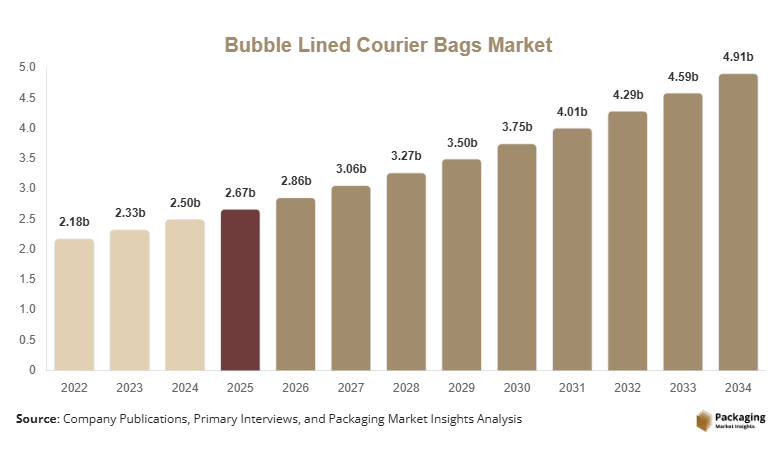
Bubble Lined Courier Bags market size is projected at USD 2.86 billion in 2026 and is expected to hit USD 4.91 billion by 2034 with a CAGR of 7.0%. The market expansion is supported by increasing parcel shipments, rising cross-border e-commerce, and higher demand for lightweight protective packaging solutions. The report provides detailed quantitative analysis covering production volumes, segment-level evaluation, competitive landscape, pricing trends, supply chain developments, and regional performance to assist stakeholders in strategic decision-making.
Bubble lined courier bags are protective mailing solutions manufactured with an internal bubble cushioning layer laminated to an outer paper or polyethylene surface, providing impact resistance during transportation. Global production exceeded 18.7 billion units in 2025, while e-commerce applications represented nearly 54% of total consumption. Logistics and courier services contributed approximately 29%, with industrial shipments accounting for the remaining 17%. Adoption of recyclable and lightweight packaging increased by over 31%, while automated fulfillment centers recorded utilization rates above 68%, reinforcing the Bubble Lined Courier Bags market.
Explore more data points, trends and opportunities Download Free Sample Report
Bubble Lined Courier Bags Trends
Increasing Adoption of Sustainable Protective Mailing Solutions
Manufacturers are increasingly investing in recyclable paper-based mailers, post-consumer recycled polyethylene films, and mono-material structures to comply with environmental regulations. More than 5.8 billion recyclable bubble mailers were produced during 2025, while recycled resin utilization increased by 24% year-over-year. Automated converting equipment improved manufacturing efficiency by nearly 18%, supporting higher production throughput and reinforcing the Bubble Lined Courier Bags market.
Growing demand from online retail continues to accelerate product innovation. Digital printing, tamper-evident closures, lightweight cushioning structures, and barcode-compatible packaging have achieved adoption rates exceeding 63% among large fulfillment centers. Smart warehouse integration improved packaging productivity by approximately 21%, while parcel volumes surpassed 210 billion shipments globally, strengthening the Bubble Lined Courier Bags market.
Bubble Lined Courier Bags Drivers
Rapid Expansion of Global E-commerce and Parcel Delivery
The continuous growth of online retail platforms has significantly increased demand for protective mailing solutions. Global e-commerce sales expanded by over 11%, while courier parcel volumes increased nearly 9% annually. More than 10.5 billion bubble-lined mailers were consumed by online marketplaces alone during 2025. Lightweight packaging reduces shipping costs by approximately 12%, while cushioning performance lowers product damage rates by nearly 28%, supporting the Bubble Lined Courier Bags market.
Bubble Lined Courier Bags Restraints
Volatility in Raw Material Prices
Price fluctuations in polyethylene resin, kraft paper, adhesives, and specialty films continue to affect manufacturer profitability. Polymer prices experienced annual variations exceeding 16%, while transportation costs increased by nearly 8% in several regions. Raw materials account for approximately 62% of total manufacturing expenses, limiting pricing flexibility for small and medium-sized manufacturers within the Bubble Lined Courier Bags market.
Bubble Lined Courier Bags Opportunities
Development of Recyclable and Paper-Based Packaging
Growing environmental awareness is creating new business opportunities for sustainable courier packaging. Demand for recyclable protective mailers increased by over 27%, while investments in paper-based bubble technologies exceeded USD 320 million during recent expansion programs. More than 45% of large retailers have announced sustainability targets favoring recyclable mailing products, creating long-term opportunities across the Bubble Lined Courier Bags market.
Challenges in Bubble Lined Courier Bags
Balancing Protection with Sustainability
Manufacturers face increasing pressure to maintain cushioning performance while reducing plastic usage. More than 39% of packaging buyers now prioritize recyclable materials, whereas shipping damage tolerance remains below 2%. Research investments in bio-based cushioning materials have increased by 19%, but commercial-scale adoption remains limited, presenting an ongoing challenge for the Bubble Lined Courier Bags market.
Report Scope
| Report Metric | Details |
|---|---|
| Market Size in 2025 | USD 2.67 billion |
| Market Size in 2026 | USD 2.86 billion |
| Market Size in 2034 | USD 4.91 billion |
| CAGR | 7.0% (2026-2034) |
| Base Year for Estimation | 2025 |
| Historical Data | 2022-2024 |
| Forecast Period | 2026-2034 |
| Report Coverage | Revenue Forecast, Competitive Landscape, Supply Chain Disruption, Growth Factors, Environment & Regulatory Landscape and Trends |
| Geographies Covered | North America, Europe, APAC, Middle East and Africa, LATAM |
| Countries Covered | U.S., Canada, U.K., Germany, France, Spain, Italy, Russia, Nordic, Benelux, Rest of Europe, China, South Korea, Japan, India, Australia, Singapore, Taiwan, South East Asia, Rest of Asia-Pacific, UAE, Turky, Saudi Arabia, South Africa, Egypt, Nigeria, Rest of MEA, Brazil, Mexico, Argentina, Chile, Colombia, Rest of LATAM |
Explore more data points, trends and opportunities Download Free Sample Report
Bubble Lined Courier Bags Market Segmentation
The market is segmented by type and application, with polyethylene products accounting for nearly 52% of revenue, followed by kraft-based solutions at 31% and recycled products at 17%. E-commerce remains the dominant application with more than 54% market contribution.
By Type
Polyethylene Bubble Courier Bags
Polyethylene bubble courier bags accounted for approximately 52% of total shipments, exceeding 9.6 billion units annually. These products provide excellent moisture resistance, lightweight construction below 90 grams, and high puncture resistance. Multi-layer film technology improves durability while maintaining cushioning efficiency for electronics, apparel, and consumer goods.
Kraft Bubble Courier Bags
Kraft bubble courier bags represented nearly 31% of global demand with production exceeding 5.7 billion units. They combine recyclable paper exteriors with internal bubble cushioning, supporting improved sustainability performance. Typical grammage ranges from 70–120 GSM, making them suitable for books, cosmetics, and accessories.
Recycled Bubble Courier Bags
Recycled bubble courier bags accounted for approximately 17% of market consumption. Products contain post-consumer recycled content exceeding 50% while maintaining comparable protective performance. Production surpassed 3.1 billion units, supported by increasing corporate sustainability commitments and circular economy initiatives.
By Application
E-commerce
E-commerce remains the largest application, contributing over 54% of total demand. Annual consumption exceeded 10 billion units, supported by apparel, electronics, books, healthcare products, and consumer accessories. Automated packaging lines have increased operational efficiency by approximately 20%.
Logistics & Courier Services
Logistics and courier providers accounted for approximately 29% of market demand. Courier companies utilize bubble-lined mailers for secure transportation of sensitive documents and lightweight merchandise. More than 5.4 billion units were consumed annually, supported by expanding same-day delivery services.
Retail & Industrial Shipping
Retail and industrial shipping represented nearly 17% of total demand. Bubble-lined mailers are widely used for replacement parts, samples, medical supplies, and promotional materials. Industrial adoption increased by approximately 8%, with production exceeding 3 billion units annually.
Bubble Lined Courier Bags Market Segmentations
Type
- Polyethylene Bubble Courier Bags
- Kraft Bubble Courier Bags
- Recycled Bubble Courier Bags
Application
- E-commerce
- Logistics & Courier Services
- Retail & Industrial Shipping
Distribution Channel
- Online Sales
- Packaging Distributors
- Wholesale Suppliers
- Retail Stores
- Direct Sales
Bubble Lined Courier Bags Regional Outlook
North America
North America accounted for approximately 33% of global demand. The United States contributed nearly 82% of regional consumption, while Canada represented around 12%. Annual production exceeded 5.8 billion units, supported by advanced logistics infrastructure and strong online retail penetration.
Europe
Europe represented approximately 28% of global consumption. Germany, the United Kingdom, France, Italy, and Spain collectively accounted for over 74% of regional demand. Sustainable packaging adoption exceeded 46%, while regional production surpassed 4.9 billion units.
Asia-Pacific
Asia-Pacific held nearly 30% market share and recorded the fastest expansion. China contributed approximately 47% of regional production, followed by India, Japan, and South Korea. Manufacturing output exceeded 5.6 billion units, driven by expanding e-commerce and export activities.
Latin America
Latin America represented approximately 5% of the market. Brazil and Mexico together contributed nearly 68% of regional demand, supported by increasing digital commerce and logistics investments. Production exceeded 900 million units annually.
Middle East & Africa
The Middle East & Africa accounted for approximately 4% of global demand. The UAE, Saudi Arabia, and South Africa remained leading markets due to expanding retail distribution and courier services. Regional production exceeded 700 million units.
Top players in Bubble Lined Courier Bags
- Sealed Air Corporation
- Pregis LLC
- ProAmpac LLC
- PAC Worldwide Corporation
- Intertape Polymer Group
- 3M Company
- Smurfit Westrock
- Mondi plc
- DS Smith Plc
- Rajapack Group
- Shorr Packaging Corporation
- Veritiv Corporation
Sealed Air Corporation
-
Estimated market presence of 11–13% in protective packaging.
-
Strong global manufacturing footprint with advanced bubble cushioning technologies.
-
Extensive product portfolio serving e-commerce, healthcare, and industrial sectors.
-
Continuous investment in recyclable packaging innovation and automation.
Pregis LLC
-
Estimated market presence of 8–10% globally.
-
Leading supplier of protective mailing and flexible packaging products.
-
Strong focus on sustainable materials, lightweight structures, and fulfillment automation.
-
Expanding manufacturing capacity to support increasing parcel shipment volumes.