Brick Carton Packaging Market Size
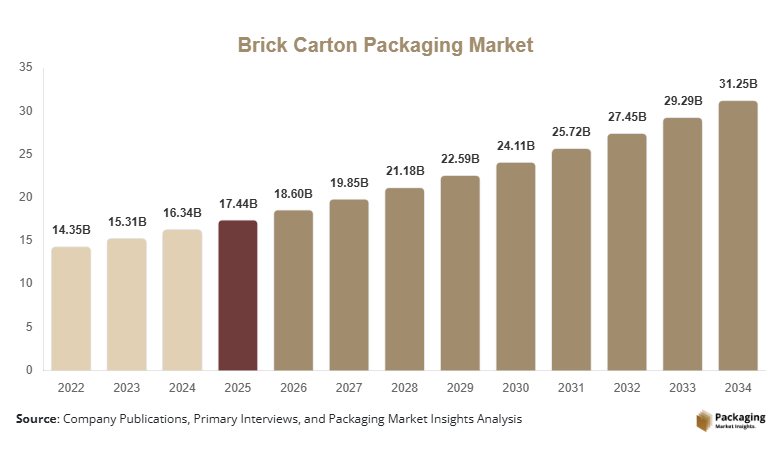
The brick carton packaging market size is projected at USD 18.60 billion in 2026 and is expected to hit USD 31.40 billion by 2034 with a CAGR of 6.7%. The market analysis provides detailed evaluation of packaging consumption patterns, production capacity, material innovations, application demand, regional performance, and competitive strategies. The report covers segmentation analysis, industry trends, manufacturing developments, and key market participants influencing future growth.
"Brick" carton packaging refers to rectangular-shaped carton packaging solutions manufactured using layered paperboard, polyethylene, and aluminum barrier materials to protect liquid and dry products. Global production exceeded 105 billion brick carton packages in 2025, with beverage applications accounting for nearly 62% of total consumption. Aseptic brick cartons represented approximately 58% of production due to extended shelf-life advantages, while recyclable carton adoption reached 46% across major packaging manufacturers, strengthening the brick carton packaging market.
Explore more data points, trends and opportunities Download Free Sample Report
Brick Carton Packaging Market Trends
Increasing Adoption of Sustainable and Lightweight Carton Solutions
Packaging manufacturers are shifting toward renewable paper-based materials, recyclable structures, and reduced-plastic carton designs. More than 72 billion sustainable brick cartons were produced globally in 2025, while fiber-based material usage increased by 19%. Advanced barrier coating technologies improved product protection by 25%, and sustainable carton adoption exceeded 48% among beverage and food producers, supporting the brick carton packaging market.
Digital printing, smart packaging technologies, and automated filling systems are transforming carton packaging production. Smart tracking adoption increased by 31%, high-speed carton filling machines exceeded 25,000 packs per hour, and premium beverage brands increased brick carton utilization by 17%. Demand for convenient, recyclable, and efficient packaging formats continues driving technological advancement across the brick carton packaging market.
Brick Carton Packaging Market Drivers
Rising Demand for Sustainable Food and Beverage Packaging Solutions
Growing environmental concerns and consumer preference for recyclable packaging are major growth factors. Sustainable packaging demand increased by 22%, beverage carton consumption exceeded 65 billion units, and food manufacturers increased carton-based packaging adoption by 15%. The replacement of rigid plastic containers with lightweight carton alternatives is supporting the expansion of the brick carton packaging market.
Brick Carton Packaging Market Restraints
High Production Costs and Raw Material Price Fluctuations
Manufacturers face challenges from fluctuating paperboard, polymer, and aluminum prices. Paperboard costs increased by 13%, raw material supply volatility affected approximately 18% of producers, and production expenses increased by 9% due to energy and logistics costs. These factors create pricing pressure and operational challenges within the brick carton packaging market.
Brick Carton Packaging Market Opportunities
Expansion of Aseptic Packaging and Emerging Market Consumption
Increasing demand for long-life beverages, dairy products, and packaged foods creates new opportunities for brick carton manufacturers. Aseptic packaging adoption increased by 26%, emerging economies contributed nearly 38 billion carton units, and investments in automated filling infrastructure expanded by 21%, creating additional growth opportunities for the brick carton packaging market.
Challenges in Brick Carton Packaging Market
Recycling Infrastructure Limitations and Material Complexity
Although brick cartons offer sustainability benefits, recycling challenges remain due to multi-layer material structures. Global carton recycling rates reached approximately 54%, while collection infrastructure coverage remained below 65% in several developing regions. Improving separation technology and recycling efficiency remains a major challenge for the brick carton packaging market.
Report Scope
| Report Metric | Details |
|---|---|
| Market Size in 2025 | USD 17.44 Billion |
| Market Size in 2026 | USD 18.60 Billion |
| Market Size in 2034 | USD 31.40 Billion |
| CAGR | 6.7% (2026-2034) |
| Base Year for Estimation | 2025 |
| Historical Data | 2022-2024 |
| Forecast Period | 2026-2034 |
| Report Coverage | Revenue Forecast, Competitive Landscape, Supply Chain Disruption, Growth Factors, Environment & Regulatory Landscape and Trends |
| Geographies Covered | North America, Europe, APAC, Middle East and Africa, LATAM |
| Countries Covered | U.S., Canada, U.K., Germany, France, Spain, Italy, Russia, Nordic, Benelux, Rest of Europe, China, South Korea, Japan, India, Australia, Singapore, Taiwan, South East Asia, Rest of Asia-Pacific, UAE, Turkey, Saudi Arabia, South Africa, Egypt, Nigeria, Rest of MEA, Brazil, Mexico, Argentina, Chile, Colombia, Rest of LATAM |
Explore more data points, trends and opportunities Download Free Sample Report
Brick Carton Packaging Market Segmentation
The market is segmented by type and application, with aseptic brick cartons accounting for approximately 58% of total demand due to their suitability for beverages and dairy products. Beverage packaging dominates application demand with nearly 62% market contribution, followed by food packaging and dairy applications.
By Type
Aseptic brick cartons held approximately 58% market share with annual production exceeding 61 billion units. These cartons use multi-layer structures containing paperboard, polyethylene, and aluminum foil layers to provide oxygen, moisture, and light protection. They support extended shelf life ranging from 6 months to 12 months without refrigeration.
Gable-top brick cartons represented nearly a 24% share, with production exceeding 25 billion units. These cartons are widely used for refrigerated beverages and dairy products due to easy pouring functionality, consumer convenience, and compatibility with filling systems operating above 10,000 packages per hour.
Standard brick cartons accounted for approximately 18% of demand, with more than 19 billion units produced annually. These packaging formats are commonly used for dry foods, powdered products, and shelf-stable goods requiring lightweight transportation and efficient storage.
By Application
Food packaging accounted for nearly 28% of market demand with production exceeding 29 billion units annually. Brick cartons are used for cereals, sauces, soups, snacks, and processed foods due to barrier protection, lightweight construction, and extended storage capability.
Beverage packaging dominated with approximately 62% share and exceeded 65 billion units globally. Applications include juices, plant-based beverages, flavored drinks, and functional beverages. High penetration in beverage manufacturing facilities reached approximately 72%, driven by sustainability requirements.
Dairy product packaging contributed nearly a 10% share, with production surpassing 10 billion units. Milk, yogurt drinks, and liquid dairy products utilize brick cartons due to hygiene protection, temperature resistance, and compatibility with aseptic filling technologies.
Brick Carton Packaging Market Segmentations
Type
- Aseptic Brick Cartons
- Gable Top Brick Cartons
- Standard Brick Cartons
Application
- Food Packaging
- Beverage Packaging
- Dairy Products Packaging
Brick Carton Packaging Market Regional Outlook
North America
North America represented approximately 29% of global market revenue, producing more than 30 billion brick cartons annually. The United States contributed nearly 83% of regional demand, supported by beverage manufacturers, dairy producers, and sustainable packaging initiatives.
Europe
Europe accounted for approximately a 34% share, with production exceeding 36 billion units. Germany, France, Italy, and the United Kingdom contributed over 72% of regional consumption. Strong recycling infrastructure and environmental regulations continue supporting carton packaging adoption.
Asia-Pacific
The Asia-Pacific held approximately 27% of global demand, with more than 28 billion units produced annually. China contributed nearly 46% of regional production, followed by India at 18%, Japan at 12%, and South Korea at 8%. Rising beverage consumption and food processing expansion support regional growth.
Latin America
Latin America contributed approximately 7% of global demand. Brazil represented nearly 48% of regional production, followed by Mexico at 26%, driven by increasing packaged beverage consumption and food manufacturing expansion.
Middle East & Africa
The Middle East & Africa accounted for nearly 3% of global demand. Saudi Arabia, the UAE, South Africa, and Egypt are increasing carton packaging adoption through investments in beverage and dairy processing industries.
Top Players In The Brick Carton Packaging Market
- Tetra Pak International S.A.
- SIG Group AG
- Elopak ASA,
- Greatview Aseptic Packaging Co., Ltd.,
- Amcor plc
- Mondi plc
- Stora Enso Oyj
- Smurfit Kappa Group
- WestRock Company
- Sealed Air Corporation
Tetra Pak International S.A. Holds an estimated 35% market share globally. Maintains leadership through advanced aseptic packaging technologies, extensive carton manufacturing facilities, integrated filling solutions, and strong sustainability initiatives. The company supports beverage, dairy, and food manufacturers with high-speed packaging systems capable of processing billions of units annually. Continuous investment in recyclable carton materials and digital packaging solutions strengthens its competitive position in the brick carton packaging market. SIG Group AG accounts for approximately 15% market share. Strengthens market positioning through flexible carton packaging solutions, aseptic filling technologies, sustainable material development, and advanced manufacturing systems. The company focuses on reducing packaging waste, improving production efficiency, and expanding carton packaging applications across beverages, dairy, and food industries worldwide.