Box Liners Market Size
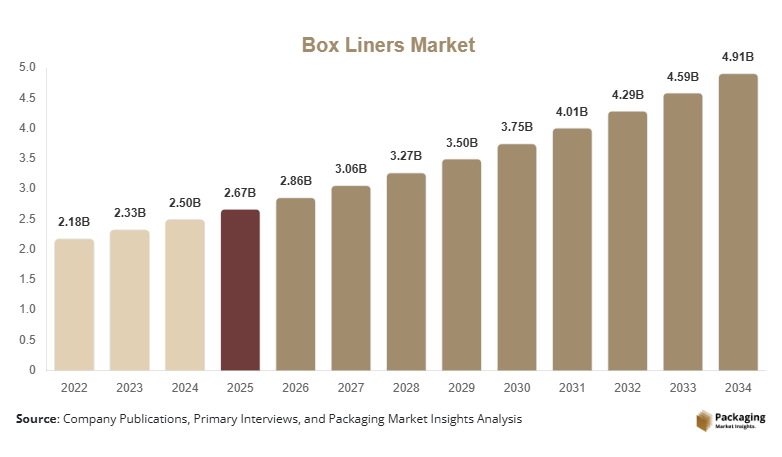
Box liners' market size is projected at USD 2.86 billion in 2026 and is expected to hit USD 4.91 billion by 2034 with a CAGR of 7.0%. Rising demand for protective bulk packaging, increasing food safety requirements, and expanding industrial logistics continue supporting market expansion. The report evaluates production capacity, material innovations, segmentation, regional performance, and the competitive landscape across major manufacturing regions.
Box liners are protective flexible liners inserted into corrugated boxes, bulk containers, and cartons to provide moisture resistance, contamination protection, and extended product shelf life. Global production exceeded 31.5 billion units during 2025, while food & beverage applications accounted for approximately 56% of total consumption. Polyethylene liners represented nearly 61% of production volume, and industrial packaging contributed approximately 24% of global demand, reinforcing the box liners market.
Explore more data points, trends and opportunities Download Free Sample Report
Box Liners Trends
Increasing Adoption of Sustainable Flexible Liners
Packaging manufacturers continue introducing recyclable and biodegradable box liners to meet sustainability objectives and regulatory standards. Production of recyclable liners exceeded 13.8 billion units during 2025, while biodegradable liner adoption increased by approximately 18% year-over-year. Investments in mono-material flexible packaging technologies increased by 14%, strengthening the box liners market.
Demand for hygienic packaging continues rising across food processing, pharmaceuticals, and export logistics. More than 17 billion food-grade box liners were supplied globally during 2025, while automated liner insertion systems improved packaging efficiency by 16%. Food export packaging represented approximately 41% of liner consumption, supporting the box liners market.
Box Liners Drivers
Growing Demand for Safe Food Transportation
Increasing global trade in fresh produce, seafood, meat, and processed foods continues driving box liner demand. Food packaging shipments increased by 11% during 2025, while more than 18 billion food-grade liners were utilized annually. Approximately 69% of export-oriented food packaging now incorporates protective liners to improve hygiene and shelf life, supporting the box liners market.
Box Liners' Restraints
Fluctuating Polymer Raw Material Prices
Volatility in polyethylene and polypropylene resin prices remains a key challenge. Raw material costs fluctuated by 9%–12% during 2025, while logistics expenses increased by approximately 7%. Small manufacturers representing nearly 36% of total production continue to face profitability challenges, affecting the box liners market.
Box Liners Opportunities
Expansion of Cold Chain Logistics
Growing investments in temperature-controlled transportation and food exports continue creating opportunities for advanced liner solutions. Global cold chain capacity expanded by 12% during 2025, while insulated liner demand increased by 17%. Pharmaceutical cold-chain shipments also recorded growth exceeding 10%, creating new opportunities for the box liner market.
Challenges in Box Liners
Environmental Regulations on Plastic Packaging
Increasing regulations regarding single-use plastics continue encouraging manufacturers to redesign products using recyclable and compostable materials. Nearly 31% of packaging companies are increasing investment in sustainable liner technologies, while regulatory compliance costs rose by approximately 9% during 2025, creating ongoing challenges for the box liner market.
Report Scope
| Report Metric | Details |
|---|---|
| Market Size in 2025 | USD 2.67 Billion |
| Market Size in 2026 | USD 2.86 Billion |
| Market Size in 2034 | USD 4.91 Billion |
| CAGR | 7.0% (2026-2034) |
| Base Year for Estimation | 2025 |
| Historical Data | 2022-2024 |
| Forecast Period | 2026-2034 |
| Report Coverage | Revenue Forecast, Competitive Landscape, Supply Chain Disruption, Growth Factors, Environment & Regulatory Landscape and Trends |
| Geographies Covered | North America, Europe, APAC, Middle East and Africa, LATAM |
| Countries Covered | U.S., Canada, U.K., Germany, France, Spain, Italy, Russia, Nordic, Benelux, Rest of Europe, China, South Korea, Japan, India, Australia, Singapore, Taiwan, South East Asia, Rest of Asia-Pacific, UAE, Turkey, Saudi Arabia, South Africa, Egypt, Nigeria, Rest of MEA, Brazil, Mexico, Argentina, Chile, Colombia, Rest of LATAM |
Explore more data points, trends and opportunities Download Free Sample Report
Box Liners Market Segmentation
The market is segmented by material type and end-use industry. Polyethylene box liners accounted for approximately 61% of market revenue during 2025, while food & beverage remained the dominant application with nearly 56% market share because of stringent food safety and contamination prevention requirements.
By Material Type
Polyethylene liners dominated the market with approximately 61% share. Annual production exceeded 19 billion units, providing superior moisture resistance, flexibility, puncture resistance, and food-contact compliance for industrial and food packaging applications.
Polypropylene liners represented approximately 25% of market demand. Production exceeded 7.8 billion units, offering improved chemical resistance, dimensional stability, and lightweight performance for industrial packaging.
Biodegradable liners accounted for nearly 14% of total production. Annual production exceeded 4.4 billion units, supported by increasing sustainability initiatives and regulatory requirements across developed markets.
By Application
Food & beverage remained the leading application with approximately 56% market share. More than 17 billion liners were utilized annually for fresh produce, meat, seafood, frozen foods, and processed food packaging while maintaining hygiene and shelf-life standards.
Industrial packaging represented approximately 24% of total demand. Manufacturers increasingly utilize box liners for chemicals, powders, granules, and industrial raw materials requiring contamination protection and moisture barriers.
Pharmaceutical packaging accounted for nearly 20% of market demand. More than 6 billion liners were supplied annually for medical products, active pharmaceutical ingredients, and healthcare logistics requiring high cleanliness standards.
Box Liners Market Segmentations
Material Type
- Polyethylene Box Liners
- Polypropylene Box Liners
- Biodegradable Box Liners
End-use Industry
- Food & Beverage
- Industrial Packaging
- Pharmaceutical Packaging
Distribution Channel
- Direct Sales
- Packaging Distributors
- Industrial Supply Companies
- Online Sales
Box Liners Regional Outlook
North America
North America accounted for approximately 28% of global revenue during 2025. The United States represented nearly 81% of regional demand, while annual production exceeded 8 billion liners. Food exports and pharmaceutical packaging remained primary growth drivers.
Europe
Europe contributed approximately 29% of global revenue. Germany, France, Italy, Spain, and the United Kingdom collectively manufactured over 8.7 billion liners annually. Sustainable packaging adoption exceeded 45%, supporting regional market expansion.
Asia-Pacific
Asia-Pacific held approximately 36% market share and remained the fastest-growing regional market. China, India, Japan, South Korea, and Southeast Asian countries produced more than 11 billion liters annually. Food processing and industrial manufacturing supported annual demand growth exceeding 8%.
Latin America
Latin America accounted for approximately 4% of global demand. Brazil and Mexico generated over 68% of regional consumption through agricultural exports and processed food industries.
Middle East & Africa
Middle East & Africa represented approximately 3% of total market revenue. Expansion of food logistics infrastructure and pharmaceutical distribution supported regional demand.
Top Players In Box Liners
- Sealed Air Corporation
- Pregis, LLC, a
- Berry Global Inc.
- Greif Inc.
- Inteplast Group
- LC Packaging International BV,
- International Plastics Inc.
- Coveris Holdings S.A.
- Novolex Holdings, LLC
- RKW Group
Sealed Air Corporation Estimated market share: 15%–17% Global leader in protective and food packaging solutions with extensive flexible packaging capabilities. Strong manufacturing presence across North America, Europe, and Asia-Pacific. The company focuses on sustainable liner technologies, recyclable flexible packaging, advanced barrier materials, and automation-compatible packaging systems. Continuous investments in product innovation and global production capacity strengthen its competitive market position. Pregis LLC Estimated market share: 11%–13% Leading supplier of protective packaging and flexible industrial liner solutions. Strong portfolio serving food processing, industrial manufacturing, and healthcare industries. The company emphasizes high-performance protective films, recyclable packaging materials, customized liner solutions, and operational efficiency while expanding sustainable product offerings for industrial customers worldwide.