Botanical Packaging Market Size
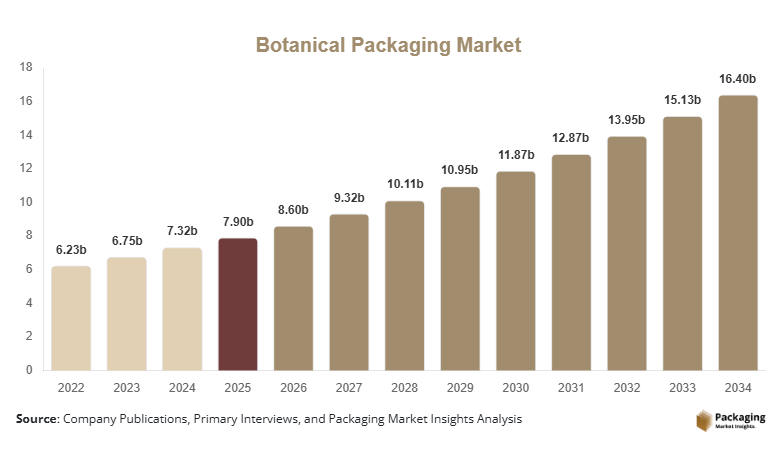
Botanical Packaging market size is projected at USD 8.6 billion in 2026 and is expected to hit USD 16.4 billion by 2034 with a CAGR of 8.4%.The report evaluates production capacity, sustainable material adoption, innovation trends, segmentation, and the competitive landscape across key regional markets. It provides historical analysis from 2022–2024, establishes 2025 as the base year, and forecasts market developments through 2034.
Botanical packaging refers to packaging solutions manufactured from renewable plant-derived materials including paper pulp, bamboo, bagasse, hemp, agricultural fibers, seaweed, and other bio-based feedstocks. Global production surpassed 15.2 billion packaging units in 2025, while renewable material utilization exceeded 68% across premium packaging applications. Food & beverage represented approximately 46% of demand, followed by personal care & cosmetics with 29%. Sustainable packaging adoption increased by 18% between 2022 and 2025, reinforcing the Botanical Packaging Market.
Explore more data points, trends and opportunities Download Free Sample Report
Botanical Packaging Market Trends
Rising Adoption of Plant-Based Sustainable Packaging
Growing environmental regulations and consumer preference for eco-friendly products continue accelerating the adoption of botanical packaging solutions. More than 9.4 billion plant-based packages were produced globally during 2025, while biodegradable packaging penetration exceeded 42% across premium consumer goods. Investments in bio-based material innovation surpassed USD 7 billion, supporting the Botanical Packaging Market Trend.
Expansion of Compostable Fiber Technologies
Manufacturers are increasingly investing in molded fiber, bamboo pulp, hemp fiber, and seaweed-based packaging technologies. More than 2,600 commercial production facilities worldwide adopted advanced botanical packaging manufacturing technologies by 2025, improving production efficiency by 21%. Compostable packaging demand increased by approximately 17% annually, strengthening the Botanical Packaging Market.
Botanical Packaging Market Drivers
Growing Consumer Preference for Sustainable Packaging
Demand for environmentally friendly packaging continues expanding across retail, food, and cosmetics industries. More than 74% of consumers globally prefer products packaged in sustainable materials, while corporate sustainability commitments increased bio-based packaging procurement by nearly 23% during 2025. Government restrictions on single-use plastics continue accelerating Botanical Packaging Market Growth.
Botanical Packaging Market Restraints
Higher Production Costs Compared with Conventional Packaging
Botanical packaging materials remain more expensive than petroleum-based alternatives. Production costs are approximately 18–30% higher depending on raw materials, while agricultural fiber availability fluctuates by nearly 10% annually due to seasonal harvesting. Limited large-scale processing infrastructure also restricts rapid expansion of the Botanical Packaging Market.
Botanical Packaging Market Opportunities
Expansion of Premium Personal Care and Food Packaging
Premium packaging manufacturers increasingly adopt botanical materials to improve sustainability performance. Organic food sales exceeded USD 240 billion, while natural cosmetics represented over USD 65 billion globally during 2025. Demand for compostable premium packaging continues expanding by approximately 15% annually, creating opportunities within the Botanical Packaging Market.
Challenges in Botanical Packaging Market
Raw Material Availability and Industrial Composting Infrastructure
Seasonal agricultural waste supply and inadequate industrial composting facilities remain major challenges. Nearly 35% of emerging economies lack commercial composting infrastructure, while logistics costs for biomass transportation increased by approximately 9% in 2025. Maintaining consistent material quality also challenges manufacturers within the Botanical Packaging Market.
Report Scope
| Report Metric | Details |
|---|---|
| Market Size in 2025 | USD 7.9 billion |
| Market Size in 2026 | USD 8.6 billion |
| Market Size in 2034 | USD 16.4 billion |
| CAGR | 8.4% (2026-2034) |
| Base Year for Estimation | 2025 |
| Historical Data | 2022-2024 |
| Forecast Period | 2026-2034 |
| Report Coverage | Revenue Forecast, Competitive Landscape, Supply Chain Disruption, Growth Factors, Environment & Regulatory Landscape and Trends |
| Geographies Covered | North America, Europe, APAC, Middle East and Africa, LATAM |
| Countries Covered | U.S., Canada, U.K., Germany, France, Spain, Italy, Russia, Nordic, Benelux, Rest of Europe, China, South Korea, Japan, India, Australia, Singapore, Taiwan, South East Asia, Rest of Asia-Pacific, UAE, Turky, Saudi Arabia, South Africa, Egypt, Nigeria, Rest of MEA, Brazil, Mexico, Argentina, Chile, Colombia, Rest of LATAM |
Explore more data points, trends and opportunities Download Free Sample Report
Botanical Packaging Market Segmentation
The market is segmented by material type and end-use industry. Paper & paperboard-based botanical packaging accounted for approximately 45% of market revenue in 2025, while food & beverage remained the leading application with nearly 46% market share.
By Type
Paper & Paperboard
Paper & paperboard accounted for approximately 45% of market demand, with production exceeding 6.8 billion packaging units annually. Renewable fiber content averages 80–95%, supporting recyclable and compostable packaging applications.
Bioplastics
Bioplastics represented nearly 32% of market revenue during 2025. Annual production exceeded 4.9 billion units, utilizing PLA, PHA, and starch-based materials for bottles, trays, flexible packaging, and containers with improved biodegradability.
Plant Fiber-Based Packaging
Plant fiber-based packaging contributed around 23% of market demand, producing more than 3.5 billion units annually using bamboo, bagasse, hemp, wheat straw, and molded agricultural fibers for premium sustainable packaging.
By Application
Food & Beverage
Food & beverage accounted for approximately 46% of total demand. More than 7 billion botanical packaging units were consumed annually for beverages, fresh produce, ready-to-eat meals, and organic food packaging.
Personal Care & Cosmetics
Personal care & cosmetics represented nearly 29% market share, with annual consumption exceeding 4.4 billion units. Premium skincare, fragrances, and natural cosmetic brands increasingly adopt botanical packaging for sustainability positioning.
Pharmaceuticals
Pharmaceuticals contributed approximately 18% of market demand. Botanical packaging solutions are increasingly utilized for nutraceuticals, herbal medicines, and over-the-counter healthcare products due to renewable material characteristics.
Botanical Packaging Market Segmentations
Material Type
- Paper & Paperboard
- Bioplastics
- Plant Fiber-Based Packaging
Application
- Food & Beverage
- Personal Care & Cosmetics
- Pharmaceuticals
- Household Products
- Retail Packaging
Packaging Type
- Bottles & Containers
- Pouches & Bags
- Boxes & Cartons
- Trays & Clamshells
- Wraps & Films
Botanical Packaging Regional Outlook
North America
North America accounted for approximately 31% of global market revenue during 2025. The United States represented over 79% of regional demand, supported by strong sustainable packaging regulations and premium consumer product manufacturers.
Europe
Europe held approximately 34% market share, led by Germany, France, Italy, and the United Kingdom. Circular economy legislation and plastic reduction policies accelerated botanical packaging adoption, while renewable packaging utilization exceeded 48% across premium brands.
Asia-Pacific
Asia-Pacific represented nearly 28% of market revenue. China, Japan, India, and South Korea collectively generated over 72% of regional production capacity. Expanding food processing and cosmetics manufacturing continue supporting market development.
Rest of World
Latin America and Middle East & Africa accounted for approximately 7% of global revenue. Growing investments in sustainable agriculture, renewable packaging, and export-oriented food industries are expected to support annual growth exceeding 8% through 2034.
Top players in Botanical Packaging Market
- Mondi plc
- Smurfit Westrock plc
- Stora Enso Oyj
- DS Smith Plc
- Huhtamaki Oyj
- UPM-Kymmene Corporation
- Amcor plc
- Sonoco Products Company
- Sealed Air Corporation
- Ranpak Holdings Corp.
Mondi plc
-
Holds an estimated 10–13% market presence across sustainable fiber-based packaging.
-
Invests extensively in renewable paper packaging and botanical fiber innovations.
-
Operates integrated manufacturing facilities across Europe, Asia, and the Americas.
-
Focuses on recyclable and compostable packaging solutions for consumer goods and food applications.
-
Strengthens market leadership through continuous investments in sustainable material technologies.
Smurfit Westrock plc
-
Accounts for approximately 9–11% of the botanical packaging market.
-
Develops renewable paper-based and molded fiber packaging for global consumer brands.
-
Operates advanced recycling and sustainable packaging production facilities worldwide.
-
Expands bio-based packaging portfolios through innovation and circular economy investments.
-
Maintains strong partnerships across food, beverage, healthcare, and retail industries.