Blood Glucose Test Strip Packaging Market Size and Growth
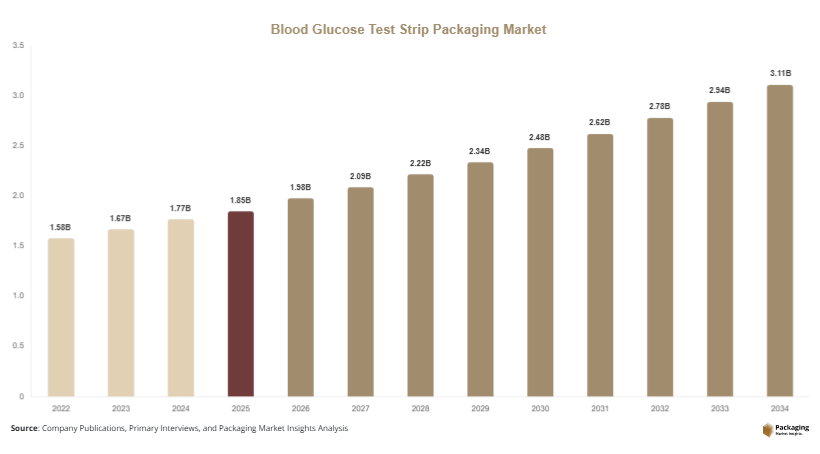
In 2025, the global blood glucose test strip packaging market size is estimated at USD 1.85 billion and is projected to reach approximately USD 1.98 billion in 2026. With consistent demand from healthcare providers and homecare users, the market is forecast to reach USD 3.12 billion by 2034, registering a CAGR of 5.8% during the forecast period from 2025 to 2034. The blood glucose test strip packaging market is experiencing steady expansion due to the increasing prevalence of diabetes, rising adoption of self-monitoring devices, and the growing emphasis on safe and contamination-free medical packaging solutions.
The need for advanced packaging solutions in the healthcare sector is driven by strict regulatory requirements related to product safety, sterility, and shelf life. Blood glucose test strips are highly sensitive to moisture, light, and contamination, which makes packaging design a critical component of product performance. Manufacturers are increasingly investing in high-barrier materials such as multilayer plastics and aluminum laminates to ensure optimal protection and extended usability.
Key Highlights:
- Asia Pacific dominated the market with a 38.1% share in 2025, while Latin America is projected to grow at the fastest CAGR of 6.4%.
- Vial-based packaging led the type segment with a 46.7% share, while strip-level pouch packaging is expected to grow at a CAGR of 6.6%.
- Plastic-based packaging dominated with a 54.2% share, while aluminum-based laminates are forecasted to grow at a CAGR of 6.1%.
- Homecare applications led the segment with 48.5% share, while hospital usage is expected to grow at a CAGR of 5.9%.
- The United States remained the dominant country with a market size of USD 0.62 billion in 2025 and USD 0.66 billion in 2026.
Explore more data points, trends and opportunities Download Free Sample Report
Market Trends
The market is witnessing a growing shift toward smart and functional packaging solutions designed to improve product performance and user convenience. Manufacturers are incorporating features such as moisture indicators, integrated desiccants, and tamper-evident seals to enhance the reliability of blood glucose test strips. These innovations help maintain product integrity throughout the supply chain and during end-use. Additionally, packaging formats are evolving to support easy handling for elderly patients, with ergonomic designs and simplified opening mechanisms gaining traction. This trend is aligned with the increasing demand for patient-centric healthcare products that prioritize usability and safety.
Another emerging trend is the adoption of sustainable and recyclable packaging materials. Healthcare companies are under increasing pressure to reduce their environmental footprint while maintaining strict compliance with regulatory standards. As a result, there is a growing focus on developing eco-friendly packaging solutions that offer high barrier properties without relying heavily on non-recyclable plastics. Innovations in biodegradable materials and lightweight packaging designs are helping companies meet sustainability goals. This shift is also supported by regulatory frameworks promoting environmentally responsible practices in the medical packaging industry.
Market Drivers
The increasing prevalence of diabetes worldwide is a major factor driving the demand for blood glucose test strip packaging. With a growing number of patients requiring regular glucose monitoring, the consumption of test strips has increased significantly. This rise in demand directly impacts the need for reliable and efficient packaging solutions that ensure product safety and longevity. Healthcare providers and patients rely on packaging that protects test strips from environmental factors such as humidity and temperature fluctuations, making packaging innovation a critical component of market growth.
Another important driver is the rapid expansion of home healthcare and point-of-care diagnostics. As healthcare systems move toward decentralized models, patients are increasingly managing their conditions at home. This shift has created demand for compact, portable, and user-friendly packaging formats that support easy storage and transportation. Manufacturers are responding by developing packaging solutions that are not only functional but also convenient for daily use. The integration of advanced materials and technologies in packaging design further enhances product reliability, supporting the overall growth of the blood glucose test strip packaging market.
Market Restraint
One of the key challenges in the blood glucose test strip packaging market is the high cost associated with advanced packaging materials and technologies. The use of high-barrier laminates, specialized plastics, and integrated desiccant systems increases production costs, which can impact pricing strategies for manufacturers. These costs are particularly significant for small and medium-sized companies that may have limited resources for research and development.
In addition, stringent regulatory requirements for medical packaging add complexity to the manufacturing process. Companies must comply with strict guidelines related to material safety, sterility, and labeling, which can lead to longer product development cycles and higher compliance costs. For example, packaging solutions must undergo rigorous testing to ensure they maintain the integrity of test strips under various environmental conditions. These factors can create barriers to entry for new players and limit innovation in cost-sensitive markets, ultimately affecting overall market growth.
Market Opportunities
The increasing demand for sustainable packaging solutions presents significant opportunities for market players. As environmental concerns continue to grow, healthcare companies are seeking packaging options that reduce waste and improve recyclability. This has led to the development of innovative materials that combine high barrier properties with environmental benefits. Companies that invest in sustainable packaging technologies are likely to gain a competitive advantage, particularly in regions with strict environmental regulations.
Another promising opportunity lies in the integration of digital and smart packaging technologies. The use of QR codes, NFC tags, and other digital features can enhance product traceability and provide valuable information to users. These technologies enable real-time monitoring of product conditions and improve supply chain transparency. In the context of blood glucose test strip packaging, smart features can help ensure proper storage conditions and provide alerts for potential issues. This integration of digital solutions is expected to drive innovation and create new growth avenues in the market.
Report Scope
| Report Metric | Details |
|---|---|
| Market Size in 2025 | USD 1.85 Billion |
| Market Size in 2026 | USD 1.98 Billion |
| Market Size in 2034 | USD 3.12 Billion |
| CAGR | 5.8% (2026-2034) |
| Base Year for Estimation | 2025 |
| Historical Data | 2022-2024 |
| Forecast Period | 2026-2034 |
| Report Coverage | Revenue Forecast, Competitive Landscape, Supply Chain Disruption, Growth Factors, Environment & Regulatory Landscape and Trends |
| Geographies Covered | North America, Europe, APAC, Middle East and Africa, LATAM |
| Countries Covered | U.S., Canada, U.K., Germany, France, Spain, Italy, Russia, Nordic, Benelux, Rest of Europe, China, South Korea, Japan, India, Australia, Singapore, Taiwan, South East Asia, Rest of Asia-Pacific, UAE, Turky, Saudi Arabia, South Africa, Egypt, Nigeria, Rest of MEA, Brazil, Mexico, Argentina, Chile, Colombia, Rest of LATAM |
Explore more data points, trends and opportunities Download Free Sample Report
Segmental Analysis
By Packaging Type
Vial-based packaging dominated the market in 2024, accounting for approximately 46.7% of the total market share. This format is widely used due to its ability to store multiple test strips while maintaining protection against moisture and contamination. Vials are often equipped with desiccants and secure closures, ensuring the integrity of the strips over extended periods. The convenience of storing multiple strips in a single container makes this format popular among both healthcare providers and home users. Additionally, the durability and reusability of vial packaging contribute to its widespread adoption.
Individually sealed pouch packaging is expected to witness the fastest growth, with a projected CAGR of 6.6% during the forecast period. This packaging type offers enhanced protection by isolating each test strip, reducing the risk of contamination and exposure to environmental factors. The growing demand for single-use packaging in healthcare settings is driving the adoption of this format. It is particularly suitable for hospital and clinical use, where maintaining sterility is critical. The increasing focus on infection control and patient safety further supports the growth of pouch-based packaging solutions.
By Material Type
Plastic-based packaging held the largest market share in 2024, accounting for around 54.2% of the total market. Plastics are widely used due to their flexibility, durability, and cost-effectiveness. They offer excellent barrier properties when combined with advanced coatings and laminates, making them suitable for protecting sensitive medical products. The availability of various plastic materials allows manufacturers to design packaging solutions tailored to specific requirements.
Aluminum-based laminates are expected to grow at a CAGR of 6.1% during the forecast period. These materials provide superior barrier properties against moisture, oxygen, and light, making them ideal for preserving the quality of blood glucose test strips. The increasing demand for high-performance packaging solutions in the healthcare sector is driving the adoption of aluminum laminates. Additionally, advancements in material technology are enabling the development of lightweight and recyclable aluminum-based packaging options.
By End-Use
Homecare applications dominated the market in 2024, with a share of approximately 48.5%. The growing trend of self-monitoring and home-based healthcare has increased the demand for user-friendly packaging solutions. Patients prefer packaging that is easy to handle, store, and transport, leading to the adoption of compact and portable formats. The availability of advanced monitoring devices further supports the growth of this segment.
Hospital and clinical use is expected to grow at a CAGR of 5.9% during the forecast period. The need for sterile and reliable packaging solutions in healthcare facilities drives demand in this segment. Hospitals require packaging that ensures product integrity and minimizes the risk of contamination. The increasing focus on infection control and patient safety is encouraging the adoption of high-quality packaging materials and designs.
Blood Glucose Test Strip Packaging Market Segmentations
By Product Type
- Vial Packaging
- Individual Pouch Packaging
- Blister Packaging
- Strip-Level Sealed Packaging
By Application
- Homecare Use
- Hospitals
- Diagnostic Centers
- Clinics
By Distribution Channel
- Direct Sales
- Medical Distributors
- Online Healthcare Platforms
- Retail Pharmacies
Regional Analysis
North America
North America accounted for a significant share of the blood glucose test strip packaging market in 2025, with approximately 34.6% of the global market. The region is expected to maintain steady growth, with a projected CAGR of 5.4% during the forecast period. The presence of advanced healthcare infrastructure and high adoption of self-monitoring devices contributes to the region’s strong market position. In addition, continuous technological advancements in packaging materials and design support market expansion.
The United States remains the dominant country in this region, driven by a high prevalence of diabetes and strong healthcare spending. A key growth factor is the widespread adoption of home healthcare solutions, which increases the demand for convenient and reliable packaging formats. The country also benefits from robust research and development activities, enabling the introduction of innovative packaging solutions that meet evolving consumer needs.
Europe
Europe held a market share of around 26.3% in 2025 and is projected to grow at a CAGR of 5.2% during the forecast period. The region’s growth is supported by stringent regulatory standards that ensure high-quality medical packaging. These regulations drive the adoption of advanced materials and technologies, contributing to the overall development of the market. Additionally, increasing awareness about diabetes management supports demand for blood glucose monitoring products.
Germany is the leading country in the European market, supported by a strong manufacturing base and advanced healthcare systems. A unique growth factor in this region is the focus on sustainability, with many companies investing in eco-friendly packaging solutions. This trend aligns with the European Union’s environmental policies, encouraging the use of recyclable and biodegradable materials in medical packaging.
Asia Pacific
Asia Pacific dominated the global market in 2025 with a share of 38.1% and is expected to register a CAGR of 6.3% during the forecast period. Rapid urbanization, increasing healthcare expenditure, and a growing diabetic population are key factors driving market growth in this region. The expansion of healthcare infrastructure and rising adoption of diagnostic devices further contribute to market development.
China leads the Asia Pacific market, supported by its large population and increasing prevalence of diabetes. A significant growth factor is the government’s focus on improving healthcare access and promoting early diagnosis of chronic diseases. This has led to increased demand for blood glucose monitoring devices and associated packaging solutions. The country’s strong manufacturing capabilities also support the production of cost-effective packaging products.
Middle East & Africa
The Middle East & Africa region accounted for approximately 5.8% of the market in 2025 and is expected to grow at a CAGR of 5.6% during the forecast period. The market is gradually expanding due to improving healthcare infrastructure and increasing awareness about diabetes management. Government initiatives aimed at enhancing healthcare services are also contributing to market growth.
Saudi Arabia is a key market in this region, driven by a high prevalence of diabetes and increasing healthcare investments. A unique growth factor is the government’s focus on digital healthcare solutions, which supports the adoption of advanced diagnostic devices. This, in turn, drives demand for high-quality packaging solutions that ensure product safety and reliability.
Latin America
Latin America held a market share of around 5.2% in 2025 and is projected to grow at the fastest CAGR of 6.4% during the forecast period. The region’s growth is supported by increasing healthcare awareness and rising adoption of home-based diagnostic solutions. Economic development and improving access to healthcare services also contribute to market expansion.
Brazil is the leading country in Latin America, supported by a large population and growing healthcare sector. A key growth factor is the increasing focus on preventive healthcare, which encourages regular monitoring of blood glucose levels. This trend drives demand for test strips and associated packaging solutions, supporting overall market growth in the region.
Competitive Landscape
The blood glucose test strip packaging market is characterized by the presence of several established players focusing on innovation, product quality, and regulatory compliance. Companies are investing in research and development to introduce advanced packaging solutions that meet the evolving needs of the healthcare industry. Strategic partnerships, mergers, and acquisitions are common strategies adopted by market participants to strengthen their market position.
Amcor Plc is recognized as a leading player in the market, known for its extensive portfolio of medical packaging solutions. The company recently introduced a new line of recyclable high-barrier packaging materials designed for healthcare applications, reflecting its commitment to sustainability. Other key players are also focusing on developing eco-friendly and technologically advanced packaging solutions to gain a competitive edge.
Key Players List
- Amcor Plc
- Berry Global Inc.
- West Pharmaceutical Services Inc.
- Gerresheimer AG
- Schott AG
- AptarGroup Inc.
- Constantia Flexibles
- Sealed Air Corporation
- Sonoco Products Company
- UFP Technologies Inc.
- Oliver Healthcare Packaging
- Tekni-Plex Inc.
- Winpak Ltd.
- Nelipak Healthcare Packaging
- Klöckner Pentaplast