Blockchain Technology In Packaging Market Size and Growth
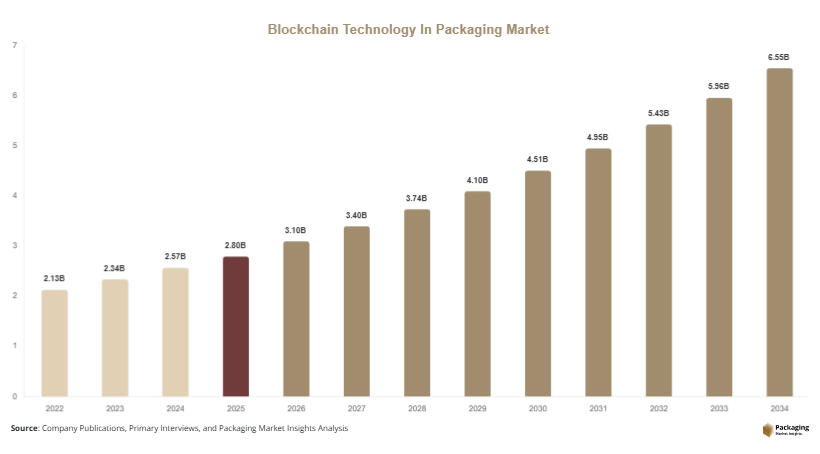
The global blockchain technology in packaging market size reached an estimated USD 2.8 billion in 2025 and is projected to expand to USD 3.1 billion in 2026. Analysts forecast a robust CAGR of 14.5% from 2025 to 2034, with the market expected to reach approximately USD 9.8 billion by 2034. The increasing complexity of global packaging supply chains and the need for real-time monitoring are critical factors driving the adoption of blockchain-based solutions across diverse sectors, including food, pharmaceuticals, and consumer goods.
One significant growth factor is the increasing regulatory focus on product authenticity and anti-counterfeiting measures, which drives companies to integrate blockchain solutions into packaging workflows. Secondly, the rising consumer demand for sustainability and product provenance ensures that blockchain technology remains a valuable tool for brands seeking to communicate transparency to end-users. Thirdly, the integration of IoT sensors and smart packaging with blockchain platforms enables end-to-end visibility, reducing operational inefficiencies and loss of goods during transit.
Furthermore, technological advancements in distributed ledger technology and declining blockchain implementation costs are contributing to broader adoption across SMEs and large enterprises alike. Blockchain’s ability to provide immutable records, enhance product traceability, and prevent fraudulent practices positions it as a crucial component in the modern packaging ecosystem.
Key Highlights:
- The global blockchain technology in packaging market reached USD 2.8 billion in 2025, reflecting growing investments in traceable and secure packaging solutions across key industries such as food & beverage and pharmaceuticals.
- The market is expected to grow to USD 3.1 billion in 2026, driven by the increasing integration of blockchain with smart packaging systems and rising consumer demand for product authenticity.
- Analysts forecast a robust CAGR of 14.5% between 2025 and 2034, indicating strong long-term growth fueled by digitalization and technological adoption across global supply chains.
- By 2034, the market is projected to reach USD 9.8 billion, highlighting the expanding role of blockchain in ensuring supply chain efficiency, traceability, and operational transparency.
- Market expansion is primarily propelled by the rising adoption of blockchain for supply chain transparency, anti-counterfeiting measures, and sustainability initiatives, enabling brands to meet regulatory requirements and boost consumer trust.
Explore more data points, trends and opportunities Download Free Sample Report
Market Trends
Integration of Blockchain with IoT and Smart Packaging
The convergence of blockchain technology with IoT devices and smart packaging is a significant trend shaping the packaging industry. Companies are increasingly embedding sensors and QR codes in packaging that connect to blockchain networks, allowing real-time tracking of products from production to delivery. This integration not only provides enhanced traceability but also helps in monitoring environmental conditions such as temperature, humidity, and transit time. For instance, pharmaceutical companies can ensure the integrity of temperature-sensitive medications, while food brands can track freshness and prevent spoilage. Moreover, this trend allows brands to provide end-users with instant access to verified product information, enhancing trust and promoting transparency. The combination of blockchain and IoT ensures operational efficiency by minimizing manual errors, reducing product recalls, and improving compliance with industry regulations.
Adoption of Sustainable and Eco-Friendly Packaging Solutions
Sustainability remains a critical trend in the packaging market, with blockchain playing a pivotal role in verifying eco-friendly practices. Brands are increasingly using blockchain to authenticate recycled or biodegradable packaging materials, ensuring compliance with environmental standards. Consumers are becoming more conscious of the environmental impact of products, demanding verified claims on recyclability and material origin. Blockchain provides immutable records of sourcing and production processes, allowing companies to transparently communicate sustainability metrics. This trend is also influencing corporate procurement strategies, as businesses prioritize suppliers with blockchain-enabled eco-friendly practices, creating a ripple effect across the entire packaging supply chain.
Market Drivers
Growing Need for Supply Chain Transparency
The primary driver for blockchain adoption in packaging is the growing need for transparency across complex supply chains. As global supply chains expand, companies face challenges in ensuring the authenticity, safety, and quality of products. Blockchain offers an immutable ledger where every transaction is recorded and verified, enabling stakeholders to track product movement in real-time. This feature is particularly critical in sectors such as food and pharmaceuticals, where recalls and counterfeit products can have severe consequences. The ability to trace products from origin to end-user ensures compliance with regulatory standards and reduces operational risks, incentivizing businesses to invest in blockchain-enabled packaging solutions.
Increasing Incidence of Counterfeiting and Fraud
Counterfeiting remains a major concern in packaging-intensive industries, including luxury goods, electronics, and healthcare products. Blockchain technology helps mitigate fraud by providing a secure, tamper-proof record of each product’s journey. By integrating blockchain with QR codes or NFC tags, consumers and businesses can verify the authenticity of products instantly. For example, luxury cosmetic brands can ensure that their products are not replaced with substandard or counterfeit alternatives during distribution. The rising costs associated with counterfeiting losses and reputational damage drive widespread adoption of blockchain in packaging solutions, making it an essential tool for risk management.
Market Restraint
High Implementation Costs and Integration Complexity
Despite the growing adoption, high implementation costs and technological complexities act as significant restraints for the blockchain technology in packaging market. Integrating blockchain with existing packaging lines, especially for small and medium-sized enterprises, can require substantial investments in software development, IoT devices, and staff training. Additionally, ensuring interoperability between blockchain networks, enterprise resource planning (ERP) systems, and logistics platforms is a complex process that can slow adoption. For instance, food packaging companies attempting to implement blockchain for traceability may face hurdles in integrating sensors with legacy systems, leading to delays and increased operational costs. Moreover, the initial cost of setting up blockchain infrastructure may discourage smaller players from entering the market, limiting overall market penetration. This financial and technical barrier underscores the need for cost-effective solutions and user-friendly platforms to accelerate adoption, particularly in emerging markets.
Market Opportunities
Expansion in Pharmaceutical and Healthcare Packaging
The pharmaceutical sector offers a significant growth opportunity for blockchain-enabled packaging. With increasing regulations around drug traceability and anti-counterfeiting measures, blockchain can help pharmaceutical companies maintain compliance while ensuring patient safety. For example, blockchain-enabled packaging allows verification of batch numbers, expiry dates, and transport conditions, reducing the risk of counterfeit drugs entering the market. The global push for secure medication supply chains and rising demand for high-value healthcare products makes this sector particularly attractive for blockchain integration. Companies that successfully implement these solutions can gain a competitive edge by offering verified, secure packaging solutions that enhance trust with both distributors and consumers.
Growth in Food and Beverage Transparency Initiatives
Blockchain offers significant opportunities in the food and beverage sector, where consumers increasingly demand information about the origin, processing, and transportation of products. By enabling real-time tracking and verification, blockchain allows brands to authenticate claims such as organic, non-GMO, or ethically sourced ingredients. This capability not only enhances brand credibility but also reduces the likelihood of product recalls due to contamination or mislabeling. Retailers can leverage blockchain-based packaging to provide end-users with transparent supply chain information via QR codes, creating trust-driven purchasing decisions and fostering long-term loyalty.
Report Scope
| Report Metric | Details |
|---|---|
| Market Size in 2025 | USD 2.8 Billion |
| Market Size in 2026 | USD 3.1 Billion |
| Market Size in 2034 | USD 14.5 Billion |
| CAGR | 9.8% (2026-2034) |
| Base Year for Estimation | 2025 |
| Historical Data | 2022-2024 |
| Forecast Period | 2026-2034 |
| Report Coverage | Revenue Forecast, Competitive Landscape, Supply Chain Disruption, Growth Factors, Environment & Regulatory Landscape and Trends |
| Geographies Covered | North America, Europe, APAC, Middle East and Africa, LATAM |
| Countries Covered | U.S., Canada, U.K., Germany, France, Spain, Italy, Russia, Nordic, Benelux, Rest of Europe, China, South Korea, Japan, India, Australia, Singapore, Taiwan, South East Asia, Rest of Asia-Pacific, UAE, Turky, Saudi Arabia, South Africa, Egypt, Nigeria, Rest of MEA, Brazil, Mexico, Argentina, Chile, Colombia, Rest of LATAM |
Explore more data points, trends and opportunities Download Free Sample Report
Segmental Analysis
Type Segment
In the type segment, the distributed ledger technology (DLT)-based blockchain solution dominates, accounting for approximately 62% of the market share in 2024. This dominance is due to its ability to provide secure, transparent, and tamper-proof recordkeeping across complex packaging supply chains. Companies prefer DLT-based solutions as they facilitate traceability, anti-counterfeiting, and operational efficiency, especially in high-value sectors like pharmaceuticals and luxury goods. DLT-based blockchain allows multiple stakeholders to access and verify product data in real-time, reducing disputes and ensuring compliance with regulatory standards. The technology also supports smart contracts that automate packaging processes, such as shipment verification and temperature monitoring, providing measurable benefits for both manufacturers and distributors.
The fastest-growing subsegment in the type category is hybrid blockchain, expected to register a CAGR of 15.2% during 2025–2034. Growth is driven by the flexibility and scalability offered by hybrid networks, which combine public and private blockchain features. Companies are increasingly adopting hybrid blockchain solutions to manage sensitive data internally while maintaining transparency for external stakeholders. The increasing need for secure data sharing across geographically dispersed packaging supply chains fuels the adoption of hybrid blockchain. Furthermore, hybrid solutions provide cost advantages and operational efficiency by minimizing redundancies, enabling real-time collaboration, and improving supply chain resilience.
Application Segment
In the application segment, supply chain traceability is the dominant subsegment, accounting for around 58% of the market in 2024. This subsegment’s dominance is primarily due to the critical need for tracking goods across production, logistics, and distribution channels. Supply chain traceability ensures that packaging integrity is maintained, products are authentic, and regulatory compliance is achieved. Companies in food, beverage, pharmaceutical, and luxury sectors rely on blockchain-enabled packaging to prevent counterfeit products, track temperature-sensitive shipments, and reduce product recalls. Moreover, supply chain traceability enhances consumer trust by providing access to verified information about product origin and handling.
The fastest-growing subsegment in the application category is anti-counterfeiting and brand protection, projected to grow at a CAGR of 16.1% during 2025–2034. The surge in counterfeit products globally has made anti-counterfeiting solutions critical for maintaining brand reputation. Blockchain-based packaging with QR codes or NFC tags enables consumers to verify product authenticity instantly. Growth is fueled by increasing regulatory scrutiny and heightened consumer awareness regarding counterfeit risks. Companies are investing in blockchain systems to safeguard brand integrity, prevent revenue loss, and ensure secure distribution across retail and e-commerce channels.
End-Use Segment
In the end-use segment, the pharmaceutical industry holds the largest share at approximately 40% in 2024. The sector requires highly secure and traceable packaging solutions to meet stringent regulatory requirements, particularly in temperature-sensitive drugs and high-value medications. Blockchain-enabled packaging allows real-time monitoring of shipment conditions, accurate batch verification, and compliance with regulatory mandates such as serialization and anti-counterfeiting measures. Pharmaceutical companies benefit from reduced recalls, improved supply chain efficiency, and enhanced consumer trust through verifiable product tracking.
The fastest-growing end-use subsegment is the food and beverage industry, projected to register a CAGR of 15.7% during the forecast period. Increasing consumer demand for transparency, traceability, and sustainability drives the adoption of blockchain-enabled packaging. Companies are implementing blockchain systems to monitor product freshness, validate organic claims, and provide traceable supply chain data. Additionally, rising global food trade and stringent export regulations require secure packaging solutions, further boosting blockchain adoption in the sector.
Blockchain Technology In Packaging Market Segmentations
By Type
- Distributed Ledger Technology (DLT)
- Hybrid Blockchain
- Public Blockchain
- Private Blockchain
By Application
- Supply Chain Traceability
- Anti-Counterfeiting & Brand Protection
- Smart Packaging & IoT Integration
- Compliance & Regulatory Monitoring
By End-Use
- Pharmaceutical Industry
- Food & Beverage Industry
- Consumer Goods
- Luxury & High-Value Goods
Regional Analysis
North America
The North American blockchain technology in packaging market accounted for approximately 34% of the global market in 2025 and is projected to grow at a CAGR of 13.8% from 2025 to 2034. The presence of advanced supply chain infrastructure and early adoption of digital solutions in packaging processes contributes to market dominance. Companies in the region are actively investing in blockchain solutions to enhance traceability and reduce counterfeit risks across industries such as pharmaceuticals, food, and consumer goods. The regulatory environment in the U.S. and Canada, emphasizing product safety and transparency, further accelerates blockchain adoption in packaging applications.
The United States is the dominant country in North America, driven by stringent regulatory requirements from agencies such as the FDA and USDA. A unique growth factor is the extensive presence of blockchain-focused startups collaborating with packaging firms to develop smart packaging solutions. These collaborations are aimed at integrating IoT devices and blockchain platforms to track shipments in real-time and ensure the authenticity of high-value goods. Additionally, the increasing consumer awareness about product origin and quality further supports the adoption of blockchain-enabled packaging solutions.
Europe
Europe held approximately 28% of the global market share in 2025, with a forecasted CAGR of 12.9% during the period from 2025 to 2034. The region’s mature packaging industry, combined with stringent anti-counterfeiting and traceability regulations, supports blockchain adoption. European companies are increasingly integrating blockchain into packaging workflows to improve supply chain efficiency and reduce operational risks. Growing investments in Industry 4.0 and digital transformation strategies also contribute to market growth.
Germany leads the European market, driven by its robust automotive, pharmaceutical, and food industries. A unique growth factor is the strong emphasis on sustainable packaging practices, with blockchain solutions used to verify eco-friendly material sourcing and recycling processes. Additionally, collaborations between packaging manufacturers and blockchain technology providers are facilitating the development of traceable, secure packaging solutions, ensuring compliance with EU regulations and enhancing supply chain transparency.
Asia Pacific
The Asia Pacific market accounted for approximately 22% of the global market in 2025 and is expected to register the highest CAGR of 16.3% during the forecast period. Rapid industrialization, growing e-commerce penetration, and increasing demand for secure and traceable packaging solutions are key drivers of blockchain adoption. The presence of several high-volume manufacturing hubs in China, India, and Southeast Asia creates a strong demand for solutions that ensure authenticity and prevent counterfeit goods from entering the supply chain.
China dominates the region, fueled by government initiatives promoting digital supply chains and anti-counterfeiting measures. A unique growth factor is the expansion of the e-commerce sector, which requires secure and verifiable packaging solutions to maintain product integrity during delivery. Companies are increasingly implementing blockchain-enabled packaging to track products in real-time, ensuring compliance with domestic and international quality standards.
Middle East & Africa
The Middle East & Africa market accounted for roughly 8% of the global market in 2025, with a CAGR forecast of 14.1% from 2025 to 2034. The region is gradually adopting blockchain in packaging, driven by growing investments in logistics, food security, and pharmaceutical supply chain improvements. Blockchain adoption is supported by an increasing number of pilot projects in smart packaging and anti-counterfeit applications across the region.
The United Arab Emirates is the dominant country in the region, driven by government-led initiatives to promote smart cities and digital supply chain solutions. A unique growth factor is the region’s focus on luxury goods and high-value imports, where blockchain-enabled packaging helps prevent counterfeiting and ensures authenticity. Companies in the UAE are implementing blockchain systems to enhance transparency, traceability, and trust across their logistics and packaging processes.
Latin America
Latin America accounted for approximately 8% of the global blockchain technology in packaging market in 2025 and is projected to grow at a CAGR of 13.5% during the forecast period. The region’s market expansion is driven by rising food and beverage exports, increasing awareness of supply chain traceability, and the gradual adoption of digital technologies in packaging.
Brazil dominates the Latin American market, supported by its large agricultural export sector. A unique growth factor is the increasing focus on food safety and traceability, where blockchain-enabled packaging ensures the integrity and authenticity of exported goods. Companies are adopting blockchain solutions to provide verified product information, reduce counterfeit risks, and comply with international trade regulations, thereby enhancing competitiveness in global markets.
Competitive Landscape
The blockchain technology in packaging market is characterized by the presence of several key players investing in advanced solutions to enhance supply chain transparency and anti-counterfeiting measures. Leading companies include IBM Corporation, SAP SE, Oracle Corporation, Microsoft Corporation, and Infosys Limited. IBM leads the market, driven by its robust blockchain platform, IBM Food Trust, which focuses on secure and traceable packaging solutions across food and pharmaceutical industries. Recently, IBM collaborated with a leading consumer goods manufacturer to integrate IoT-enabled smart packaging, allowing real-time tracking and enhanced product verification.
SAP SE is expanding its blockchain solutions for supply chain management, while Oracle Corporation focuses on cloud-based blockchain platforms for packaging traceability. Microsoft Corporation and Infosys Limited emphasize hybrid blockchain solutions for diverse industrial applications. Collectively, these companies are advancing blockchain adoption through strategic partnerships, technology enhancements, and pilot projects targeting secure and sustainable packaging solutions, positioning themselves competitively in the global market.
Key Players List
- IBM Corporation
- SAP SE
- Oracle Corporation
- Microsoft Corporation
- Infosys Limited
- Accenture plc
- VeChain Technology
- Chronicled Inc.
- Everledger
- AntChain (Alibaba Group)
- Guardtime
- Hyperledger Foundation
- ConsenSys
- R3 Corda
- Digital Asset Holdings