Blockchain Integrated Smart Packaging Market Size and Growth
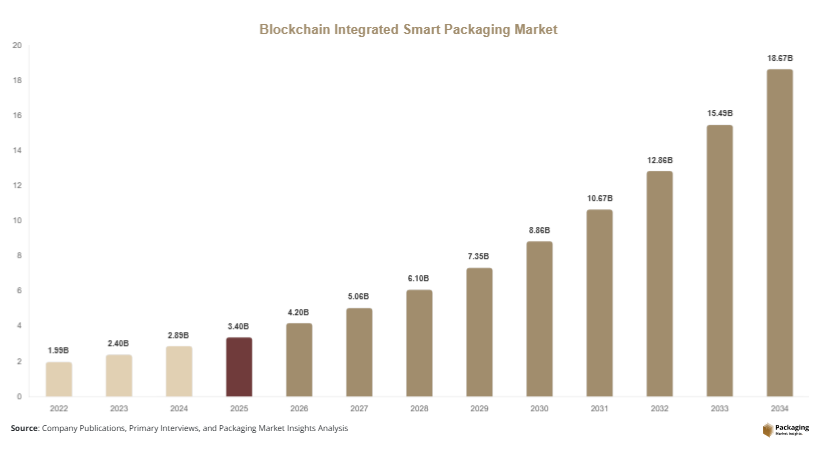
In 2025, the global blockchain integrated smart packaging market size is estimated at USD 3.4 billion and is projected to reach approximately USD 4.2 billion in 2026. With increasing adoption across food & beverage, pharmaceuticals, and logistics industries, the market is expected to expand to USD 18.7 billion by 2034, registering a compound annual growth rate (CAGR) of 20.5% during the forecast period (2025–2034).
This growth is primarily driven by the increasing demand for anti-counterfeiting solutions and supply chain transparency. Blockchain integration enables tamper-proof records, while smart packaging technologies such as QR codes, NFC tags, and IoT sensors allow real-time tracking and monitoring of products. Together, these technologies provide end-to-end visibility, which is becoming critical in regulated industries.
Key Highlights:
- Market size is projected to reach USD 18.7 billion by 2034, reflecting strong expansion across multiple industries. The increasing adoption of digital supply chain technologies is significantly contributing to this growth trajectory.
- The market is expected to register a CAGR of 20.5% from 2025 to 2034, indicating rapid technological adoption. This growth is supported by continuous innovation and increasing investments in blockchain and smart packaging solutions.
- There is strong adoption across food, pharmaceutical, and logistics sectors due to the need for safety and compliance. These industries rely on advanced packaging systems to ensure product integrity and regulatory adherence.
- Demand for traceability and anti-counterfeiting solutions is increasing as supply chains become more complex. Businesses are focusing on improving transparency and reducing risks associated with counterfeit products.
- The integration of IoT and blockchain technologies is rising, enabling real-time data tracking and secure information sharing. This combination enhances operational efficiency and strengthens end-to-end supply chain visibility.
Explore more data points, trends and opportunities Download Free Sample Report
Market Trends
Integration of IoT Sensors with Blockchain Platforms
One of the most prominent trends in the blockchain integrated smart packaging market is the growing integration of IoT sensors with blockchain systems. Smart packaging now includes temperature sensors, humidity trackers, and GPS-enabled devices that collect real-time data during transportation and storage. This data is securely recorded on blockchain networks, ensuring transparency and immutability. Industries such as pharmaceuticals and perishable food rely heavily on these technologies to maintain product quality and compliance. This trend is further supported by advancements in low-power sensor technologies and cost-efficient connectivity solutions, enabling broader adoption across mid-sized enterprises.
Adoption of Consumer-Interactive Packaging Solutions
Another notable trend is the increasing use of blockchain-enabled consumer-interactive packaging. Brands are incorporating QR codes and NFC tags that allow consumers to scan packaging and access detailed product information, including origin, manufacturing date, and supply chain journey. This trend enhances consumer engagement and builds trust, especially in premium and organic product segments. Companies are also leveraging these solutions for marketing and brand storytelling. The rise of mobile applications and digital wallets is facilitating seamless interaction between consumers and packaging systems, making this trend a significant contributor to market expansion.
Market Drivers
Rising Demand for Supply Chain Transparency
The growing complexity of global supply chains has created a strong demand for transparency and traceability. Blockchain integrated smart packaging addresses this need by providing a decentralized and immutable record of product movement. Companies can track products from origin to end-user, ensuring authenticity and reducing fraud risks. This is particularly important in industries such as food and pharmaceuticals, where safety and compliance are critical. The ability to quickly trace contaminated or defective products also helps organizations minimize recall costs and protect brand reputation, thereby driving market growth.
Increasing Incidence of Counterfeit Products
The rise in counterfeit goods across various industries is another key driver for the market. Counterfeit pharmaceuticals, electronics, and luxury goods pose significant risks to consumers and businesses. Blockchain technology, when integrated with smart packaging, offers a reliable solution to combat this issue. Unique digital identities assigned to each product enable verification at every stage of the supply chain. This reduces the chances of duplication and unauthorized distribution. As regulatory bodies enforce stricter anti-counterfeiting measures, companies are increasingly investing in blockchain-enabled packaging solutions.
Market Restraint
High Implementation Costs and Technical Complexity
Despite its benefits, the blockchain integrated smart packaging market faces challenges related to high implementation costs and technical complexity. Integrating blockchain systems with existing packaging infrastructure requires significant investment in hardware, software, and skilled personnel. Small and medium-sized enterprises often find it difficult to adopt these technologies due to budget constraints. Additionally, interoperability issues between different blockchain platforms can hinder seamless data exchange across supply chains. For example, a multinational logistics company may face difficulties in integrating systems across regions with varying technological standards. These challenges can slow down market adoption, particularly in developing economies.
Market Opportunities
Expansion in Emerging Economies
Emerging economies present significant growth opportunities for the blockchain integrated smart packaging market. Rapid industrialization, increasing internet penetration, and growing awareness of product safety are driving demand for advanced packaging solutions. Governments in these regions are also investing in digital infrastructure, creating a favorable environment for blockchain adoption. Industries such as agriculture and pharmaceuticals are particularly poised to benefit from these technologies. As companies expand their operations in these markets, the demand for cost-effective and scalable smart packaging solutions is expected to rise significantly.
Growth in Sustainable Packaging Initiatives
The increasing focus on sustainability is creating new opportunities for blockchain integrated smart packaging. Companies are using blockchain to track the lifecycle of packaging materials, ensuring compliance with environmental standards. Smart packaging solutions can provide data on recyclability, carbon footprint, and waste management practices. This transparency helps organizations meet regulatory requirements and appeal to environmentally conscious consumers. Additionally, innovations in biodegradable materials and eco-friendly sensors are enhancing the sustainability profile of smart packaging, further driving market growth.
Report Scope
| Report Metric | Details |
|---|---|
| Market Size in 2025 | USD 3.4 Billion |
| Market Size in 2026 | USD 4.2 Billion |
| Market Size in 2034 | USD 18.7 Billion |
| CAGR | 20.5% (2026-2034) |
| Base Year for Estimation | 2025 |
| Historical Data | 2022-2024 |
| Forecast Period | 2026-2034 |
| Report Coverage | Revenue Forecast, Competitive Landscape, Supply Chain Disruption, Growth Factors, Environment & Regulatory Landscape and Trends |
| Geographies Covered | North America, Europe, APAC, Middle East and Africa, LATAM |
| Countries Covered | U.S., Canada, U.K., Germany, France, Spain, Italy, Russia, Nordic, Benelux, Rest of Europe, China, South Korea, Japan, India, Australia, Singapore, Taiwan, South East Asia, Rest of Asia-Pacific, UAE, Turky, Saudi Arabia, South Africa, Egypt, Nigeria, Rest of MEA, Brazil, Mexico, Argentina, Chile, Colombia, Rest of LATAM |
Explore more data points, trends and opportunities Download Free Sample Report
Segmental Analysis
By Technology
The QR code-based blockchain smart packaging segment dominated the market in 2024, accounting for approximately 38% of the total share. QR codes are widely used due to their cost-effectiveness and ease of implementation. They allow consumers and stakeholders to access detailed product information by simply scanning the code with a smartphone. This technology is particularly popular in the food and beverage industry, where transparency regarding product origin and ingredients is crucial. Additionally, QR codes can be easily integrated into existing packaging systems without significant infrastructure changes, making them a preferred choice for many companies.
The NFC-enabled smart packaging segment is expected to be the fastest-growing, with a projected CAGR of 23.4% during the forecast period. NFC technology offers enhanced security and user experience compared to QR codes, as it allows contactless data transfer and real-time updates. This makes it ideal for high-value products such as pharmaceuticals and luxury goods. The growth of this segment is driven by increasing consumer demand for seamless and secure product verification. Advancements in NFC technology and declining costs are further supporting its adoption across various industries.
By Application
The supply chain tracking segment held the largest market share of approximately 42% in 2024. This dominance is attributed to the increasing need for end-to-end visibility in complex supply chains. Blockchain integrated smart packaging enables real-time tracking of products, ensuring transparency and reducing the risk of fraud. Industries such as logistics and retail rely heavily on these solutions to optimize operations and improve efficiency. The ability to monitor product conditions during transit also helps companies maintain quality standards and reduce losses.
The anti-counterfeiting segment is expected to grow at the highest CAGR of 24.1% during the forecast period. The rising incidence of counterfeit products across industries is driving the demand for advanced authentication solutions. Blockchain technology provides a secure and tamper-proof system for verifying product authenticity. Smart packaging solutions such as RFID tags and NFC chips enhance this capability by enabling real-time verification. The growth of this segment is further supported by stringent regulations and increasing consumer awareness regarding product authenticity.
By End-Use Industry
The food and beverage industry dominated the market in 2024, accounting for around 36% of the total share. The need for transparency and traceability in food supply chains is a major factor driving the adoption of blockchain integrated smart packaging in this sector. Companies are using these solutions to track product origin, monitor storage conditions, and ensure compliance with safety standards. This helps in building consumer trust and reducing the risk of foodborne illnesses. The growing demand for organic and premium food products is also contributing to the segment’s growth.
The pharmaceutical industry is expected to be the fastest-growing segment, with a CAGR of 25.2% during the forecast period. The increasing prevalence of counterfeit drugs and stringent regulatory requirements are driving the adoption of advanced packaging solutions in this sector. Blockchain integrated smart packaging enables secure tracking and authentication of pharmaceutical products, ensuring patient safety. The integration of IoT sensors further enhances the ability to monitor storage conditions, making it an essential tool for maintaining drug efficacy.
Blockchain Integrated Smart Packaging Market Segmentations
Technology
- QR Codes
- NFC Tags
- RFID Tags
- Sensors & IoT Devices
Application
- Supply Chain Tracking
- Anti-Counterfeiting
- Quality Monitoring
- Consumer Engagement
End-Use Industry
- Food & Beverage
- Pharmaceuticals
- Logistics
- Retail
- Personal Care
Regional Analysis
North America
North America accounted for approximately 34% of the global blockchain integrated smart packaging market share in 2025 and is expected to grow at a CAGR of 19.2% during the forecast period. The region’s growth is supported by advanced technological infrastructure and early adoption of blockchain solutions across industries. The presence of major technology providers and strong investment in research and development further contribute to market expansion.
The United States dominates the regional market, driven by stringent regulations related to food safety and pharmaceutical traceability. A key growth factor is the increasing adoption of smart packaging in the healthcare sector to ensure compliance with regulatory standards. Companies are investing in blockchain-enabled solutions to enhance patient safety and reduce counterfeit drug distribution.
Europe
Europe held around 27% of the market share in 2025 and is projected to grow at a CAGR of 18.5%. The region’s emphasis on sustainability and transparency is driving the adoption of blockchain integrated smart packaging. Regulatory frameworks related to product traceability and environmental impact are encouraging companies to invest in advanced packaging technologies.
Germany is the dominant country in the European market, supported by its strong manufacturing base and focus on innovation. A unique growth factor is the integration of blockchain with circular economy initiatives, enabling companies to track and manage packaging waste effectively. This aligns with regional sustainability goals and boosts market demand.
Asia Pacific
Asia Pacific accounted for approximately 23% of the market share in 2025 and is expected to witness the fastest growth with a CAGR of 22.8%. Rapid industrialization, expanding e-commerce sector, and increasing adoption of digital technologies are key factors driving the market in this region.
China leads the Asia Pacific market due to its large manufacturing base and growing focus on supply chain efficiency. A major growth factor is the increasing use of blockchain integrated smart packaging in the food and beverage industry to ensure product authenticity and quality. Government initiatives promoting digital transformation further support market growth.
Middle East & Africa
The Middle East & Africa region held a market share of around 9% in 2025 and is projected to grow at a CAGR of 17.6%. The market is driven by increasing investments in digital infrastructure and growing awareness of product safety and authenticity.
The United Arab Emirates is the leading country in this region, with strong adoption of blockchain technologies across logistics and retail sectors. A unique growth factor is the government’s focus on becoming a global hub for blockchain innovation, which is encouraging companies to adopt smart packaging solutions.
Latin America
Latin America accounted for approximately 7% of the market share in 2025 and is expected to grow at a CAGR of 18.1%. The region is witnessing increasing adoption of smart packaging technologies in the food and agriculture sectors.
Brazil dominates the regional market, driven by its large agricultural industry and growing export activities. A key growth factor is the need for improved traceability in food supply chains to meet international quality standards. Blockchain integrated smart packaging helps exporters ensure compliance and enhance product credibility.
Competitive Landscape
The blockchain integrated smart packaging market is characterized by the presence of both established technology providers and emerging startups. Leading companies are focusing on strategic partnerships, product innovation, and expansion into emerging markets to strengthen their position. The competitive landscape is moderately fragmented, with companies investing heavily in research and development to enhance their offerings.
IBM Corporation is considered a leading player in this market, leveraging its blockchain platform to provide comprehensive supply chain solutions. The company recently introduced enhanced blockchain-based tracking features integrated with smart packaging technologies, enabling real-time monitoring and improved transparency. Other key players are also focusing on integrating advanced technologies such as artificial intelligence and IoT to differentiate their products and gain a competitive edge.
Key Players List
- IBM Corporation
- Microsoft Corporation
- Amazon Web Services Inc.
- Oracle Corporation
- SAP SE
- Honeywell International Inc.
- Avery Dennison Corporation
- Zebra Technologies Corporation
- Smurfit Kappa Group
- Amcor plc
- Sealed Air Corporation
- Tetra Pak International S.A.
- R.R. Donnelley & Sons Company
- Thinfilm Electronics ASA
- EVRYTHNG Ltd.