Blister Packaging Market Size and Growth
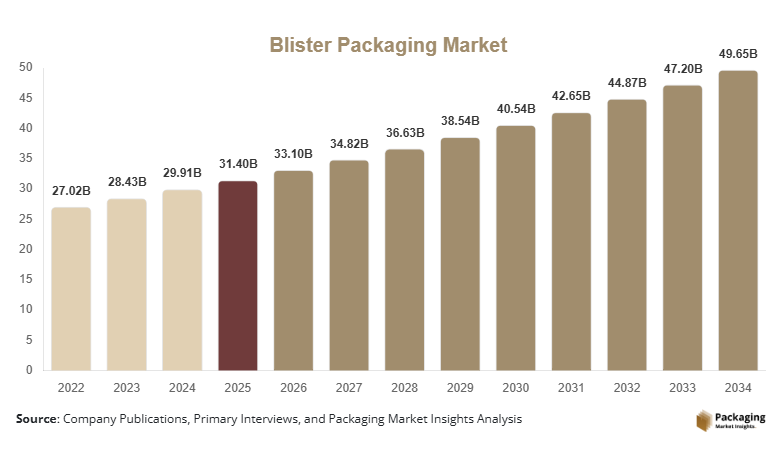
The global blister packaging market size was valued at USD 31.4 billion in 2025 and is estimated to reach USD 33.1 billion in 2026. The market is projected to reach USD 49.7 billion by 2034, expanding at a CAGR of 5.2% during the forecast period from 2025 to 2034. Pharmaceutical applications account for a major portion of global revenue, driven by increasing production of tablets, capsules, and unit-dose medicines. Consumer preference for lightweight, portable, and secure packaging formats is also contributing to broader adoption across retail sectors.
The blister packaging market is experiencing steady growth due to increasing demand from pharmaceutical, consumer goods, food, and electronics industries. Blister packaging is widely used because it provides product protection, tamper resistance, visibility, and extended shelf life. The market has evolved with advancements in thermoforming and cold-forming technologies, enabling manufacturers to improve packaging efficiency while reducing material waste. Growing regulatory focus on safe pharmaceutical packaging and the expansion of over-the-counter medication sales continue to support market expansion across developed and emerging economies.
Key Highlights
- North America dominated the market with a 35.1% share in 2025.
- Asia Pacific is projected to grow at the fastest CAGR of 6.4%.
- Thermoformed blister packaging led the type segment with a 58.7% share.
- Pharmaceuticals dominated the application segment with a 61.3% share.
- PVC material accounted for the largest market share in 2025.
- The US remained the dominant country with a market size of USD 9.4 billion in 2025 and USD 9.9 billion in 2026.
Explore more data points, trends and opportunities Download Free Sample Report
Market Trends
Growing Adoption of Sustainable Blister Packaging Materials
The blister packaging industry is witnessing increased adoption of recyclable and environmentally responsible materials. Manufacturers are replacing conventional multilayer plastics with mono-material PET and paper-based alternatives to reduce environmental impact and improve recyclability. Regulatory pressure regarding single-use plastics is encouraging packaging companies to redesign blister structures using thinner films and reduced aluminum content. Pharmaceutical firms are also investing in sustainable blister packs to align with corporate sustainability goals and strengthen brand positioning among environmentally conscious consumers. This trend is accelerating across Europe and North America, where recycling regulations are becoming stricter for healthcare and retail packaging applications.
In addition, advancements in bio-based polymers and recyclable barrier coatings are improving the performance of eco-friendly blister packaging formats. Packaging companies are collaborating with material suppliers to develop alternatives that maintain moisture protection and product safety while reducing carbon emissions. Sustainable blister packaging solutions are becoming more common in over-the-counter medicine, nutraceuticals, and personal care products. As consumer awareness increases, demand for transparent and recyclable packaging is expected to continue influencing material innovation across the blister packaging market.
Integration of Smart and Connected Packaging Technologies
Smart blister packaging is becoming an important trend in the healthcare and pharmaceutical sectors. Companies are integrating digital technologies such as QR codes, NFC tags, and electronic monitoring systems into blister packs to improve patient adherence and supply chain transparency. Smart blister packs can track medication consumption, send reminders, and provide dosage instructions through connected mobile applications. This trend is particularly relevant for chronic disease management and elderly patient care, where medication compliance remains a major concern.
The integration of serialization and track-and-trace technologies is also improving anti-counterfeiting measures within pharmaceutical packaging. Regulatory agencies in several countries are requiring digital tracking systems to ensure drug authenticity and supply chain security. Electronics and consumer goods manufacturers are adopting interactive blister packaging for product authentication and customer engagement. As digital packaging infrastructure expands, smart blister packaging solutions are expected to gain broader acceptance across healthcare and retail industries over the coming years.
Market Drivers
Expansion of the Global Pharmaceutical Industry
The rapid expansion of the pharmaceutical industry is one of the major drivers supporting the blister packaging market. Blister packs are widely used for tablets, capsules, and unit-dose medicines because they provide excellent barrier protection against moisture, contamination, and oxygen exposure. Pharmaceutical manufacturers prefer blister packaging due to its ability to improve product safety, dosage accuracy, and patient convenience. Increasing production of generic medicines and over-the-counter drugs is contributing to growing packaging demand across developed and emerging economies.
Healthcare regulations regarding tamper-evident and child-resistant packaging are also driving the adoption of advanced blister packaging solutions. Pharmaceutical companies are investing in automated blister packaging systems to improve production efficiency and reduce packaging errors. The growth of aging populations and rising healthcare spending in countries such as the US, China, Germany, and India are expected to maintain strong demand for pharmaceutical blister packaging throughout the forecast period.
Increasing Demand for Retail and Consumer Goods Packaging
The growing retail and consumer goods industry is another significant driver for the blister packaging market. Blister packaging provides product visibility, theft prevention, and attractive shelf presentation, making it suitable for electronics, batteries, toys, cosmetics, and personal care products. Retailers prefer blister packs because they enhance product display and support organized merchandising in supermarkets and convenience stores.
The expansion of e-commerce channels is further increasing demand for secure packaging solutions that can withstand transportation and handling. Manufacturers are developing customized blister packaging formats with improved sealing and impact resistance to protect products during shipping. Consumer preference for lightweight and portable packaging is also contributing to the wider adoption of blister packaging across multiple industries. Rising disposable incomes and increased spending on packaged consumer products are expected to sustain long-term market growth.
Market Restraint
High Environmental Concerns Associated with Plastic Waste
Environmental concerns related to plastic waste remain a major restraint for the blister packaging market. Traditional blister packs are often made using combinations of PVC, PET, aluminum foil, and multilayer materials that are difficult to recycle through conventional waste management systems. Increasing regulatory restrictions on single-use plastics in Europe and North America are placing pressure on packaging manufacturers to redesign products and invest in recyclable alternatives. These transitions can increase production costs and require significant capital investment in new manufacturing technologies.
The pharmaceutical industry faces additional challenges because blister packaging materials must meet strict safety and barrier protection standards. Replacing conventional plastic structures with sustainable alternatives without compromising product performance remains technically complex. For example, some recyclable blister materials may offer lower moisture resistance compared to traditional aluminum-based packaging formats. Smaller manufacturers often face financial limitations in adopting advanced eco-friendly materials and automated recycling-compatible systems. Consumer criticism regarding excessive plastic packaging in retail products is also influencing brand purchasing decisions. As sustainability regulations continue to evolve globally, companies operating in the blister packaging market must balance environmental compliance with packaging functionality and cost efficiency.
Market Opportunities
Rising Demand for Unit-Dose and Personalized Medicine Packaging
The increasing adoption of personalized medicine and unit-dose drug delivery systems presents significant growth opportunities for the blister packaging market. Healthcare providers are emphasizing accurate dosage management to improve patient safety and treatment effectiveness. Blister packaging supports organized medication schedules and reduces the risk of contamination, making it suitable for personalized healthcare applications. Hospitals and pharmacies are increasingly using customized blister packs for elderly patients and chronic disease management programs.
Advancements in digital printing and automated packaging technologies are enabling pharmaceutical companies to produce smaller and more flexible packaging batches for personalized medicine. Smart labeling and patient-specific information integration are also becoming more common in healthcare packaging systems. As precision medicine expands globally, demand for advanced blister packaging solutions with improved traceability and compliance features is expected to increase steadily during the forecast period.
Growth of Sustainable and Paper-Based Blister Packaging
The development of paper-based and recyclable blister packaging solutions offers a major opportunity for manufacturers seeking long-term market expansion. Companies are investing in fiber-based blister structures that reduce plastic usage while maintaining product visibility and protective performance. Paper-backed blister packs are gaining popularity in consumer electronics, cosmetics, and over-the-counter pharmaceutical applications due to growing sustainability awareness among consumers and retailers.
Several packaging companies are collaborating with material suppliers to develop compostable and recyclable blister solutions that comply with environmental regulations. Retail brands are adopting sustainable packaging strategies to strengthen environmental commitments and improve customer perception. Innovations in barrier coatings and thermoforming technologies are improving the functionality of paper-based blister packaging formats. As governments introduce stricter packaging waste regulations, demand for sustainable blister packaging products is expected to increase across global markets.
Report Scope
| Report Metric | Details |
|---|---|
| Market Size in 2025 | USD 31.4 Billion |
| Market Size in 2026 | USD 33.1 Billion |
| Market Size in 2034 | USD 49.7 Billion |
| CAGR | 5.2% (2026-2034) |
| Base Year for Estimation | 2025 |
| Historical Data | 2022-2024 |
| Forecast Period | 2026-2034 |
| Report Coverage | Revenue Forecast, Competitive Landscape, Supply Chain Disruption, Growth Factors, Environment & Regulatory Landscape and Trends |
| Geographies Covered | North America, Europe, APAC, Middle East and Africa, LATAM |
| Countries Covered | U.S., Canada, U.K., Germany, France, Spain, Italy, Russia, Nordic, Benelux, Rest of Europe, China, South Korea, Japan, India, Australia, Singapore, Taiwan, South East Asia, Rest of Asia-Pacific, UAE, Turky, Saudi Arabia, South Africa, Egypt, Nigeria, Rest of MEA, Brazil, Mexico, Argentina, Chile, Colombia, Rest of LATAM |
Explore more data points, trends and opportunities Download Free Sample Report
Segmental Analysis
By Type
Thermoformed blister packaging dominated the market with a 58.7% share in 2024 due to its cost efficiency, design flexibility, and high production speed. Thermoforming technology is widely used in pharmaceutical, electronics, and consumer goods packaging because it enables manufacturers to create transparent and lightweight packaging structures with strong sealing performance. PVC and PET materials are commonly used in thermoformed blister packs due to their clarity and durability. Pharmaceutical manufacturers prefer thermoformed blister packaging because it supports high-volume production and provides effective protection against contamination and moisture exposure. The increasing use of automated thermoforming equipment is also improving manufacturing efficiency and reducing operational costs for packaging companies globally.
Cold-formed blister packaging is projected to register the fastest CAGR of 6.1% during the forecast period due to rising demand for superior barrier protection in pharmaceutical applications. Cold-form blister packs use aluminum-based materials that provide enhanced protection against moisture, oxygen, and light exposure, making them suitable for sensitive medicines and high-value drugs. The growth of biologics and specialty pharmaceutical products is increasing demand for advanced packaging formats with extended shelf-life capabilities. Pharmaceutical companies are adopting cold-form packaging solutions to comply with stringent healthcare regulations and maintain product integrity during international distribution and long-term storage operations.
By Application
Pharmaceutical applications accounted for the largest share of 61.3% in 2024 due to the widespread use of blister packaging for tablets, capsules, and unit-dose medicines. Blister packaging supports dosage accuracy, tamper resistance, and patient convenience, making it a preferred format in regulated healthcare environments. Increasing generic drug production and over-the-counter medication sales are driving demand for pharmaceutical blister packs across developed and emerging markets. Healthcare providers also favor blister packaging because it improves medication adherence and reduces contamination risks. The expansion of automated pharmaceutical packaging lines is enabling manufacturers to increase production capacity while improving packaging precision and operational efficiency across global healthcare supply chains.
Consumer goods applications are expected to witness the fastest CAGR of 5.9% during the forecast period due to rising demand for protective and visually attractive retail packaging solutions. Blister packaging is widely used for electronics accessories, batteries, personal care products, and small hardware items because it improves shelf visibility and prevents product theft. Growth in e-commerce retailing is increasing demand for durable packaging capable of protecting products during transportation and storage. Manufacturers are also introducing customized blister packaging designs with recyclable materials to improve sustainability and consumer appeal. Rising urbanization and organized retail expansion are expected to further support growth in consumer goods blister packaging applications.
By Material
PVC material dominated the blister packaging market with a 42.5% share in 2024 because of its low cost, transparency, and thermoforming efficiency. PVC-based blister packaging is extensively used in pharmaceutical and retail applications due to its ability to provide reliable sealing and product visibility. Manufacturers continue to prefer PVC materials because they support large-scale production and maintain compatibility with automated packaging systems. The material is widely available and offers strong mechanical performance for various consumer and healthcare packaging applications. Demand for PVC blister packaging remains stable in emerging economies where cost-effective packaging solutions are essential for pharmaceutical distribution and consumer goods packaging operations.
PET material is anticipated to grow at the fastest CAGR of 6.3% during the forecast period due to increasing sustainability initiatives and recyclability requirements. PET-based blister packaging offers improved environmental performance compared to traditional PVC structures while maintaining high transparency and durability. Regulatory pressure to reduce plastic waste is encouraging packaging manufacturers to adopt recyclable PET materials in healthcare and retail packaging applications. Advancements in barrier coating technologies are improving the moisture resistance and functionality of PET blister packs. Consumer preference for environmentally responsible packaging solutions is also supporting broader adoption of PET materials across global blister packaging markets.
Blister Packaging Market Segmentations
By Material Type
- Plastic Films
- Aluminum Foils
- Paper & Paperboard
- PVC and PET Materials
- Sustainable Bioplastic Materials
By Application
- Pharmaceutical Packaging
- Consumer Goods Packaging
- Food Packaging
- Electronics Packaging
- Personal Care & Cosmetics Packaging
By Technology
- Thermoforming
- Cold Forming
- Clamshell Blister Packaging
- Carded Blister Packaging
- Child-Resistant Blister Packaging
Regional Analysis
North America
North America accounted for 35.1% of the global blister packaging market share in 2025 and is expected to maintain steady growth at a CAGR of 4.9% during the forecast period. The region benefits from strong pharmaceutical manufacturing activity, advanced healthcare infrastructure, and high demand for consumer packaged goods. Regulatory emphasis on child-resistant and tamper-evident packaging continues to support the adoption of advanced blister packaging solutions across healthcare and retail industries.
The United States remained the dominant country in North America due to its large pharmaceutical industry and expanding over-the-counter medicine market. A unique growth factor in the country is the increasing adoption of smart medication packaging systems integrated with patient adherence monitoring technologies. Pharmaceutical companies are investing in connected blister packs that improve medication compliance and reduce healthcare management costs.
Europe
Europe represented 27.4% of the global blister packaging market in 2025 and is projected to grow at a CAGR of 5.1% through 2034. Strong environmental regulations and rising demand for recyclable packaging materials are influencing market growth across the region. Pharmaceutical and healthcare industries remain major consumers of blister packaging products due to strict product safety standards and growing prescription drug demand.
Germany dominated the European blister packaging market because of its advanced pharmaceutical manufacturing sector and strong industrial packaging capabilities. A unique growth factor in Germany is the rapid adoption of sustainable thermoforming materials and recyclable mono-material blister packaging structures. Manufacturers are investing in environmentally compliant packaging technologies to meet regional sustainability targets and reduce plastic waste generation.
Asia Pacific
Asia Pacific held 24.6% of the blister packaging market share in 2025 and is expected to register the fastest CAGR of 6.4% during the forecast period. Rising pharmaceutical production, expanding healthcare access, and increasing packaged consumer goods consumption are driving market growth in the region. Growing investments in manufacturing automation and packaging technology are also supporting higher blister packaging production capacity across emerging economies.
China remained the leading country in Asia Pacific due to its extensive pharmaceutical manufacturing base and expanding electronics sector. A unique growth factor in China is the rapid growth of domestic healthcare packaging demand driven by aging populations and increased healthcare spending. Packaging companies are expanding local production facilities to support growing medicine exports and domestic pharmaceutical consumption.
Middle East & Africa
The Middle East & Africa blister packaging market accounted for 6.2% of global revenue in 2025 and is projected to grow at a CAGR of 5.0% through 2034. Increasing pharmaceutical imports, healthcare infrastructure development, and rising retail packaging demand are supporting market expansion in the region. Governments are investing in healthcare modernization initiatives that require improved pharmaceutical packaging standards and product protection solutions.
Saudi Arabia dominated the regional market due to increasing pharmaceutical manufacturing investments and healthcare sector expansion. A unique growth factor in the country is the development of local pharmaceutical production facilities supported by government diversification programs. Demand for secure and moisture-resistant blister packaging is increasing as domestic medicine production and healthcare distribution networks continue to expand.
Latin America
Latin America captured 6.7% of the global blister packaging market share in 2025 and is expected to grow at a CAGR of 5.3% during the forecast period. Rising healthcare spending, expanding retail industries, and increasing demand for packaged pharmaceuticals are contributing to regional market growth. Consumer preference for convenient and portable packaging formats is also supporting wider adoption across food and personal care applications.
Brazil remained the dominant country in Latin America because of its large pharmaceutical and consumer goods industries. A unique growth factor in Brazil is the growing use of blister packaging for nutraceutical and dietary supplement products. Expanding health awareness and increased consumption of vitamins and wellness products are encouraging packaging manufacturers to introduce cost-effective and durable blister packaging solutions.
Competitive Landscape
The blister packaging market is moderately consolidated, with several global and regional companies competing through product innovation, sustainable packaging development, and strategic partnerships. Major market participants are focusing on recyclable blister materials, smart packaging technologies, and automated manufacturing systems to strengthen their competitive position. Companies are also expanding production capacity in emerging markets to meet rising pharmaceutical and retail packaging demand.
Amcor plc remains one of the leading companies in the blister packaging market due to its broad packaging portfolio and strong pharmaceutical packaging capabilities. The company recently introduced recyclable thermoform blister packaging solutions designed to reduce plastic consumption while maintaining barrier protection standards. Sonoco Products Company, Constantia Flexibles, WestRock Company, and Klockner Pentaplast are also major players investing in sustainable packaging technologies and advanced barrier materials.
Competitive strategies in the market include mergers, acquisitions, product launches, and investments in digital packaging systems. Companies are increasingly collaborating with pharmaceutical manufacturers to develop customized blister packaging formats with improved compliance and traceability features. Growing demand for eco-friendly packaging and healthcare safety solutions is expected to intensify competition during the forecast period.
Key Players List
- Amcor plc
- Sonoco Products Company
- Constantia Flexibles
- WestRock Company
- Klockner Pentaplast
- Honeywell International Inc.
- DuPont de Nemours, Inc.
- Tekni-Plex, Inc.
- Display Pack, Inc.
- Pharma Packaging Solutions
- UFlex Limited
- Bilcare Limited
- AptarGroup, Inc.
- WINPAK LTD.
- Bemis Manufacturing Company