Blister Packaging Machine Market Size and Growth
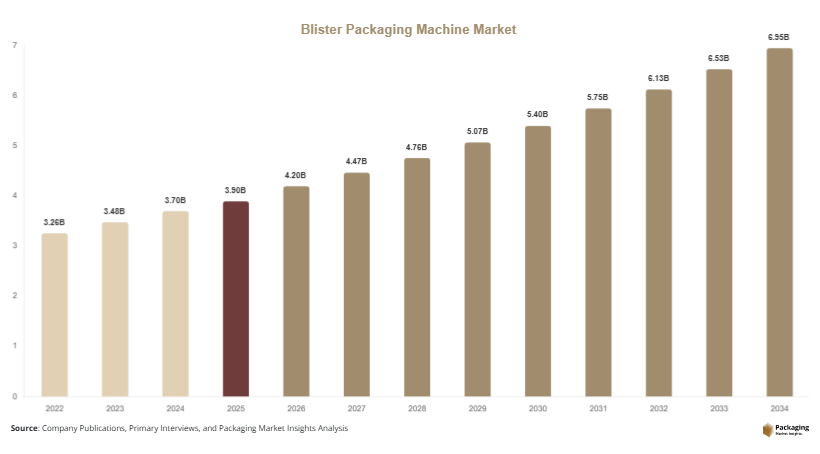
The blister packaging machine market size was valued at approximately USD 3.9 billion in 2025 and is projected to reach USD 4.2 billion in 2026. By 2034, the market is expected to attain nearly USD 7.4 billion, expanding at a CAGR of 6.5% during 2025–2034. The growing adoption of automated packaging systems and increasing demand for product safety are contributing significantly to market expansion. The blister packaging machine market is experiencing consistent growth due to the increasing demand for secure, efficient, and automated packaging solutions across pharmaceutical, consumer goods, and food industries.
One of the major growth factors driving the blister packaging machine market is the rapid expansion of the pharmaceutical industry. Pharmaceutical manufacturers are increasingly using blister packaging machines to improve dosage accuracy, extend shelf life, and ensure product protection from contamination. Another important growth factor is the rise in consumer demand for convenient and tamper-evident packaging. Blister packs offer visibility, portability, and improved product security, making them highly preferred in retail packaging applications. Additionally, advancements in automation and smart manufacturing technologies are encouraging companies to upgrade existing packaging systems with high-speed and digitally integrated blister packaging equipment.
Key Highlights
- Asia Pacific dominated the market with a 39.1% share in 2025.
- Latin America is projected to grow at the fastest CAGR of 7.0%.
- Automatic blister packaging machines led the type segment with a 57.3% share.
- Pharmaceutical applications dominated with a 48.6% share.
- Plastic-based blister packaging materials accounted for 51.2% share.
- The US remained the dominant country with a market size of USD 0.9 billion in 2025 and USD 1.0 billion in 2026.
Explore more data points, trends and opportunities Download Free Sample Report
Market Trends
Increasing Adoption of Smart and Automated Packaging Systems
Automation is becoming a significant trend in the blister packaging machine market as manufacturers seek to improve production efficiency and reduce operational costs. Advanced blister packaging systems equipped with robotic handling, touchscreen interfaces, and IoT-enabled monitoring are gaining popularity across pharmaceutical and consumer goods industries. These systems help reduce human error, improve packaging consistency, and increase production speed. Real-time monitoring and predictive maintenance features also support operational efficiency by minimizing machine downtime. Companies are increasingly integrating data analytics into packaging systems to improve process optimization and quality control. This trend is particularly strong in large-scale pharmaceutical manufacturing facilities where compliance and precision are essential for maintaining production standards.
Shift Toward Sustainable Blister Packaging Solutions
Sustainability is influencing packaging machinery design and material selection across the blister packaging industry. Manufacturers are developing machines compatible with recyclable and biodegradable blister materials to align with environmental regulations and consumer preferences. Traditional plastic-based packaging is gradually being replaced by paper-based and mono-material alternatives that reduce environmental impact. Packaging equipment providers are also introducing energy-efficient systems that consume less power during operation. Pharmaceutical and food companies are increasingly adopting sustainable packaging to strengthen brand positioning and comply with regional waste reduction policies. As governments implement stricter environmental standards, the demand for machines capable of handling eco-friendly packaging materials is expected to increase steadily throughout the forecast period.
Market Drivers
Expansion of the Global Pharmaceutical Industry
The rapid growth of the pharmaceutical industry is a major driver for the blister packaging machine market. Pharmaceutical companies rely heavily on blister packaging for tablets, capsules, and medical devices because it provides protection against moisture, contamination, and tampering. Increasing production of generic medicines, rising healthcare expenditure, and growing demand for over-the-counter drugs are supporting machine adoption globally. Regulatory authorities also encourage the use of secure and traceable packaging formats, further increasing demand for advanced blister packaging systems. In addition, pharmaceutical manufacturers are investing in automated production lines to improve packaging efficiency and meet rising demand, particularly in developing economies where healthcare infrastructure is expanding rapidly.
Rising Demand for Convenient Consumer Packaging
Consumer preference for convenient, portable, and tamper-resistant packaging is driving growth in the blister packaging machine market. Blister packs provide product visibility and easy handling, making them widely used for batteries, electronics, cosmetics, and personal care products. Retailers also favor blister packaging because it improves shelf presentation and reduces theft risks. The increasing popularity of single-dose and unit-dose packaging formats is further boosting machine demand. E-commerce growth is also contributing to the expansion of blister packaging, as products require secure packaging during transportation. Manufacturers are responding by introducing flexible packaging machines capable of handling multiple product types and packaging designs efficiently.
Market Restraint
High Initial Investment and Maintenance Costs
One of the primary restraints affecting the blister packaging machine market is the high capital investment required for advanced packaging systems. Automated and high-speed blister packaging machines involve substantial installation, integration, and maintenance expenses, making them difficult to adopt for small and medium-sized manufacturers. Companies operating in price-sensitive markets may continue using semi-automatic or outdated packaging systems due to budget limitations. In addition, advanced machinery often requires skilled technicians for operation and maintenance, increasing labor and training costs. Frequent upgrades in automation technology can also create financial pressure for manufacturers attempting to remain competitive. For example, pharmaceutical companies upgrading from conventional packaging lines to fully automated blister systems may face significant operational disruptions and higher implementation costs during the transition period. These financial challenges can slow market penetration, particularly in emerging economies with limited manufacturing budgets.
Market Opportunities
Growth of Packaging Demand in Emerging Economies
Emerging economies are creating strong opportunities for the blister packaging machine market due to rapid industrialization and healthcare expansion. Countries across Asia Pacific, Latin America, and Africa are witnessing increasing investments in pharmaceutical production facilities and packaging infrastructure. Rising urbanization and growing disposable income are also increasing demand for packaged consumer products. Governments in developing economies are encouraging local pharmaceutical manufacturing, which is supporting adoption of modern blister packaging machinery. Furthermore, the expansion of retail and e-commerce sectors in these regions is increasing demand for durable and attractive packaging formats. As packaging standards improve, machine manufacturers are expected to benefit from rising equipment installations in these high-growth markets.
Development of Sustainable and Flexible Packaging Equipment
The transition toward environmentally friendly packaging materials is opening new opportunities for machine manufacturers. Companies are developing blister packaging machines compatible with recyclable plastics, paper-based materials, and compostable films. Flexible machinery capable of handling multiple material types is becoming increasingly valuable for manufacturers seeking operational adaptability. In addition, industries are looking for modular systems that can be upgraded according to changing production requirements. The demand for sustainable machinery is particularly strong in Europe and North America, where environmental regulations are becoming stricter. Machine manufacturers investing in energy-efficient technologies and eco-compatible packaging capabilities are expected to gain long-term growth opportunities across several end-use industries.
Report Scope
| Report Metric | Details |
|---|---|
| Market Size in 2025 | USD 3.9 Billion |
| Market Size in 2026 | USD 4.2 Billion |
| Market Size in 2034 | USD 7.4 Billion |
| CAGR | 6.5% (2026-2034) |
| Base Year for Estimation | 2025 |
| Historical Data | 2022-2024 |
| Forecast Period | 2026-2034 |
| Report Coverage | Revenue Forecast, Competitive Landscape, Supply Chain Disruption, Growth Factors, Environment & Regulatory Landscape and Trends |
| Geographies Covered | North America, Europe, APAC, Middle East and Africa, LATAM |
| Countries Covered | U.S., Canada, U.K., Germany, France, Spain, Italy, Russia, Nordic, Benelux, Rest of Europe, China, South Korea, Japan, India, Australia, Singapore, Taiwan, South East Asia, Rest of Asia-Pacific, UAE, Turky, Saudi Arabia, South Africa, Egypt, Nigeria, Rest of MEA, Brazil, Mexico, Argentina, Chile, Colombia, Rest of LATAM |
Explore more data points, trends and opportunities Download Free Sample Report
Segmental Analysis
By Machine Type
Automatic blister packaging machines dominated the market in 2024, accounting for approximately 57.3% of the total market share. These machines are widely used because they provide high-speed production, reduced labor dependency, and improved packaging consistency. Pharmaceutical companies prefer automatic systems for large-scale tablet and capsule packaging operations where accuracy and efficiency are critical. The integration of servo motors, digital controls, and robotic feeding systems has further improved operational performance. Automatic machines also help manufacturers comply with strict regulatory standards by ensuring uniform sealing and packaging quality. The growing trend toward smart factories and continuous manufacturing processes is expected to sustain strong demand for automatic blister packaging systems across global industries.
Thermoforming blister packaging machines are projected to be the fastest-growing subsegment, registering a CAGR of 6.9% during the forecast period. These machines are gaining popularity due to their flexibility, lower material costs, and suitability for high-volume packaging applications. Thermoforming technology allows manufacturers to create customized blister cavities using heated plastic sheets, making it suitable for pharmaceutical, electronics, and consumer product packaging. Increasing demand for lightweight and transparent packaging solutions is supporting adoption of thermoforming systems. In addition, advancements in heating efficiency and material handling technologies are improving machine productivity and reducing operational waste. Manufacturers are increasingly investing in thermoforming equipment to meet changing packaging design requirements and improve cost efficiency.
By Application
The pharmaceutical application segment dominated the blister packaging machine market in 2024 with a market share of 48.6%. Blister packaging is widely used in the pharmaceutical sector because it provides product protection, dosage accuracy, and tamper resistance. Tablets, capsules, and medical devices are commonly packaged in blister packs to ensure product stability and compliance with healthcare regulations. The increasing production of generic medicines and over-the-counter drugs is supporting market demand. Pharmaceutical companies are also focusing on traceability and anti-counterfeit measures, which is encouraging investment in advanced blister packaging machinery equipped with serialization and inspection technologies. Rising global healthcare demand continues to strengthen the position of the pharmaceutical application segment.
Consumer goods applications are expected to witness the fastest growth, expanding at a CAGR of 6.8% during the forecast period. Products such as batteries, cosmetics, toys, electronics accessories, and personal care items are increasingly packaged using blister packs due to their visibility and convenience. Retailers favor blister packaging because it improves shelf presentation and protects products from theft and damage. The expansion of organized retail and e-commerce channels is further increasing demand for attractive and secure packaging formats. Manufacturers are also introducing customized blister designs and compact packaging solutions to enhance customer appeal. These factors are expected to drive strong adoption of blister packaging machines within the consumer goods industry.
By Material Type
Plastic-based blister packaging materials accounted for the largest market share of 51.2% in 2024. Materials such as PVC, PET, and polypropylene are commonly used because they offer transparency, durability, and cost efficiency. Plastic materials also provide excellent thermoforming properties, making them suitable for high-speed packaging operations. Pharmaceutical and consumer goods industries rely heavily on plastic blister packaging to ensure product visibility and protection. Additionally, improvements in recyclable plastic formulations are helping manufacturers address environmental concerns while maintaining packaging performance. The widespread availability and affordability of plastic materials continue to support their dominance in the global blister packaging machine market.
Sustainable and recyclable materials are anticipated to be the fastest-growing subsegment, with a projected CAGR of 7.2% during the forecast period. Growing environmental awareness and stricter packaging regulations are encouraging companies to shift toward eco-friendly materials such as paper-based laminates and biodegradable films. Packaging manufacturers are developing advanced blister packaging machines capable of handling these alternative materials efficiently without compromising production speed or packaging quality. Consumer preference for sustainable packaging is also influencing purchasing decisions across pharmaceutical and retail sectors. As companies strengthen sustainability initiatives and reduce plastic waste, the demand for machines compatible with environmentally friendly packaging materials is expected to increase steadily.
Blister Packaging Machine Market Segmentations
By Machine Type
- Automatic Blister Packaging Machines
- Semi-Automatic Blister Packaging Machines
- Thermoforming Machines
- Cold Forming Machines
By Application
- Pharmaceuticals
- Consumer Goods
- Food & Beverages
- Electronics
By Material Type
- Plastic-Based Materials
- Aluminum-Based Materials
- Paper-Based Materials
- Sustainable & Biodegradable Materials
By Distribution Channel
- Direct Sales
- Industrial Equipment Distributors
- Online Industrial Platforms
- Third-Party Packaging Solution Providers
Regional Analysis
North America
North America accounted for approximately 27.6% of the global blister packaging machine market share in 2025 and is projected to expand at a CAGR of 5.8% during the forecast period. The region benefits from advanced pharmaceutical manufacturing infrastructure and high adoption of automated packaging technologies. Strong demand for secure medical packaging and increasing investments in smart production facilities continue to support market expansion. Regulatory compliance requirements are also encouraging companies to modernize packaging operations with efficient blister packaging systems.
The United States dominates the North American market due to its large pharmaceutical and consumer goods industries. A unique growth factor in the country is the increasing demand for unit-dose medication packaging in hospitals and healthcare facilities. This trend is encouraging pharmaceutical manufacturers to install advanced blister packaging lines capable of ensuring precise dosage packaging and improved patient safety while reducing medication handling errors across healthcare systems.
Europe
Europe held nearly 24.1% of the blister packaging machine market share in 2025 and is forecast to grow at a CAGR of 5.7% through 2034. The region is characterized by strong pharmaceutical exports, advanced packaging standards, and increasing adoption of sustainable packaging technologies. European manufacturers are investing in automation and recyclable material compatibility to meet environmental targets. Demand for high-speed and precision packaging machinery remains strong in pharmaceutical and medical packaging applications across the region.
Germany remains the leading country within the European market due to its established industrial automation sector and strong pharmaceutical production base. A unique growth factor in Germany is the integration of Industry 4.0 technologies into packaging lines. Manufacturers are increasingly using smart monitoring systems and connected machinery to improve production efficiency, reduce downtime, and maintain packaging quality consistency throughout manufacturing operations.
Asia Pacific
Asia Pacific dominated the blister packaging machine market with a 39.1% share in 2025 and is expected to register a CAGR of 7.2% during the forecast period. Rapid industrialization, rising healthcare expenditure, and growing pharmaceutical production are major growth drivers in the region. Expanding consumer goods manufacturing and increasing adoption of packaged products are also contributing to machine demand. Countries across the region are investing heavily in automated packaging infrastructure to improve manufacturing capabilities.
China leads the Asia Pacific market due to its large-scale pharmaceutical and electronics manufacturing sectors. One unique growth factor is the rapid expansion of domestic pharmaceutical production for export markets. Chinese manufacturers are increasingly adopting automated blister packaging systems to improve production speed and meet international packaging quality standards. This trend is expected to support strong equipment demand over the coming years.
Middle East & Africa
The Middle East & Africa region accounted for approximately 4.9% of the global market share in 2025 and is projected to grow at a CAGR of 6.0% through 2034. Rising healthcare investments and increasing demand for packaged consumer products are driving market growth. Governments across the region are investing in pharmaceutical manufacturing and logistics infrastructure to reduce import dependency. These developments are creating opportunities for blister packaging machine suppliers.
Saudi Arabia dominates the regional market due to ongoing investments in healthcare and industrial diversification programs. A unique growth factor is the increasing establishment of local pharmaceutical manufacturing facilities under national economic development strategies. This expansion is driving demand for automated blister packaging systems capable of meeting regional pharmaceutical production and packaging requirements efficiently.
Latin America
Latin America held around 4.3% of the blister packaging machine market share in 2025 and is anticipated to grow at the fastest CAGR of 7.0% during the forecast period. Increasing pharmaceutical production, rising healthcare awareness, and growth in packaged consumer products are contributing to market expansion. Investments in manufacturing automation and packaging modernization are also supporting the adoption of advanced blister packaging equipment throughout the region.
Brazil remains the dominant country in Latin America due to its large pharmaceutical and food processing industries. A unique growth factor is the growing demand for cost-efficient packaging solutions among domestic pharmaceutical manufacturers. Companies are increasingly adopting automated blister packaging systems to improve productivity, reduce material waste, and strengthen product distribution capabilities across expanding retail and healthcare networks.
Competitive Landscape
The blister packaging machine market is moderately competitive, with leading companies focusing on automation, digital integration, and sustainable packaging compatibility. Major players are investing in research and development to improve machine speed, reduce energy consumption, and enhance operational flexibility. Strategic partnerships, acquisitions, and regional expansion remain common growth strategies among market participants.
IMA Group is recognized as one of the leading companies in the market due to its extensive product portfolio and strong pharmaceutical packaging expertise. In 2024, the company introduced a new high-speed blister packaging system equipped with integrated digital monitoring capabilities to improve production efficiency and reduce maintenance downtime. Other key companies including Uhlmann Group, Marchesini Group, Romaco Group, and ACG Worldwide are also focusing on advanced automation technologies and modular machine designs. These companies are expanding manufacturing capacities and strengthening distribution networks to increase market presence across emerging economies. Competitive intensity is expected to rise further as sustainability and smart manufacturing become central industry priorities.
Key Players List
- IMA Group
- Uhlmann Group
- Marchesini Group
- Romaco Group
- ACG Worldwide
- Mediseal GmbH
- Hoonga Co., Ltd.
- Zhejiang Hualian Pharmaceutical Machinery
- CAM Packaging Systems
- Algus Packaging
- Koch Pac-Systeme GmbH
- Sepha Ltd.
- Jornen Machinery
- Hamer Packaging Technology
- Fabrima Machinery
- Blipack S.A.
- Pharmaworks LLC