Biotechnology Labels And Packaging Market Size and Growth
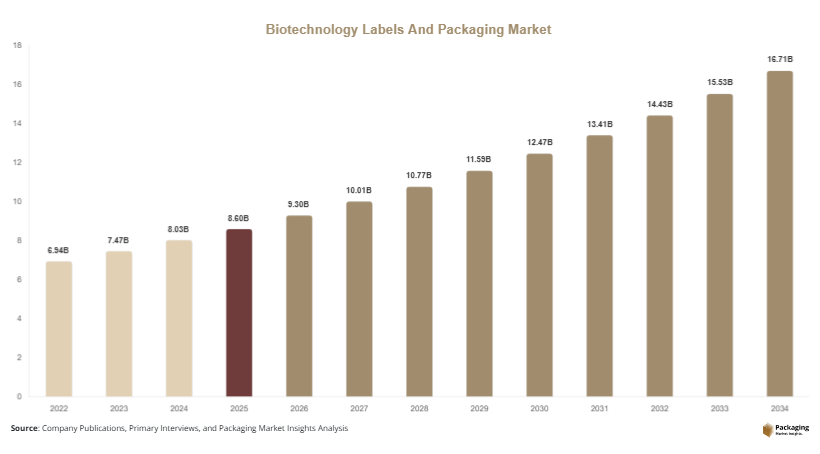
The global biotechnology labels and packaging market size is estimated at USD 8.6 billion in 2025 and is projected to reach USD 9.3 billion in 2026. Over the forecast period, the market is expected to grow significantly and reach approximately USD 16.8 billion by 2034, registering a CAGR of 7.6% from 2025 to 2034. This steady growth reflects increasing demand for high-performance packaging solutions that ensure product stability, regulatory compliance, and supply chain visibility. The biotechnology labels and packaging market continues to expand as the global biotechnology and pharmaceutical industries shift toward complex biologics, personalized therapies, and temperature-sensitive drug formulations.
A key factor contributing to this growth is the rapid rise in biologics and biosimilars. These products require specialized packaging formats that can maintain strict environmental conditions such as temperature, humidity, and light exposure. Advanced labeling solutions, including tamper-evident and temperature-indicating labels, are becoming essential to ensure product safety and compliance. In addition, global regulatory authorities are implementing strict guidelines for labeling accuracy, serialization, and traceability, which is driving the adoption of advanced labeling systems.
Key Highlights
- North America dominated the market with a 34.8% share in 2025, while Asia Pacific is projected to grow at the fastest CAGR of 8.4%.
- Pressure-sensitive labels led the type segment with a 31.2% share, while smart labels are expected to grow at a CAGR of 9.1%.
- Plastic packaging dominated with a 49.7% share, while biodegradable packaging is forecasted to grow at a CAGR of 8.8%.
- Pharmaceutical applications led the segment with 45.6% share, while clinical research packaging is expected to grow at a CAGR of 8.2%.
- The United States remained the dominant country with a market size of USD 2.6 billion in 2025 and USD 2.8 billion in 2026.
Explore more data points, trends and opportunities Download Free Sample Report
Market Trends
Integration of smart labeling and digital tracking technologies
The biotechnology labels and packaging market is undergoing a transformation driven by the integration of intelligent labeling technologies. Smart labels equipped with RFID, NFC, and QR codes are being widely adopted to enhance traceability and product authentication. These technologies allow real-time monitoring of temperature, location, and handling conditions, which is critical for biologics and other sensitive pharmaceutical products. As supply chains become more complex and global, the need for transparency and accuracy is increasing. Companies are leveraging digital systems to connect packaging with enterprise resource planning platforms, enabling better inventory management and compliance. This trend is also reducing the risk of counterfeit drugs and improving patient safety, making it an essential component of modern biotechnology packaging strategies.
Growing emphasis on sustainable and eco-friendly packaging solutions
Sustainability has become a central focus in the biotechnology packaging industry as companies aim to reduce their environmental footprint. There is a noticeable shift toward biodegradable materials, recyclable packaging formats, and paper-based labeling solutions. Manufacturers are developing lightweight packaging designs to minimize material usage and lower transportation emissions. Regulatory pressure in regions such as Europe and North America is encouraging the adoption of eco-friendly alternatives without compromising product integrity. In addition, biotechnology companies are aligning their packaging strategies with broader corporate sustainability goals. This shift is also influencing consumer perception and brand value, as stakeholders increasingly prioritize environmentally responsible practices across the pharmaceutical supply chain.
Market Drivers
Expansion of biologics and advanced therapeutics production
The rapid growth of biologics and advanced therapeutic products is significantly influencing the demand for specialized labeling and packaging solutions. Biologics, including vaccines, gene therapies, and monoclonal antibodies, require highly controlled environments to maintain stability and efficacy. Packaging solutions must ensure protection from temperature fluctuations, contamination, and physical damage. As pharmaceutical companies expand their pipelines for biologics, the need for advanced packaging systems continues to rise. This includes temperature-sensitive labels, tamper-proof packaging, and high-barrier materials. The increasing investment in biotechnology research and development is further supporting the demand for innovative packaging solutions that can meet the complex requirements of these advanced therapies.
Increasing regulatory requirements for labeling and traceability
Stringent regulatory frameworks across global markets are shaping the biotechnology labels and packaging industry. Governments and regulatory bodies have introduced strict guidelines for product labeling, serialization, and traceability to ensure patient safety and prevent counterfeit drugs. Compliance with these regulations requires the implementation of advanced labeling technologies and standardized packaging systems. Serialization mandates have increased the need for unique identification codes and track-and-trace capabilities, driving demand for digital labeling solutions. Companies are investing in compliance-focused packaging innovations to meet these requirements, which is contributing to market growth. The emphasis on transparency and accountability in pharmaceutical supply chains is expected to further strengthen this trend over the forecast period.
Market Restraint
High cost associated with advanced packaging technologies
The adoption of advanced biotechnology packaging solutions often involves significant financial investment, which can act as a limiting factor for market growth. Technologies such as smart labels, RFID systems, and temperature-controlled packaging require specialized materials and infrastructure, increasing overall costs. Small and medium-sized enterprises may find it challenging to implement these solutions due to budget constraints. In addition, maintaining compliance with stringent regulatory standards adds to operational expenses. Continuous innovation and the need for frequent upgrades further increase the cost burden. This can slow down the adoption of advanced packaging technologies, particularly in developing regions where cost sensitivity remains high. As a result, companies must balance innovation with affordability to remain competitive in the market.
Market Opportunities
Expansion of temperature-controlled logistics and cold chain systems
The increasing demand for temperature-sensitive biotechnology products presents strong growth potential for the packaging industry. Cold chain logistics systems are expanding globally to support the safe transportation of biologics, vaccines, and other sensitive pharmaceuticals. This expansion is creating opportunities for advanced packaging solutions that can maintain precise temperature conditions throughout the supply chain. Insulated containers, phase-change materials, and temperature-monitoring labels are becoming essential components of biotechnology packaging. Companies investing in these technologies can enhance product reliability and reduce the risk of spoilage. The growth of online pharmaceutical distribution channels is also contributing to the demand for robust cold chain packaging solutions.
Rising demand from emerging economies with expanding healthcare infrastructure
Emerging markets are becoming important growth areas for the biotechnology labels and packaging market due to increasing healthcare investments and improving infrastructure. Countries in Asia Pacific, Latin America, and the Middle East are witnessing a rise in biotechnology research, pharmaceutical production, and healthcare access. Governments are implementing policies to strengthen regulatory frameworks and promote the adoption of advanced medical technologies. This is driving the demand for high-quality labeling and packaging solutions that meet international standards. Companies expanding into these regions can benefit from untapped opportunities and growing demand for biotechnology products. The increasing awareness of product safety and quality is further supporting market expansion in these regions.
Report Scope
| Report Metric | Details |
|---|---|
| Market Size in 2025 | USD 8.6 Billion |
| Market Size in 2026 | USD 9.3 Billion |
| Market Size in 2034 | USD 16.8 Billion |
| CAGR | 7.6% (2026-2034) |
| Base Year for Estimation | 2025 |
| Historical Data | 2022-2024 |
| Forecast Period | 2026-2034 |
| Report Coverage | Revenue Forecast, Competitive Landscape, Supply Chain Disruption, Growth Factors, Environment & Regulatory Landscape and Trends |
| Geographies Covered | North America, Europe, APAC, Middle East and Africa, LATAM |
| Countries Covered | U.S., Canada, U.K., Germany, France, Spain, Italy, Russia, Nordic, Benelux, Rest of Europe, China, South Korea, Japan, India, Australia, Singapore, Taiwan, South East Asia, Rest of Asia-Pacific, UAE, Turky, Saudi Arabia, South Africa, Egypt, Nigeria, Rest of MEA, Brazil, Mexico, Argentina, Chile, Colombia, Rest of LATAM |
Explore more data points, trends and opportunities Download Free Sample Report
Segmental Analysis
By Type
Pressure-sensitive labels accounted for the largest share of approximately 31.2% in 2024, driven by their versatility, ease of application, and compatibility with various packaging materials. These labels are widely used in biotechnology applications due to their strong adhesion properties and ability to withstand different environmental conditions. They are suitable for a range of pharmaceutical products, including vials, syringes, and containers. The demand for high-quality labeling solutions that ensure compliance with regulatory standards is supporting the growth of this segment. In addition, advancements in printing technologies are enhancing the functionality and durability of pressure-sensitive labels, making them a preferred choice among manufacturers.
Smart labels are projected to experience the fastest growth, with a CAGR of 9.1% over the forecast period. These labels incorporate advanced technologies such as RFID and NFC, enabling real-time tracking and monitoring of products. The increasing need for supply chain transparency and anti-counterfeiting measures is driving demand for smart labeling solutions. Their ability to provide detailed product information and enhance traceability makes them particularly valuable for biotechnology applications. As digital transformation continues to influence the pharmaceutical industry, the adoption of smart labels is expected to increase significantly, supporting overall market growth.
By Application
Pharmaceutical applications dominated the market in 2024, accounting for 45.6% of the share. The increasing production of biologics, vaccines, and specialty drugs is driving demand for advanced labeling and packaging solutions in this segment. Pharmaceutical companies require reliable packaging systems that ensure product safety, stability, and compliance with regulatory standards. The growing focus on patient safety and product integrity is further supporting the adoption of high-quality packaging solutions.
Clinical research packaging is expected to grow at the fastest CAGR of 8.2%. The rising number of clinical trials and research activities is driving demand for specialized packaging solutions that ensure the safe handling and transportation of experimental drugs. Accurate labeling and tracking are essential for maintaining the integrity of clinical samples and ensuring regulatory compliance. As biotechnology research continues to expand, the demand for advanced clinical packaging solutions is expected to increase.
By Material
Plastic-based packaging held the largest share of 49.7% in 2024 due to its durability, flexibility, and resistance to environmental factors. Plastic materials are widely used in biotechnology packaging as they provide strong protection against contamination and physical damage. Their versatility and cost-effectiveness make them a preferred choice for a wide range of pharmaceutical applications. Continuous innovations in plastic packaging are further enhancing its performance and sustainability.
Biodegradable packaging is projected to grow at the fastest CAGR of 8.8%. Increasing environmental concerns and regulatory pressure are encouraging the adoption of sustainable packaging solutions. Companies are investing in bio-based materials and recyclable packaging formats to reduce their environmental impact. This shift toward sustainability is expected to drive significant growth in the biodegradable packaging segment over the forecast period.
Biotechnology Labels And Packaging Market Segmentations
By Type
- Pressure-Sensitive Labels
- Glue-Applied Labels
- Sleeve Labels
- Smart Labels
By Application
- Pharmaceutical
- Clinical Research
- Diagnostics
By Material
- Plastic
- Paper
- Metal
- Biodegradable
Regional Analysis
North America
North America accounted for a significant share of 34.8% in 2025 and is expected to grow at a CAGR of 6.9% during the forecast period. The region benefits from a well-developed biotechnology and pharmaceutical industry supported by advanced research infrastructure and high healthcare expenditure. The presence of major industry players and strong regulatory frameworks contributes to the steady demand for advanced labeling and packaging solutions. Increasing investments in biologics and personalized medicine are further driving market growth.
The United States remains the dominant country in this region due to its extensive biotechnology ecosystem and strong focus on innovation. A key growth factor is the widespread adoption of serialization and track-and-trace technologies, which enhance supply chain transparency and regulatory compliance. The country’s advanced cold chain logistics infrastructure also supports the distribution of temperature-sensitive biotechnology products.
Europe
Europe held approximately 27.6% of the market share in 2025 and is projected to grow at a CAGR of 6.7%. The region is characterized by stringent regulatory requirements and a strong emphasis on sustainability. Companies are increasingly adopting eco-friendly packaging materials and innovative labeling solutions to meet regulatory standards and environmental goals. The presence of established pharmaceutical manufacturers supports consistent demand for biotechnology packaging solutions.
Germany leads the European market due to its strong manufacturing capabilities and advanced pharmaceutical sector. A unique growth factor in this region is the increasing adoption of circular economy practices, which encourage the use of recyclable and reusable packaging materials. This approach is driving innovation and supporting long-term market growth.
Asia Pacific
Asia Pacific accounted for 22.9% of the market share in 2025 and is projected to grow at the fastest CAGR of 8.4%. Rapid industrialization, expanding healthcare infrastructure, and increasing demand for biotechnology products are key factors driving growth in this region. The rising prevalence of chronic diseases and growing population are also contributing to the demand for advanced pharmaceutical packaging solutions.
China dominates the regional market due to its large-scale pharmaceutical manufacturing capabilities and growing biotechnology sector. A significant growth factor is the government’s focus on healthcare reforms and investments in biotechnology research. These initiatives are increasing the demand for advanced labeling and packaging technologies across the country.
Middle East & Africa
The Middle East and Africa region held a market share of 7.3% in 2025 and is expected to grow at a CAGR of 7.1%. The region is experiencing gradual improvements in healthcare infrastructure and increasing investments in pharmaceutical manufacturing. These developments are creating opportunities for the adoption of advanced biotechnology packaging solutions.
Saudi Arabia is a key market in this region due to its focus on healthcare modernization and industrial diversification. A unique growth factor is the establishment of pharmaceutical manufacturing hubs, which is driving demand for high-quality labeling and packaging solutions. Government initiatives to enhance healthcare services are also supporting market growth.
Latin America
Latin America accounted for 7.4% of the market share in 2025 and is projected to grow at a CAGR of 7.5%. The region is witnessing growth due to increasing healthcare spending and improved access to advanced medical treatments. Regulatory reforms and rising demand for biologics are contributing to market expansion.
Brazil dominates the Latin American market due to its large pharmaceutical industry and growing biotechnology sector. A key growth factor is the increasing demand for vaccines and biologics, which require specialized packaging solutions. This is driving the adoption of advanced labeling technologies and supporting market growth.
Competitive Landscape
The biotechnology labels and packaging market is characterized by the presence of several global and regional players competing through innovation and strategic expansion. Companies are focusing on developing advanced labeling technologies, improving sustainability, and enhancing supply chain efficiency. 3M Company is recognized as a leading player due to its strong product portfolio and technological capabilities in labeling solutions. The company continues to invest in research and development to introduce innovative products that meet evolving industry requirements.
Other major players are adopting strategies such as mergers, acquisitions, and partnerships to strengthen their market presence. Recent developments include the introduction of smart labeling technologies and sustainable packaging solutions aimed at addressing regulatory and environmental challenges. The competitive landscape remains dynamic, with companies striving to differentiate themselves through innovation and compliance-driven solutions.
Key Players List
- 3M Company
- Avery Dennison Corporation
- CCL Industries Inc.
- UPM Raflatac
- Brady Corporation
- Schreiner Group
- Constantia Flexibles
- Amcor plc
- WestRock Company
- Berry Global Inc.
- Mondi Group
- Huhtamaki Oyj
- Coveris Holdings S.A.
- Optel Group
- Zebra Technologies Corporation