Bioprocess Container Market Size and Growth
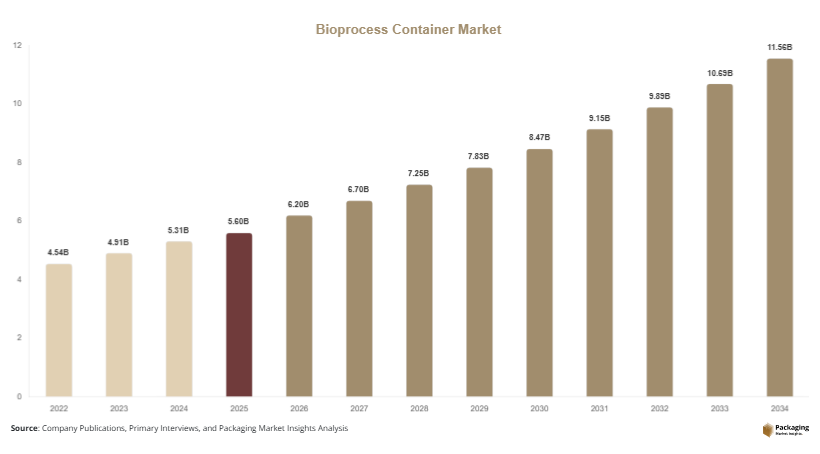
The global bioprocess container market size is estimated at USD 5.6 billion in 2025 and is projected to reach USD 6.2 billion in 2026. Over the forecast period from 2025 to 2034, the market is expected to grow at a CAGR of 8.1%, reaching approximately USD 12.4 billion by 2034. This growth reflects increasing demand for biologics, vaccines, and advanced therapies that require reliable and sterile storage and transport solutions. The bioprocess container market is expanding steadily as biopharmaceutical manufacturing transitions toward flexible, single-use systems that improve efficiency and reduce contamination risks.
One of the primary growth factors is the rapid expansion of the biopharmaceutical industry. The growing demand for monoclonal antibodies, cell and gene therapies, and biosimilars is driving the need for efficient bioprocessing systems. Bioprocess containers play a crucial role in storing, mixing, and transporting sensitive biological materials, making them essential components of modern biomanufacturing.
Key Highlights
- North America dominated the market with a 35.9% share in 2025, while Asia Pacific is projected to grow at the fastest CAGR of 9.1%.
- 2D containers led the type segment with a 42.6% share, while 3D containers are expected to grow at a CAGR of 8.7%.
- Plastic materials dominated with a 58.3% share, while advanced polymer composites are forecasted to grow at a CAGR of 8.4%.
- Biopharmaceutical applications led the segment with 64.2% share, while cell & gene therapy applications are expected to grow at a CAGR of 9.3%.
- The United States remained the dominant country with a market size of USD 1.9 billion in 2025 and USD 2.1 billion in 2026.
Explore more data points, trends and opportunities Download Free Sample Report
Market Trends
Increasing adoption of single-use bioprocessing systems
The bioprocess container market is experiencing a shift toward single-use technologies as manufacturers seek more efficient and flexible production methods. Single-use containers eliminate the need for cleaning and sterilization, reducing downtime and operational complexity. These systems are particularly useful in multi-product facilities, where cross-contamination risks must be minimized. The growing demand for biologics and personalized medicines is further driving the adoption of disposable systems, as they allow for faster production cycles and easier scalability. Manufacturers are also investing in advanced materials that enhance the durability and performance of single-use containers, making them suitable for a wide range of applications. This trend is expected to continue as the industry moves toward more agile and cost-effective manufacturing processes.
Rising focus on advanced materials and container customization
Another significant trend in the bioprocess container market is the development of advanced materials and customized container solutions. Manufacturers are designing containers with improved barrier properties, chemical resistance, and compatibility with various biopharmaceutical products. Customization is becoming increasingly important, as different processes require specific container configurations, including size, shape, and connection systems. Innovations such as multi-layer films and integrated sensors are enhancing container performance and monitoring capabilities. These advancements enable better control over bioprocessing conditions, improving product quality and consistency. As the demand for specialized therapies grows, the need for tailored container solutions is expected to increase, driving further innovation in the market.
Market Drivers
Growth in biologics and advanced therapeutic development
The increasing demand for biologics and advanced therapies is a key factor driving the bioprocess container market. Biologics, including monoclonal antibodies and vaccines, require specialized manufacturing processes that rely on sterile and reliable container systems. The rise of cell and gene therapies has further increased the need for flexible and scalable bioprocessing solutions. Bioprocess containers provide a safe and efficient way to store and transport sensitive biological materials, ensuring product integrity. As pharmaceutical companies continue to invest in research and development, the demand for high-quality bioprocessing equipment is expected to grow. This trend is particularly strong in regions with advanced healthcare infrastructure and strong biopharmaceutical industries.
Increasing need for contamination control and regulatory compliance
Strict regulatory requirements for pharmaceutical manufacturing are driving the adoption of advanced bioprocess containers. Contamination control is critical in biopharmaceutical production, as even minor impurities can affect product safety and efficacy. Bioprocess containers are designed to maintain sterility and prevent cross-contamination, making them essential for compliance with regulatory standards. The use of single-use systems further reduces contamination risks by eliminating the need for cleaning and sterilization. As regulatory agencies continue to enforce stringent quality standards, manufacturers are increasingly adopting advanced container solutions. This focus on safety and compliance is expected to support market growth over the forecast period.
Market Restraint
Concerns related to material compatibility and waste management
The bioprocess container market faces challenges related to material compatibility and environmental impact. Bioprocess containers are typically made from plastic materials, which may interact with certain biological products, affecting their stability and quality. Ensuring compatibility between container materials and various formulations requires extensive testing and validation, which can increase costs and development time. In addition, the widespread use of single-use containers generates significant plastic waste, raising environmental concerns. For example, large-scale biopharmaceutical facilities using disposable systems may produce substantial amounts of waste that require proper disposal and management. These challenges can limit adoption, particularly in regions with strict environmental regulations. While efforts are being made to develop recyclable and biodegradable materials, addressing these concerns remains a key challenge for the industry.
Market Opportunities
Expansion of biopharmaceutical manufacturing in emerging markets
Emerging economies are creating new growth opportunities for the bioprocess container market. Countries in Asia Pacific, Latin America, and the Middle East are investing in biopharmaceutical manufacturing infrastructure to meet growing healthcare demands. Government initiatives and favorable regulatory policies are encouraging the establishment of new production facilities. These developments are increasing the demand for bioprocessing equipment, including containers. The availability of cost-effective manufacturing solutions and a growing skilled workforce are further supporting market expansion in these regions. Companies that establish a strong presence in emerging markets are likely to benefit from increased demand and long-term growth opportunities.
Development of sustainable and recyclable bioprocess containers
The growing focus on sustainability is creating opportunities for innovation in the bioprocess container market. Manufacturers are exploring the use of recyclable and biodegradable materials to reduce environmental impact. Advances in material science are enabling the development of containers that maintain performance while minimizing waste. The adoption of sustainable solutions can help companies meet regulatory requirements and improve their environmental footprint. In addition, the integration of recycling programs and waste management solutions is gaining traction in the industry. As sustainability becomes a key consideration for stakeholders, the demand for eco-friendly bioprocess containers is expected to increase, providing new avenues for market growth.
Report Scope
| Report Metric | Details |
|---|---|
| Market Size in 2025 | USD 5.6 Billion |
| Market Size in 2026 | USD 6.2 Billion |
| Market Size in 2034 | USD 12.4 Billion |
| CAGR | 8.1% (2026-2034) |
| Base Year for Estimation | 2025 |
| Historical Data | 2022-2024 |
| Forecast Period | 2026-2034 |
| Report Coverage | Revenue Forecast, Competitive Landscape, Supply Chain Disruption, Growth Factors, Environment & Regulatory Landscape and Trends |
| Geographies Covered | North America, Europe, APAC, Middle East and Africa, LATAM |
| Countries Covered | U.S., Canada, U.K., Germany, France, Spain, Italy, Russia, Nordic, Benelux, Rest of Europe, China, South Korea, Japan, India, Australia, Singapore, Taiwan, South East Asia, Rest of Asia-Pacific, UAE, Turky, Saudi Arabia, South Africa, Egypt, Nigeria, Rest of MEA, Brazil, Mexico, Argentina, Chile, Colombia, Rest of LATAM |
Explore more data points, trends and opportunities Download Free Sample Report
Segmental Analysis
By Type
2D bioprocess containers dominated the bioprocess container market in 2024, accounting for approximately 42.6% of the total share. These containers are widely used for storage and transport applications due to their simple design and ease of handling. Their compatibility with various bioprocessing systems makes them a preferred choice among manufacturers.
3D bioprocess containers are expected to grow at a CAGR of 8.7% during the forecast period. These containers are designed for large-volume applications and offer enhanced flexibility and scalability. Their ability to handle complex bioprocessing requirements is driving their adoption.
By Material
Plastic materials dominated the market in 2024, accounting for 58.3% of the total share. These materials are widely used due to their flexibility, durability, and compatibility with single-use systems. They are suitable for a wide range of bioprocessing applications.
Advanced polymer composites are expected to grow at a CAGR of 8.4%. These materials offer improved performance characteristics, including better barrier properties and chemical resistance. Their adoption is increasing as manufacturers seek more reliable and efficient solutions.
By Application
Biopharmaceutical applications held the largest share of the bioprocess container market in 2024, accounting for 64.2% of the total market. The growing demand for biologics and vaccines is driving the adoption of bioprocess containers in this segment.
Cell and gene therapy applications are expected to grow at a CAGR of 9.3% during the forecast period. The increasing focus on advanced therapies is driving demand for specialized bioprocessing solutions.
Bioprocess Container Market Segmentations
By Product Type
- 2D Containers
- 3D Containers
By Application
- Biopharmaceuticals
- Cell & Gene Therapy
- Research & Development
- Others
By Material
- Plastic
- Advanced Polymer Composites
- Others
Regional Analysis
North America
North America accounted for approximately 35.9% of the bioprocess container market share in 2025 and is projected to grow at a CAGR of 7.6% during the forecast period. The region benefits from a well-established biopharmaceutical industry and strong investment in research and development. The presence of leading pharmaceutical companies and advanced healthcare infrastructure supports market growth.
The United States dominates the regional market due to its large number of biopharmaceutical manufacturing facilities. A unique growth factor is the high level of innovation in biologics and advanced therapies, which drives demand for specialized bioprocessing equipment.
Europe
Europe held a 27.4% share of the bioprocess container market in 2025 and is expected to grow at a CAGR of 7.9%. The region is characterized by strong regulatory frameworks and a focus on high-quality pharmaceutical production. These factors are encouraging the adoption of advanced bioprocessing technologies.
Germany leads the European market, supported by its strong manufacturing base and research capabilities. A unique growth factor is the region’s emphasis on biosimilar development, which requires efficient and scalable bioprocessing solutions.
Asia Pacific
Asia Pacific is projected to be the fastest-growing region, with a CAGR of 9.1% and a market share of 24.8% in 2025. The region’s growth is driven by increasing investments in biopharmaceutical manufacturing and rising healthcare demand. Rapid economic development is supporting the expansion of the pharmaceutical sector.
China is the dominant country in this region, benefiting from government support and a growing biotechnology industry. A unique growth factor is the increasing number of contract manufacturing organizations, which require advanced bioprocessing equipment.
Middle East & Africa
The Middle East & Africa region accounted for 6.5% of the bioprocess container market share in 2025 and is expected to grow at a CAGR of 8.3%. Growth is supported by increasing investments in healthcare infrastructure and pharmaceutical production. The demand for advanced bioprocessing solutions is rising steadily.
Saudi Arabia leads the regional market due to its focus on healthcare development. A unique growth factor is the expansion of local pharmaceutical manufacturing capabilities, which is driving demand for bioprocess containers.
Latin America
Latin America held a 5.4% share of the bioprocess container market in 2025 and is projected to grow at a CAGR of 8.7%. The region’s growth is driven by increasing healthcare investments and rising demand for biopharmaceutical products. The expansion of manufacturing facilities is supporting market growth.
Brazil dominates the regional market due to its growing pharmaceutical industry. A unique growth factor is the increasing adoption of modern bioprocessing technologies, which is driving demand for advanced container solutions.
Competitive Landscape
The bioprocess container market is moderately competitive, with several global players focusing on innovation and product development. Companies are investing in advanced materials and technologies to improve container performance and meet regulatory requirements. Strategic partnerships and acquisitions are common as firms aim to expand their market presence.
Thermo Fisher Scientific is recognized as a leading player in the market, known for its comprehensive portfolio of bioprocessing solutions. The company recently introduced advanced single-use container systems with improved durability and compatibility. Other players are also focusing on expanding their product offerings and enhancing manufacturing capabilities to meet growing demand.
Key Players List
- Thermo Fisher Scientific
- Sartorius AG
- Merck KGaA
- Danaher Corporation
- Avantor, Inc.
- Saint-Gobain Life Sciences
- Lonza Group
- Meissner Filtration Products
- Entegris, Inc.
- Parker Hannifin Corporation
- Corning Incorporated
- Eppendorf AG
- GE Healthcare Life Sciences
- Kuhner AG
- Charter Medical