Biopharmaceuticals Packaging Market Report Size and Growth
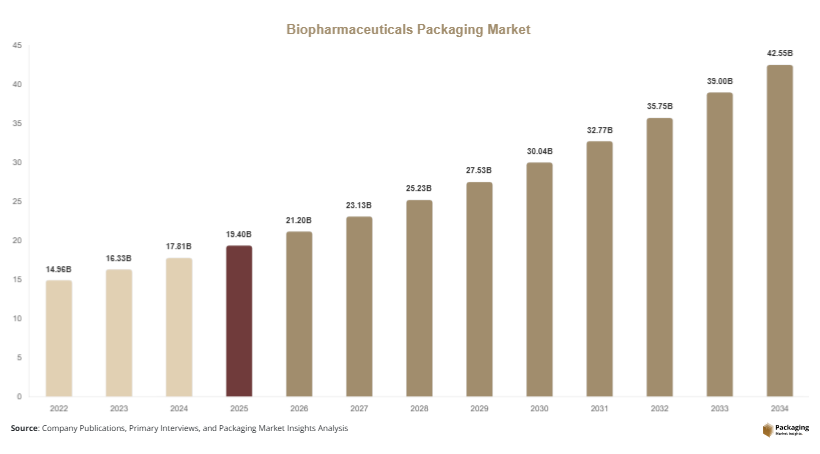
The Biopharmaceuticals Packaging Market was valued at USD 19.4 billion in 2025 and is projected to reach USD 32.7 billion by 2030, expanding at a compound annual growth rate (CAGR) of 9.1% between 2025 and 2031. The market is experiencing steady expansion as biopharmaceutical products such as monoclonal antibodies, vaccines, recombinant proteins, and gene therapies require advanced packaging systems that maintain sterility, stability, and temperature control throughout distribution.
A major global factor supporting the growth of the Biopharmaceuticals Packaging Market size is the increasing commercialization of biologic medicines. Pharmaceutical companies are expanding biologics pipelines to address chronic and rare diseases, creating demand for specialized packaging formats including prefilled syringes, vials, cartridges, and cold-chain compatible containers. In addition, stringent regulatory requirements for sterile packaging and product integrity are encouraging the adoption of high-barrier materials and advanced primary packaging solutions.
The expansion of temperature-sensitive biologic drugs has also increased the use of insulated packaging systems, active temperature-controlled containers, and protective secondary packaging. As biopharmaceutical supply chains become more globalized, manufacturers are focusing on packaging solutions that ensure stability during long-distance transportation and storage.
Technological improvements in polymer-based containers, cyclic olefin polymers, and smart tracking technologies are further shaping the Biopharmaceuticals Packaging Market growth. Packaging manufacturers are investing in automation, contamination control, and high-performance materials to meet evolving pharmaceutical industry requirements.
Key Highlights
- North America dominated the market with a 39.2% share in 2025, while Asia Pacific is expected to grow at a CAGR of 10.4%.
- Primary packaging led the packaging type segment with 56.8% share, while prefilled syringes are projected to grow at a CAGR of 10.9%.
- Plastic and polymer materials accounted for 48.6% share, while cyclic olefin polymer packaging is expected to grow at 11.2% CAGR.
- The United States led the market with USD 6.1 billion in 2025 and is estimated to reach USD 6.6 billion in 2026.
Explore more data points, trends and opportunities Download Free Sample Report
Market Trends
Expansion of Prefilled Drug Delivery Systems
One of the most significant Biopharmaceuticals Packaging Market trends is the rapid adoption of prefilled drug delivery systems. Biopharmaceutical companies are increasingly using prefilled syringes and cartridges to improve dosing accuracy and patient convenience. These systems reduce contamination risk and simplify drug administration in hospital and homecare environments.
Prefilled packaging formats are widely used for biologics such as monoclonal antibodies and vaccines that require precise dosing and sterile conditions. Pharmaceutical manufacturers are investing in polymer-based syringe barrels and advanced coatings that improve compatibility with sensitive biologic formulations. This trend is strengthening the demand for specialized packaging solutions that integrate drug delivery functionality with packaging performance.
Adoption of Cold Chain and Temperature-Controlled Packaging
Another major Biopharmaceuticals Packaging Market trend is the expansion of temperature-controlled packaging systems. Biologic drugs are highly sensitive to temperature fluctuations, making cold chain logistics critical to maintaining product stability.
Packaging companies are developing insulated containers, vacuum insulated panels, phase-change materials, and active temperature monitoring technologies. These solutions help maintain strict temperature ranges during transportation and storage. The increasing distribution of biologic medicines across global healthcare networks is encouraging pharmaceutical companies to adopt advanced cold chain packaging solutions.
Market Drivers
Rising Global Demand for Biologic Medicines
A primary driver of Biopharmaceuticals Packaging Market growth is the rising global demand for biologic therapies. Biopharmaceutical products have gained widespread adoption in the treatment of cancer, autoimmune diseases, and rare genetic disorders.
Unlike traditional small-molecule drugs, biologics are complex molecules that require sterile, high-barrier packaging to preserve their stability and efficacy. Packaging solutions must prevent contamination, protect against oxygen and moisture exposure, and maintain controlled temperatures. As pharmaceutical companies expand biologics production, demand for specialized packaging solutions is increasing significantly.
The growth of biosimilars is also contributing to packaging demand. Biosimilar manufacturers require reliable packaging systems that meet regulatory compliance while supporting large-scale drug distribution.
Expansion of Global Biopharmaceutical Manufacturing
Another key driver of the Biopharmaceuticals Packaging Market is the expansion of biopharmaceutical manufacturing capacity worldwide. Pharmaceutical companies are investing heavily in biologics production facilities across North America, Europe, and Asia.
These facilities require advanced packaging systems to support sterile filling operations and high-volume production. Packaging manufacturers are collaborating with pharmaceutical companies to develop packaging solutions compatible with automated filling systems and aseptic manufacturing environments.
The integration of automation in packaging processes is improving efficiency, reducing contamination risk, and enabling large-scale biologic drug production.
Market Restraint
High Cost of Specialized Packaging Materials
One of the primary restraints affecting the Biopharmaceuticals Packaging Market is the high cost associated with specialized packaging materials and manufacturing processes.
Biologic drugs require packaging materials that maintain sterility and chemical stability while resisting temperature variations and physical stress. Materials such as cyclic olefin polymers, high-grade glass vials, and multilayer barrier films involve higher production costs compared with conventional pharmaceutical packaging.
In addition, stringent regulatory requirements increase compliance costs for packaging manufacturers. Packaging systems must undergo extensive testing to ensure compatibility with sensitive biologic formulations and compliance with pharmaceutical regulations.
These factors raise production costs for pharmaceutical companies and may limit the adoption of advanced packaging solutions in certain emerging markets.
Despite these challenges, continuous innovation in polymer materials and manufacturing processes is gradually improving cost efficiency and enabling broader adoption of biopharmaceutical packaging technologies.
Market Opportunities
Growth of Personalized Biologic Therapies
The increasing development of personalized biologic therapies is creating new opportunities for the Biopharmaceuticals Packaging Market. Personalized medicines often require smaller batch sizes and specialized packaging formats tailored to individual patient treatments.
Packaging manufacturers are developing flexible packaging systems that support customized dosing, secure transport, and sterile drug delivery. As personalized medicine becomes more common, demand for adaptable packaging solutions will increase.
Integration of Smart Packaging Technologies
Another emerging opportunity in the Biopharmaceuticals Packaging Market is the integration of smart packaging technologies. Pharmaceutical companies are adopting digital monitoring solutions to improve drug traceability and temperature monitoring throughout the supply chain.
Smart packaging solutions incorporate sensors, RFID tags, and temperature indicators that help track drug integrity during transportation. These technologies improve supply chain visibility and ensure compliance with regulatory requirements.
The integration of digital monitoring tools within packaging systems is expected to enhance product safety and create new value-added services for pharmaceutical manufacturers.
Report Scope
| Report Metric | Details |
|---|---|
| Market Size in 2025 | USD 19.4 Billion |
| Market Size in 2026 | USD 21.2 Billion |
| Market Size in 2034 | USD 32.7 Billion |
| CAGR | 9.1% (2026-2034) |
| Base Year for Estimation | 2025 |
| Historical Data | 2022-2024 |
| Forecast Period | 2026-2034 |
| Report Coverage | Revenue Forecast, Competitive Landscape, Supply Chain Disruption, Growth Factors, Environment & Regulatory Landscape and Trends |
| Geographies Covered | North America, Europe, APAC, Middle East and Africa, LATAM |
| Countries Covered | U.S., Canada, U.K., Germany, France, Spain, Italy, Russia, Nordic, Benelux, Rest of Europe, China, South Korea, Japan, India, Australia, Singapore, Taiwan, South East Asia, Rest of Asia-Pacific, UAE, Turky, Saudi Arabia, South Africa, Egypt, Nigeria, Rest of MEA, Brazil, Mexico, Argentina, Chile, Colombia, Rest of LATAM |
Explore more data points, trends and opportunities Download Free Sample Report
Segmental Analysis
By Packaging Type
Primary packaging dominated the Biopharmaceuticals Packaging Market in 2024 and accounted for 56.8% of the total market share. Primary packaging systems such as vials, syringes, cartridges, and ampoules directly contain biopharmaceutical products and play a crucial role in maintaining sterility and product stability.
Glass vials were widely used due to their chemical inertness and compatibility with biologic formulations. Pharmaceutical manufacturers relied heavily on high-quality borosilicate glass packaging to prevent interactions with sensitive drug molecules.
Prefilled syringes will represent the fastest-growing subsegment with a projected CAGR of 10.9% during the forecast period. Their growth will be driven by increasing demand for convenient drug administration systems and improved patient safety. Pharmaceutical companies will adopt prefilled systems that simplify dosing and reduce contamination risks.
By Material
Plastic and polymer materials accounted for 48.6% share of the Biopharmaceuticals Packaging Market in 2024. Polymer-based containers offer lightweight construction, design flexibility, and high durability compared with traditional glass packaging.
Common materials used in biopharmaceutical packaging include polyethylene, polypropylene, and cyclic olefin polymers. These materials provide excellent moisture resistance and compatibility with automated packaging systems.
Cyclic olefin polymer packaging will grow at a CAGR of 11.2% during the forecast period. This material offers superior transparency, chemical resistance, and break resistance. Pharmaceutical companies will increasingly adopt polymer packaging solutions to reduce shipping risks and improve drug stability.
By Drug Type
Monoclonal antibodies represented the dominant drug type segment with 41.3% share in 2024. These biologic therapies require sterile packaging systems capable of maintaining product integrity during storage and distribution.
Biopharmaceutical manufacturers relied heavily on glass vials and prefilled syringes for monoclonal antibody packaging. The widespread adoption of monoclonal antibody treatments for oncology and autoimmune diseases contributed to the large share of this segment.
Gene therapies will represent the fastest-growing drug type segment with a projected CAGR of 12.1%. Gene therapy products require specialized packaging that maintains ultra-low temperature conditions and prevents contamination. Packaging manufacturers will develop advanced containers designed specifically for gene therapy transportation.
Biopharmaceuticals Packaging Market Segmentations
By Packaging Type
- Primary Packaging
- Secondary Packaging
- Tertiary Packaging
By Material
- Glass
- Plastic & Polymers
- Metal
- Others
By Drug Type
- Monoclonal Antibodies
- Vaccines
- Recombinant Proteins
- Cell & Gene Therapies
By End-Use
- Pharmaceutical Companies
- Biotechnology Companies
- Contract Manufacturing Organizations
Regional Analysis
North America
North America accounted for 39.2% of the Biopharmaceuticals Packaging Market share in 2025. The region’s market expansion was driven by the presence of large biopharmaceutical companies, advanced healthcare infrastructure, and high demand for biologic drugs. The region will expand at a CAGR of 8.7% between 2025 and 2033 as pharmaceutical companies continue investing in biologics manufacturing and distribution networks.
The United States dominated the regional market due to its strong pharmaceutical research ecosystem and large biologics pipeline. The country hosts numerous biotechnology companies that focus on developing monoclonal antibodies, gene therapies, and vaccines. Pharmaceutical manufacturers in the U.S. are increasingly adopting advanced packaging solutions to meet stringent regulatory requirements for sterile drug packaging and cold chain distribution.
Europe
Europe represented 27.4% of the Biopharmaceuticals Packaging Market size in 2025. Growth in the region was supported by strong pharmaceutical manufacturing capabilities and government support for biotechnology research. The European market will grow at a CAGR of 8.5% during the forecast period as demand for biologic medicines continues to rise.
Germany emerged as the dominant country in the region due to its well-established pharmaceutical manufacturing infrastructure. German pharmaceutical companies are investing in advanced packaging technologies that support biologic drug stability and compliance with strict pharmaceutical quality standards.
Asia Pacific
Asia Pacific held 21.8% share of the global Biopharmaceuticals Packaging Market in 2025. The region will register the fastest growth rate of 10.4% during the forecast period. Rapid expansion of pharmaceutical manufacturing facilities and rising healthcare demand are supporting market growth.
China dominated the regional market due to the rapid development of its biotechnology industry. The country has significantly increased investments in biologics research and manufacturing. Pharmaceutical companies in China are expanding their packaging capabilities to support large-scale biologic drug production and export.
Middle East & Africa
The Middle East & Africa accounted for 6.1% of the Biopharmaceuticals Packaging Market share in 2025. The regional market will grow at a CAGR of 7.9% between 2025 and 2033 as healthcare infrastructure and pharmaceutical manufacturing capacity improve.
The United Arab Emirates emerged as a key country in the region due to its investments in healthcare infrastructure and pharmaceutical distribution hubs. The country is developing advanced logistics networks that support temperature-controlled transportation of biologic drugs.
Latin America
Latin America held 5.5% of the global Biopharmaceuticals Packaging Market in 2025. The region will expand at a CAGR of 7.8% during the forecast period as pharmaceutical demand increases.
Brazil dominated the regional market due to its large pharmaceutical industry and growing demand for biologic therapies. Pharmaceutical companies in Brazil are investing in packaging solutions that support cold chain logistics and improve drug distribution efficiency.
Competitive Landscape
The Biopharmaceuticals Packaging Market is characterized by the presence of global packaging manufacturers and pharmaceutical packaging specialists. Companies focus on innovation, material development, and strategic partnerships with pharmaceutical manufacturers to strengthen their market position.
Schott AG remains a leading market participant due to its extensive portfolio of pharmaceutical glass packaging products. The company recently introduced advanced borosilicate glass vials designed for biologic drug compatibility and improved break resistance.
Other key companies such as Gerresheimer AG, West Pharmaceutical Services, Berry Global, and Amcor plc continue investing in polymer-based packaging solutions and prefilled drug delivery systems.
Market participants are also focusing on sustainability initiatives and automation technologies to enhance packaging efficiency and reduce environmental impact.
Key Players in the Biopharmaceuticals Packaging Market
- Schott AG
- Gerresheimer AG
- West Pharmaceutical Services Inc.
- Amcor plc
- Berry Global Inc.
- AptarGroup Inc.
- SGD Pharma
- Nipro Corporation
- Catalent Inc.
- Becton Dickinson and Company
- Stevanato Group
- DWK Life Sciences
- WestRock Company
- Ompi (Stevanato Group)
- Piramal Glass