Biologics CDMO Secondary Packaging Market Size and Growth
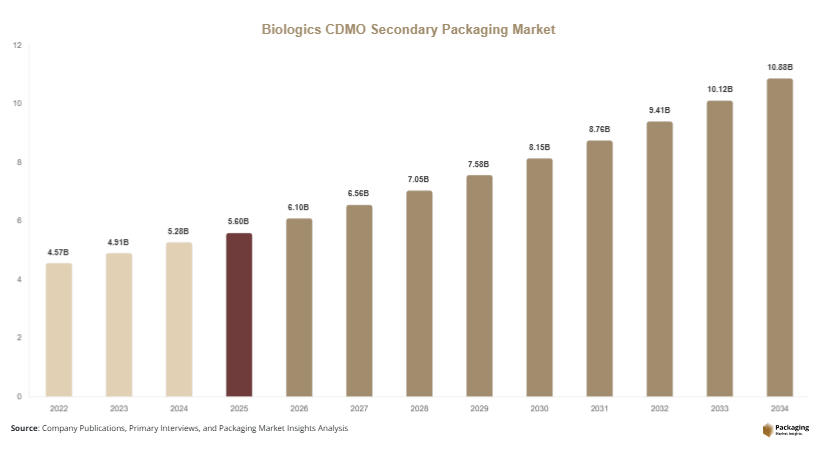
The biologics CDMO secondary packaging market size was valued at approximately USD 5.6 billion in 2025 and is expected to reach USD 6.1 billion in 2026, with projections indicating expansion to nearly USD 10.9 billion by 2034, reflecting a CAGR of 7.5% during 2025–2034. Secondary packaging for biologics involves labeling, cartoning, serialization, and protective packaging, which are critical for maintaining product integrity and regulatory compliance. The biologics CDMO secondary packaging market is experiencing steady growth as pharmaceutical companies increasingly outsource packaging operations to contract development and manufacturing organizations (CDMOs).
A major growth factor for the biologics CDMO secondary packaging market is the rapid increase in biologics production. Biologics, including monoclonal antibodies, vaccines, and gene therapies, require specialized handling and packaging to preserve their stability. As demand for these therapies rises, pharmaceutical companies are turning to CDMOs for efficient and compliant packaging solutions. This trend is driving market growth and encouraging innovation in packaging technologies.
Key Highlights:
- Asia Pacific dominated the market with a 36.8% share in 2025, while Latin America is projected to grow at the fastest CAGR of 7.8%.
- Cartons led the type segment with a 31.4% share, while smart packaging solutions are expected to grow at a CAGR of 8.2%.
- Plastic packaging dominated with a 48.9% share, while paper-based packaging is forecasted to grow at a CAGR of 7.1%.
- Biopharmaceutical applications led the segment with 52.6% share, while cell and gene therapy packaging is expected to grow at a CAGR of 8.5%.
- The United States remained the dominant country with a market size of USD 1.3 billion in 2025 and USD 1.4 billion in 2026.
Explore more data points, trends and opportunities Download Free Sample Report
Market Trends
Increasing Adoption of Smart and Track-and-Trace Packaging Solutions
The biologics CDMO secondary packaging market is witnessing a strong shift toward smart packaging technologies that enable real-time tracking and monitoring of biologics. Serialization, barcoding, and RFID-enabled solutions are being widely adopted to ensure product authenticity and prevent counterfeiting. These technologies provide end-to-end visibility across the supply chain, helping pharmaceutical companies comply with regulatory requirements. In addition, smart packaging enhances patient safety by ensuring that products are stored and transported under appropriate conditions. As the demand for secure and traceable packaging increases, CDMOs are investing in advanced technologies to offer integrated solutions.
Growing Emphasis on Sustainable Packaging Materials
Sustainability is becoming a key focus in the biologics CDMO secondary packaging market, with companies seeking to reduce environmental impact. There is a growing shift toward recyclable and biodegradable materials in secondary packaging. CDMOs are developing innovative solutions that maintain product protection while minimizing waste. This trend is driven by regulatory pressure and increasing awareness among consumers and stakeholders. The adoption of sustainable packaging is also helping companies enhance their brand image and meet corporate sustainability goals. As environmental concerns continue to grow, the demand for eco-friendly packaging solutions is expected to increase.
Market Drivers
Expansion of Biologics and Biosimilars Production
The rapid growth of biologics and biosimilars production is a major driver of the biologics CDMO secondary packaging market. These therapies are increasingly being used to treat complex diseases, leading to higher demand for specialized packaging solutions. CDMOs play a critical role in providing efficient and compliant packaging services. The increasing number of biologics in development pipelines is further supporting market growth. As pharmaceutical companies continue to invest in biologics, the demand for secondary packaging services is expected to rise significantly.
Increasing Outsourcing by Pharmaceutical Companies
Pharmaceutical companies are increasingly outsourcing packaging operations to CDMOs to reduce costs and improve efficiency. Outsourcing allows companies to focus on core competencies such as research and development while leveraging the expertise of CDMOs. This trend is particularly evident in secondary packaging, where specialized knowledge and infrastructure are required. The growing complexity of packaging requirements is driving the demand for outsourcing services. As a result, the biologics CDMO secondary packaging market is experiencing steady growth.
Market Restraint
Stringent Regulatory Requirements and Compliance Challenges
One of the major restraints in the biologics CDMO secondary packaging market is the complexity of regulatory requirements. Compliance with international standards and guidelines can be challenging for CDMOs and pharmaceutical companies. These regulations often require significant investment in technology and infrastructure. For example, serialization and track-and-trace systems must meet specific standards, which can increase operational costs. Additionally, frequent updates to regulatory requirements can create uncertainty and require continuous adaptation. This can slow down market growth and limit the adoption of new packaging solutions, particularly for smaller players with limited resources.
Market Opportunities
Growth of Personalized Medicine and Specialty Therapies
The increasing focus on personalized medicine is creating new opportunities for the biologics CDMO secondary packaging market. Customized therapies require flexible packaging solutions that can accommodate small batch sizes and unique requirements. CDMOs are well-positioned to provide these services, offering tailored solutions to meet the needs of pharmaceutical companies. As the demand for personalized medicine continues to grow, the need for advanced secondary packaging solutions is expected to increase.
Expansion in Emerging Markets
Emerging markets are offering significant growth opportunities for the biologics CDMO secondary packaging market. Countries in Asia Pacific, Latin America, and the Middle East are witnessing growth in pharmaceutical manufacturing and healthcare infrastructure. This is driving demand for packaging services, including secondary packaging. CDMOs are expanding their presence in these regions to capitalize on growing demand. As healthcare access improves and pharmaceutical production increases, the market is expected to experience strong growth.
Report Scope
| Report Metric | Details |
|---|---|
| Market Size in 2025 | USD 5.6 Billion |
| Market Size in 2026 | USD 6.1 Billion |
| Market Size in 2034 | USD 10.9 Billion |
| CAGR | 7.5% (2026-2034) |
| Base Year for Estimation | 2025 |
| Historical Data | 2022-2024 |
| Forecast Period | 2026-2034 |
| Report Coverage | Revenue Forecast, Competitive Landscape, Supply Chain Disruption, Growth Factors, Environment & Regulatory Landscape and Trends |
| Geographies Covered | North America, Europe, APAC, Middle East and Africa, LATAM |
| Countries Covered | U.S., Canada, U.K., Germany, France, Spain, Italy, Russia, Nordic, Benelux, Rest of Europe, China, South Korea, Japan, India, Australia, Singapore, Taiwan, South East Asia, Rest of Asia-Pacific, UAE, Turky, Saudi Arabia, South Africa, Egypt, Nigeria, Rest of MEA, Brazil, Mexico, Argentina, Chile, Colombia, Rest of LATAM |
Explore more data points, trends and opportunities Download Free Sample Report
Segmental Analysis
By Type
Cartons dominated the biologics CDMO secondary packaging market in 2024, accounting for approximately 31.4% of the total market share. Cartons are widely used due to their versatility, cost-effectiveness, and ability to provide protection during transportation. They are suitable for a wide range of biologic products, including vials and syringes. The increasing demand for standardized packaging solutions is supporting the growth of this segment. Additionally, advancements in printing and labeling technologies are enhancing the functionality of cartons, making them more suitable for regulatory compliance.
Smart packaging solutions are expected to grow at the fastest CAGR of 8.2% during the forecast period. These solutions incorporate technologies such as RFID and sensors to provide real-time monitoring and tracking. The growing need for product safety and traceability is driving the adoption of smart packaging. As regulatory requirements become more stringent, the demand for advanced packaging solutions is expected to increase.
By Material
Plastic materials accounted for the largest share of the biologics CDMO secondary packaging market in 2024, at approximately 48.9%. Plastic-based packaging solutions are widely used due to their durability and flexibility. They provide effective protection for biologics during transportation and storage. The widespread use of plastic materials in pharmaceutical packaging is supporting the growth of this segment. Additionally, innovations in polymer technology are improving the performance of plastic packaging solutions.
Paper-based packaging is projected to grow at the fastest CAGR of 7.1% during the forecast period. The increasing focus on sustainability is driving the adoption of paper-based materials. These materials are recyclable and biodegradable, making them an attractive option for environmentally conscious companies. As regulatory pressure increases, the demand for sustainable packaging solutions is expected to rise.
By End-Use
Biopharmaceutical applications dominated the market in 2024 with a share of approximately 52.6%. The need for specialized packaging solutions for biologics is driving demand in this segment. Secondary packaging plays a critical role in ensuring product safety and compliance. The growth of the biopharmaceutical industry is further supporting this trend.
Cell and gene therapy packaging is expected to grow at the fastest CAGR of 8.5%. These therapies require highly specialized packaging solutions due to their complexity and sensitivity. The increasing adoption of advanced therapies is driving demand for innovative packaging solutions. As the field of cell and gene therapy continues to evolve, the demand for specialized packaging is expected to increase.
Biologics CDMO Secondary Packaging Market Segmentations
By Type
- Cartons
- Labels
- Inserts & Leaflets
- Smart Packaging
By Material
- Plastic
- Paper & Paperboard
- Metal
By End-Use
- Biopharmaceutical
- Cell & Gene Therapy
- Clinical Trials
Regional Analysis
North America
North America accounted for approximately 34.2% of the biologics CDMO secondary packaging market share in 2025 and is projected to grow at a CAGR of 7.2% during the forecast period. The region benefits from a well-established pharmaceutical industry and advanced healthcare infrastructure. The increasing demand for biologics and biosimilars is driving the adoption of secondary packaging services.
The United States dominates the regional market due to its strong presence of pharmaceutical companies and CDMOs. A unique growth factor is the high level of investment in biologics research and development, which is driving demand for advanced packaging solutions. This trend is expected to support market growth.
Europe
Europe held a market share of around 27.6% in 2025 and is expected to grow at a CAGR of 7.1%. The region is characterized by strict regulatory standards and a focus on quality and safety in pharmaceutical packaging.
Germany leads the European market due to its strong pharmaceutical manufacturing base. A unique growth factor is the increasing adoption of sustainable packaging solutions, which is driving innovation in secondary packaging. This is expected to boost market growth.
Asia Pacific
Asia Pacific dominated the market with a 36.8% share in 2025 and is expected to grow at the highest CAGR of 7.8%. Rapid industrialization and expanding pharmaceutical production are key drivers in this region.
China is the leading country in the region due to its large manufacturing capacity. A unique growth factor is the expansion of contract manufacturing services, which is driving demand for secondary packaging solutions. This is supporting market growth.
Middle East & Africa
The Middle East & Africa region accounted for approximately 5.4% of the market share in 2025 and is projected to grow at a CAGR of 6.9%. The growth is supported by increasing investments in healthcare infrastructure.
Saudi Arabia is a key contributor to the regional market. A unique growth factor is the development of local pharmaceutical manufacturing capabilities, which is driving demand for packaging services. This is expected to boost market growth.
Latin America
Latin America held a market share of around 6.0% in 2025 and is expected to grow at the fastest CAGR of 7.8%. The region is witnessing growth in pharmaceutical manufacturing and healthcare services.
Brazil dominates the regional market due to its expanding pharmaceutical industry. A unique growth factor is the increasing adoption of outsourcing services, which is driving demand for CDMO packaging solutions. This trend is expected to support market growth.
Competitive Landscape
The biologics CDMO secondary packaging market is characterized by the presence of several global and regional players focusing on innovation and service expansion. Companies are investing in advanced technologies to enhance packaging efficiency and compliance. The market is moderately competitive, with players adopting strategies such as partnerships and acquisitions to strengthen their position.
Catalent Inc. is recognized as a leading player due to its comprehensive service offerings and global presence. The company recently expanded its packaging capabilities to support biologics, highlighting its focus on meeting growing demand. Other players are also investing in similar initiatives to remain competitive.
Key Players List
- Catalent Inc.
- Lonza Group
- Thermo Fisher Scientific Inc.
- Recipharm AB
- PCI Pharma Services
- Sharp Packaging Services
- West Pharmaceutical Services
- Almac Group
- Vetter Pharma International
- Baxter BioPharma Solutions
- Siegfried Holding AG
- Boehringer Ingelheim BioXcellence
- Samsung Biologics
- Jubilant HollisterStier
- Rentschler Biopharma