Biodegradable Plastics Market Size and Growth
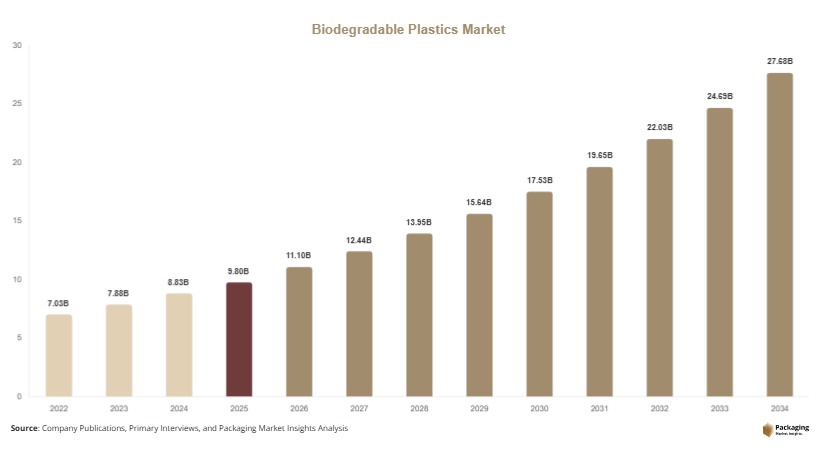
The global biodegradable plastics market size was valued at approximately USD 9.8 billion in 2025 and is expected to reach USD 11.1 billion in 2026, progressing to nearly USD 27.6 billion by 2034, expanding at a CAGR of 12.1% from 2025 to 2034. This growth trajectory reflects increasing environmental awareness, regulatory pressure on conventional plastics, and rising demand for sustainable alternatives across multiple industries. The biodegradable plastics market is gaining strong momentum as industries and governments shift toward environmentally sustainable materials to reduce plastic waste and carbon emissions.
One of the key growth factors influencing the market is the global push toward reducing single-use plastics. Governments across regions are implementing bans and restrictions on traditional plastic products, encouraging the adoption of biodegradable materials. Another important factor is the growing demand from the packaging industry, which is transitioning toward eco-friendly solutions to meet consumer expectations and regulatory standards. Additionally, advancements in polymer science and material engineering are enhancing the performance characteristics of biodegradable plastics, making them more viable for diverse applications.
Key Highlights:
- Asia Pacific dominated the market with a 36.8% share in 2025, while Latin America is projected to grow at the fastest CAGR of 13.4%.
- Polylactic acid led the type segment with a 31.2% share, while polyhydroxyalkanoates are expected to grow at a CAGR of 13.9%.
- Packaging applications dominated with a 48.6% share, while agriculture applications are forecasted to grow at a CAGR of 12.8%.
- Food & beverage end-use led the segment with 41.5% share, while healthcare is expected to grow at a CAGR of 13.2%.
- China remained the dominant country with a market size of USD 2.1 billion in 2025 and USD 2.4 billion in 2026.
Explore more data points, trends and opportunities Download Free Sample Report
Market Trends
Increasing integration of biodegradable plastics in flexible packaging solutions
The growing demand for sustainable packaging is driving the adoption of biodegradable plastics in flexible packaging applications. Manufacturers are increasingly replacing conventional plastic films with biodegradable alternatives to reduce environmental impact. These materials are being used in food packaging, retail bags, and e-commerce packaging solutions. Flexible packaging offers advantages such as lightweight structure, cost efficiency, and extended shelf life, making it suitable for various industries. As consumer awareness regarding plastic pollution rises, brands are focusing on eco-friendly packaging options to maintain competitiveness. This shift is encouraging innovation in biodegradable polymers, leading to improved strength, durability, and barrier properties.
Rising adoption of bio-based polymers in industrial and consumer applications
The use of bio-based biodegradable plastics is expanding across industries such as automotive, textiles, and consumer goods. These materials are derived from renewable resources such as corn starch, sugarcane, and cellulose, reducing dependence on fossil fuels. Companies are incorporating biodegradable plastics into products like disposable cutlery, packaging containers, and agricultural films. This trend is supported by increasing investments in bio-refineries and sustainable material production. Additionally, advancements in material blending and processing technologies are improving the functionality of biodegradable plastics, enabling their use in high-performance applications. This shift toward bio-based materials is expected to influence long-term market growth.
Market Drivers
Growing regulatory pressure to reduce plastic waste and carbon footprint
Governments worldwide are introducing policies and regulations aimed at minimizing plastic waste and promoting sustainable materials. Bans on single-use plastics and strict waste management regulations are encouraging industries to adopt biodegradable plastics. These materials decompose naturally under specific conditions, reducing environmental impact compared to conventional plastics. Regulatory frameworks are also supporting research and development activities, leading to innovation in biodegradable materials. Companies are aligning their operations with environmental standards to maintain compliance and enhance brand reputation. This regulatory environment is playing a significant role in driving the adoption of biodegradable plastics across various sectors.
Increasing demand from packaging and food service industries
The packaging industry is one of the largest consumers of biodegradable plastics, driven by the need for sustainable and recyclable materials. Food service providers are adopting biodegradable packaging solutions such as containers, cups, and cutlery to meet consumer expectations and regulatory requirements. The rise of takeaway and delivery services has further increased demand for eco-friendly packaging. Biodegradable plastics offer advantages such as reduced environmental impact and compatibility with composting systems. This demand is encouraging manufacturers to expand production capacities and develop innovative solutions, supporting overall market growth.
Market Restraint
High production costs and limited industrial composting infrastructure
The relatively high cost of biodegradable plastics compared to conventional plastics remains a significant challenge for market growth. Production processes for biodegradable polymers often require specialized raw materials and advanced technologies, leading to higher manufacturing costs. This cost difference can limit adoption, particularly in price-sensitive markets. Additionally, the effectiveness of biodegradable plastics depends on proper disposal and composting conditions. In many regions, the lack of industrial composting facilities hinders the decomposition process, reducing the environmental benefits of these materials. For example, biodegradable packaging may end up in landfills where conditions are not suitable for decomposition, limiting its effectiveness. These challenges highlight the need for improved infrastructure and cost optimization to support widespread adoption.
Market Opportunities
Expansion of biodegradable plastics in agricultural applications
The agricultural sector presents significant opportunities for biodegradable plastics, particularly in applications such as mulch films, plant pots, and seed coatings. These materials decompose naturally in soil, reducing the need for removal and disposal. This feature helps farmers lower labor costs and minimize environmental impact. The increasing focus on sustainable farming practices and soil health is driving demand for biodegradable agricultural products. Governments and agricultural organizations are promoting the use of eco-friendly materials, further supporting market growth. As awareness increases, biodegradable plastics are expected to gain traction in this sector.
Advancements in material science and large-scale production capabilities
Technological advancements are creating new opportunities in the biodegradable plastics market. Innovations in polymer chemistry are improving the performance characteristics of biodegradable materials, including strength, flexibility, and thermal resistance. These improvements are enabling their use in a wider range of applications. Additionally, the development of large-scale production facilities is helping reduce manufacturing costs and improve supply chain efficiency. Companies are investing in automation and advanced processing technologies to enhance productivity. These advancements are expected to make biodegradable plastics more accessible and competitive, driving market expansion.
Report Scope
| Report Metric | Details |
|---|---|
| Market Size in 2025 | USD 9.8 Billion |
| Market Size in 2026 | USD 11.1 Billion |
| Market Size in 2034 | USD 27.6 Billion |
| CAGR | 12.1% (2026-2034) |
| Base Year for Estimation | 2025 |
| Historical Data | 2022-2024 |
| Forecast Period | 2026-2034 |
| Report Coverage | Revenue Forecast, Competitive Landscape, Supply Chain Disruption, Growth Factors, Environment & Regulatory Landscape and Trends |
| Geographies Covered | North America, Europe, APAC, Middle East and Africa, LATAM |
| Countries Covered | U.S., Canada, U.K., Germany, France, Spain, Italy, Russia, Nordic, Benelux, Rest of Europe, China, South Korea, Japan, India, Australia, Singapore, Taiwan, South East Asia, Rest of Asia-Pacific, UAE, Turky, Saudi Arabia, South Africa, Egypt, Nigeria, Rest of MEA, Brazil, Mexico, Argentina, Chile, Colombia, Rest of LATAM |
Explore more data points, trends and opportunities Download Free Sample Report
Segmental Analysis
By Type
Polylactic acid dominated the biodegradable plastics market with a share of 31.2% in 2024, driven by its wide range of applications and favorable properties. PLA is derived from renewable resources such as corn starch and sugarcane, making it an environmentally friendly alternative to conventional plastics. It is widely used in packaging, textiles, and consumer goods due to its transparency, strength, and biodegradability. The increasing demand for sustainable packaging solutions is significantly contributing to the growth of this segment. Additionally, advancements in PLA processing technologies are improving its performance characteristics, enabling its use in more complex applications.
Polyhydroxyalkanoates are expected to witness the fastest growth, registering a CAGR of 13.9% during the forecast period. PHAs are biodegradable polymers produced by microbial fermentation, offering excellent biodegradability and biocompatibility. These materials are gaining popularity in applications such as medical devices, packaging, and agriculture. The growing focus on reducing environmental impact and the development of cost-effective production methods are driving the adoption of PHAs. Additionally, increasing research and development activities are enhancing the properties of these materials, supporting their market growth.
By Application
Packaging accounted for the largest share of 48.6% in 2024, driven by the increasing demand for sustainable packaging solutions across various industries. Biodegradable plastics are widely used in food packaging, shopping bags, and protective packaging due to their environmental benefits. The growing awareness of plastic pollution and regulatory restrictions on conventional plastics are encouraging the adoption of biodegradable materials. Additionally, the expansion of e-commerce and retail sectors is increasing the demand for eco-friendly packaging solutions, supporting segment growth.
Agriculture applications are expected to grow at a CAGR of 12.8% during the forecast period. Biodegradable plastics are used in mulch films, plant pots, and irrigation systems, offering benefits such as reduced environmental impact and improved soil health. The increasing focus on sustainable farming practices and the need to reduce agricultural waste are driving the adoption of biodegradable materials. Additionally, government support and subsidies for eco-friendly agricultural products are contributing to the growth of this segment.
By End-Use
Food and beverage end-use dominated the market with a share of 41.5% in 2024, driven by the increasing demand for sustainable packaging solutions. Biodegradable plastics are widely used in packaging applications such as containers, films, and cutlery. The growing awareness of environmental issues and the need to reduce plastic waste are encouraging the adoption of these materials. Additionally, the rise of takeaway and delivery services is increasing demand for eco-friendly packaging solutions, supporting segment growth.
Healthcare is expected to be the fastest-growing end-use segment, registering a CAGR of 13.2% during the forecast period. Biodegradable plastics are used in medical applications such as sutures, implants, and drug delivery systems due to their biocompatibility and ability to degrade naturally. The increasing focus on sustainable healthcare solutions and advancements in medical technology are driving the adoption of biodegradable materials. Additionally, regulatory support for eco-friendly medical products is contributing to the growth of this segment.
Biodegradable Plastics Market Segmentations
By Type
- Polylactic Acid (PLA)
- Polyhydroxyalkanoates (PHA)
- Starch Blends
- Others
By Application
- Packaging
- Agriculture
- Textiles
- Consumer Goods
By End-Use
- Food & Beverage
- Healthcare
- Agriculture
- Retail
Regional Analysis
North America
North America accounted for approximately 23.5% of the global biodegradable plastics market share in 2025 and is expected to grow at a CAGR of 11.2% during the forecast period. The region’s growth is driven by increasing environmental awareness and strong regulatory support for sustainable materials. The demand for biodegradable plastics is rising across industries such as packaging, agriculture, and consumer goods. Additionally, the presence of advanced manufacturing technologies and established supply chains is supporting market expansion.
The United States dominates the North American market due to its large consumer base and strong focus on sustainability initiatives. A key growth factor in the region is the increasing adoption of biodegradable packaging by major retail and food service companies. These organizations are implementing sustainability strategies to reduce their environmental footprint, which is driving demand for biodegradable plastics.
Europe
Europe held a market share of around 25.4% in 2025 and is projected to grow at a CAGR of 11.8%. The region is characterized by strict environmental regulations and a strong commitment to reducing plastic waste. The European Union’s policies on single-use plastics and recycling are encouraging the adoption of biodegradable materials. The packaging industry is a major contributor to market growth, with increasing demand for eco-friendly solutions.
Germany leads the European market due to its strong industrial base and advanced recycling infrastructure. A unique growth factor is the widespread adoption of compostable packaging solutions in the food and retail sectors. This trend is supported by government initiatives and consumer awareness, which are driving the use of biodegradable plastics across various applications.
Asia Pacific
Asia Pacific dominated the global market with a share of 36.8% in 2025 and is expected to grow at a CAGR of 12.9%. Rapid industrialization, urbanization, and population growth are driving demand for sustainable materials in the region. The expansion of the packaging and agriculture industries is further supporting market growth. Additionally, increasing government initiatives to reduce plastic pollution are encouraging the adoption of biodegradable plastics.
China is the leading country in the region, supported by its large manufacturing capacity and growing demand for eco-friendly materials. A major growth factor is the government’s strict regulations on plastic waste, which are driving industries to adopt biodegradable alternatives. This regulatory support is significantly contributing to market expansion.
Middle East & Africa
The Middle East & Africa region accounted for a market share of 6.7% in 2025 and is expected to grow at a CAGR of 12.3%. The region is experiencing increasing demand for sustainable materials due to rising environmental concerns and government initiatives. The packaging and agriculture sectors are key contributors to market growth. Additionally, improvements in infrastructure and industrial development are supporting the adoption of biodegradable plastics.
Saudi Arabia is a dominant country in this region, driven by its focus on sustainability and economic diversification. A unique growth factor is the increasing investment in eco-friendly manufacturing processes and materials. These investments are enhancing production capabilities and supporting the adoption of biodegradable plastics across industries.
Latin America
Latin America held a market share of 7.6% in 2025 and is projected to grow at the fastest CAGR of 13.4%. The region’s growth is driven by increasing awareness of environmental issues and the need for sustainable solutions. The packaging industry is a major driver, with growing demand for biodegradable materials in food and beverage applications. Additionally, government initiatives to reduce plastic waste are supporting market expansion.
Brazil is the leading country in Latin America, supported by its large agricultural sector and growing consumer base. A key growth factor is the increasing adoption of biodegradable agricultural products such as mulch films and plant containers. This trend is contributing to the overall growth of the biodegradable plastics market in the region.
Competitive Landscape
The biodegradable plastics market is characterized by the presence of several global and regional players focusing on innovation, sustainability, and capacity expansion. Companies are investing in research and development to improve material performance and reduce production costs. Strategic partnerships, mergers, and acquisitions are also common as companies aim to strengthen their market position and expand their product portfolios.
NatureWorks LLC is considered a leading player in the market due to its strong presence in the production of polylactic acid. The company recently expanded its manufacturing capacity to meet increasing global demand for biodegradable plastics. Other key players are focusing on developing advanced materials and enhancing production efficiency to remain competitive. Sustainability initiatives, including the use of renewable resources and reduction of carbon emissions, are also a major focus area for market participants.
Key Players List
- NatureWorks LLC
- BASF SE
- TotalEnergies Corbion
- Mitsubishi Chemical Group
- Novamont S.p.A.
- Danimer Scientific
- Biome Bioplastics
- Plantic Technologies
- Toray Industries Inc.
- FKuR Kunststoff GmbH
- Green Dot Bioplastics
- Yield10 Bioscience
- Bio-on S.p.A.
- NaturePlast
- Corbion N.V.