Biodegradable Milk Packaging Market Size and Growth
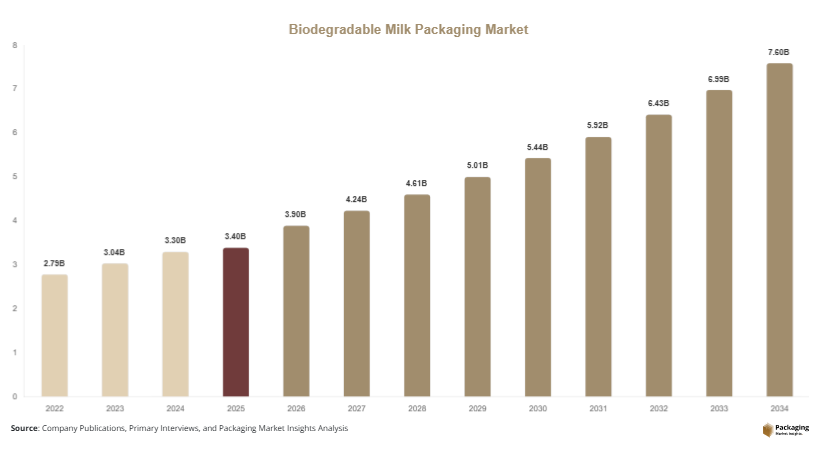
The global Biodegradable Milk Packaging Market size was estimated at USD 3.4 billion in 2025 and is projected to reach USD 3.9 billion in 2026, reflecting early-stage adoption across developed and emerging economies. Over the forecast period from 2025 to 2034, the market is expected to grow at a compound annual growth rate (CAGR) of 8.7%, reaching approximately USD 7.6 billion by 2034. This growth trajectory is supported by evolving regulatory frameworks, changing consumer preferences, and technological advancements in biodegradable materials. The biodegradable milk packaging market is gaining steady traction as sustainability becomes a core priority across the dairy value chain.
One of the primary growth factors is the increasing global focus on reducing plastic waste. Governments and regulatory bodies are implementing stricter policies targeting single-use plastics, pushing dairy manufacturers to adopt eco-friendly alternatives. Biodegradable packaging materials such as polylactic acid (PLA), paperboard composites, and starch-based polymers are gaining prominence as viable substitutes for conventional plastic milk containers.
Key Highlights:
- Market size reached USD 3.4 billion in 2025 and is projected to reach USD 7.6 billion by 2034
- Expected CAGR of 8.7% during the forecast period (2025–2034)
- Increasing regulatory pressure on plastic packaging waste
- Rising consumer preference for eco-friendly and sustainable packaging
- Advancements in biodegradable material technology improving performance and cost-efficiency
Explore more data points, trends and opportunities Download Free Sample Report
Market Trends
Rising Adoption of Bio-Based Polymers in Dairy Packaging
The increasing use of bio-based polymers such as PLA, PHA, and starch blends is emerging as a significant trend in the biodegradable milk packaging market. These materials are derived from renewable resources and offer improved environmental benefits compared to petroleum-based plastics. Dairy companies are actively exploring these materials to align with sustainability targets and regulatory requirements. Innovations in polymer science are enhancing the mechanical strength and moisture resistance of these materials, making them suitable for liquid packaging. Additionally, advancements in blending technologies are enabling the development of hybrid materials that combine biodegradability with durability. This trend is expected to reshape packaging standards in the dairy industry.
Integration of Circular Economy Practices
Another key trend is the integration of circular economy principles into packaging strategies. Companies are focusing on designing packaging that not only biodegrades but also fits into composting and recycling ecosystems. This includes the use of compostable cartons, reusable packaging systems, and closed-loop supply chains. Partnerships between packaging manufacturers and waste management companies are becoming more common, enabling efficient disposal and recovery processes. The emphasis on lifecycle assessment and carbon footprint reduction is driving innovation in packaging design. As a result, biodegradable milk packaging is evolving beyond simple material substitution to a more holistic sustainability approach.
Market Drivers
Stringent Environmental Regulations and Policies
Government regulations aimed at reducing plastic waste are a major driver for the biodegradable milk packaging market. Many countries have introduced bans or restrictions on single-use plastics, compelling dairy producers to adopt sustainable alternatives. Regulatory frameworks are also promoting the use of compostable and biodegradable materials through incentives and subsidies. Compliance with these regulations is becoming essential for market participation, especially in developed regions. Furthermore, international agreements and environmental commitments are pushing companies to reduce their carbon footprint. This regulatory pressure is accelerating the transition toward biodegradable packaging solutions across the dairy industry.
Growing Consumer Awareness and Demand for Sustainable Products
Consumer awareness regarding environmental issues has increased significantly in recent years, influencing purchasing decisions. Consumers are actively seeking products that align with their values, including sustainability and environmental responsibility. This shift is particularly evident in the food and beverage sector, where packaging plays a crucial role in product perception. Biodegradable milk packaging is gaining acceptance as it reduces environmental impact and enhances brand image. Companies are leveraging this trend to differentiate their products and build customer loyalty. As awareness continues to grow, the demand for sustainable packaging solutions is expected to rise further.
Market Restraint
High Cost of Biodegradable Packaging Materials
One of the major restraints in the biodegradable milk packaging market is the relatively high cost of biodegradable materials compared to conventional plastics. The production of bio-based polymers involves complex processes and often relies on agricultural feedstocks, which can be subject to price fluctuations. This cost disparity poses a challenge for small and medium-sized dairy producers who operate on tight margins. Additionally, the lack of economies of scale in biodegradable material production further contributes to higher costs.
The higher cost of packaging can impact the overall pricing of milk products, potentially affecting consumer demand in price-sensitive markets. For example, in developing regions, where affordability is a key factor, the adoption of biodegradable packaging may be slower. Moreover, infrastructure limitations for composting and waste management can reduce the effectiveness of biodegradable solutions, limiting their perceived value. Addressing these challenges requires advancements in material science, increased production capacity, and supportive government policies.
Market Opportunities
Expansion in Emerging Markets
Emerging economies present significant growth opportunities for the biodegradable milk packaging market. Rapid urbanization, increasing disposable incomes, and growing awareness of environmental issues are driving demand for sustainable packaging solutions. Countries in Asia Pacific and Latin America are witnessing a surge in milk consumption, creating a parallel demand for innovative packaging. Governments in these regions are also introducing policies to reduce plastic waste, further supporting market growth. Local manufacturing and cost optimization strategies can help companies tap into these markets effectively. As infrastructure improves, the adoption of biodegradable packaging is expected to accelerate.
Technological Innovations in Material Development
Advancements in material science offer substantial opportunities for market expansion. Research and development efforts are focused on improving the performance characteristics of biodegradable materials, including strength, flexibility, and barrier properties. Innovations such as nanocomposites and multi-layer biodegradable films are enhancing the suitability of these materials for liquid packaging. Additionally, the development of cost-effective production methods is expected to reduce overall costs, making biodegradable packaging more accessible. Collaboration between research institutions and industry players is driving innovation and accelerating commercialization. These technological advancements are likely to open new avenues for growth in the market.
Report Scope
| Report Metric | Details |
|---|---|
| Market Size in 2025 | USD 3.4 Billion |
| Market Size in 2026 | USD 3.9 Billion |
| Market Size in 2034 | USD 7.6 Billion |
| CAGR | 8.7% (2026-2034) |
| Base Year for Estimation | 2025 |
| Historical Data | 2022-2024 |
| Forecast Period | 2026-2034 |
| Report Coverage | Revenue Forecast, Competitive Landscape, Supply Chain Disruption, Growth Factors, Environment & Regulatory Landscape and Trends |
| Geographies Covered | North America, Europe, APAC, Middle East and Africa, LATAM |
| Countries Covered | U.S., Canada, U.K., Germany, France, Spain, Italy, Russia, Nordic, Benelux, Rest of Europe, China, South Korea, Japan, India, Australia, Singapore, Taiwan, South East Asia, Rest of Asia-Pacific, UAE, Turky, Saudi Arabia, South Africa, Egypt, Nigeria, Rest of MEA, Brazil, Mexico, Argentina, Chile, Colombia, Rest of LATAM |
Explore more data points, trends and opportunities Download Free Sample Report
Segmental Analysis
By Material Type
The paper-based biodegradable packaging segment dominated the market in 2024, accounting for approximately 42% of the total share. Paperboard cartons coated with biodegradable layers are widely used for milk packaging due to their cost-effectiveness and recyclability. These materials offer good structural integrity and are compatible with existing packaging machinery, making them a preferred choice for dairy producers. Additionally, paper-based packaging aligns well with sustainability goals and regulatory requirements, further driving its adoption.
The bio-based plastic segment is expected to be the fastest-growing, with a CAGR of 9.8% during the forecast period. Materials such as PLA and PHA are gaining traction due to their biodegradability and improved performance characteristics. Advances in polymer technology are enhancing their barrier properties and durability, making them suitable for liquid packaging. The growing demand for innovative and sustainable materials is driving the expansion of this segment.
By Packaging Format
Cartons held the largest market share in 2024, accounting for around 48% of the market. They are widely used for milk packaging due to their convenience, durability, and compatibility with cold chain logistics. Cartons made from biodegradable materials are gaining popularity as they offer a balance between functionality and sustainability. Their ability to preserve product freshness and extend shelf life makes them a preferred choice for dairy companies.
Flexible pouches are expected to be the fastest-growing segment, with a CAGR of 9.2%. These pouches are lightweight, cost-effective, and require less material compared to rigid packaging. The development of biodegradable films is enabling the use of flexible pouches for milk packaging. Their convenience and reduced environmental impact are driving their adoption in both developed and emerging markets.
By End-Use
The dairy processing companies segment dominated the market in 2024, accounting for approximately 55% of the total share. Large dairy producers are leading the adoption of biodegradable packaging solutions due to their resources and commitment to sustainability. These companies are investing in research and development to improve packaging performance and reduce environmental impact.
The retail and private label segment is expected to grow at the fastest rate, with a CAGR of 9.4%. Retailers are increasingly offering private label dairy products packaged in biodegradable materials to attract environmentally conscious consumers. The growing competition in the retail sector is encouraging innovation in packaging design and materials, driving the growth of this segment.
Biodegradable Milk Packaging Market Segmentations
By Material Type
- Paper-Based Packaging
- Bio-Based Plastics
- Starch-Based Materials
By Packaging Format
- Cartons
- Bottles
- Flexible Pouches
By End-User
- Dairy Processing Companies
- Retail & Private Label
- Food Service Industry
Regional Analysis
North America
North America accounted for a significant share of the biodegradable milk packaging market in 2025, contributing approximately 28% of the global market. The region is expected to grow at a CAGR of 7.9% during the forecast period. Strong regulatory frameworks and high consumer awareness regarding environmental sustainability are key factors supporting market growth. The presence of advanced packaging technologies and well-established dairy industries further strengthens the market outlook.
The United States dominates the regional market due to its robust dairy sector and increasing adoption of sustainable packaging solutions. A unique growth factor in this region is the strong presence of eco-conscious consumers who prioritize environmentally friendly products. This consumer behavior is encouraging dairy companies to invest in biodegradable packaging innovations and expand their product offerings.
Europe
Europe held around 26% of the global market share in 2025 and is projected to grow at a CAGR of 8.2%. The region is characterized by stringent environmental regulations and strong government support for sustainable practices. Policies promoting the reduction of plastic waste are driving the adoption of biodegradable packaging solutions in the dairy sector.
Germany leads the European market due to its advanced recycling infrastructure and commitment to sustainability. A unique growth factor in this region is the widespread implementation of circular economy initiatives. These initiatives encourage the use of biodegradable materials and support efficient waste management systems, boosting market growth.
Asia Pacific
Asia Pacific accounted for approximately 30% of the market share in 2025 and is expected to register the highest CAGR of 9.5% during the forecast period. Rapid urbanization, population growth, and increasing milk consumption are driving the demand for packaging solutions in the region. Governments are also taking steps to address plastic pollution, supporting the adoption of biodegradable materials.
China dominates the regional market due to its large dairy industry and growing focus on sustainability. A unique growth factor in this region is the increasing investment in eco-friendly packaging technologies. Local manufacturers are developing cost-effective biodegradable materials, making them more accessible to a broader market.
Middle East & Africa
The Middle East & Africa region held a smaller share of around 8% in 2025 but is expected to grow at a CAGR of 7.4%. The market is gradually expanding as awareness of environmental issues increases. Governments are beginning to implement policies aimed at reducing plastic waste, creating opportunities for biodegradable packaging.
South Africa is a key market in the region due to its growing dairy industry. A unique growth factor is the increasing focus on sustainable agriculture and packaging practices. This trend is encouraging dairy producers to adopt biodegradable packaging solutions, contributing to market growth.
Latin America
Latin America accounted for approximately 8% of the global market in 2025 and is projected to grow at a CAGR of 8.6%. The region is experiencing steady growth in milk consumption, driving demand for packaging solutions. Environmental concerns and government initiatives are supporting the adoption of biodegradable materials.
Brazil leads the regional market due to its large dairy sector and increasing focus on sustainability. A unique growth factor is the rising consumer preference for eco-friendly products. This trend is encouraging companies to invest in biodegradable packaging solutions and expand their market presence.
Competitive Landscape
The biodegradable milk packaging market is moderately fragmented, with several global and regional players competing based on innovation, sustainability, and cost efficiency. The top five companies are focusing on expanding their product portfolios and investing in research and development to enhance material performance.
One of the leading players in the market is Tetra Pak, which has been actively developing biodegradable and recyclable packaging solutions. The company has introduced new carton packages made from renewable materials, reducing carbon emissions and environmental impact. Other key players are also focusing on strategic partnerships and acquisitions to strengthen their market position.
Recent developments include the launch of compostable packaging solutions and investments in advanced manufacturing technologies. Companies are also collaborating with dairy producers to develop customized packaging solutions that meet specific requirements. These strategies are expected to intensify competition and drive innovation in the market.
Key Players List
- Tetra Pak
- Amcor plc
- Mondi Group
- Smurfit Kappa Group
- Stora Enso
- Elopak AS
- SIG Combibloc Group
- WestRock Company
- UFlex Limited
- Huhtamaki Oyj
- DS Smith Plc
- International Paper Company
- Evergreen Packaging
- Nippon Paper Industries
- Ball Corporation