Biodegradable Loose Fill Packaging Market Size and Growth
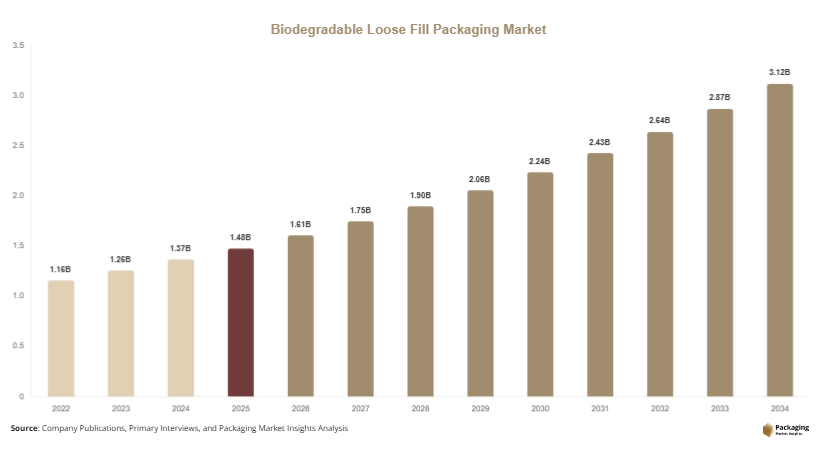
The global biodegradable loose fill packaging market size was valued at approximately USD 1.48 billion in 2025 and is expected to reach nearly USD 1.61 billion in 2026. By 2034, the market is forecasted to reach around USD 3.12 billion, expanding at a CAGR of 8.6% during 2025–2034. The biodegradable loose fill packaging market is witnessing substantial growth as industries shift toward sustainable packaging alternatives to reduce environmental impact and comply with tightening regulations on plastic waste. Biodegradable loose fill packaging materials are commonly used for cushioning and protecting products during shipping and storage. These materials are increasingly replacing conventional petroleum-based foam peanuts due to their compostable nature, lightweight structure, and compatibility with eco-friendly logistics operations.
One of the primary growth factors driving the market is the increasing adoption of sustainable packaging practices across e-commerce, food delivery, and consumer goods industries. Online retailers are increasingly using biodegradable cushioning materials to reduce packaging waste and improve brand sustainability. Another major growth factor is the implementation of government regulations restricting single-use plastics and encouraging compostable alternatives. Countries across Europe and North America are introducing policies aimed at reducing landfill waste, which is accelerating the transition toward biodegradable packaging products.
Key Highlights
- Europe dominated the market with a 34.7% share in 2025.
- Asia Pacific is projected to grow at the fastest CAGR of 9.1%.
- Starch-based loose fill led the material segment with a 42.6% share.
- E-commerce applications dominated with a 46.8% share.
- Food & beverage end-use led the segment with 31.9% share.
- The US remained the dominant country with a market size of USD 298 million in 2025 and USD 324 million in 2026, driven by strong e-commerce logistics expansion and sustainable packaging adoption.
Explore more data points, trends and opportunities Download Free Sample Report
Market Trends
Rising Adoption of Compostable Packaging Materials in E-commerce
The rapid growth of global e-commerce activities is significantly influencing the biodegradable loose fill packaging market. Online retailers are increasingly adopting compostable loose fill materials to reduce environmental impact and improve sustainable branding initiatives. Traditional foam-based protective fillers are being replaced with starch-derived and recycled paper-based alternatives that decompose naturally without releasing harmful residues. Large retail and logistics companies are implementing sustainable shipping programs to reduce packaging waste generated from parcel deliveries. Additionally, consumers are actively favoring businesses that use eco-friendly protective packaging. This trend is encouraging packaging manufacturers to develop loose fill materials with enhanced durability, lower dust generation, and improved moisture resistance suitable for large-scale logistics operations.
Technological Advancements in Bio-Based Cushioning Materials
Material innovation is becoming a major trend in the biodegradable loose fill packaging market as manufacturers focus on improving product performance and cost efficiency. Companies are developing advanced bio-based cushioning materials using corn starch, potato starch, cellulose fibers, and agricultural waste by-products. These materials provide improved shock absorption while remaining lightweight and compostable. Manufacturers are also introducing anti-static biodegradable loose fill products designed for electronics and healthcare packaging applications. Increased research into water-resistant biodegradable compounds is expanding the usability of loose fill packaging in humid transportation conditions. As industries continue seeking alternatives to petroleum-based packaging, technological advancements are expected to create more durable and commercially viable biodegradable packaging solutions.
Market Drivers
Growing Regulatory Restrictions on Plastic Packaging Waste
Stringent government regulations targeting plastic pollution are a significant driver for the biodegradable loose fill packaging market. Regulatory authorities across Europe, North America, and several Asian countries are implementing bans and restrictions on non-recyclable plastic packaging materials. These regulations are encouraging businesses to transition toward compostable and biodegradable packaging alternatives. Packaging manufacturers and logistics providers are increasingly replacing expanded polystyrene foam fillers with biodegradable loose fill solutions to meet compliance standards. In addition, landfill reduction targets and extended producer responsibility policies are accelerating investments in environmentally friendly packaging materials. These regulatory developments are expected to sustain strong market demand throughout the forecast period.
Expansion of Sustainable Logistics and Shipping Practices
The expansion of sustainable logistics operations is another major driver supporting the biodegradable loose fill packaging market. E-commerce companies, third-party logistics providers, and retail brands are implementing sustainability programs aimed at reducing carbon emissions and packaging waste. Biodegradable loose fill packaging offers lightweight cushioning properties that help lower transportation costs while supporting environmental objectives. Shipping companies are increasingly using biodegradable fillers because they are easier to dispose of and compatible with composting systems. Furthermore, the rise of environmentally conscious consumers is encouraging businesses to adopt sustainable shipping practices that align with corporate social responsibility goals and green packaging strategies.
Market Restraint
Higher Production Costs Compared to Conventional Foam Packaging
One of the major restraints limiting the growth of the biodegradable loose fill packaging market is the relatively high production cost associated with bio-based materials. Biodegradable loose fill products made from starch compounds, cellulose fibers, and plant-derived polymers generally cost more than traditional expanded polystyrene foam materials. The manufacturing process for biodegradable packaging often requires specialized processing equipment and raw materials, increasing operational expenses for producers. As a result, some small and medium-sized enterprises continue using conventional plastic fillers due to lower procurement costs.
The higher price of biodegradable loose fill packaging can also affect adoption in cost-sensitive industries where packaging expenses significantly influence profit margins. For example, low-cost consumer goods manufacturers and regional logistics providers may prioritize affordability over sustainability when selecting packaging materials. Additionally, fluctuations in agricultural raw material availability can impact production consistency and pricing stability. Although consumer demand for sustainable packaging continues to increase, the cost gap between biodegradable and petroleum-based alternatives remains a challenge for widespread market penetration, particularly in developing economies with limited environmental packaging regulations.
Market Opportunities
Expansion of Sustainable Packaging in Emerging Economies
Emerging economies are creating substantial opportunities for the biodegradable loose fill packaging market due to increasing environmental awareness and industrial growth. Countries across Asia Pacific and Latin America are witnessing rapid expansion in e-commerce, food delivery, and manufacturing sectors, all of which require protective packaging solutions. Governments in these regions are introducing policies encouraging sustainable packaging adoption to address rising waste management concerns. Local manufacturers are also investing in biodegradable packaging production to reduce dependency on imported plastic materials. As disposable incomes and online shopping activities increase, demand for environmentally friendly packaging solutions is expected to expand significantly in developing economies.
Increasing Demand from Electronics and Healthcare Packaging
The growing demand for protective packaging in electronics and healthcare industries presents another key opportunity for the market. Electronic products require lightweight cushioning materials that prevent damage from vibration and impact during transportation. Biodegradable loose fill packaging is gaining traction in this segment because it offers protective performance while supporting sustainability goals. Healthcare and pharmaceutical companies are also adopting compostable protective packaging to align with environmental initiatives and reduce plastic waste. The development of anti-static biodegradable loose fill products suitable for sensitive electronic devices is expected to further expand market opportunities across industrial and medical packaging applications.
Report Scope
| Report Metric | Details |
|---|---|
| Market Size in 2025 | USD 1.48 Billion |
| Market Size in 2026 | USD 1.61 Billion |
| Market Size in 2034 | USD 3.12 Billion |
| CAGR | 8.6% (2026-2034) |
| Base Year for Estimation | 2025 |
| Historical Data | 2022-2024 |
| Forecast Period | 2026-2034 |
| Report Coverage | Revenue Forecast, Competitive Landscape, Supply Chain Disruption, Growth Factors, Environment & Regulatory Landscape and Trends |
| Geographies Covered | North America, Europe, APAC, Middle East and Africa, LATAM |
| Countries Covered | U.S., Canada, U.K., Germany, France, Spain, Italy, Russia, Nordic, Benelux, Rest of Europe, China, South Korea, Japan, India, Australia, Singapore, Taiwan, South East Asia, Rest of Asia-Pacific, UAE, Turky, Saudi Arabia, South Africa, Egypt, Nigeria, Rest of MEA, Brazil, Mexico, Argentina, Chile, Colombia, Rest of LATAM |
Explore more data points, trends and opportunities Download Free Sample Report
Segmental Analysis
By Material Type
Starch-based loose fill packaging dominated the market in 2024, accounting for approximately 42.6% of total market share. These materials are widely used because they are compostable, lightweight, and capable of dissolving in water without leaving toxic residues. Corn starch and potato starch are commonly used raw materials for manufacturing biodegradable loose fill products due to their availability and renewable nature. E-commerce companies and retail brands prefer starch-based fillers because they provide effective cushioning while supporting sustainability initiatives. Additionally, these materials are increasingly replacing petroleum-derived foam fillers in food, cosmetics, and consumer electronics packaging applications.
Recycled paper loose fill is expected to be the fastest-growing subsegment, registering a CAGR of 9.3% during the forecast period. Increasing emphasis on circular economy practices and paper recycling infrastructure is supporting segment growth. Recycled paper loose fill products offer enhanced cushioning performance and improved recyclability, making them suitable for fragile product transportation. The growing use of recycled fiber packaging materials among environmentally conscious brands is also driving demand. Furthermore, advancements in paper processing technologies are enabling manufacturers to produce lightweight and dust-resistant loose fill materials for commercial shipping applications.
By Application
E-commerce packaging dominated the biodegradable loose fill packaging market in 2024 with a market share of approximately 46.8%. The rapid growth of online shopping and parcel delivery services has significantly increased demand for protective packaging solutions capable of minimizing product damage during transportation. Biodegradable loose fill materials are increasingly used by e-commerce companies because they are lightweight, compostable, and compatible with automated packaging systems. Retailers are also adopting sustainable packaging practices to strengthen brand image and meet consumer expectations regarding environmentally responsible shipping materials.
Electronics packaging is projected to be the fastest-growing application segment, expanding at a CAGR of 8.9% during the forecast period. The increasing shipment of consumer electronics, smart devices, and industrial electronic components is driving demand for lightweight cushioning materials with shock absorption properties. Biodegradable loose fill packaging is gaining popularity because it provides protective performance while reducing environmental impact. Manufacturers are also developing anti-static biodegradable fillers suitable for sensitive electronic products. The rising focus on sustainable packaging within the electronics industry is expected to support continued growth in this segment.
By End-Use Industry
Food & beverage applications held the largest share of the biodegradable loose fill packaging market in 2024 at approximately 31.9%. Food manufacturers and distributors increasingly use biodegradable protective packaging materials to align with sustainability objectives and comply with packaging waste regulations. Loose fill materials are commonly used for protecting glass bottles, packaged snacks, and specialty food items during transportation. The growth of meal kit delivery services and premium food exports is also contributing to rising demand for eco-friendly cushioning materials across food supply chains.
Healthcare applications are expected to witness the fastest growth, with a projected CAGR of 9.0% through 2034. Pharmaceutical companies and medical device manufacturers are increasingly adopting biodegradable protective packaging solutions to reduce plastic waste and support environmental initiatives. Biodegradable loose fill materials are used to protect fragile medical instruments, healthcare supplies, and laboratory products during shipping. Increasing healthcare spending, rising pharmaceutical exports, and growing demand for sustainable healthcare packaging are expected to accelerate growth in this segment over the forecast period.
Biodegradable Loose Fill Packaging Market Segmentations
By Material Type
- Starch-Based Loose Fill
- Recycled Paper Loose Fill
- Cellulose-Based Loose Fill
- Biopolymer-Based Loose Fill
By Application
- E-commerce Packaging
- Electronics Packaging
- Food Packaging
- Industrial Packaging
- Healthcare Packaging
By End-Use Industry
- Food & Beverage
- Healthcare & Pharmaceuticals
- Consumer Goods
- Electronics
- Industrial Manufacturing
Regional Analysis
North America
North America accounted for approximately 28.4% of the global biodegradable loose fill packaging market share in 2025 and is projected to grow at a CAGR of 8.1% during the forecast period. The region benefits from strong demand for sustainable packaging across e-commerce, food delivery, and retail industries. Increasing regulatory restrictions on plastic packaging waste and rising consumer awareness regarding environmentally responsible products are supporting market growth. Packaging manufacturers are also investing in compostable cushioning materials compatible with automated fulfillment operations.
The United States dominates the regional market due to its advanced logistics infrastructure and expanding online retail sector. A unique growth factor in the country is the rapid adoption of sustainable packaging programs among major e-commerce companies. Retailers are increasingly using biodegradable loose fill materials to reduce packaging waste and improve environmental performance throughout distribution networks.
Europe
Europe held the largest market share of 34.7% in 2025 and is expected to expand at a CAGR of 8.4% during the forecast period. Strict environmental regulations and strong sustainability policies are major factors driving market growth across the region. European packaging manufacturers are rapidly replacing conventional foam fillers with compostable loose fill products to meet circular economy goals. Increasing investments in recyclable and bio-based packaging technologies are also contributing to regional market expansion.
Germany remains the leading country in the European biodegradable loose fill packaging market because of its strong packaging manufacturing industry and environmental regulations. One unique growth factor is the widespread implementation of zero-waste logistics initiatives among industrial manufacturers and retail companies. These initiatives are increasing demand for biodegradable cushioning materials in domestic and export packaging applications.
Asia Pacific
Asia Pacific represented approximately 24.6% of the market share in 2025 and is projected to register the fastest CAGR of 9.1% through 2034. Rapid urbanization, expanding industrial production, and growing e-commerce activities are driving market growth across the region. Countries such as China, India, and Japan are experiencing increasing demand for sustainable packaging materials due to rising environmental concerns and government-led waste reduction initiatives.
China dominates the Asia Pacific market because of its large-scale manufacturing sector and rapidly growing online retail industry. A unique growth factor is the expansion of export-oriented packaging operations requiring lightweight and eco-friendly protective materials. Chinese manufacturers are increasingly adopting biodegradable loose fill packaging to comply with international sustainability standards and improve global trade competitiveness.
Middle East & Africa
The Middle East & Africa region accounted for nearly 5.1% of the biodegradable loose fill packaging market share in 2025 and is forecast to grow at a CAGR of 7.3%. Growth in this region is supported by rising awareness regarding sustainable packaging and increasing investments in logistics infrastructure. Governments are gradually introducing environmental initiatives aimed at reducing plastic waste generation. Food delivery and consumer goods sectors are also contributing to market demand for biodegradable protective packaging materials.
The United Arab Emirates leads the regional market due to its expanding retail and logistics industries. A unique growth factor is the development of green logistics hubs and sustainable trade infrastructure projects. Companies operating in the UAE are increasingly adopting environmentally friendly packaging materials to align with national sustainability goals and international environmental standards.
Latin America
Latin America held around 7.2% of the global market share in 2025 and is projected to grow at a CAGR of 8.7% during the forecast period. Rising demand for sustainable consumer packaging and increasing e-commerce penetration are supporting market growth across the region. Packaging manufacturers are gradually adopting biodegradable loose fill materials to address growing concerns related to plastic waste and landfill management. Investments in local packaging production facilities are also contributing to regional market development.
Brazil dominates the Latin American market due to its large consumer goods sector and expanding online retail activities. One unique growth factor is the increasing export of agricultural and processed food products requiring protective and environmentally compliant packaging solutions. This trend is driving demand for biodegradable loose fill materials in transportation and export packaging operations.
Competitive Landscape
The biodegradable loose fill packaging market is moderately fragmented, with several global and regional companies competing through product innovation, sustainability initiatives, and strategic partnerships. Market participants are focusing on expanding bio-based material production and improving cushioning performance to meet rising demand from e-commerce and industrial packaging sectors. Many manufacturers are investing in compostable packaging technologies and recyclable product portfolios to strengthen competitive positioning.
Storopack remains one of the leading companies in the market due to its extensive sustainable protective packaging portfolio and strong international distribution network. In 2024, the company introduced a new starch-based loose fill product with improved moisture resistance for industrial shipping applications.
Other key companies operating in the market include Ranpak Holdings Corp., Sealed Air Corporation, Green Light Packaging Ltd., and EcoEnclose. These firms are focusing on sustainable material sourcing, regional manufacturing expansion, and eco-friendly packaging innovations. Strategic collaborations with e-commerce companies and logistics providers are also becoming increasingly common as businesses seek customized biodegradable protective packaging solutions.
Key Players List
- Storopack
- Ranpak Holdings Corp.
- Sealed Air Corporation
- EcoEnclose
- Green Light Packaging Ltd.
- Pregis LLC
- Cruz Foam
- ACH Foam Technologies
- Veritiv Corporation
- FP International
- NaturePac
- Polycell International Corp.
- Smurfit Kappa Group
- DS Smith Plc
- ProAmpac